









How to Become an AI Engineer in Nauru in 2026
By Irene Holden
Last Updated: April 21st 2026
Quick Summary
To become an AI engineer in Nauru in 2026, you'll need a 12-18 month plan that merges global AI skills with local projects, such as using Python to analyze Nauru datasets for employers like RONPHOS. With the new East Micronesia Cable enabling high-speed internet, you can start with courses from AUD 680 and tap into Nauru's time-zone advantage for remote work with Asia-Pacific tech companies. This strategy builds a career that supports Nauru's growing digital services while connecting you to international opportunities.
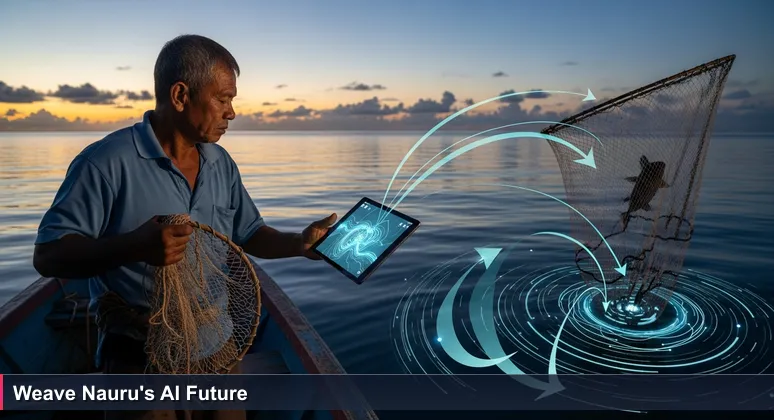
The fisherman's dilemma is a perfect analogy for our moment: the universal tools of AI are now accessible, but their true power in Nauru comes from applying them to our specific shores. The activation of the East Micronesia Cable System has fundamentally changed the game, providing the high-speed, stable internet that makes intensive AI development and remote collaboration not just possible, but practical right from your home in Yaren or Aiwo.
This connectivity places you in a unique sweet spot for the Asia-Pacific tech economy. Your workday now aligns perfectly with business hours in key regional hubs like Brisbane, Auckland, and Singapore, making you an ideal candidate for remote AI roles with companies there. This access is critical, as a Gallup report indicates 71% of organizations are now increasing their AI spending, signaling a surge in opportunity.
Locally, the demand is equally tangible. Entities like the Government of Nauru, RONPHOS, and Digicel are actively pursuing digital transformation and require professionals who can build cost-effective, integrated solutions. An expert analysis from the Lowy Institute stresses that Pacific nations must reboot regional AI leadership, creating a need for homegrown talent who understand both the technology and the local context.
This isn't about chasing Silicon Valley trends. It's about leveraging a global skillset to solve hyper-local challenges - whether optimizing utility loads for NUC or creating digital public services - and in doing so, building a career with impact here and reach everywhere. The high-speed cable is your new chart; your unique understanding of Nauru is the current you must learn to navigate.
Pro tip: While remote degrees from universities like Canterbury can cost over AUD 60,000, strategic upskilling through affordable, focused programs can build the same core competencies for a fraction of the price, a crucial consideration for financial planning in Nauru's economy.
Steps Overview
- Why AI Engineering in Nauru is Your Next Big Opportunity
- Essential Gear and Mindset for Your AI Voyage
- Lay the Groundwork with Programming and Mathematics
- Unlock Intelligence with Machine Learning
- Power Up with Deep Learning and Real-World Deployment
- Craft Your Unique AI Portfolio for Nauru's Market
- Join the Global AI Community from Nauru
- Test Your Skills and Launch Your Career
- Common Questions
If you're interested in getting into AI in Nauru in 2026, check this detailed guide.
Essential Gear and Mindset for Your AI Voyage
Just as our fisherman needs both a seaworthy boat and the patience to read the water, your AI journey requires the right technical setup paired with a resilient, adaptive mindset. Consider this less about buying the latest gear and more about establishing a reliable foundation for the long voyage ahead.
Cultivating the AI Mindset
Success here is built on continuous learning. The field evolves at a breathtaking pace; what's cutting-edge this year may be standard next. Your greatest asset isn't memorizing a single framework, but developing the ability to learn, unlearn, and relearn. As noted by industry analysts, knowing how to learn and apply AI is now considered a basic professional skill, essential whether you're targeting a role at RONPHOS or a remote position with a firm in Sydney.
Assembling Your Digital Toolkit
With the East Micronesia Cable active, your primary hardware need is a reliable computer and that stable connection. Your software journey begins with free, industry-standard tools: Python, a code editor like VS Code, and accounts on GitHub and cloud platforms like Google Colab. This setup mirrors the global standard, putting you on equal footing with peers worldwide.
Mapping Your Investment: Time and Finance
Be realistic with your timeline. A dedicated learner can build an employable foundation in 12-18 months. Financial planning is equally critical. Educational costs vary wildly, from an introductory AUD 680 course at USP's Pacific TAFE to international online master's degrees exceeding AUD 60,000.
This is where strategic, affordable upskilling becomes essential. Bootcamps like Nucamp's Back End, SQL and DevOps with Python (16 weeks, ~AUD 3,186) provide a focused, practical pathway that builds the exact foundational skills - Python, databases, deployment - required for AI work, without the multi-year commitment and cost of a full degree. This kind of planning ensures you can navigate the currents of this new career without running aground financially.
Lay the Groundwork with Programming and Mathematics
This initial phase is your boat-building season. You're mastering the universal language and logic that every AI system is constructed from. Without this sturdy hull of programming and mathematics, you won't be able to navigate the more complex currents of machine learning later on.
Your first and most critical tool is Python. As emphasized in multiple expert roadmaps, this is the undisputed primary language for AI development. Don't just learn the syntax; learn to solve problems with it. Begin with free resources like Codecademy, but for a structured, project-based approach that builds professional-grade skills, consider a focused bootcamp. For example, a program like Nucamp's Back End, SQL and DevOps with Python (16 weeks, ~AUD 3,186) teaches Python in the context of databases and deployment - the exact environment where AI models live.
Simultaneously, you must build your mathematical foundation. You need a working understanding, not a PhD. Focus on three core areas: Linear Algebra for understanding data structures and transformations, Statistics for evaluating your models' performance, and Probability for dealing with uncertainty. Resources like Khan Academy are excellent, but always seek to apply the concepts.
Local Application is Key: This is where you start reading both charts. Don't just practice on generic datasets. Write a Python script to organize and analyze local climate data from the Nauru Meteorological Service. Use statistical concepts to examine patterns in public health reports or utility usage data from NUC. This practice grounds abstract knowledge in the tangible context of your home, building skills that are immediately relevant to potential employers on the island.
⚠️ Common Mistake: The biggest error learners make is rushing through these fundamentals to get to the "flashy" AI topics. A weak foundation in Python and math will severely cap your growth and problem-solving ability later, when you're trying to debug a model for RONPHOS or optimize a pipeline for Digicel.
Unlock Intelligence with Machine Learning
With your programming and math hull now seaworthy, it's time to learn to cast your net. This phase is about machine learning (ML) - the core engine that teaches computers to find patterns and make predictions from data. Here, you transition from writing instructions to creating systems that can learn from Nauru's own information.
The journey begins with mastering ML fundamentals: supervised versus unsupervised learning, how to split data for training and testing, and how to evaluate a model's performance with metrics like accuracy and precision. The canonical starting point is Andrew Ng’s Machine Learning Specialization on Coursera. Simultaneously, get your hands dirty with Python’s essential libraries - pandas for data manipulation, numpy for numerical operations, and scikit-learn for building your first models.
Formalize Your Learning with Regional Pathways
This is the ideal time to engage with the Pacific's growing AI education ecosystem. The University of the South Pacific (USP) is launching its dedicated Bachelor of Artificial Intelligence, a premier regional degree accessible from Nauru. For a more immediate, skills-based entry, USP’s Pacific TAFE offers an Introduction to Artificial Intelligence online course for approximately AUD 680.
For an intensive, product-focused track that bridges ML and entrepreneurship, bootcamps like Nucamp’s Solo AI Tech Entrepreneur Bootcamp (25 weeks, ~AUD 5,970) teach you to build and deploy AI applications, covering large language models and AI agents - skills directly applicable to launching a local service or securing a remote tech role.
Pro tip: Start a learning journal or a simple blog. Documenting your process as you apply ML concepts to a local dataset - like historical fish catch data or energy consumption patterns - doesn't just solidify knowledge; it begins building your professional narrative and portfolio, showing employers you can translate theory into island-relevant practice.
Power Up with Deep Learning and Real-World Deployment
Now you harness more powerful currents. This phase moves beyond standard machine learning into deep learning - the technology behind image recognition, advanced language models, and complex predictions - and crucially, into AI Operations (AIOps), the art of deploying and maintaining these systems in the real world. This is the difference between a model idling on your laptop and a reliable tool used by the Nauru Utilities Corporation.
Mastering Advanced Frameworks
Your next step is to learn a deep learning framework like TensorFlow or PyTorch to build neural networks. Follow official tutorials, but immediately apply them to local contexts. Build a simple classifier for local plant species using image data, or a model to predict coastal erosion patterns. This practical application ensures you're learning to solve problems, not just replicate code.
The Critical Shift to Deployment and AIOps
The true 2026 advantage, as highlighted in industry analysis, lies in "platform coherence - the ability to run data, analytics, and AI without friction". This means mastering deployment. You must learn the basics of data engineering (SQL, building data pipelines) and how to deploy models via cloud services like AWS or Google Cloud, always starting with their free tiers.
In Nauru’s context, cost efficiency and integration are paramount. Local employers need solutions that connect seamlessly to existing systems and have a predictable, manageable financial impact. You must design "lean" AI solutions suitable for resource-conscious environments.
🛑 Warning: Cloud costs can spiral unexpectedly. Always use built-in budgeting tools and monitor usage meticulously. Practice architecting solutions that are effective yet frugal - a key skill whether you're working for a government ministry or a startup. Programs like the Solo AI Tech Entrepreneur Bootcamp emphasize this product-minded, deployment-ready skillset, teaching you to build and ship AI applications with real-world constraints in mind.
Craft Your Unique AI Portfolio for Nauru's Market
This is where you weave your net. Your portfolio is your most powerful asset, transforming abstract knowledge into proof of what you can do. In Nauru's close-knit market, a project that demonstrates clear local value is infinitely more compelling than a generic tutorial clone.
Choose a Strategic Specialization
Align your focus with tangible opportunities. Generative AI & LLMs are perfect for automating government reports or enhancing customer service for Digicel. Computer Vision could support infrastructure monitoring or conservation efforts. Often, Data Analytics & Prediction is the most directly applicable across sectors like public health, utilities, and commerce.
Build "Messy," Real-World Projects
As one expert roadmap advises, "Don’t follow toy tutorials". Instead, tackle projects with real, imperfect local data. For your portfolio, develop 2-3 substantial initiatives. First, a Public Service Triage Chatbot using an LLM to answer common FAQs for a ministry, reducing call center load. Second, a Utilities Load Forecasting model that predicts peak electricity demand for NUC, showcasing direct value to a major employer. Third, an Agricultural or Fisheries Yield Prediction model using local weather and historical data.
Deploy and Share Your Work: Use platforms like Streamlit or Gradio to create simple web interfaces so anyone can interact with your models. Host the complete code on GitHub with a crystal-clear README file that explains the project's purpose, the problem it solves for Nauru, and how to run it. This demonstrates the full pipeline from idea to deployment.
Pro tip: Frame your project documentation for two audiences: the technical manager who will scrutinize your code, and the non-technical community leader who needs to understand the practical benefit. This ability to bridge the gap is a critical skill for AI work in Nauru's interconnected environment.
Join the Global AI Community from Nauru
The sea of technology never stops changing; your final, ongoing task is to become part of the navigating community. Isolation is a career risk in a field that evolves daily, while connection provides support, opportunity, and crucial insight that can come from a conversation at the USP Nauru Campus or a forum in Fiji.
Anchor Yourself in Regional Networks
Begin by engaging with the digital and in-person communities at the USP Nauru Campus. Participate in online Pacific tech forums and follow regional knowledge-sharing initiatives. Organizations like the Commonwealth of Learning are actively promoting AI integration in STEM education across the Pacific, creating a valuable network for collaboration and professional development.
Cast a Wide Net for Remote Opportunity
Your strategic position is a major asset. Use Nauru’s time-zone alignment with Asia-Pacific business hours to seamlessly collaborate with teams in Sydney, Auckland, or Singapore. Platforms like Himalayas.app list genuine remote jobs accessible in Nauru, providing a direct pathway to international roles. Complement this search by applying for prestigious programs like the King's Commonwealth Fellowship 2026, which is specifically funded for students from Small Island Developing States.
The Lifelong Voyage of Learning
Consider advanced, remote qualifications if they align with your goals, but remember that learning is continuous. The most successful AI professionals are those who remain curious, engaged in online communities, and ready to adapt. By weaving your unique Nauruan perspective into these global conversations, you don't just find a job; you help shape the island's digital future from within a worldwide network.
Test Your Skills and Launch Your Career
You've navigated the currents and woven your net. Now, how do you know you're truly ready to set out? Your journey culminates in being able to confidently demonstrate a hybrid skillset that works both in global tech terms and within Nauru's unique context. Pass these three checks, and you're prepared to launch.
The Technical Verification
Can you independently execute a full, simple pipeline using local data? The test is this: source a Nauru-relevant dataset (like publicly available climate or health statistics), clean it, train a basic machine learning model, evaluate its performance, and deploy it to a simple web application using Streamlit or Gradio. This end-to-end process proves you can transform raw information into a functional tool.
The Portfolio Verification
Your GitHub profile must be your professional lighthouse. It should clearly host at least two projects that go beyond code to tell a story. Each project must articulate a specific local problem, your AI-driven solution, and its potential impact on a sector like health, utilities, or commerce. As emphasized in industry guides, "Upload everything to GitHub with a clear README" that explains the value. This shows employers you can think in terms of solutions, not just algorithms.
The Community Verification
This is your unique advantage. Can you explain your projects and career goals to two different audiences? You must be able to discuss technical details with a software architect from a potential remote employer in Australia, and then clearly explain the practical, on-island benefit of the same work to a non-technical community leader in Nauru. This ability to bridge the gap between global technology and local need is the ultimate sign you've built a career craft that's truly seaworthy for 2026 and beyond.
Common Questions
Is it really possible to build a successful AI career from a small place like Nauru?
Yes, it's very feasible with Nauru's unique advantages. The East Micronesia Cable System provides stable high-speed internet, enabling remote work with Asia-Pacific tech hubs, while local employers like the Government of Nauru and RONPHOS are exploring AI for digital public services and operational efficiency.
How much does it cost to get started with AI training in Nauru, and are there budget-friendly options?
Costs range from about AUD 680 for an introductory course like USP Pacific TAFE's program to over AUD 60,000 for international online master's degrees. Affordable bootcamps, such as Nucamp's options around AUD 3,000 to 6,000, offer payment plans and practical skills tailored for Nauru's job market.
How long will it take me to become job-ready as an AI engineer if I'm starting from scratch in Nauru?
With dedicated learning, you can reach an employable foundation in 12-18 months. Accelerated paths of 6-8 months are possible with prior coding experience, but investing time in fundamentals ensures you can handle real-world projects for local sectors like utilities or fisheries.
What AI job opportunities are available in Nauru, and can I work remotely for companies abroad?
Local opportunities include roles with employers like Nauru Utilities Corporation or Digicel Nauru for AI-driven solutions. Remote work is also accessible, with Nauru's time-zone alignment allowing you to target tech jobs in Australia or New Zealand, often listed on platforms like Himalayas.app.
What basic tools and resources do I need to begin learning AI from Nauru?
Start with a reliable computer and internet connection, then learn Python and foundational math using free resources like Codecademy. Practice with local datasets, such as public health stats, to build projects that showcase your skills for Nauru's growing tech entrepreneurship scene.
Learn how to navigate the cost of living in Nauru for tech professionals in 2026.
Find your ideal hub with this comprehensive list of tech coworking and incubation spots in Nauru for 2026.
Get insights into the Nauru AI hiring landscape for 2026 from expert perspectives.
Learn about the highest compensation tech employers in Nauru in 2026, including details on benefits and negotiations.
For insights on the top 10 tech startups hiring junior developers in Nauru in 2026, check out this comprehensive guide.

Irene Holden
Operations Manager
Former Microsoft Education and Learning Futures Group team member, Irene now oversees instructors at Nucamp while writing about everything tech - from careers to coding bootcamps.