









The Complete Guide to Using AI in the Healthcare Industry in Myanmar in 2025
Last Updated: September 11th 2025
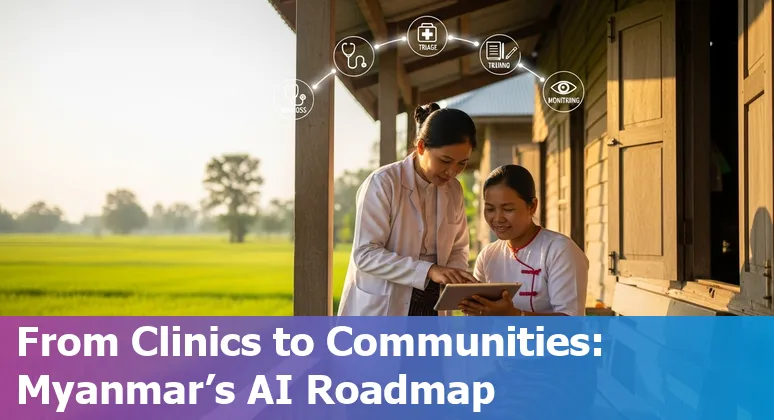
Too Long; Didn't Read:
In 2025 Myanmar's healthcare pivots to pragmatic AI - scaling AI‑assisted radiology, telemedicine and predictive operations - offline engines read X‑rays in 20–30s (~97–98% accuracy), mobile CXR shows ICER US$1,064/DALY, and 15‑week bootcamps close skills gaps.
Myanmar's healthcare system in 2025 is at a practical inflection point: chronic infrastructure gaps and uneven urban–rural care make AI less a novelty and more a fast track to better outcomes.
Local reporting and regional analysis show AI reshaping patient care through faster image-based diagnostics, telemedicine for remote clinics, and operational automation that trims admin time and waitlists (How AI is transforming healthcare in Myanmar; Latest technology trends in Myanmar 2025).
Obstacles - connectivity, data privacy, and a skills gap - are real, which is why practical training matters: a 15‑week AI Essentials for Work bootcamp teaches nontechnical teams to use AI tools and write effective prompts so clinics and managers can deploy useful solutions quickly (AI Essentials for Work syllabus).
Picture an AI flagging a suspicious chest X‑ray in a township clinic and launching a specialist video consult within an hour - small tech, huge impact.
"The engagement conducted by YCP was comprehensive and was very helpful for Shell to take immediate strategic decisions and actions in our market; their work allowed Shell to see the unseen, especially with regards to the competitor assessment and detailed customer issues. The YCP team has always been professional to work with, and I've appreciated how they accommodate client requests and enthusiastically took on the challenges we gave them. Overall, I am very happy with the services provided by YCP, they managed to get very insightful and unbiased recommendations for our business."
Table of Contents
- What is the future of AI in healthcare in Myanmar in 2025?
- Current healthcare landscape and challenges in Myanmar
- Core AI impacts and use cases for Myanmar healthcare
- Emerging pilots, platforms and vendors in Myanmar
- Barriers, risks and governance needs in Myanmar
- Building local capacity: workforce, data and partnerships in Myanmar
- What countries are using AI in healthcare and which country aims to lead by 2030? Lessons for Myanmar
- What are three ways AI will change healthcare by 2030? Implications for Myanmar
- Conclusion and a practical 12‑month roadmap for healthcare AI adoption in Myanmar
- Frequently Asked Questions
Upgrade your career skills in AI, prompting, and automation at Nucamp's Myanmar location.
What is the future of AI in healthcare in Myanmar in 2025?
(Up)The near-term future of AI in Myanmar's healthcare in 2025 looks pragmatic: expect proven, high‑value tools - AI‑assisted radiology, predictive hospital operations and virtual health assistants - to scale first, closing urban–rural gaps while more experimental tech waits in the wings.
Regional reporting highlights that AI and IoT devices can extend care into remote townships, improving access where specialists are scarce (AI and IoT devices for rural healthcare access), and case studies show medical imaging and predictive diagnostics already easing diagnostic bottlenecks (AI‑powered medical imaging and predictive diagnostics).
Real gains will come from blending these tools with better training, modest infrastructure upgrades and phased pilots - not hype: predictive analytics can cut wasted inventory and speed triage, while chatbots and Burmese‑language assistants handle routine questions to free clinicians for urgent care.
The 2025 earthquake also underlines why resilient systems matter: smarter triage and rapid remote consults can be the difference between a treatment delay and timely life‑saving care - imagine a township X‑ray flagged by AI and a specialist video consult launched within an hour.
| Use case | 2025 status in Myanmar | Source |
|---|---|---|
| AI‑Assisted Radiology | Mainstream, scalable | AI in Healthcare: 2025 Trend Radar |
| Predictive Hospital Operations | Mainstream, efficiency gains | AI in Healthcare: 2025 Trend Radar |
| Virtual Health Assistants / Chatbots | Pilot to early roll‑out, supports patient access | Use Cases of AI in Myanmar's Healthcare; Banking interviews |
“AI opportunities: chatbots, credit risk scoring, transaction monitoring; localized Burmese NLP essential.”
Current healthcare landscape and challenges in Myanmar
(Up)Myanmar's current healthcare landscape is defined by a severe supply-and-access squeeze: years of attacks on facilities, blockades of medicines and surgical supplies, and nearly 1,200 documented assaults on health workers since 2021 have hollowed the system and driven more than 70% of clinicians to leave, leaving makeshift hospitals where staff “turn the lights out when jets fly overhead” to keep patients safe; the result is rising infectious disease burdens and 2.6 million people displaced, making routine care and vaccination campaigns uneven at best (Think Global Health - Myanmar's health-care system under attack).
That fragile reality changes the calculus for AI: pragmatic tools that cut admin time, like EHR automation and appointment optimization for Myanmar healthcare, and demand‑smoothing models such as predictive capacity-planning models for healthcare demand smoothing become high‑value because they work within scarce resources and help keep care running where infrastructure and staff are under constant threat.
"Because health-care workers are key members of the community, they become targets," said Christina Wille, director of Insecurity Insight.
Core AI impacts and use cases for Myanmar healthcare
(Up)Core AI impacts in Myanmar revolve around practical wins that fit resource constraints: AI‑assisted chest X‑rays are already easing radiologist shortages and boosting TB case-finding in community and private clinics, with PATH reporting improved detection among household contacts and walk‑ins (PATH report on AI-assisted chest X-rays in Myanmar); a mobile screening app paired with CXR has been shown to be affordable and highly cost‑effective at scale - the study found an incremental cost‑effectiveness ratio of US$1,064 per DALY averted and 325 additional DALYs averted per 100,000 versus symptom‑based screening, making targeted app+CXR rollouts a pragmatic priority; and offline, laptop‑run engines like DeepTek's Genki can read portable X‑rays in about 20–30 seconds with reported high accuracy, enabling rapid triage in townships and border screening where connectivity and specialists are scarce (JMIR study on mobile app plus chest X-ray cost-effectiveness; DeepTek Genki offline AI for portable chest X-rays).
Together these use cases - mass and mobile TB screening, AI‑flagged images that trigger same‑day sputum collection or referral, and program dashboards for monitoring - translate to faster diagnosis, fewer missed cases, and better use of scarce workforce time: imagine a portable van screening queue where an AI flags a probable TB film in half a minute and a sample is collected before a patient leaves.
| Use case | Impact / evidence | Source |
|---|---|---|
| AI‑assisted chest X‑ray screening | Improves case‑finding among contacts and walk‑ins; supports private sector engagement | PATH |
| Mobile app + CXR screening | ICER US$1,064 per DALY averted; +325 incremental DALYs averted per 100,000 vs TBSS | JMIR formative study |
| Offline AI for portable X‑rays (Genki) | 20–30s reads, high reported accuracy (97–98%), works without constant internet | DeepTek |
Emerging pilots, platforms and vendors in Myanmar
(Up)Emerging pilots and platforms in Myanmar are increasingly pragmatic: PATH's AI‑assisted chest X‑ray pilots and the TB Reach Wave 7 work show how CAD (computer‑aided detection) is being deployed with private clinics and outreach teams to boost case finding among household contacts and walk‑ins, while PATH's plans to scale ultra‑portable X‑rays and AI screening to reach migrant and hard‑to‑reach populations in Yangon underline a shift from isolated demos to operational rollouts (PATH AI-assisted TB screening pilots in Myanmar; Qure.ai summary of PATH AI and TB screening in Myanmar).
Complementary platforms - EHR automation, appointment optimization and predictive capacity planning - are being promoted as practical tools to shave admin time and optimize beds and supplies in strained hospitals, creating the back‑end scaffolding that lets screening pilots translate into timely treatment (EHR automation and appointment optimization for Myanmar healthcare AI use cases).
The most promising vendor‑led pilots marry a fast, offline‑capable screening engine with simple referral workflows - picture a mobile screening team that flags a likely TB film and triggers same‑day sample collection or a private‑sector referral on the spot - small lifts that can yield outsized gains in hard‑to‑reach settings.
“The AI hospital aims to train doctor agents through a simulated environment so that it can autonomously evolve and improve its ability to treat ...”
Barriers, risks and governance needs in Myanmar
(Up)Barriers to safe, equitable AI in Myanmar are as practical as they are political: roughly half of households still lack grid electricity, so intermittent power and weak infrastructure make reliable imaging, cloud services and cold‑chain dependent devices fragile without parallel investments like the World Bank‑backed upgrades and off‑grid solar mini‑grids that target thousands of villages and rural clinics (World Bank press release on the Myanmar Power System Efficiency Project).
Chronic underinvestment and human‑resource gaps - evident in the persistence of localized, volunteer community health workers and more than a decade of system fragility - mean governance must go beyond pilots to cover data standards, Burmese‑language models, workforce transition plans, and clear procurement rules so private vendors don't outpace regulation.
Operational risks include workflow disruption and stranded devices in clinics without reliable power; a vivid example is a township van that can screen dozens for TB but can't upload results when its laptop battery dies - mitigations include offline AI engines, local image‑annotation jobs to create Burmese datasets, and hospital capacity forecasting tied to national supply chains.
Practical governance priorities are straightforward: invest in electrification and clinic connectivity, mandate transparency and validation for deployed models, and fund on‑ramps for staff (image annotation and data curation training) so AI creates local jobs instead of widening inequities (predictive capacity planning and EHR automation).
“We highly appreciate the World Bank and Global Financing Facility's additional finance for the Essential Health Services Access Project. It provides vital support in reaching the goal of our National Health Plan 2017-2021 to extend access to essential health services of good quality for all people in Myanmar.”
Building local capacity: workforce, data and partnerships in Myanmar
(Up)Building local capacity in Myanmar means three practical pillars: targeted workforce training, data‑ready pipelines, and pragmatic partnerships that bring short, applied courses to clinicians and health managers.
Data literacy and ethics training - from modular AI literacy programs to clinician-focused continuing education - are essential so staff can read model output, validate flagging rules and manage consent; global examples include an accessible e‑learning Medical AI Literacy course and longer certificate pathways such as the eCornell AI in Healthcare certificate, which show how curricula can combine human‑centred design, data management and NLP training (Medical AI Literacy course; eCornell AI in Healthcare certificate).
Practical on‑ramps that fit Myanmar's realities include short bootcamps and paid image‑annotation/data‑curation roles so local workers “join the AI lifecycle and create local value” while models are built on Burmese datasets; Nucamp's prompts and use‑case guides illustrate how EHR automation and annotation workstreams free clinicians for care (Nucamp AI Essentials for Work syllabus and prompts).
Partnerships should pair NGOs, private vendors and universities to run supervised pilots, fund offline AI tools, and certify clinicians - so an outreach team can not only screen and refer but also sustain the local data and skills pipeline that keeps AI useful, accountable and locally owned.
| Program | Format | Cost / Duration |
|---|---|---|
| Medical AI Literacy | Online e‑learning | £300; lifetime access |
| eCornell: AI in Healthcare | Online certificate | $3,750; ~2 months (5–7 hrs/week) |
| Harvard Medical School: AI in Clinical Medicine | Live online course | $1,900; 2 days; up to 22.5 AMA PRA credits |
“The Medical AI Literacy course is what every medical professional needs. It is a concise yet comprehensive introduction to the world of AI and its applicability to our profession.”
What countries are using AI in healthcare and which country aims to lead by 2030? Lessons for Myanmar
(Up)Global leaders show a clear playbook for Myanmar: the United States still drives model development and private funding (U.S. private AI investment hit $109.1 billion in 2024), China is closing the performance gap and backing hardware at scale, and countries from India to Dubai are already using AI for diagnostics, telemedicine and imaging - trends that matter for Myanmar's priorities of mobile screening and offline tools; see the detailed landscape in the Stanford 2025 AI Index report.
Practical takeaways for Myanmar are straightforward: focus on low-cost, efficient models (inference costs for GPT-3.5–level systems fell over 280‑fold, making edge and small‑model deployment realistic), prioritize pilots that mirror India's imaging and telehealth rollouts, and design procurement and training so local clinics can adopt proven tools rather than chase experimental tech.
The market math supports urgency - global AI in healthcare is scaling rapidly, with forecasts showing huge growth over the decade - so Myanmar's most effective strategy is to import proven workflows (radiology CAD, teleconsults, EHR automation) while building offline, low‑power solutions and local data skills so a township van can reliably read an X‑ray even when the grid falters.
| Country | Notable strength / investment | Source |
|---|---|---|
| United States | Leads in model production; $109.1B private AI investment (2024) | Stanford 2025 AI Index report on AI investment and policy (2025) |
| China | Large semiconductor fund ($47.5B); closing performance gap with U.S. | Stanford 2025 AI Index report |
| India | Rapid deployment of telemedicine and imaging AI; government support ($1.25B pledge) | Stanford 2025 AI Index report / IoT World review |
| Saudi Arabia | Project Transcendence ($100B initiative) | Stanford 2025 AI Index report |
“AI must not become a new frontier for exploitation. Indigenous Peoples and local communities must be protected and active partners in shaping the future of AI in traditional medicine.”
What are three ways AI will change healthcare by 2030? Implications for Myanmar
(Up)By 2030 three practical AI shifts will reshape Myanmar's health system: first, telemedicine will move from emergency stopgap to everyday backbone - Telekyanmar's high client (≈96% privacy/overall satisfaction) and clinician (≈88.6% overall satisfaction) scores show virtual clinics can win trust and scale care into townships and diasporas (Telekyanmar telemedicine satisfaction study); second, AI-driven diagnostics and triage will speed detection at the point of care so outreach teams and small clinics can act within minutes instead of days - think of a township van where a screen is flagged by an algorithm in 30 seconds and a sputum sample is collected before the patient walks away; and third, operations AI - EHR automation, appointment optimization and predictive capacity planning - will shave admin time, cut wasted inventory and match scarce staff to demand so limited beds and medicines go farther (predictive capacity planning for Myanmar hospitals).
Together these changes mean more timely diagnoses, fewer missed cases, and a pragmatic route to equity - provided investments in offline-capable tools, clinic connectivity and short applied training keep the technology working where the grid and specialists do not (telehealth's role in care deserts).
| AI change by 2030 | Why it matters for Myanmar | Source |
|---|---|---|
| Telemedicine becomes routine | Extends trusted care into underserved townships and across borders | Telekyanmar telemedicine satisfaction study |
| Point-of-care AI diagnostics | Faster triage and case-finding in low‑resource outreach settings | Local AI use-case reporting / sector summaries |
| Operations & predictive planning | Reduces admin burden, optimizes beds/supplies, stretches scarce staff | Predictive capacity planning guidance (Nucamp) |
Conclusion and a practical 12‑month roadmap for healthcare AI adoption in Myanmar
(Up)Conclusion: a practical 12‑month roadmap for Myanmar starts with governance and targeted pilots, moves to hands‑on training and resilient infrastructure, and finishes with measured scale‑up tied to regional best practice - practical steps that match Myanmar's e‑governance ambitions and the country's readiness gaps.
Months 0–3: form a small national AI in health taskforce, map data and power constraints, and adopt baseline principles aligned with the ASEAN Guide on AI governance (ASEAN Guide on AI Governance and Ethics (LawTech Asia)) and the Government AI Readiness Index to benchmark progress (Government AI Readiness Index 2024 (Oxford Insights)).
Months 4–6: run 2–3 focused pilots (mobile TB/CXR screening, teleconsults, EHR automation) designed for offline operation and clear success metrics; pair each pilot with workforce on‑ramps such as a 15‑week applied course so clinic managers and community health workers can write prompts, run models, and annotate local data (Nucamp AI Essentials for Work syllabus).
Months 7–9: evaluate, validate models locally, lock in procurement and data‑sharing agreements, and invest in modest electrification/connectivity where pilots depend on uptime.
Months 10–12: scale the highest‑value pilots, publish transparent model validation results and SOPs, and create paid local roles for data curation so AI yields local jobs not stranded devices.
This sequence keeps AI pragmatic - start small, train fast, govern clearly - and makes a township clinic's AI referral a reliable tool, not an unpredictable experiment.
| Months | Focus | Key actions |
|---|---|---|
| 0–3 | Governance & planning | Taskforce, benchmark (Oxford Index), ASEAN alignment |
| 4–6 | Pilots & training | Offline pilots, Nucamp AI Essentials training, local data jobs |
| 7–12 | Validate, procure, scale | Local validation, procurement rules, electrification, scale-up |
Frequently Asked Questions
(Up)What is the current and near‑term future of AI in Myanmar's healthcare in 2025?
In 2025 AI is shifting from novelty to practical scale in Myanmar: proven tools such as AI‑assisted radiology, predictive hospital operations and telemedicine are scaling first to close urban–rural gaps. Examples include AI flagging suspicious chest X‑rays that trigger specialist video consults within an hour, offline inference engines for portable X‑rays, and Burmese‑language virtual assistants handling routine patient questions. The emphasis is pragmatic pilots, modest infrastructure upgrades, and targeted training rather than experimental research alone.
Which core AI use cases are already delivering measurable impact in Myanmar?
High‑value, evidence‑backed uses include AI‑assisted chest X‑ray screening (improving TB case‑finding in community and private clinics), mobile app + CXR screening (JMIR study: ICER ≈ US$1,064 per DALY averted and +325 incremental DALYs averted per 100,000 versus symptom‑based screening), and offline engines like DeepTek's Genki that read portable X‑rays in ~20–30 seconds with high reported accuracy. Complementary applications include teleconsults and operations AI (EHR automation, appointment optimization, capacity planning) to reduce admin burden and speed treatment.
What are the main barriers, risks and governance priorities for deploying AI in Myanmar?
Major barriers are practical and political: intermittent power and weak connectivity (about half of households lack grid electricity), chronic workforce loss and safety concerns (many clinicians have left; health workers have been attacked), and data/privacy governance gaps. Risks include stranded devices, workflow disruption and biased or opaque models. Priority actions are electrification/connectivity investments, mandated model validation and transparency, Burmese‑language datasets, procurement rules, workforce transition plans, and paid local roles for annotation and data curation. Mitigations include offline AI engines, local annotation jobs, and phased pilots tied to clear SOPs.
What practical roadmap should Myanmar follow in the next 12 months to adopt AI in healthcare?
A pragmatic 12‑month sequence: Months 0–3 - form a small national AI in Health taskforce, map data/power constraints and adopt baseline governance aligned with ASEAN/Oxford indices. Months 4–6 - run 2–3 focused offline‑capable pilots (mobile TB/CXR screening, teleconsults, EHR automation) paired with workforce on‑ramps such as a 15‑week applied AI Essentials bootcamp and local data jobs. Months 7–9 - locally validate models, lock procurement and data‑sharing agreements, and invest in targeted electrification/connectivity. Months 10–12 - scale highest‑value pilots, publish validation results and SOPs, and create paid local roles for ongoing data curation so AI yields local jobs and reliable services.
Explore practical examples of EHR automation and appointment optimization that cut admin time and reduce patient wait lists in busy clinics.
With chatbots and automated scheduling handling routine calls, reception teams should learn care navigation and AI supervision skills.
Understand how predictive capacity planning helps hospitals optimize beds, staff and supplies to lower length of stay and costs.

Ludo Fourrage
Founder and CEO
Ludovic (Ludo) Fourrage is an education industry veteran, named in 2017 as a Learning Technology Leader by Training Magazine. Before founding Nucamp, Ludo spent 18 years at Microsoft where he led innovation in the learning space. As the Senior Director of Digital Learning at this same company, Ludo led the development of the first of its kind 'YouTube for the Enterprise'. More recently, he delivered one of the most successful Corporate MOOC programs in partnership with top business schools and consulting organizations, i.e. INSEAD, Wharton, London Business School, and Accenture, to name a few. With the belief that the right education for everyone is an achievable goal, Ludo leads the nucamp team in the quest to make quality education accessible