









The Complete Guide to Using AI in the Hospitality Industry in Myanmar in 2025
Last Updated: September 12th 2025
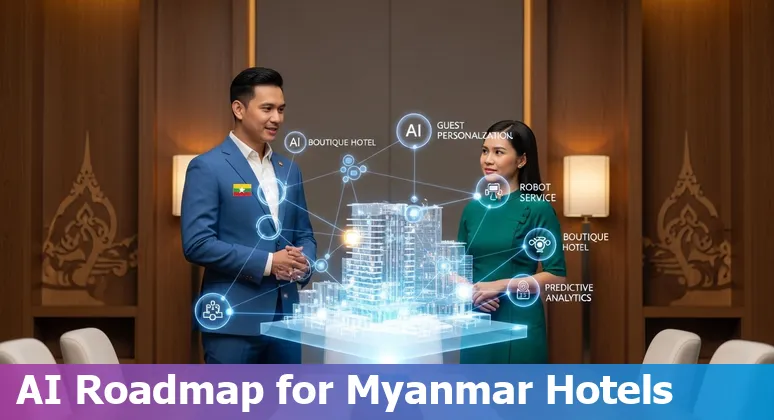
Too Long; Didn't Read:
AI can help Myanmar hotels in 2025 deliver dynamic pricing, personalized guest experiences and HVAC energy savings up to 30%. Global AI-in-hospitality ≈ $20.47B (2025); local headwinds: ~US$11B earthquake damage, GDP −2.5% and a 40% U.S. tariff, Myanma Tourism Bank PD 0.866 (Jun 2025).
In 2025 Myanmar's hotels face a sharp contrast: global AI investment in hospitality is accelerating - the AI in Hospitality and Tourism market is already worth about $20.47B in 2025 and headed much higher - even as local headwinds (a major early‑2025 earthquake with roughly US$11B in damage, ongoing sanctions and a projected GDP contraction of about −2.5% for FY2025/26) squeeze margins and capital access.
Myanma Tourism Bank, a state lender central to hotel financing, shows volatile but improving credit metrics (default probability down toward 0.866 by June 2025), which means investment decisions must balance risk with opportunity.
Practically, AI use cases like predictive occupancy, personalized guest experiences and smart‑room energy optimization can cut costs and differentiate properties - and local teams can build those skills through programs such as Nucamp's Nucamp AI Essentials for Work bootcamp.
For market sizing and local finance context, see the AI in Hospitality and Tourism Market Report 2025 and the Myanma Tourism Bank credit analysis.
| Attribute | Information |
|---|---|
| Bootcamp | AI Essentials for Work |
| Length | 15 Weeks |
| Cost (early bird) | $3,582 |
| Registration | AI Essentials for Work registration |
“Hotels know they need to set loftier goals and innovate. This can't be done without the technology and the right partnerships.”
Table of Contents
- What is AI and AI trends in hospitality technology 2025 in Myanmar
- What is AI Myanmar: local context, regulation and banking study relevance
- What is the size of the AI in travel and hospitality market and opportunity for Myanmar
- Core AI use cases for hotels in Myanmar in 2025
- Vendor ecosystem and solutions for Myanmar hotels in 2025
- Concrete case studies and expected ROI for Myanmar hotels
- Implementation roadmap and technical checklist for Myanmar hotels
- Risks, governance, compliance and guest trust for Myanmar hotels
- Conclusion and next steps for Myanmar hoteliers in 2025
- Frequently Asked Questions
Join a welcoming group of future-ready professionals at Nucamp's Myanmar bootcamp.
What is AI and AI trends in hospitality technology 2025 in Myanmar
(Up)Think of AI not as sci‑fi robots but as practical, learning software that quietly turns hotel data into better choices - everything from chatbots and digital concierges to voice‑enabled in‑room controls, predictive forecasting and automated pricing.
Revinate's primer shows how today's AI combines machine learning, NLP and computer vision to automate guest messages, power digital concierges and analyze reviews for actionable insights, while decision‑focused systems are starting to push beyond insights into prescriptive actions for revenue and operations.
In practice for Myanmar hotels that means deployable wins: smart rooms and in‑room controls that let guests set mood lighting and temperature in their language, and AI‑driven HVAC and energy optimization that Nucamp highlights as a real cost saver.
The next wave is Decision Intelligence - AI built around commercial decisions - which ties channel, demand and guest data into rapid, reliable pricing and staffing moves; Peak.ai and industry guides show DI can reduce human error, speed decisions and scale automation across departments.
So the “so what?” is simple: with modest data and thoughtful integration, AI moves hotels from reactive firefighting to proactive pricing, cleaner operations and personalized stays - delivering measurable uplifts (Roomdex cites typical RevPAR and ROI gains in the single‑digit to low‑double‑digit range) without losing the human touch.
“If you are a CIO and your organization doesn't use AI, chances are high that your competitors do. This should be a concern.”
What is AI Myanmar: local context, regulation and banking study relevance
(Up)In Myanmar the “AI in hotels” story runs through a complicated local lens: banks, tariffs, and regulation shape what's feasible. Credit studies show that state-backed Myanma Tourism Bank has steadied materially (default probability down toward 0.866 by June 2025), which supports project lending for renovations and AI pilots, while issuer notes for local operators such as KMA Hotels (Martini letter rating B2; PD ~1.594% in July 2025) warn that a new 40% U.S. tariff (effective Aug 1, 2025) and lingering sanctions can act like an immediate surcharge on imported tech and supplies, squeezing margins and forcing choices between capital investment and day‑to‑day liquidity - see the Myanma Tourism Bank credit analysis and the KMA Hotels briefing for details.
At the same time regional regulators are tightening rules around tech, data and financial services - Deloitte's 2025 Asia Pacific Regulatory Outlook flags AI, virtual assets and fragmented policies that hoteliers must navigate when deploying guest‑facing AI, payroll systems or digital wallets.
Practically, that means prioritize low‑capex, high‑ROI pilots (energy optimization, chatbots) and build procurement plans that hedge tariffs through local sourcing or alternative vendors; with pockets of public‑private support and improving bank metrics, carefully staged AI adoption can still be the lever that shifts hotels from cost pressure to differentiated guest experience.
| Metric | Value / Date |
|---|---|
| Myanma Tourism Bank - Default Probability | 0.866 (June 2025) - martini.ai |
| KMA Hotels - Probability of Default | 1.594 (Jul 2025) - martini.ai |
| KMA Hotels - Current credit spread | 3.5% (reported) |
| U.S. tariff on Myanmar | 40% (effective Aug 1, 2025) |
| Macro shocks cited | GDP −2.5% (FY2025/26 projection); ~US$11B earthquake damage (early 2025) |
“Hotels know they need to set loftier goals and innovate. This can't be done without the technology and the right partnerships.”
What is the size of the AI in travel and hospitality market and opportunity for Myanmar
(Up)Global dollars are moving fast and that creates a practical opening for Myanmar hoteliers: the AI-in-travel market is still relatively small today but expanding rapidly - an estimated USD 2.9 billion in 2024 projected to exceed USD 13.38 billion by 2030 - a more-than-fourfold jump that will push AI from niche pilots into everyday operations (AI in travel market forecast); at the same time the broader travel industry is back in growth mode (roughly USD 956 billion in 2025) as travelers seek detour destinations and AI-enabled planning tools (2025 travel trends and industry projection).
For Myanmar that means a two-part opportunity: capture rising demand from “off‑the‑beaten‑track” and bleisure travelers by sharpening online visibility, and cut operating costs while lifting guest experience with targeted AI pilots - think AI-driven dynamic pricing and smart-room controls or energy systems that, in local trials and guidance, can materially reduce utility bills (AI-driven HVAC optimization in Myanmar hotels).
The math is simple: even modest RevPAR and efficiency gains scale quickly when a small national market plugs into global AI tailwinds, making staged, low‑capex pilots the most realistic path to capture value.
| Metric | Value / Year |
|---|---|
| AI in travel & hospitality | USD 2.9B (2024) → USD 13.38B (2030) - Apptunix |
| Global travel industry | ≈ USD 956B (2025) - The Future of Commerce |
| Global hospitality market | ≈ USD 4.9T (2024) - EHL Hospitality Insights |
“We are at a pivotal juncture in the travel industry. We believe the pace of technology innovation today has surpassed anything in history and Generative AI will have significant impacts on the way people search for, book and experience travel.” - Glenn Fogel, Booking Holdings
Core AI use cases for hotels in Myanmar in 2025
(Up)Core AI use cases for Myanmar hotels in 2025 fall into a tight, practical set of wins: AI‑driven dynamic pricing and unified revenue management that reprice rooms in real time across OTAs to protect RevPAR and cut manual work (see how platforms like myCloud Hospitality AI revenue management system turn data into faster, more precise rate decisions); demand forecasting and scenario planning that anticipate event‑driven pick‑ups and reduce over/underbooking; guest‑facing automation - multilingual chatbots and digital concierges - that lift conversion and save staff hours; and operational AI such as smart‑room controls and HVAC optimization that both personalize stays and materially lower costs (local guidance highlights in‑room language controls and AI HVAC pilots that can cut energy bills substantially).
Boutique and mid‑market properties can pilot these with modest data feeds from a PMS, prioritizing channel sync, segmentation rules and one high‑ROI pilot (pricing or energy) to prove value; the payoff is tangible, with case studies and vendor reports citing uplifts from single‑digit to 20–30% in revenue or efficiency when systems are properly integrated - plus a memorable guest perk: letting visitors dim lights and set room temperature in their own language before they unpack.
“Airlines have long been pioneers in dynamic pricing, adjusting fares based on demand, booking patterns, and other factors,” said Lee Taylor, head of hospitality sales, at Capgemini.
Vendor ecosystem and solutions for Myanmar hotels in 2025
(Up)Myanmar hoteliers evaluating vendors in 2025 will find a pragmatic, mature ecosystem where cloud PMS platforms, AI revenue engines and full‑stack operations suites are already packaged for mid‑market and independent properties: mycloud PMS brings AI pricing and an extensive partner library (and explicitly lists Myanmar among its markets), enabling smaller hotels to run advanced rate strategies and realtime channel sync; its recent integration with Aiosell means fully automated, market‑aware rate setting that reacts to occupancy, competitor moves and booking pace; meanwhile RMS Cloud offers an all‑in‑one PMS with channel management, embedded payments and BI dashboards that simplify housekeeping, check‑in and corporate bookings so teams can focus on guest experience rather than manual updates.
For Myanmar this matters because low‑capex pilots - dynamic pricing, OTA sync and guest self‑service - can be stood up quickly, and case studies in the mycloud materials show uplifts (for example, a 60‑room business hotel saw a double‑digit RevPAR gain after AI RMS integration).
Pair these vendor solutions with local pilots like smart in‑room controls or HVAC optimization to protect margins and differentiate stays, then scale integrations that prove ROI first before wider rollout; the right vendor stack makes automation affordable, audit‑ready and operationally sensible.
| Vendor / Solution | Relevant capability / fact |
|---|---|
| mycloud PMS AI pricing case study | AI pricing, partner library, active in Myanmar; case studies showing double‑digit RevPAR/ADR uplifts |
| Aiosell AI RMS integration with mycloud PMS | Fully automated real‑time rate setting integrated into mycloud platform |
| RMS Cloud hotel PMS solution | End‑to‑end PMS: channel management, embedded payments, BI and housekeeping automation |
“mycloud PMS properties can now use our advanced automation to improve booking rates, drive sales, and enhance revenues – all within one cloud-based platform.”
Concrete case studies and expected ROI for Myanmar hotels
(Up)Concrete case studies from nearby markets give Myanmar hoteliers a realistic playbook: AI and RMS pilots have produced measurable uplifts and clear cost savings that translate well when adapted locally.
For example, a multi‑property chain using ZettaRMS recorded a 23% revenue boost in a published case study, showing how algorithmic pricing can move the needle quickly (ZettaRMS revenue management case study in India); consulting and revenue teams in India report net‑profit turnarounds of roughly 25% after combining revenue strategy with operational fixes, while property management deployments have produced large improvements in front‑desk throughput and error reduction (Datamate documented a 25% faster check‑in and a 40% drop in manual booking errors after implementing an advanced PMS) (Datamate PMS ROI case study).
Crucially for Myanmar's cost‑sensitive market, pilots that pair pricing engines with operational AI yield the twin benefits hoteliers need: revenue upside plus lower run‑rate - local Nucamp guidance highlights AI‑driven HVAC pilots that can cut energy bills by up to 30%, a vivid operational saving that can cover a sizeable portion of operating costs during shoulder seasons (Nucamp AI Essentials for Work HVAC optimization guidance).
Read together, these examples suggest a staged approach for Myanmar properties: start with a revenue‑management pilot to chase double‑digit revenue gains, add a targeted operational AI pilot (energy or check‑in automation) to shave tens of percent off OPEX, and use the combined results as the basis for scaled investment - real, measurable wins rather than speculative promises.
Implementation roadmap and technical checklist for Myanmar hotels
(Up)Start small, prove value, then scale - that's the practical roadmap for Myanmar hotels in 2025: prioritize low‑capex pilots (dynamic pricing, a multilingual chatbot and HVAC/room‑control energy optimization), pick vendors that integrate with your PMS to avoid rip‑and‑replace projects, and lock in measurable KPIs and a pilot→production plan up front.
For pricing, activate an RMS‑integrated engine that runs with a no‑code setup so revenue moves within days rather than months (TakeUp's RMS integration is a good model); for guest messaging, define two clear goals (e.g., cut front‑desk calls by 30% and lift direct bookings 10–15%), then deploy an AI chatbot that's fully integrated with PMS/CRM/booking engine and WhatsApp/SMS channels and trained continuously as UpMarket and Intellias recommend.
Don't forget infrastructure and security reviews early (keep data flows and storage explicit), size pilots to represent real usage, and budget for ongoing training and a revenue strategist or vendor support rather than “set‑and‑forget.” Add one vivid guest feature to win hearts: let visitors dim lights and set room temperature in their own language before they unpack, proving tech that guests actually love.
Timelines and costs should be realistic - basic integrations can be live in under a month while fuller AI training and multichannel chatbots take 2–4 months and modest starter budgets - and measure automation rate, direct booking lift, average response time and CSAT to decide what to scale.
Finally, avoid building from scratch: use proven integrators, follow a staged pilot that IntraSee and Voiceflow advise, and combine a revenue pilot with one operational AI (energy or contactless check‑in) so ROI covers OPEX quickly and creates a clear case for lenders and owners.
| Step / Checklist | Notes & source |
|---|---|
| Quick‑win pilots | Dynamic pricing + chatbot + HVAC energy pilot - low capex, fast ROI (Nucamp AI Essentials HVAC guidance) |
| Choose integrated vendors | Prefer RMS‑integrated pricing (no‑code activation) for rapid deployment (TakeUp RMS integration case study (HospitalityNet)) |
| Chatbot checklist | Define goals, integrate PMS/CRM/Payments, enable WhatsApp/SMS, continuous training (UpMarket hotel chatbot implementation guide) |
| Security & pilot plan | Review infra/security early, set pilot audience, pilot→production timeline (2–4 months) |
| KPIs to track | Automation rate, direct bookings lift, response time, CSAT |
“Automation without insight is just noise. Hospitality operators don't need another tool, they need results.”
Risks, governance, compliance and guest trust for Myanmar hotels
(Up)For Myanmar hotels, AI promise comes with concrete governance and trust obligations: legal counsel and operations teams must treat guest data as a high‑risk asset, applying the same data‑protection guardrails that regional experts warn are often overlooked - see the briefing on AI privacy and data protection in Southeast Asia.
Local sentiment and early banking pilots show a clear pattern: people accept AI for routine tasks but want human oversight on complex matters, and they prize security - 41.7% said they're comfortable with AI for basic tasks while 61.8% prefer humans for complex issues and 82.8% rank real‑time fraud alerts as very important (Myanmar banking study), so hotels should treat trust as a design requirement, not an afterthought.
Practical controls include data minimization, pseudonymization and masking, strict vendor SLAs and transparency to guests about what data is used and why - best practices summarized in industry guides on data security for AI.
Operational risks matter equally: a system crash that knocks out the PMS or AI check‑in assistant can literally leave guests stranded at the desk, so incident tracking, audit logs and phased pilots are essential.
Finally, embed accountability (incident monitoring, clear data flows and human fallback paths) so AI adds convenience without sacrificing legal compliance or the personal touch that builds repeat business.
| Metric | Value / Source |
|---|---|
| Comfort with AI for basic tasks | 41.7% - Artificial Intelligence in Myanmar's Banking Sector (May 2025) |
| Preference for human on complex matters | 61.8% - Artificial Intelligence in Myanmar's Banking Sector (May 2025) |
| Importance of real‑time fraud alerts | 82.8% - Artificial Intelligence in Myanmar's Banking Sector (May 2025) |
| Recommended technical controls | Data minimization, pseudonymization, masking, vendor SLAs - Publicis Sapient |
Conclusion and next steps for Myanmar hoteliers in 2025
(Up)Conclusion - clear and practical: Myanmar hoteliers should treat 2025 as the year to move from experiment to disciplined pilots - pick one revenue pilot (RMS/dynamic pricing) and one operational pilot (HVAC or smart‑room controls), measure impact, then scale what pays; a vivid win to aim for is letting guests dim lights and set room temperature in their own language before they unpack, which both delights visitors and drives measurable energy savings (see AI‑driven HVAC optimization).
Invest in an integrated tech stack so pricing decisions and guest data flow together (the APAC briefing warns hotels to become “AI optimised, not just search engine optimised”), and build a documented 90‑day adoption plan while upskilling staff through targeted courses like Nucamp's AI Essentials for Work to lock in prompt‑writing, tool use and operational AI skills - register for training and start small but measurable pilots now.
For immediate tactical reading, see practical HVAC pilots and use cases for Myanmar hotels and the regional overview of AI adoption in APAC to shape priorities and avoid overreliance on OTAs.
| Bootcamp | Detail |
|---|---|
| AI Essentials for Work | 15 Weeks - Early bird $3,582 - Register for Nucamp AI Essentials for Work (15-week bootcamp) |
“It's really, really critical to be AI optimised, not just search engine optimised or mobile optimised.”
Frequently Asked Questions
(Up)What AI use cases should Myanmar hotels prioritize in 2025 and what returns can they expect?
Prioritize low‑capex, high‑ROI pilots: dynamic pricing / RMS integration, predictive occupancy & demand forecasting, multilingual chatbots/digital concierges, and operational AI such as smart‑room controls and HVAC energy optimization. Typical vendor and case study results range from single‑digit to low‑double‑digit RevPAR or ROI uplifts; published examples include a 23% revenue boost from an algorithmic RMS pilot and property case studies reporting double‑digit RevPAR/ADR gains. Operational pilots (AI HVAC) can reduce energy bills by up to ~30%, providing a direct OPEX saving that accelerates payback.
What is the market size and the macro‑financial context for AI investment in Myanmar in 2025?
Global AI in hospitality & tourism is sizable (reported ≈ USD 20.47B in 2025) and the AI‑in‑travel segment is growing (USD 2.9B in 2024 → projected USD 13.38B by 2030). The broader travel market is ≈ USD 956B in 2025. Locally, financing and policy headwinds matter: Myanma Tourism Bank default probability improved toward 0.866 (June 2025) and a sample issuer (KMA Hotels) had PD ≈ 1.594% (Jul 2025). Key risk drivers include a new 40% U.S. tariff effective Aug 1, 2025, projected GDP contraction ~ −2.5% for FY2025/26 and ~US$11B early‑2025 earthquake damage. These factors mean hotels should balance opportunistic AI pilots with staged financing and local procurement to hedge tariffs and liquidity risk.
How should a Myanmar hotel implement AI quickly and safely - timeline, pilot scope, KPIs and training?
Recommended roadmap: start with one revenue pilot (RMS/dynamic pricing) and one operational pilot (HVAC or smart‑room controls). Quick‑win pilots and basic PMS/RMS integrations can be live in under a month; fuller AI training and multichannel chatbots typically take 2–4 months. Define pilot KPIs up front: automation rate, direct bookings lift (%), average response time, CSAT, energy savings (%) and RevPAR/ADR change. Keep pilots small, use RMS‑integrated no‑code vendors, budget for vendor support and a revenue strategist (avoid set‑and‑forget). Upskilling options include courses such as Nucamp's “AI Essentials for Work” (15 weeks; early bird US$3,582) to build operational/practical skills.
Which vendor solutions and outcomes are relevant for Myanmar hotels?
Vendors serving mid‑market and independent hotels include cloud PMS providers with embedded AI pricing and partner libraries (examples cited: mycloud PMS with Aiosell integration), full‑stack systems like RMS Cloud, and revenue engines such as ZettaRMS. Reported outcomes: a 60‑room business hotel showed double‑digit RevPAR gains after AI RMS integration; a ZettaRMS case study reported a 23% revenue boost; property management deployments reduced check‑in time by ~25% and cut manual booking errors by ~40% in published examples. Choose vendors with proven integrations to avoid rip‑and‑replace and to measure ROI early.
What governance, compliance and guest‑trust issues must hotels manage when deploying AI?
Treat guest data as a high‑risk asset: apply data minimization, pseudonymization/masking, strict vendor SLAs, audit logs and incident tracking, plus clear human fallback paths. Surveyed attitudes in Myanmar show 41.7% comfortable with AI for basic tasks, 61.8% prefer humans for complex matters, and 82.8% rate real‑time fraud alerts as very important - so prioritize transparency with guests and legal review. Operational safeguards (phased pilots, disaster recovery for PMS/AI outages, and vendor accountability) are essential to preserve trust while capturing AI benefits.
See how robotic housekeeping and IoT are starting to appear in resorts like Ngapali and what maintenance skills matter next.
Enhance on-property safety while addressing consent and retention rules with responsible security, biometrics & surveillance automation.
Learn how predictive maintenance for hotel equipment prevents costly downtime and extends asset life in Myanmar.

Ludo Fourrage
Founder and CEO
Ludovic (Ludo) Fourrage is an education industry veteran, named in 2017 as a Learning Technology Leader by Training Magazine. Before founding Nucamp, Ludo spent 18 years at Microsoft where he led innovation in the learning space. As the Senior Director of Digital Learning at this same company, Ludo led the development of the first of its kind 'YouTube for the Enterprise'. More recently, he delivered one of the most successful Corporate MOOC programs in partnership with top business schools and consulting organizations, i.e. INSEAD, Wharton, London Business School, and Accenture, to name a few. With the belief that the right education for everyone is an achievable goal, Ludo leads the nucamp team in the quest to make quality education accessible