









Top 10 AI Prompts and Use Cases and in the Retail Industry in Lexington Fayette
Last Updated: August 21st 2025
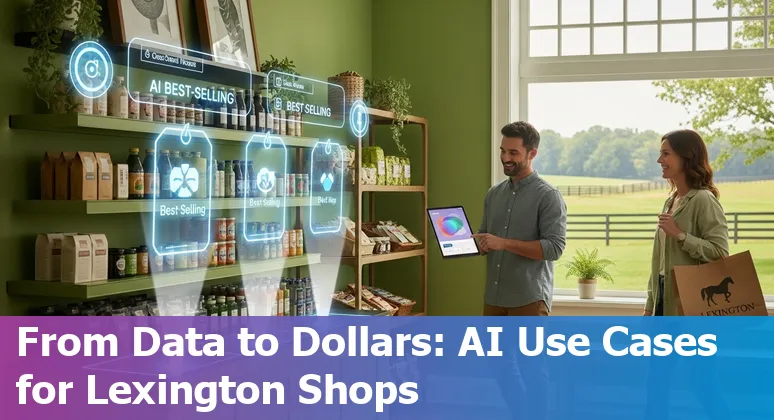
Too Long; Didn't Read:
Lexington–Fayette retailers can use AI to cut out‑of‑stocks and markdowns, boost conversion (recommendations ≈35% of purchases), improve pricing/margins (RELEX: 1–2% uplift, 20–25% less manual work), halve order splits (~50%) and see ROI within 90 days.
Lexington–Fayette retailers face tight margins, local supply‑chain quirks, and seasonal foot traffic - AI helps by sharpening demand forecasts, reducing shrinkage, and delivering personalized offers that keep shelves stocked and customers returning.
Industry analyses show AI boosts customer experience and operational efficiency across inventory, pricing, and loss prevention (research on AI in retail efficiency: Artificial Intelligence in Retail and Improving Efficiency), and vendors highlight practical tools like computer vision for near‑real‑time inventory and frictionless checkout (Intel's guide to AI in retail: Intel AI in Retail guide).
For a Lexington grocer, the result is concrete: fewer markdowns and out‑of‑stocks that protect local margins and free staff to focus on service. Teams can learn these exact, workplace-ready skills through Nucamp's AI Essentials for Work 15-week bootcamp, a program that teaches prompts and business use cases so managers can pilot measurable AI wins within a season.
| Bootcamp | Details |
|---|---|
| AI Essentials for Work | Length: 15 Weeks; Cost: $3,582 (early bird) / $3,942 (after); Syllabus: AI Essentials for Work syllabus; Registration: Register for AI Essentials for Work |
Tractor Supply CEO Hal Lawton stated the company has “leveraged AI within its supply chain, human resources, and sales and marketing activities.”
For inquiries about Nucamp, contact CEO Ludo Fourrage.
Table of Contents
- Methodology: How we selected these top 10 use cases and prompts
- Predictive, searchless product discovery - Recommendation Engine
- Real-time hyper-personalization - Dynamic Content Personalization
- Dynamic price & promotion optimization - Price Optimization Engine
- AI-orchestrated inventory, fulfillment & delivery - Fulfillment Orchestrator
- AI copilots for merchandising & eCommerce teams - Merchandising Copilot
- Conversational AI & virtual shopping assistants - Virtual Shopping Assistant
- Generative AI for product content automation - Content Generator
- Real-time sentiment & experience intelligence - Experience Intelligence Platform
- Intelligent labor planning & workforce optimization - Workforce Optimizer
- Fraud detection, loss prevention & responsible AI governance - Loss Prevention Engine
- Conclusion: How Lexington–Fayette retailers can start small and scale AI pilots
- Frequently Asked Questions
Understand why Computer vision to cut shrink and theft is becoming a must-have for Lexington-Fayette retailers balancing convenience with loss prevention.
Methodology: How we selected these top 10 use cases and prompts
(Up)Selection focused on practical, high‑impact prompts that Lexington–Fayette retailers can run as short pilots and scale: use cases were weighted by evidence of ROI (inventory, pricing, personalization), technical feasibility with existing store and ERP data, and the people‑and‑governance risks flagged by industry studies.
Benchmarks from EPAM's large survey and NetSuite's catalog of retail use cases guided prioritization - favoring demand‑forecasting, loss‑prevention, and dynamic pricing that directly reduce seasonal out‑of‑stocks and markdowns - while Neontri's market metrics ensured attention to customer‑facing wins like visual search and recommendations.
Projects were scored on data readiness, time‑to‑pilot, measurable KPI (shrink, stock‑days, average basket), and required retraining so pilots build operator confidence before broader rollout; this approach responds to common challenges - data protection and skill gaps - identified in the research and yields fast, auditable improvements for local grocers and department stores.
For reproducibility, each prompt includes expected inputs, a minimum viable model, and governance checks from the studies below.
| Metric | Value |
|---|---|
| Retail/CPG respondents advanced in AI (EPAM) | 45% |
| Plan to hire AI roles in 2025 (EPAM) | 96% |
| Data protection cited as top challenge (EPAM) | 30% |
| Workforce lacks GenAI skills (EPAM) | 54% |
Tractor Supply CEO Hal Lawton stated the company has “leveraged AI within its supply chain, human resources, and sales and marketing activities.”
Predictive, searchless product discovery - Recommendation Engine
(Up)Searchless, predictive product discovery turns browsing friction into instant buys: modern recommendation engines use multi-modal input - photo, voice, text, or video - to infer intent and surface the exact SKU or a curated shopping list, so a customer who snaps a picture of a desired meal can get ingredient suggestions in seconds rather than hunting aisle by aisle; Egen Retail Recommendation Engine multi-modal search highlights that capability and the concierge-style journey that reduces frustrated searches (Egen Retail Recommendation Engine - multi-modal search).
These systems also power real-time personalization that raises conversion and loyalty - shoppers will pay more for tailored experiences (up to 16% premium in some studies), so Lexington–Fayette grocers and boutiques can use recommendation widgets and cart suggestions to lift average order value while cutting decision fatigue and speeding checkout (Retail personalization and recommendation engines by Saxon.ai).
| Metric | Source / Value |
|---|---|
| Willingness to pay for personalization | Saxon.ai / up to 16% |
| Share of purchases from recommendations (example) | Polestar / Amazon ~35% |
Real-time hyper-personalization - Dynamic Content Personalization
(Up)Real‑time hyper‑personalization turns every Lexington–Fayette storefront and ecommerce page into a context‑aware salesperson: dynamic content adapts in real time to visitor signals (location, cart value, past visits) to show relevant CTAs, local pickup windows, or region‑specific promos that reduce friction and lift conversions.
Practical tactics - like the dynamic free‑shipping progress bar that updates as customers add items, or geo‑targeted hero banners that surface nearby store stock and same‑day pickup - deliver measurable results for local grocers and boutiques by increasing average order value and reducing abandoned carts (see OptiMonk website personalization examples for dynamic web personalization at OptiMonk website personalization examples for dynamic web personalization).
Because dynamic content responds instantly to behavior, marketers can run low‑risk pilots across email and site banners and scale winners; research shows consumers expect personalization (and notice when it's missing), so real‑time personalization in a local context can turn casual browsers into repeat customers (read Camphouse's guide to dynamic content personalization at Camphouse guide to dynamic content personalization).
| Metric | Value / Source |
|---|---|
| Consumers who find personalization appealing | 90% - Camphouse |
| Consumers frustrated when personalization is missing | 76% - Camphouse |
Dynamic price & promotion optimization - Price Optimization Engine
(Up)Dynamic price and promotion optimization turns local market signals into automated, margin‑protecting action: AI pricing engines ingest sales history, competitor feeds, inventory and promotion calendars to recommend real‑time price moves and promotional depth that balance competitiveness with profit.
RELEX's guide explains how machine‑learning models learn price elasticity per SKU, cut manual pricing work by 20–25%, and suggests starting with zone‑level localization (3–5 price zones) and localizing roughly 10–15% of assortment to capture local demand differences (RELEX retail price optimization guide - retail price optimization).
Strategy matters: BCG highlights that item‑and‑store‑level optimization must sit behind a pricing center of excellence and a single source of truth to enable fast “read and react” decisions (BCG analysis on AI‑powered pricing for retail).
Practical examples from Pricefx show dynamic repricing and scenario testing - tools Lexington–Fayette grocers can pilot to protect margins while keeping key value items competitive (Pricefx examples of price optimization in retail).
The takeaway: start small with zone‑based pilots, automate elasticity learning, and use exception workflows so pricing changes are fast, explainable, and auditable for local teams.
| Metric | Source / Value |
|---|---|
| Sales uplift from AI pricing | RELEX / 1–2% |
| Margin improvement | RELEX / 1–2% |
| Reduction in manual pricing work | RELEX / 20–25% |
| Localization impact (15% assortment) | RELEX / ~1–2% margin gain |
| Recommended initial price zones | RELEX / 3–5 zones |
AI-orchestrated inventory, fulfillment & delivery - Fulfillment Orchestrator
(Up)An AI‑driven Fulfillment Orchestrator turns Lexington–Fayette stores into coordinated micro‑hubs: real‑time order‑routing and batching engines treat stores as mini‑DCs, pick the closest fulfillment node, and schedule pickups to cut splits and last‑mile distance - Grid Dynamics' MILP example showed cross‑order optimization can halve order splits and unlock multi‑million annual savings for large retailers (Grid Dynamics ship-from-store MILP optimization).
Practical steps for Kentucky retailers include dedicating a packing zone and training staff for picking/packing workflows, keeping packaging uniform across origins, and choosing SFS locations that can reach customers in 1–2 days to meet expectations (USPS Ship From Store best practices); local pilots that combine AI routing with simple store layout changes can deliver measurable cost and speed wins for Lexington grocers and boutiques (see examples of warehouse optimization for Kentucky logistics at Kentucky logistics warehouse optimization case study).
The concrete payoff: fewer split shipments, faster customer delivery, and lower in‑store fulfillment costs when packaging, staffing, and routing are orchestrated by models that learn demand and proximity.
| Metric | Source / Value |
|---|---|
| Order split reduction | Grid Dynamics / ~50% |
| Packaging vendor consolidation | Smurfit Westrock / 65% vendor reduction (case example) |
| In‑store fulfillment cost reduction (example) | Smurfit Westrock / ~15% |
| Target delivery reach for SFS stores | USPS / 1–2 days |
AI copilots for merchandising & eCommerce teams - Merchandising Copilot
(Up)Merchandising Copilots give Lexington–Fayette merchandisers a daily, actionable snapshot of product, category and catalog health so local grocers and boutiques can stop hunting across forms and fix issues before they cause out‑of‑stocks or price errors; Microsoft's Copilot for Dynamics 365 surfaces a “one‑click” summary of variant groups, attribute mismatches and catalog risks, runs batch risk detection every 24 hours, and links directly to the affected records so teams can resolve problems with far fewer clicks (Microsoft Copilot-based merchandising insights documentation).
Paired with retail Copilot scenarios - agents for product selection, inventory signals, and pricing - these copilots turn messy product data into prioritized tasks that reduce manual validation and speed time‑to‑shelf (Microsoft Retail Copilot scenario library for retail).
The practical payoff for a Lexington store is instant: faster fixes mean fewer markdowns on local seasonal items and more accurate online pickup availability, preserving margin and customer trust.
| Copilot summary section | What it reveals |
|---|---|
| Channel overview | Totals for products, categories, catalogs |
| Product risks | Missing or inaccurate product data |
| Category risks | Category hierarchy and attribute issues |
| Catalog risks | Catalog mismatches and configuration errors |
AI-generated content might be incorrect.
Conversational AI & virtual shopping assistants - Virtual Shopping Assistant
(Up)Conversational AI and virtual shopping assistants can act like a tireless, hyper‑local sales associate for Lexington–Fayette retailers: by linking NLP chat flows to real‑time store inventory and pickup windows, assistants answer questions, suggest nearby substitutes only when an item is truly low or out of stock, and guide customers to same‑day pickup or delivery options - reducing the checkout friction that Baymard found frustrates 76% of online grocery users and prompts abandonment (Baymard research on grocery substitution issues and cart abandonment).
These assistants boost engagement and revenue (Bloomreach outlines inventory integrations and 24/7 availability as core benefits) while automating routine service so staff can focus on in‑store experience (Bloomreach guide to virtual shopping assistants).
Practical pilots for a Lexington grocer: start with chat‑enabled low‑stock alerts that ask one contextual substitution question, surface local pickup slots, and hand off complex cases to humans - an approach that captures convenience‑seeking shoppers (CrossML reports high chatbot ROI and rapid resolution rates) without overburdening customers or clerks (CrossML analysis of AI virtual assistants ROI in retail); the payoff is fewer abandoned carts, fewer unwanted swaps, and faster in‑market conversions for neighborhood staples.
| Metric | Value / Source |
|---|---|
| Users who had difficulty with grocery substitutions | 76% - Baymard |
| Shoppers who purchased using AI tools (2025) | 17% - Salsify |
| Chatbot conversion potential in retail | Up to 70% - CrossML |
"I make enough decisions in my life. I don't need to make 17 hypothetical grocery decisions when I don't know [if they're out of stock]."
Generative AI for product content automation - Content Generator
(Up)Generative AI turns the grunt work of product copy into a repeatable, local‑SEO aware workflow for Lexington–Fayette retailers: use an AI product description generator to bulk‑create thousands of SKU descriptions, auto‑translate listings for expanded reach, and produce SEO titles and meta descriptions that highlight local search terms for neighborhoods and pickup windows (see Copy.ai's AI product description generator for ecommerce workflows and its bulk/translation workflows).
Pair generation with a human review to keep accuracy and brand voice - Yoast's guide to best practices for AI-generated SEO titles and meta descriptions stresses manual checks and balance between optimization and user value.
Also follow Google's rules: label AI‑generated product data and metadata separately and avoid scaled content that adds no user value (see Google Search guidance on generative AI content).
A practical Lexington pilot: generate 500–2,000 locally tuned descriptions for seasonal categories (e.g., Kentucky Derby supplies, summer grilling), review a 10% sample for accuracy, then push winners live to improve discoverability and free staff time for in‑store service.
| Capability | Source / Note |
|---|---|
| Bulk product descriptions & translations | Copy.ai - thousands, workflows |
| Human review recommended | Yoast - check AI output for relevance & tone |
| Label AI-generated product data | Google - specify & label metadata |
“By partnering with Copy.ai, we're able to leverage Generative AI to offer personalized outreach emails at scale. This results in increased engagement and conversions for our customers, at a fraction of the effort.” - Ran Oelgiesser, Co-Founder & CEO at RightBound
Real-time sentiment & experience intelligence - Experience Intelligence Platform
(Up)An Experience Intelligence Platform gives Lexington–Fayette retailers real‑time eyes and ears on customer sentiment across social, reviews, and forums so local teams can catch small problems before they hit the wider market: AI‑driven sentiment analysis and anomaly detection surface spikes in negative mentions (for example, a pickup or pricing complaint at a specific store), image recognition finds posts that show an empty shelf or mispriced sign, and integrated alerts route those signals into CRM or store‑manager workflows so a local fix preserves weekend sales and reputation.
Platforms referenced in leading reviews combine real‑time trend detection, multilingual sentiment, and visual listening - tools that turn scattered mentions into prioritized tasks and briefings for merchandisers and store ops (see Sprinklr's guide to social listening and Talkwalker's brand intelligence capabilities for examples of visual recognition and global coverage).
For Lexington grocers, that means spotting Derby‑related demand shifts or a sudden pickup‑slot backlash and acting on them the same day to keep customers buying locally.
| Capability | Practical benefit for Lexington–Fayette retailers |
|---|---|
| Real‑time sentiment & anomaly detection | Catch spikes in complaints and prioritize store responses |
| Image/logo recognition | Identify visual proof of out‑of‑stocks or promo errors |
| CRM & review integration | Route issues to store managers and document remediation |
“If you make customers unhappy in the physical world, they might each tell six friends, but online, they can each tell thousands or even millions of connections through social media.”
Intelligent labor planning & workforce optimization - Workforce Optimizer
(Up)Lexington–Fayette retailers can turn erratic foot traffic, Derby weekends, high school games and sudden storms into predictable staffing plans by using AI that fuses store POS, weather and local‑event data into demand forecasts and automated schedules; mature engines now forecast by location down to 15‑minute intervals and feed those forecasts into shift generators so managers stop guessing and start matching labor to real customer peaks (Legion AI demand-forecasting guide for retailers).
The business case is concrete: Forrester data cited in these guides shows each 1% uplift in forecast accuracy can cut labor cost about 0.5% while boosting sales conversion and satisfaction, and event‑aware signals (sports, concerts, severe weather) can improve model accuracy materially - PredictHQ reports up to a 30% lift in forecast models and many retailers see measurable gains in 90 days or less when they integrate event intelligence (PredictHQ demand-signal research for workforce optimization).
Practical pilots for Kentucky grocers and boutiques can start with a 4‑week POC that automates peak coverage, honors employee preferences, and reduces manager scheduling time while protecting service during known local spikes (TimeForge guide to AI labor scheduling for retail).
| Metric | Value / Source |
|---|---|
| Forecast granularity | 15‑minute intervals - Legion |
| Labor cost impact | 1% accuracy → ~0.5% labor cost reduction - Forrester (Legion) |
| Forecast improvement with event data | Up to 30% model accuracy gain - PredictHQ |
| Time to measurable ROI | ≤ 90 days after event‑data integration - PredictHQ |
“The quality of forecasts is directly related to high-quality data. If data quality is poor, forecasts will be off, which means schedules - fed by forecasts - will be sub-optimal, costing companies a lot of money.”
Fraud detection, loss prevention & responsible AI governance - Loss Prevention Engine
(Up)Lexington–Fayette retailers can cut shrink, chargebacks and employee‑enabled loss by layering anomaly detection with payment‑focused ML so suspicious activity (odd velocity, out‑of‑area card use, atypical refund patterns) is flagged for human review before fulfillment - in many deployments models score transactions in real time (often within milliseconds) so risky orders can be blocked or stepped up for verification (real-time machine learning fraud detection in payments).
Techniques like isolation forests, autoencoders and clustering detect point, contextual and collective anomalies across POS, online payments and inventory feeds (anomaly detection for fraud prevention guide), while retail use cases show POS‑level monitoring can surface staff refund or void abuse that precedes organized theft (machine learning eCommerce fraud detection).
Start with a narrow pilot - card declines + high‑value orders + cross‑channel velocity - and expect faster, auditable decisions that stop many losses before they hit the ledger.
| Technique | Retail benefit |
|---|---|
| Isolation Forest | Efficiently isolates unusual transactions at scale for fast alerts |
| Autoencoders | Detects complex, high‑dimensional fraud patterns (account takeover, synthetic IDs) |
| Clustering (k‑means, DBSCAN) | Finds collective anomalies like coordinated returns or linked accounts |
Conclusion: How Lexington–Fayette retailers can start small and scale AI pilots
(Up)Lexington–Fayette retailers can move AI from experiment to everyday value by naming a business owner, picking 1–2 high‑impact pilots (inventory, pricing, or fulfillment), and setting a short, measurable cadence for review - Valtech notes nearly 85% of retailers experiment but only 15–20% scale because pilots lack ownership and repeatability (Valtech analysis: From pilot to production in retail); MarTech warns that cautious, isolated pilots can fragment efforts, so align each pilot to a clear business goal and design it to deliver a visible win fast (MarTech guide: Risks of starting small with AI pilots).
Practical next steps for a Lexington grocer: choose a KPI, run a 4–12 week POC with cleaned POS and supplier data, embed an escalation workflow for human review, and schedule a 90‑day scaling decision - training store managers to run and evaluate pilots is essential, and Nucamp's 15‑week AI Essentials for Work program prepares non‑technical leaders to write prompts, measure impact, and operationalize winners (Nucamp AI Essentials for Work: 15-week program for non-technical leaders).
| Bootcamp | Length | Early bird cost | Registration |
|---|---|---|---|
| AI Essentials for Work | 15 Weeks | $3,582 | Register for Nucamp AI Essentials for Work (15-week bootcamp) |
“The tech is ready,” said Matt Hildon, Retail Portfolio Director at Valtech.
Frequently Asked Questions
(Up)What are the top AI use cases for retailers in Lexington–Fayette?
High-impact use cases include: 1) Recommendation engines for searchless product discovery, 2) Real-time hyper-personalization of site and in-store messaging, 3) Dynamic price and promotion optimization, 4) AI-driven fulfillment orchestration for store-as-hub fulfillment, 5) Merchandising and eCommerce copilots, 6) Conversational virtual shopping assistants, 7) Generative AI for product content automation, 8) Real-time sentiment and experience intelligence, 9) Intelligent labor planning and workforce optimization, and 10) Fraud detection and loss-prevention engines. These were prioritized for measurable ROI on inventory, pricing, personalization, and shrink.
How can a Lexington grocer start small with AI pilots and measure impact?
Start by naming a business owner, selecting 1–2 pilots (inventory, pricing, or fulfillment), and defining a clear KPI (e.g., shrink, stock-days, average basket). Run a 4–12 week proof-of-concept using cleaned POS and supplier data, include human-in-the-loop escalation workflows, and schedule a 90-day review to decide scaling. Score projects on data readiness, time-to-pilot, measurable KPI improvements, and required retraining to build operator confidence.
Which AI pilots deliver the fastest, most auditable wins for local retailers?
Pilots with short time-to-value and clear KPIs include demand-forecasting/inventory optimization to reduce out-of-stocks and markdowns, zone-based dynamic pricing for margin protection, small-scale fulfillment routing to cut order splits, merchandising copilots to surface catalog risks, and targeted conversational assistants for substitution and pickup flows. The methodology favored pilots that are technically feasible with existing store and ERP data and that provide auditable improvements.
What practical governance and risk checks should Lexington–Fayette retailers use when deploying AI?
Implement governance checks such as human review for automated price or fulfillment exceptions, labeling AI-generated product content, privacy and data-protection controls on customer and payment data, explainability for pricing and fraud decisions, and clear escalation pathways. Score pilots on people-and-governance risks, require sample human audits (e.g., 10% review for generated descriptions), and keep auditable logs for any automated blocking or payment-risk actions.
What training or skills do local store leaders need to run these AI pilots?
Store and operations leaders benefit from prompt-writing, prompt-testing, KPI measurement, basic data hygiene, and governance training. Nucamp's AI Essentials for Work (15-week program) is an example of a short program that teaches prompts and business use cases so managers can pilot measurable AI wins within a season. Emphasis should be on operationalizing pilots, reading model outputs, and running human-in-the-loop checks.
Local economic pressures pushing retailers to adopt AI - from inflation to rising operational costs - mean job risks are not hypothetical but immediate for many employees.
Modern shops increase foot traffic with AI-powered local marketing tools that optimize ad spend and creative testing.

Ludo Fourrage
Founder and CEO
Ludovic (Ludo) Fourrage is an education industry veteran, named in 2017 as a Learning Technology Leader by Training Magazine. Before founding Nucamp, Ludo spent 18 years at Microsoft where he led innovation in the learning space. As the Senior Director of Digital Learning at this same company, Ludo led the development of the first of its kind 'YouTube for the Enterprise'. More recently, he delivered one of the most successful Corporate MOOC programs in partnership with top business schools and consulting organizations, i.e. INSEAD, Wharton, London Business School, and Accenture, to name a few. With the belief that the right education for everyone is an achievable goal, Ludo leads the nucamp team in the quest to make quality education accessible