









How AI Is Helping Retail Companies in Lexington Fayette Cut Costs and Improve Efficiency
Last Updated: August 21st 2025
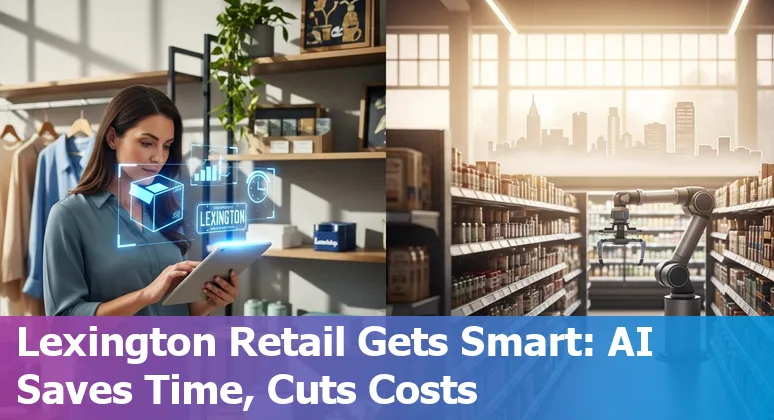
Too Long; Didn't Read:
Lexington–Fayette retailers use AI (shelf‑scanning, machine vision, Copilot, RFID) to cut costs and boost efficiency: >95% OOS detection, up to 50% OOS reduction, 20% faster MTTR, $1M material‑handling labor savings, and reclaimed 1–3 admin hours/week per employee.
Lexington–Fayette retailers facing tight margins and labor shortages are finding practical wins in AI: local vendors report that AI video surveillance solutions in Lexington reduce false alarms and surface operational insights, while a statewide trend shows more than 33,000 Kentucky small businesses adopting AI to automate marketing, customer messages and back-office tasks - Meta estimates that digital tools contribute about $5.5 billion in annual economic output across the state and deliver strong ad ROI. For retailers, that means faster restocking, fewer overnight losses, and more time for staff to serve customers; staff can gain the practical skills to run these tools in a 15-week course like Nucamp's Nucamp AI Essentials for Work bootcamp registration.
| Program | Length | Cost (early bird) | Details |
|---|---|---|---|
| AI Essentials for Work | 15 Weeks | $3,582 | AI Essentials for Work syllabus and course details |
“If you can help make it so that business owners can work on their business, not in their business, I think that's critical.” - Diana Doukas, Meta
Table of Contents
- AI-driven Quality Control and Visual Inspection in Kentucky
- Inventory Management, Shelf Scanning and Labor Savings in Lexington Fayette
- Warehouse, Conveyor Optimization and Cost Reductions in Kentucky Operations
- Admin Productivity: Copilot and Knowledge Access for Kentucky Retailers
- Automated Sales, Customer Engagement and Small-Business Marketing in Lexington Fayette
- Predictive Analytics, Demand Forecasting and Fraud Detection in Kentucky Retail
- Data, Security, Skills and Implementation Challenges in Lexington Fayette
- Step-by-step Guide: How a Lexington Fayette Retailer Can Start with AI
- Measuring Impact: KPIs and Local Metrics for Kentucky Retailers
- Conclusion and Next Steps for Lexington Fayette Businesses in Kentucky
- Frequently Asked Questions
Discover how AI-driven pricing strategies for local grocers can protect margins while staying competitive across Lexington-Fayette.
AI-driven Quality Control and Visual Inspection in Kentucky
(Up)Machine vision and computer‑vision inspection bring factory‑grade quality control to Lexington–Fayette retail supply chains, automating fast, repeatable checks that catch tiny defects humans miss and free staff for customer‑facing tasks; as Peak Technologies explains, modern MV systems pair high‑resolution cameras, lighting, and AI to perform real‑time analysis and standardize inspections across packaging, labeling and incoming goods Peak Technologies machine vision quality control overview.
Vendors that build and integrate these solutions emphasize turnkey QA and scalable deployments - V‑Soft's QA automation work, for example, produced a 17% jump in defect detection, a 10% cut in repair downtime and about $150K saved per production line in one case study - proof that local grocers and regional distributors can reduce shrink and rework by moving inspection to the edge V‑Soft manufacturing quality control automation case study.
For retailers wanting in‑store shelf monitoring, loss prevention and image analytics, partners that offer end‑to‑end camera, software and analytics integration can accelerate deployments with less IT lift Softeq retail video analytics and camera application development solutions.
“In terms of project management, Softeq is bulletproof. They respond to things quickly, and they don't cheat by doing the bare minimum work to achieve the specs. They're apologetic if something doesn't work as planned, even if it's not their fault. And they turn around resolutions extremely quickly.” - Colin Hickey, Head of Product, Sky‑Futures
Inventory Management, Shelf Scanning and Labor Savings in Lexington Fayette
(Up)Lexington–Fayette retailers can cut repetitive shelf‑work and shrink while improving on‑shelf availability by deploying in‑store shelf‑scanning robots: Badger Technologies, based in Nicholasville, KY, now markets a Digital Teammate platform that pairs computer vision, cloud analytics and RFID to push prioritized restock and pricing alerts to associates (Badger Technologies Digital Teammate platform for shelf-scanning robots and retail analytics), and real deployments show fast, measurable labor savings - McCoy's reported daily shelf scans trimmed to about 2 hours/day (down from as much as 50 hours/week), with >95% out‑of‑stock detection accuracy and up to a 50% reduction in OOS items, meaning stores can redeploy dozens of staff hours per week to customer service or order fulfillment (McCoy's deployment case study on improved on-shelf availability and price integrity).
For a mid‑sized Lexington grocer, that translates into faster restocking, fewer mispriced tags, and more associate time on the sales floor.
| Metric | Reported Result |
|---|---|
| Out‑of‑stock detection accuracy | >95% |
| Price‑tag / mispricing accuracy | >90% (often >97% reported) |
| Time for shelf scans | ~2 hours/day (vs. up to 50 hours/week prior) |
| OOS reduction | Up to 50% |
“We continually seek innovative ways to elevate customer service while removing operational obstacles for store associates.” - Waylon Walker, Senior VP, McCoy's Building Supply
Warehouse, Conveyor Optimization and Cost Reductions in Kentucky Operations
(Up)Kentucky warehouses and conveyors can cut real costs by borrowing the Lexington smart‑factory playbook: instrument conveyor lines with EcoStruxure analytics, add RFID and autonomous tuggers to shave needless travel and handoffs, and run predictive maintenance so conveyors and sorters fail less often - the Lexington site reported a 20% drop in mean time to repair and roughly 30% overall plant savings after digitizing material flows (New Equipment Digest article on the Lexington smart factory), while Schneider's Smart Factory program documents 26% energy reduction and large maintenance gains from connected drives, edge analytics and automated material handling (Schneider Electric Smart Factory and EcoStruxure solutions).
One memorable result: RFID and automation cut 128 miles of daily forklift travel and enabled about $1M in material‑handling labor savings - so local distributors can shrink operating expense and redeploy crews to faster fulfillment and fewer overtime hours.
| Metric | Result (Lexington site) |
|---|---|
| Equipment availability | +50% |
| MTTR (mean time to repair) | -20% |
| Maintenance cost reduction | up to 75% |
| Forklift travel reduction | 128 miles/day |
| Material‑handling labor savings | $1,000,000 |
| First‑year RFID ROI | ~33% |
“In the last two years, tablets in the hands of employees have grown tenfold because everything we are doing has become digitized.” - Ken Engle
Admin Productivity: Copilot and Knowledge Access for Kentucky Retailers
(Up)Administrative overhead - answering vendor emails, summarizing supplier invoices, juggling shift swaps and digging through sales reports - regularly pulls store managers off the floor; Microsoft 365 Copilot and related Azure AI tools automate those chores by summarizing meetings, drafting emails, extracting insights from documents, and surfacing next steps so teams act faster (see real-world outcomes in Microsoft's customer stories and Copilot case summaries).
Case studies report tangible time reclaimed: AvePoint gave employees back “one to three hours,” Vodafone users saved about three hours per week, and Newman's Own recovered roughly 70 hours per month using Copilot‑style workflows - small stores in Lexington–Fayette can translate that reclaimed time into more staffed checkout lanes, hands‑on merchandizing, and faster problem resolution during weekend rushes Microsoft AI customer stories showcasing enterprise AI outcomes and Microsoft 365 Copilot case studies with ROI and time savings examples.
“Using Microsoft Copilot, we've been able to give our employees back one to three hours, which helps them dedicate that time to more meaningful work.” - Mario Carvajal, AvePoint
Automated Sales, Customer Engagement and Small-Business Marketing in Lexington Fayette
(Up)Lexington–Fayette retailers can use AI agents to automate sales outreach, run personalized SMS and chat campaigns, and power virtual shopping assistants that handle pickups and substitutions - freeing floor staff to close more sales while keeping marketing spend lean; tools reviewed for small businesses range from Warmly's GTM agents that unify outbound, email and ads to no‑code builders like Lindy no‑code AI agent platform for small businesses and specialist retail agents that drive personalization and real‑time recommendations.
Real results matter: Capacity's retail examples show AI agents can lift engagement (≈60% higher for opted‑in shoppers), generate roughly $3.89 extra per session from personalization, and deliver measurable opt‑in and conversion gains - PacSun reported a 33% SMS opt‑in rate and a 19% conversion from personalized outreach - making agent deployments a low‑risk way for Lexington grocers and boutiques to increase basket size and cut manual follow‑ups (Capacity blog: AI agent examples for retail businesses, Warmly blog: AI agents for small businesses).
| Metric | Reported Result / Example |
|---|---|
| Engagement uplift (opted‑in shoppers) | ~60% higher (Capacity) |
| Extra revenue per session | $3.89 (Capacity) |
| SMS opt‑in rate | 33% (PacSun, Capacity) |
| Conversion from personalized recommendations | 19% (PacSun, Capacity) |
Predictive Analytics, Demand Forecasting and Fraud Detection in Kentucky Retail
(Up)Predictive analytics and modern demand‑forecasting methods turn point‑of‑sale history, local buying patterns and seasonality into actionable plans that shrink stockouts and keep more shopper dollars in Lexington–Fayette: retailers that tighten forecast accuracy can reduce missed sales and close the “retail leakage” Blueprint Kentucky warns happens when local demand exceeds supply, so residents are less likely to drive out of the region for purchases (Blueprint Kentucky retail leakage and surplus analysis).
Practical demand‑sensing techniques - short‑horizon models and ensemble forecasts - are proven ways to reduce stockouts and lift margins, driving higher profits for stores that act on the signals (Retail demand forecasting methods to reduce stockouts and increase profits, Retail demand‑sensing and forecasting best practices).
The same predictive stacks can be extended to anomaly detection for loss prevention - flagging unusual return patterns or refund spikes - and are best deployed first as a short POS‑data pilot to measure reduced stockouts and reclaimed local spend.
Data, Security, Skills and Implementation Challenges in Lexington Fayette
(Up)Data, security and skills form the practical chokepoints for Lexington–Fayette retailers scaling AI: University of Kentucky teams are converting research into applied tools through the University of Kentucky Center for Applied AI projects (University of Kentucky Center for Applied AI projects), while NSF‑backed work at UK shows federated learning and privacy‑preserving data preparation can keep customer records local instead of shipping raw data to the cloud (NSF CAREER research on privacy‑preserving data pipelines: NSF CAREER privacy‑preserving data pipelines at UK); that technical choice matters because heavy AI workloads are tied to large data centers and associated infrastructure - PPL Corp.
figures in reporting note prospective Kentucky data centers may each need on the order of 300–500 MW of electricity, a hard constraint that affects where compute, latency and costs will land for local retailers (Lane Report on Kentucky data‑center power demand: Lane Report: Kentucky data‑center power demand and implications).
For Lexington–Fayette operators the pragmatic path is short pilots that test privacy‑first models on POS and shelf data, partner with campus AI teams for governance, and fund focused upskilling so existing staff can run and audit models rather than outsourcing those skills entirely.
| Course | Instructor | Rating | Students Enrolled |
|---|---|---|---|
| AI and Deep Learning Certification Training (Lexington, KY) | Hoda Alavi | 5/5 Stars | 12,078 |
“This means we are preparing data and training machine learning models without losing privacy because we are not sharing the data to a cloud. All the training is done collaboratively and locally on the devices.” - Hana Khamfroush, Ph.D.
Step-by-step Guide: How a Lexington Fayette Retailer Can Start with AI
(Up)Begin with a narrow, measurable pilot: pick one high‑value use case (marketing personalization or a short POS/shelf pilot) and define two KPIs - time saved for staff and a revenue/engagement lift - then run a 30–90 day test with a commercial tool or local partner.
Use Bluevine's small‑business findings to prioritize marketing or data analysis (the two most common early wins), set conservative targets, and avoid broad rollouts until the pilot proves value (Bluevine Stacker small business AI trends for Kentucky retailers).
Protect customer data by choosing privacy‑first deployments and campus partners for governance and federated options - University of Kentucky groups offer project support and privacy research that can keep training data local (University of Kentucky Center for Applied AI projects and research).
Parallel to the pilot, upskill one or two staff through a focused course so the team can operate and audit models internally (a 15‑week introduction like Nucamp AI Essentials for Work 15-week bootcamp is a practical model).
If the pilot meets KPIs, scale in phased waves, measure uplift, and lock in security and governance before wider deployment to avoid surprises and sustain local gains.
| Pilot KPI | Benchmark from research |
|---|---|
| Admin time reclaimed | 1–3 hours/week per employee (AvePoint examples) |
| Large monthly time savings | ~70 hours/month (Newman's Own case) |
| Engagement uplift | ~60% higher for opted‑in shoppers (Capacity) |
| Ad ROI target | $4.52 return per $1 spent (Meta for KY small businesses) |
“If you can help make it so that business owners can work on their business, not in their business, I think that's critical.” - Diana Doukas, Meta
Measuring Impact: KPIs and Local Metrics for Kentucky Retailers
(Up)Measuring AI's value starts with a compact KPI set tied to local goals: combine model‑quality and system metrics (accuracy, latency, uptime) with adoption and business‑value indicators so decisions are evidence‑based - use the Google Cloud gen‑AI KPI framework for categories and evaluation methods (Google Cloud gen‑AI KPI framework).
For Lexington–Fayette pilots pick 3–5 actionable metrics you can measure in 30–90 days: reclaimed admin time (1–3 hours/week per employee; some Copilot deployments report roughly 70 hours/month recovered), marketing ROI (Kentucky small businesses see about $4.52 back for every $1 spent on AI‑powered ads) and customer engagement lifts (~60% higher for opted‑in shoppers and ~$3.89 extra revenue per session in capacity examples) to quantify staff time saved and revenue impact (Meta ad ROI for Kentucky small businesses, Capacity retail agent engagement and uplift examples).
Track these alongside cost and governance KPIs to prove ROI and justify phased scaling across stores.
| KPI | Local Benchmark / Example | Source |
|---|---|---|
| Admin time reclaimed | 1–3 hours/week per employee; ~70 hours/month reported | Microsoft Copilot / customer stories |
| Ad ROI | $4.52 return per $1 spent | Meta / Kentucky small businesses |
| Engagement uplift / revenue per session | ~60% uplift; $3.89 extra per session | Capacity retail examples |
“If you can help make it so that business owners can work on their business, not in their business, I think that's critical.” - Diana Doukas, Meta
Conclusion and Next Steps for Lexington Fayette Businesses in Kentucky
(Up)To convert the pilots and proofs in this series into durable gains for Lexington–Fayette retailers, start with a tight 30–90 day pilot (POS, shelf or marketing), upskill one or two managers in a focused course, and tap local partners and funding to scale - enroll a manager in a 15‑week practical course like AI Essentials for Work bootcamp (Nucamp), work with the Kentucky Retail Institute to pair apprenticeships and on‑the‑job learning, and apply for state workforce grants (the Bluegrass State Skills Corp.
recently approved $1.8M in training funding affecting nearly 2,300 Kentuckians) so training doesn't stall on cost; the measurable payoff is immediate: reclaiming 1–3 hours per employee per week lets stores redeploy labor to sales and fulfillment while better forecasts and shelf scans stop local retail leakage.
Begin small, measure admin time and revenue lift, use campus or vendor partners for privacy‑first governance, and scale in phased waves once KPIs prove out.
| Program / Initiative | Length / Detail | Early‑bird / Impact |
|---|---|---|
| AI Essentials for Work (Nucamp) | 15 weeks | $3,582 (early bird) |
| Kentucky Retail Institute - Retail Leaders Apprenticeship | 2,000 hours on‑the‑job + 150 hours instruction | Earn‑as‑you‑learn, nationally recognized |
| Bluegrass State Skills Corp. workforce funding | State training grants | $1.8M approved; ~2,300 trainees supported |
“Making sure Kentucky's talented workforce has the tools and resources needed to continue developing and growing is key to maintaining our economic momentum and supporting our people. Our BSSC program helps communities in every corner of the state, allowing for more investment, better jobs, and increased opportunity. We are committed to investing in the people who make the commonwealth a better place to live and do business.” - Gov. Andy Beshear
Frequently Asked Questions
(Up)How are Lexington–Fayette retailers using AI to cut costs and improve efficiency?
Retailers are deploying machine vision for quality control, shelf‑scanning robots and RFID for inventory and restock automation, predictive analytics for demand forecasting and fraud detection, AI agents for automated sales and marketing, and Copilot‑style tools to automate administrative tasks. These deployments reduce shrink and rework, shorten shelf‑scan time, cut material‑handling labor and forklift travel, reclaim manager hours, and improve on‑shelf availability.
What measurable results have local deployments delivered in Lexington–Fayette?
Reported local and vendor case metrics include: >95% out‑of‑stock detection accuracy for shelf scans, up to 50% OOS reduction, shelf scans reduced to ~2 hours/day (from up to 50 hours/week), a 17% jump in defect detection and ~$150K saved per production line (QA automation), equipment availability +50%, MTTR −20%, maintenance cost reductions up to 75%, 128 miles/day forklift travel reduction, and about $1M material‑handling labor savings at one site.
What are practical first steps for a Lexington–Fayette store to start with AI?
Begin with a narrow, measurable 30–90 day pilot focusing on one high‑value use case (e.g., a POS/shelf pilot or marketing personalization). Define 2 KPIs (time saved for staff and revenue/engagement lift), run the pilot with a commercial tool or local partner, protect customer data with privacy‑first choices or campus governance, and upskill one or two staff (a 15‑week course is a practical model). If KPIs are met, scale in phased waves while maintaining security and governance.
What KPIs should Lexington–Fayette retailers track to measure AI impact?
Track a compact set of 3–5 actionable KPIs over 30–90 days such as reclaimed admin time (benchmark: 1–3 hours/week per employee; some cases ~70 hours/month), marketing/ad ROI (Kentucky small‑business benchmark ≈ $4.52 return per $1 spent), engagement uplift (~60% higher for opted‑in shoppers) and extra revenue per session (≈ $3.89 in Capacity examples). Combine these with system metrics (accuracy, latency, uptime) and governance/cost indicators.
What data, security and skills challenges should local retailers expect and how can they address them?
Key chokepoints are data availability and quality, privacy/security, and in‑house skills. Practical mitigations: run small privacy‑first pilots (federated or local model training), partner with University of Kentucky or local vendors for governance and technical help, choose turnkey edge deployments to reduce IT lift, and invest in focused upskilling (e.g., 15‑week courses or apprenticeships) so staff can operate and audit models internally.
Robotic picking and packing in local fulfillment centers is reshaping warehouse work, making robotics maintenance and logistics coordination prime adaptation paths for workers.
Cut shrink with a Loss prevention engine combining POS and camera feeds tuned to local theft patterns.

Ludo Fourrage
Founder and CEO
Ludovic (Ludo) Fourrage is an education industry veteran, named in 2017 as a Learning Technology Leader by Training Magazine. Before founding Nucamp, Ludo spent 18 years at Microsoft where he led innovation in the learning space. As the Senior Director of Digital Learning at this same company, Ludo led the development of the first of its kind 'YouTube for the Enterprise'. More recently, he delivered one of the most successful Corporate MOOC programs in partnership with top business schools and consulting organizations, i.e. INSEAD, Wharton, London Business School, and Accenture, to name a few. With the belief that the right education for everyone is an achievable goal, Ludo leads the nucamp team in the quest to make quality education accessible