









Top 5 Jobs in Healthcare That Are Most at Risk from AI in Las Cruces - And How to Adapt
Last Updated: August 20th 2025
Too Long; Didn't Read:
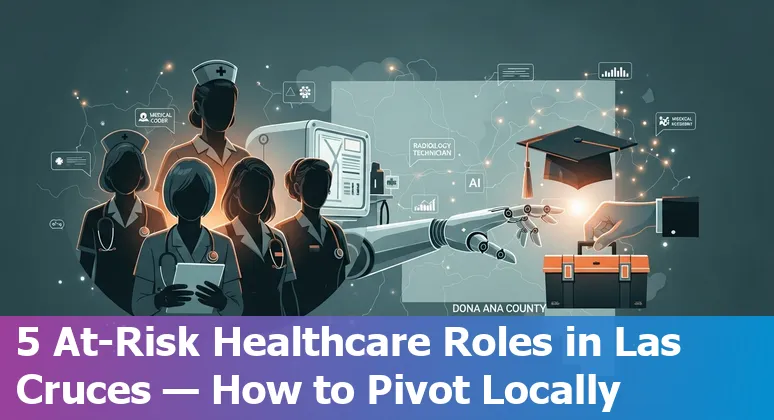
Las Cruces healthcare roles most at risk from AI: radiologists, coders/billers, transcriptionists, lab technologists, and front‑desk/pharmacy staff. Stanford: 78% of organizations used AI in 2024; FDA approved 223 AI devices (2023); AI saves ~15 minutes/critical radiology case, cuts billing denials ~40%.
Las Cruces healthcare workers should watch AI closely: Stanford's 2025 AI Index shows rapid institutional adoption - 78% of organizations used AI in 2024 and the FDA approved 223 AI-enabled medical devices in 2023 - while industry data reports roughly 38% of medical professionals already use AI for diagnosis assistance, signaling change for both clinical and administrative roles (Stanford 2025 AI Index report, AI usage statistics and trends).
Local pilots of ambient dictation, AI scribes, and telehealth triage illustrate how those tools arrive at the bedside and front desk; practical, prompt-writing and workplace AI skills matter now - see the 15-week AI Essentials for Work syllabus to start building resilient, job-focused AI capability for New Mexico teams (AI Essentials for Work syllabus (Nucamp)).
| Attribute | Information |
|---|---|
| Length | 15 Weeks |
| Description | Gain practical AI skills for any workplace; learn AI tools, prompts, and apply AI across business functions |
| Cost (early bird) | $3,582 |
| Registration | Register for AI Essentials for Work (Nucamp) |
Table of Contents
- Methodology: How we picked the Top 5 jobs and localized the risk
- Radiologists - imaging interpretation and AI vision models (high risk)
- Medical Coders and Medical Billers - automation of rules-based revenue cycle work
- Medical Transcriptionists and Physician Documentation Specialists - speech-to-text and NLP replacing charting roles
- Medical Laboratory Technologists and Medical Laboratory Assistants - automation in sample processing and AI-driven interpretation
- Pharmacy Technicians, Patient Service Representatives, and Scheduling Staff - automation in dispensing, chatbots, and scheduling
- Conclusion: Practical next steps for Las Cruces healthcare workers to stay resilient
- Frequently Asked Questions
Explore the top 2025 AI healthcare trends that are driving growth from $29B to $39B and influencing adoption in Las Cruces.
Methodology: How we picked the Top 5 jobs and localized the risk
(Up)Methodology combined a healthcare risk-management lens with empirical evidence on who is most vulnerable and where automation is already present: the Journal of Health Care Risk Management's enterprise-risk domains (clinical, legal, financial, human capital, technology) framed which job functions carry the largest patient- and system-level consequences (Journal of Health Care Risk Management journal and enterprise-risk domains); CDC data on underlying conditions and demographic disparities helped weight roles that support high-risk or underserved patients (CDC guidance on underlying medical conditions and COVID risk); and local adoption signals - pilots of ambient dictation and AI scribes in Las Cruces - identified immediate exposure in documentation and front-desk work (Las Cruces local AI pilot examples in healthcare documentation).
Jobs were scored by automation-readiness (rule-based tasks), patient-safety impact, and local prevalence of technology pilots to produce the Top 5 most-at-risk roles for Las Cruces and practical adaptation priorities.
| Criterion | Why it matters |
|---|---|
| ERM domains (ASHRM) | Prioritizes clinical, legal, financial, and human-capital risks |
| Patient vulnerability (CDC) | Weights roles serving populations with high underlying-condition burden |
| Facility access & disparities (NBER summaries) | Gives extra weight to rural/underserved settings where task shifts have bigger system effects |
| Local pilot adoption (Nucamp examples) | Signals immediate automation exposure in Las Cruces workflows |
Radiologists - imaging interpretation and AI vision models (high risk)
(Up)Radiologists in Las Cruces face high exposure to AI vision models because commercial and research tools already triage, flag, and quantify findings that once required manual reads; teleradiology firms report AI can prioritize urgent studies and shorten turnaround - vRad cites a typical reduction of 15+ minutes per critical case and 36,000+ AI-boosted critical findings annually - while peer-reviewed reviews document broad gains in workflow efficiency and diagnostic support for chest X‑rays, CTs, mammography, and more (vRad report on AI prioritization and outcomes in radiology, Peer-reviewed diagnostics review of AI integration in medical imaging).
Local systems that adopt these models will need clear governance, radiologist-led QA, and explainable-model workflows to avoid blind trust; the practical payoff is tangible - faster prioritization can move high-risk studies to the front of the queue and materially ease emergency and oncology workflows in regional hospitals - but it also shifts job tasks from routine reads toward oversight, multimodal synthesis, and patient-facing communication (Diagnostic pathology and imaging perspectives on AI adoption).
| Metric | Value |
|---|---|
| Average turnaround reduction (critical cases) | 15+ minutes (vRad) |
| AI-boosted critical findings annually | 36,000+ (vRad) |
| Diagnosis corrections attributed to AI | 2,000+ (vRad) |
| AI models deployed | 27 (vRad) |
| Reported model accuracy | 99.87% (vRad) |
“One of the biggest challenges in AI for healthcare is the lack of explainability, which makes it difficult for doctors to trust automated decisions.”
Medical Coders and Medical Billers - automation of rules-based revenue cycle work
(Up)Medical coders and billers in Las Cruces face rapid change because much of revenue-cycle work is rules-based and already ripe for automation: AI now scrubs claims, verifies eligibility, suggests codes from notes, and tracks appeals - tasks that speed reimbursements and cut error-driven rework (AI in medical billing and coding - UTSA PaCE research).
Vendors and case studies show concrete impacts: ENTER reports AI-first RCM can reduce claim errors and denials - case data notes a 40% denial reduction, roughly 20 admin hours saved per week, and a ~15% monthly revenue uplift - while industry estimates place the national cost of billing errors near $300 billion, so cleaner claims directly protect local clinic cash flow and patient trust (ENTER medical billing automation case study - denial reduction and ROI).
That said, authoritative groups urge governance and oversight: autonomous coding can code at scale and meet or exceed manual accuracy, but periodic audits and human reviewers remain essential to handle edge cases, regulatory changes, and HIPAA safeguards (AHIMA analysis of revenue cycle automation and coding accuracy); the practical takeaway for Las Cruces is clear - adopt coding automation where it reduces denials, and invest in coder upskilling for review, audits, and payer negotiation so revenue and patient experience both improve.
| Metric | Source / Value |
|---|---|
| Estimated US cost of billing errors | $300 billion annually (ENTER) |
| Case-study denial reduction | 40% (ENTER) |
| Reported admin time saved | ~20 hours/week (ENTER) |
| Revenue uplift (case) | ~15% monthly (ENTER) |
| Autonomous coding accuracy | Meets or exceeds manual coding (AHIMA) |
“Autonomous coding accelerates the medical coding and billing process by reviewing and coding charts within seconds and then submitting them for billing without any human intervention.”
Medical Transcriptionists and Physician Documentation Specialists - speech-to-text and NLP replacing charting roles
(Up)Speech-to-text and NLP are already replacing much of the clerical work done by medical transcriptionists and physician documentation specialists: AI scribes can capture encounters and extract structured fields, potentially reclaiming part of the 15.5 hours per week clinicians typically spend on paperwork, but accuracy gaps with accents, medical jargon, and contextual nuance create real patient-safety and liability risks - Maulin Law warns that mis-transcriptions (for example, “No chest pain today” becoming “Chest pain today”) have led to unnecessary referrals and show why clinician verification cannot be optional (Maulin Law article on risks of AI transcribing in healthcare).
Local Las Cruces pilots of ambient dictation and AI scribes show the technology's upside for clinic throughput, yet they also underscore practical safeguards: require mandatory human review, preserve audio for audit trails, enforce HIPAA-safe vendor contracts, and retrain documentation staff to become QA and EHR-integration specialists so the community captures efficiency gains without sacrificing safety (Analysis of AI medical scribe benefits and pitfalls, Local Las Cruces ambient dictation pilot report).
| Metric | Value |
|---|---|
| Clinician paperwork time | 15.5 hours/week (Medscape via source) |
| Projected U.S. savings from voice-enabled documentation | ~$12 billion by 2027 |
| Global medical transcription market (2024) | USD 2.55 billion |
Medical Laboratory Technologists and Medical Laboratory Assistants - automation in sample processing and AI-driven interpretation
(Up)Medical Laboratory Technologists and Assistants will see routine sample handling, pipetting, and basic result triage increasingly shifted onto total laboratory automation (TLA) lines and AI-driven interpretation - systems that take repetitive tasks off the bench and surface abnormal or urgent results for human review.
Evidence from industry reviews shows automation can cut human-error rates by more than 70% and trim hands-on time per specimen by roughly 10%, while AI-enabled flagging lets experienced staff spend more time on method validation, troubleshooting, and complex assays rather than repetitive work.
For Las Cruces facilities that face tight staffing and budget pressures, the practical payoff is concrete: fewer repeat draws, faster, more reliable lab results for clinicians, and a shift in hiring from manual bench skills toward instrument maintenance, QA, and AI validation - so local leaders should negotiate vendor support, require human sign-off on edge cases, and invest in targeted upskilling now.
For further reading, see the PMC total laboratory automation case study and the ClinicalLab article on automation benefits and staffing impacts.
redefine
| Metric | Value |
|---|---|
| Human error reduction | >70% (reported automation impact) |
| Staff time per specimen | ≈−10% (hands-on time reduction) |
| Projected job growth (lab techs) | +7% (BLS projection cited in ClinicalLab analysis) |
Pharmacy Technicians, Patient Service Representatives, and Scheduling Staff - automation in dispensing, chatbots, and scheduling
(Up)Pharmacy technicians, patient service representatives, and scheduling staff in Las Cruces confront fast-moving automation: robotic dispensers, scan‑verification counters, secure pickup kiosks, and rules‑based scheduling/triage tools change who touches a prescription or appointment first.
Industry evidence shows automation can handle well over half of a community pharmacy's daily fills and speed verification while reducing errors - freeing technicians to run vaccination clinics, medication‑therapy programs, and patient counseling instead of manual counting (benefits of pharmacy automation for community pharmacies).
The shift matters here because national staffing pressures - technicians asking for ~33% higher pay and pharmacy school applicants falling sharply - make labor scarce and costly, so automation becomes a practical way to maintain safety and throughput without burning out remaining staff (analysis of pharmacy automation and the labor shortage).
Pair automation with clear QA roles and simple rules for scheduling or telehealth triage so Las Cruces clinics convert saved technician hours into higher‑value patient services rather than operational risk (telehealth triage prompts for long-distance care in Las Cruces); the payoff is tangible: shorter waits, fewer dispensing errors, and more staff time for direct patient care.
| Metric | Source / Value |
|---|---|
| Community pharmacy automation capacity | Can automate well above 50% of daily prescriptions (Capsa Healthcare) |
| Pharmacy technician wage pressure | Technicians demanding ~33% higher wages (Pharmacy Times) |
| Pharmacy school application trend | Applications down 64% (Pharmacy Times) |
| Independent pharmacy automation threshold | Cost‑effective automation feasible for ~150 prescriptions/day (Aurio) |
Conclusion: Practical next steps for Las Cruces healthcare workers to stay resilient
(Up)Practical next steps for Las Cruces healthcare workers center on three actions: govern and validate before scaling, pilot with a human-in-the-loop, and upskill the workforce and community.
First, adopt BRIDGE-style governance and SAFER/GRaSP controls to require local validation, continuous monitoring, and clear audit trails for any AI that touches clinical decisions or documentation (BRIDGE roadmap for responsible AI integration, SAFER and GRaSP frameworks for safe AI adoption in healthcare); mandate clinician verification of AI notes, preserve audio for audits, and build routine model testing into IT workflows.
Second, start with low‑risk pilots - scheduling bots, RCM helpers, and AI scribes - coupled with periodic audits so automation reduces denials and reclaims documentation time without sacrificing safety.
Third, invest in role-specific reskilling and plain-language communication: partner with UNM's health literacy teams to make AI-driven patient messages accessible, and enroll staff in practical training like Nucamp's 15‑week AI Essentials for Work to master prompts, tool selection, and workplace integration (Register for Nucamp AI Essentials for Work (15-week bootcamp)).
Do these three and Las Cruces clinics can preserve trust while converting automation into measurable operational wins for patients and staff.
| Attribute | Information |
|---|---|
| Program | AI Essentials for Work (Nucamp) |
| Length | 15 Weeks |
| Cost (early bird) | $3,582 |
| Registration | Register for AI Essentials for Work (Nucamp) |
Frequently Asked Questions
(Up)Which healthcare jobs in Las Cruces are most at risk from AI?
The article identifies five high-risk roles: Radiologists (AI vision models for imaging triage and interpretation), Medical Coders and Billers (rules-based revenue-cycle automation), Medical Transcriptionists and Physician Documentation Specialists (speech-to-text and AI scribes), Medical Laboratory Technologists and Assistants (total laboratory automation and AI-driven flagging), and Pharmacy Technicians/Patient Service Representatives/Scheduling Staff (robotic dispensing, chatbots, and automated scheduling).
What evidence shows these jobs are exposed to AI now in Las Cruces and nationally?
National and vendor data plus local pilots indicate exposure: Stanford's 2025 AI Index showed rapid institutional AI adoption (78% of organizations used AI in 2024) and the FDA approved hundreds of AI-enabled medical devices; local Las Cruces pilots include ambient dictation, AI scribes, and telehealth triage. Specific metrics cited include vRad reporting 15+ minute turnaround reductions for critical cases and 36,000+ AI-boosted critical findings annually for radiology; case studies showing ~40% denial reduction and ~20 admin hours saved weekly for AI-first revenue cycle work; clinician paperwork averages of 15.5 hours/week with voice-enabled documentation promising major time savings; laboratory automation reporting >70% human-error reduction; and community pharmacy automation able to handle over 50% of daily fills.
How were the Top 5 at-risk jobs selected and localized for Las Cruces?
Selection combined a healthcare enterprise-risk framework (clinical, legal, financial, human capital, technology) with empirical data on automation readiness (rule-based tasks), patient vulnerability (CDC data on underlying conditions and disparities), and local adoption signals (Las Cruces pilots of ambient dictation and AI scribes). Roles were scored by automation-readiness, patient-safety impact, and local prevalence of technology pilots to produce the localized Top 5.
What practical steps can Las Cruces healthcare workers and organizations take to adapt?
Three practical actions are recommended: 1) Govern and validate before scaling - use BRIDGE-style governance and SAFER/GRaSP controls, require clinician verification of AI outputs, preserve audio for audit trails, and build routine model testing into IT workflows; 2) Pilot with human-in-the-loop - start with low-risk pilots (scheduling bots, RCM helpers, AI scribes) and conduct periodic audits to reduce denials and reclaim documentation time safely; 3) Upskill the workforce - reskill staff toward QA, EHR integration, model validation, and patient communication (e.g., plain-language messaging), and consider job-focused training like the 15-week AI Essentials for Work program.
What are the risks and safeguards to keep in mind when implementing AI in clinical workflows?
Key risks include lack of explainability, accuracy gaps (accents, jargon, edge cases), patient-safety and liability concerns from transcription or diagnostic errors, and privacy/HIPAA risks with vendors. Safeguards include mandatory human review of AI outputs, explainable-model workflows, continuous monitoring and local validation, periodic audits, clear vendor contracts enforcing HIPAA protections, preserved audit trails (e.g., audio), and assigning staff to QA, model oversight, and payer negotiation rather than fully autonomous deployment.
Learn how personalized medication dosing for complex patients can cut adverse drug events among older adults with multiple conditions.
Clinics are cutting overtime and no-shows with AI scheduling and staffing optimization that matches capacity to demand in near real time.

Ludo Fourrage
Founder and CEO
Ludovic (Ludo) Fourrage is an education industry veteran, named in 2017 as a Learning Technology Leader by Training Magazine. Before founding Nucamp, Ludo spent 18 years at Microsoft where he led innovation in the learning space. As the Senior Director of Digital Learning at this same company, Ludo led the development of the first of its kind 'YouTube for the Enterprise'. More recently, he delivered one of the most successful Corporate MOOC programs in partnership with top business schools and consulting organizations, i.e. INSEAD, Wharton, London Business School, and Accenture, to name a few. With the belief that the right education for everyone is an achievable goal, Ludo leads the nucamp team in the quest to make quality education accessible