









Top 10 AI Prompts and Use Cases and in the Education Industry in Kazakhstan
Last Updated: September 10th 2025
Too Long; Didn't Read:
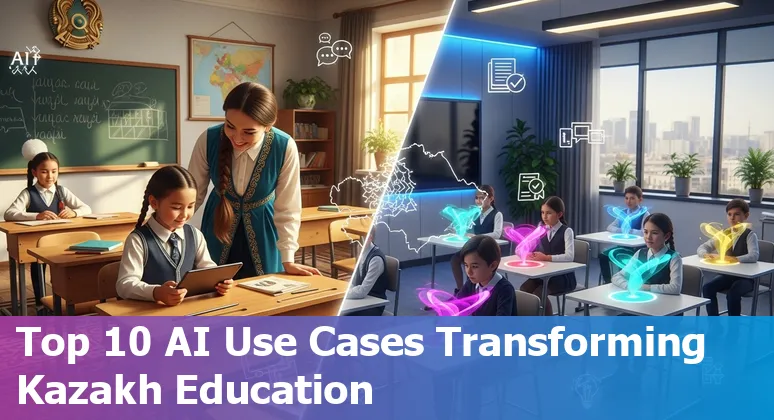
Kazakhstan's education AI rollout prioritizes practical prompts and classroom use cases: AI is compulsory in 93 state universities, 390,000 students completed foundational courses, 3,000 teachers certified, 8,042 schools; local models (KazLLM: 8B & 70B, ~150B tokens) power multimodal tools.
President Kassym-Jomart Tokayev's directive to make artificial intelligence a national priority has turned Kazakhstan's education system into a fast-moving laboratory for workforce-ready skills: AI is now compulsory across state universities and the Aisana project will give students hands-on exposure, while the government is rolling AI into school subjects with an MIT-backed pilot and major connectivity upgrades nationwide (Astana Times coverage of AI mandatory discipline in Kazakh universities, Prime Minister's briefing on AI programs and quality standards in Kazakhstan's schools).
With 390,000 learners already completing foundational AI courses and thousands of teachers certified, the moment calls for practical, job-focused training - courses like Nucamp's Nucamp AI Essentials for Work bootcamp help translate national strategy into day‑to‑day skills employers need, turning policy into classrooms and startups overnight.
| Metric | Value |
|---|---|
| Universities integrating AI | 93 |
| New institutes / tracks | 20 institutes, 25 tracks |
| Students completing AI course | 390,000 |
| Teachers officially certified | 3,000 |
| Total schools | 8,042 |
| Schools to connect (FOC) 2025–26 | 819 (2025), 1,191 (2026) |
“Every student will be able to learn how to apply AI in their profession, develop new technologies, or create start-ups in the future,” - Gulzat Kobenova, Deputy Minister of Science and Higher Education
Table of Contents
- World Bank & Nazarbayev University - Methodology: How this List Was Compiled
- Ministry of Education and Science (Deputy Minister Gulzat Kobenova) - Curriculum Integration & Course Creation
- PISA (OECD) - Personalized & Adaptive Learning and Lesson Planning
- Blockchain & AI Technology Center (BAITC) - Teacher Training & Professional Development
- Nazarbayev University - KazLLM and Kazakh Chatbot Development
- UNICEF Kazakhstan - Accessibility & Inclusive Learning Supports
- World Bank (Education Global Practice) - Student Progress Analytics & Early‑Warning Systems
- Astana Hub - Administrative Automation & System Management
- ISSAI (Beynele and Oylan) - Content Creation & Multimodal Learning Materials
- Korkyt Ata Kyzylorda State University (School of Artificial Intelligence) - Vocational Alignment & Skills Forecasting
- MOST (Ministry of Science and Higher Education) - Research Acceleration & Local Model Development
- Ministry of Education and Science - Conclusion: Practical Next Steps for Beginners in Kazakhstan
- Frequently Asked Questions
Find out how the nationwide school connectivity and FOC rollout is enabling remote AI labs and high-bandwidth learning in previously isolated regions.
World Bank & Nazarbayev University - Methodology: How this List Was Compiled
(Up)To build this ranked list, analysts cross-checked Nazarbayev University's ISSAI disclosures with on‑the‑ground reporting and education briefs, privileging tools and prompts that show real classroom value in Kazakhstan - local language support, offline deployment, and teacher upskilling were weighted highest.
The methodology leaned heavily on ISSAI's product rollout (Oylan 2.5, MangiSoz 2.0, TilSync, Beynele, Mangitas 02) and technical notes about secure, local inference, so solutions that run on Mangitas servers and don't rely on constant internet earned priority; see ISSAI press briefing: Kazakhstan's next-generation AI technologies (ISSAI press briefing: Kazakhstan's next-generation AI technologies).
Coverage of how AI is being used to broaden access and inform teacher training guided the selection of inclusive use cases and prompts (Analysis: Harnessing AI for inclusive education in Kazakhstan), and items were ranked by scalability, data‑privacy posture, and direct classroom impact - the kind of offline image‑analysis or live subtitling that lets a rural teacher project instant feedback to 30 students without leaving the schoolroom.
| Metric | Value |
|---|---|
| ISSAI founded | September 2019 |
| Autonomous status | 2024 |
| Researchers & engineers | 70+ |
| Products unveiled | 5 (Oylan 2.5, MangiSoz 2.0, TilSync, Beynele, Mangitas 02) |
| Published articles | 120+ |
“Everything unveiled today is the result of local innovation - from data collection to engineering and deployment.” - Dr. Huseyin Atakan Varol, Founding Director of ISSAI
Ministry of Education and Science (Deputy Minister Gulzat Kobenova) - Curriculum Integration & Course Creation
(Up)Under Deputy Minister Gulzat Kobenova, the Ministry of Education and Science has moved from policy to practice by weaving the state-backed Aisana project into university curricula and pushing a staged, hands‑on approach for schools that begins with an MIT‑backed “Day of AI” pilot - 30–60 minute, teacher‑ready lessons translated into Kazakh and Russian that introduce fundamentals before advancing students to project work and acceleration pathways (Aisana project makes AI mandatory in Kazakh universities (Astana Times), Kazakhstan launches “Day of AI” pilot with MIT to expand AI education (Prime Minister)).
Combined with new TUMO tech centres in Astana and Almaty and a national push to certify teachers, the ministry's curriculum strategy is explicitly designed to create clear classroom-to-career routes that can both upskill rural teachers with offline tools and make Kazakhstan a more competitive destination for international students.
| Metric | Value |
|---|---|
| Universities integrating AI | 93 |
| New institutes / tracks | 20 institutes, 25 tracks |
| Students completing AI course | 390,000 |
| Teachers certified | 3,000 |
| Total schools | 8,042 (7,917 online) |
“Every student will be able to learn how to apply AI in their profession, develop new technologies, or create start-ups in the future,” - Gulzat Kobenova, Deputy Minister of Science and Higher Education
PISA (OECD) - Personalized & Adaptive Learning and Lesson Planning
(Up)PISA's research and OECD commentary make a clear case for personalized, adaptive learning and smarter lesson planning: growth‑mindset gains are largest when students feel supported and teachers tailor instruction instead of following a fixed script, and digital tools can make learning “much more granular, much more adaptive” by studying how each student learns and adjusting pace accordingly (PISA 2018 analysis and OECD commentary on adaptive learning).
New cross‑country work on PISA item features shows adaptive assessments that change item difficulty in real time produce more tailored measures teachers can act on, turning raw scores into concrete next‑lesson signals (Study on adaptive assessment functionality in large-scale assessments).
For Kazakhstan's AI rollout, that means classroom tools and lesson‑planning prompts should prioritize adaptive item sets, clear teacher feedback loops, and offline-capable analytics - so rural and urban teachers alike can get student‑level guidance that nudges every learner forward instead of relying on one‑size‑fits‑all tests.
| Metric | Value |
|---|---|
| Article title | From framework to functionality: A cross-country analysis of PISA 2018 reading assessment framework's item features |
| Journal | Large-scale Assessments in Education |
| Published | 09 August 2025 |
| Authors | Kseniia Marcq & Johan Braeken |
| Accesses / Altmetric | 549 accesses / 7 Altmetric |
“The greatest impacts on growth mindset come when students perceive their teachers as being supportive in a safe learning environment, and when teachers adapt their teaching to the needs of the class, as opposed to simply following a fixed syllabus.” - PISA / OECD analysis
Blockchain & AI Technology Center (BAITC) - Teacher Training & Professional Development
(Up)As Kazakhstan builds institutional capacity, the Blockchain & AI Technology Center (BAITC) can anchor teacher upskilling by combining proven models: a focused, five‑week TPTP-style course that trained educators on ChatGPT and foregrounded pedagogical support, testing revamp, and practice networks offers a compact, classroom-ready template (AJET case study: TPTP teacher upskilling with generative AI); pairing that with the scale and credential pathways of the AFT's new National Academy for AI Instruction - backed by a $23M industry‑education consortium and designed around workshops, online modules and hands‑on labs - creates both depth and reach for Kazakhstan's teacher corps (AFT press release: National Academy for AI Instruction program overview).
Practical additions - AI‑driven teaching simulators that let candidates rehearse classroom interactions in low‑stakes virtual environments, as piloted in U.S. teacher prep - give Kazakh teachers repeatable, feedback‑rich practice before they try new routines with real students (Education Week: AI teaching simulators in teacher preparation).
Together these elements create a teacher‑first professional development stack: short, contextualized GenAI courses; ongoing pedagogical coaching; simulation practice; and credentialed micro‑credentials that translate training into classroom confidence and measurable learning gains.
Nazarbayev University - KazLLM and Kazakh Chatbot Development
(Up)Nazarbayev University's ISSAI has turned language inclusion into a national AI advantage with the open‑source KAZ‑LLM: a multilingual model tuned for Kazakh (plus strong Russian, English and Turkish support) that powers everything from classroom content generation to the first Kazakh “ChatGPT” agents and an AI Tutor rollout inside the Janymda app; the project trained on over 150 billion tokens and ships in 8‑ and 70‑billion‑parameter variants optimized for resource‑constrained deployments, all available for non‑commercial use on Kaz‑LLM on Hugging Face (CC‑BY‑NC) (see the ISSAI official release about Kaz‑LLM and Astana Times coverage of Kaz‑LLM and Kazakhstan AI initiatives).
By combining local linguists, university researchers and industry partners like QazCode/Beeline and the Barcelona Supercomputing Center, KazLLM not only cuts the AI language gap but creates practical education tools - text summarizers, quiz generators from Kazakh literature, and speech/text pipelines that build on the Soyle App - while flagging real-world constraints (server supply and latency) that Kazakhstan is actively addressing as it scales these classroom bots and teacher assistants (GSMA Foundry profile of Kazakhstan AI initiatives).
| Metric | Value |
|---|---|
| Official release | 10 December 2024 |
| Model sizes | 8B & 70B parameters |
| Training data | ~150 billion tokens |
| Languages | Kazakh, Russian, English (+ Turkish) |
| License / Availability | CC‑BY‑NC; six versions on Hugging Face |
“KazLLM is the cornerstone on which Kazakhstan's IT community can build future products and services using domestic innovations.” - Madina Abdrakhmanova, ISSAI deputy director
UNICEF Kazakhstan - Accessibility & Inclusive Learning Supports
(Up)UNICEF Kazakhstan is seeding real-world accessibility by championing Digital Public Goods (DPGs) that make classrooms and campus life more inclusive: a national DPG needs assessment mapped gaps and local capacity, Astana Hub helped vet candidates, and the Ozim app - recognized as the first DPG in Central Asia - lets people plan the most accessible, safe routes to schools and recreation spots, effectively turning city maps into lifelines for children with limited mobility (UNICEF Kazakhstan DPG pilot).
In practice this means UNICEF's joint workshops with Nazarbayev University's NURIS are fast-tracking open, reusable tools (Okoo, KazNu, IITU among potential DPGs) and building developer and government know-how so adaptive, accessible edtech can scale across regions; the same collaboration also explores AI use cases to personalize learning and protect children's rights as tech is adopted in schools (UNICEF–NURIS education project).
The work is pragmatic - training thousands of teachers on inclusive models, cataloguing candidate platforms, and confronting real barriers like limited early-stage funding and low DPG awareness - so that accessible digital textbooks, route‑planning apps and adaptive learning tools reach the students who need them most.
| Metric | Value |
|---|---|
| DPG pilot launch | 02 September 2022 |
| Ozim recognized | 29 April 2021 (first DPG in Central Asia) |
| UNICEF–NURIS workshop participants | More than 80 experts |
| Okoo platform reach | 14,413 teachers trained |
“Based on the United Nations Convention on the Rights of the Child, UNICEF has developed a number of guidelines that explain the requirements for the use of artificial intelligence in relation to children without violating their rights, which can help guide Kazakhstan's approach to using AI in schools. When considering the broader impact of AI on education, there is no doubt that it will be transformative – it is only a matter of time. Artificial intelligence systems promise to improve educational opportunities, from early learning to virtual mentoring and school leadership. Our task is to take into account all the positive aspects of AI use in the development of digital public goods, ensure security, and protect children from any potential harmful impacts of the technology.” - Tatiana Aderikhina, UNICEF Education Specialist
World Bank (Education Global Practice) - Student Progress Analytics & Early‑Warning Systems
(Up)World Bank research on early‑warning systems makes a practical case for student‑level analytics as a frontline tool for Kazakhstan's AI education push: systems that flag attendance drops, sudden grade declines or engagement gaps can turn raw school data into actionable alerts, but administrators must design them with privacy, inclusivity and offline realities in mind (World Bank research on early-warning systems to prevent student dropouts); complementary guidance on
Designing Inclusive, Accessible Early Warning Systems - World Bank guidance for inclusive early-warning systems
stresses entry points and safeguards so these tools actually reach rural classrooms and vulnerable learners rather than amplifying existing inequities (Designing Inclusive, Accessible Early Warning Systems - World Bank guidance).
Recent World Bank analysis also highlights how AI‑powered assistants can strengthen predictions and teacher alerts, but warns that technical gains must be matched with governance and local capacity-building so that a timely alert becomes timely support - not just another dashboard metric (World Bank analysis on AI-powered assistants to address the learning crisis).
The bottom line for Kazakhstan: build simple, privacy‑aware prediction pipelines that deliver clear, low‑friction next steps for teachers and communities - because catching a struggling learner early is what turns data into graduation, not just charts.
Astana Hub - Administrative Automation & System Management
(Up)Astana Hub is fast becoming the operational spine for administrative automation and system management in Kazakhstan's education ecosystem, turning startup momentum into practical tools that cut bureaucracy and scale services: its showcase of homegrown EdTech highlights solutions that streamline school workflows and teacher support, while hub-led programs aim to train one million citizens in AI skills - 500,000 schoolchildren and 90,000 civil servants among them - so public managers and school leaders can adopt data-driven dashboards and automated processes with local talent at the helm (Astana Hub showcase of Kazakh EdTech startups streamlining school workflows, Astana Hub plan to train one million Kazakh citizens in AI skills over five years).
Concrete pilots - like Tomorrow School's intensive peer-to-peer AI training on a 24/7 iMac campus and Tech Orda partnerships with private IT schools - seed practical automation projects that administrators can scale without importing costly vendors.
| Metric | Value |
|---|---|
| Training target (5 years) | 1,000,000 citizens |
| Schoolchildren | 500,000 |
| Students | 300,000 |
| Civil servants | 90,000 |
| Business representatives | 80,000 |
| Tomorrow School applicants (1st intake) | 2,880 applications; 120 passed pool |
“This is a strategic initiative of the Kazakh government.” - Daniya Akhmetova, Managing Director, Astana Hub
ISSAI (Beynele and Oylan) - Content Creation & Multimodal Learning Materials
(Up)ISSAI's Beynele and Oylan are already reshaping how Kazakh classrooms create and consume learning materials: Beynele is a diffusion-based, culturally aware text-to-image model that supports Kazakh, Russian and English and can produce visuals grounded in traditional ornaments, national clothing and steppe landscapes - perfect for teachers who need locally authentic illustrations for literature, history or art lessons (ISSAI launches Beynele, a culturally-aware Kazakh text-to-image model); meanwhile Oylan's multimodal language-vision capabilities (trained on a massive local dataset) let students and teachers upload diagrams or homework photos and get contextual explanations, OCR, and visual Q&A that work in Kazakh, Russian and English (Astana Times report on Oylan language-vision AI model pilot in Kazakhstan).
Paired with the Kaz‑LLM language backbone for prompts and lesson scaffolds, these tools make it easy to generate culturally respectful imagery, adapt worksheets on the fly, and produce multimodal assessments that actually understand local texts and visuals - so a rural teacher can turn a single prompt into a polished slide deck that speaks directly to students' lives.
| Model / Product | Key facts |
|---|---|
| Beynele | Launched 26 June 2025; diffusion-based; supports Kazakh, Russian, English; tuned to Kazakh ornaments, clothing, steppe landscapes |
| Oylan | Multimodal language-vision model; trained on ~10M images and 50M question-answer pairs; supports image+text tasks and API access |
| Kaz‑LLM | Language model backbone (Kazakh/Russian/English); foundation for chatbots and content generation |
“With Beynele, we're building technology that doesn't just generate images - it understands identity,” - Amina Baikenova, IT Product Manager at ISSAI
Korkyt Ata Kyzylorda State University (School of Artificial Intelligence) - Vocational Alignment & Skills Forecasting
(Up)Korkyt Ata Kyzylorda State University's School of Artificial Intelligence has a clear opportunity to marry AI training with Kazakhstan's fast-changing labor forecasts: curriculum and micro‑credentials tied to local employer demand can prepare students for concrete roles in renewables, smart grids, hydrogen and the nuclear build‑out that policymakers expect to grow sharply this decade.
National planning already projects large, tangible shifts - 99 fuel and energy projects are expected to create more than 83,000 jobs across construction and operations, and renewable projects alone could generate roughly 12,000 temporary positions as Kazakhstan scales toward carbon neutrality (Prime Minister briefing: 99 fuel and energy projects and projected 83,000 jobs, Astana Times analysis of Kazakhstan's green workforce and renewable jobs), while sectoral pushes to expand vocational pipelines and online retraining (tens of thousands trained via short courses and platforms like Skills Enbek) mean universities must be nimble partners for regional employers (TimesCA coverage of Kazakhstan vocational training expansion and Skills Enbek outcomes).
Practical alignment - stackable AI-for-energy modules, employer‑mapped apprenticeships, and localized forecasting tools - would let the School of AI turn macro projections into day‑one job readiness for Kyzylorda graduates, not abstract predictions.
| Metric | Value / Source |
|---|---|
| Jobs from 99 fuel & energy projects by 2030 | 83,000+ (Prime Minister briefing) |
| Projected green/renewable jobs (near term) | ~12,000 temporary jobs (Astana Times) |
| Energy sector jobs by 2030 (alternate) | 41,000 (Qazaq Green snippet) |
| Short-term vocational course participants (2023) | 67,500 (TimesCA) |
| Skills Enbek trained / job outcomes | 57,700 trained; 14,600 secured jobs (TimesCA) |
“Today, universities independently determine their academic policies. Many operational and procedural issues are resolved at the university level. (…) As a result of this work, universities now independently develop and update educational programs in close cooperation with employers, taking into account the needs of economic sectors.” - Ministry of Science and Higher Education (quoted in Astana Times)
MOST (Ministry of Science and Higher Education) - Research Acceleration & Local Model Development
(Up)MOST (the Ministry of Science and Higher Education) is the engine behind Kazakhstan's plan to turn policy into research firepower: by coordinating national investments that make AI compulsory in state universities and by fast‑tracking compute and lab capacity, the ministry helps scale homegrown models and incubate startups so classroom tools are built locally, not imported.
That pipeline already includes mandatory AI courses reaching hundreds of thousands of students, national research centres like Alem.ai and Nazarbayev University's model work, and a new supercomputer deployed in July with NVIDIA H200 processors to support the country's LLM efforts - concrete assets that let Kazakh teams train and serve models tuned to local language and curriculum needs (see reporting on the country's AI push and KazLLM and supercomputer rollout).
MOST's role is practical: fund targeted labs, unlock seed capital for spinouts, and link research outputs to teacher tools and vocational routes so a model trained on ~150 billion tokens can quickly power a Kazakh chatbot, classroom quiz generator or offline tutor.
The payoff is both strategic and tangible - a stronger research base, a $100M seed fund to kickstart products, and a clearer path for attracting international students and talent to KZ's AI ecosystem.
| Metric | Value / Note |
|---|---|
| Students covered by mandatory AI | ~390,000 |
| Regional supercomputer (installed) | July; NVIDIA H200 processors |
| KazLLM training data | ~150 billion tokens |
| Planned seed fund for AI startups | $100 million (NU announcement) |
| Model variants supporting deployments | 8B & 70B parameter sizes |
“There is no alternative, as this process is radically changing the world order and the way of life of all humanity.” - President Kassym‑Jomart Tokayev
Ministry of Education and Science - Conclusion: Practical Next Steps for Beginners in Kazakhstan
(Up)For beginners in Kazakhstan, practical next steps are simple and concrete: begin with the ready-made 30–60 minute “Day of AI” lesson sets (translated into Kazakh and Russian) so teachers can pilot AI in a single class period - see the Kazakhstan Ministry official guidance on AI integration in schools and the MIT-backed Day of AI pilot and national school connectivity plan for 8,042 schools.
Prioritize low‑bandwidth, teacher‑ready tools and one short professional course - three-level PD is already rolling out and 3,000+ teachers completed training - then move to hands‑on microprojects tied to local employers or vocational tracks.
For working professionals or school leaders who want a practical skillset to design prompts and deploy classroom assistants, a focused pathway like Nucamp AI Essentials for Work 15-week bootcamp teaching prompt writing and AI for the workplace teaches prompt writing, tool use, and job‑focused applications in 15 weeks, turning policy into classroom practice without waiting for full infrastructure upgrades.
“Every student will be able to learn how to apply AI in their profession, develop new technologies, or create start-ups in the future.” - Gulzat Kobenova, Deputy Minister of Science and Higher Education
Frequently Asked Questions
(Up)What are the top AI use cases and prompt types being deployed in Kazakhstan's education sector?
Key use cases and prompt types include: multilingual classroom chatbots and tutors (powered by KazLLM) for content generation and Q&A; multimodal content creation and image-to-text prompts (Oylan, Beynele) for culturally grounded visuals and OCR/visual Q&A; personalized and adaptive learning prompts for individualized lesson planning and assessments; teacher-training and rehearsal prompts used in simulators and micro‑credentials; and administrative prompts for early‑warning student analytics and automation of school workflows. Prompts prioritise low‑bandwidth, offline-capable formats (e.g., concise instructional templates, image-analysis requests, live-subtitling prompts) that deliver direct classroom impact.
What national programs, tools and metrics show the scale of AI adoption in Kazakhstan's education system?
AI is now compulsory across state universities with 93 universities integrating AI, 20 new institutes and 25 new tracks reported. Approximately 390,000 learners have completed foundational AI courses and about 3,000 teachers are certified. There are 8,042 total schools (with staged broadband/connectivity upgrades and 819 schools planned for free connection in 2025 and 1,191 in 2026). Key homegrown tools include KazLLM (official release 10 Dec 2024; 8B & 70B variants; ~150 billion tokens), ISSAI products (Oylan 2.5, MangiSoz 2.0, TilSync, Beynele, Mangitas 02), and pilots such as the MIT-backed “Day of AI,” TUMO centres, and government training targets supported by MOST and Astana Hub.
How are Kazakhstan's AI tools addressing language inclusion and offline deployment constraints?
Language inclusion is being addressed through KazLLM and locally tuned models that support Kazakh, Russian and English (plus Turkish in some variants), enabling Kazakh-language summarizers, quiz generators and speech/text pipelines. Offline and low-bandwidth deployment is prioritised: models and products are optimised for resource‑constrained servers (e.g., 8B model variants), local inference on Mangitas/other domestic servers reduces reliance on constant internet, and prompts and tools are engineered for offline-capable features like image analysis and live subtitling so rural teachers can use them without full connectivity.
What practical first steps should teachers or beginners take to start using AI in Kazakh classrooms?
Begin with the 30–60 minute translated “Day of AI” lesson sets to pilot AI in a single class period. Prioritise low‑bandwidth, teacher‑ready tools and take one short professional development course (many teachers have completed three-level PDs). Move to hands‑on microprojects tied to local employers or vocational tracks, use prompt-writing and tool-use modules to design classroom assistants, and practise in low‑stakes simulators before deploying with students. For focused upskilling, follow a 12–15 week practical pathway that covers prompt design, tool workflow and job‑focused applications.
How are privacy, inclusivity and governance considered when deploying AI in schools?
Deployment guidance emphasises privacy-aware, inclusive design: UNICEF-backed Digital Public Goods and guidelines for child-safe AI inform product selection; World Bank and OECD/PISA guidance recommend privacy, local capacity‑building and low-friction teacher actions for early‑warning systems; and national actors (MOST, ISSAI, Ministry of Education) prioritise local model development and governance. Practical safeguards include offline inference to limit data exposure, clear teacher-facing next steps for alerts, training thousands of teachers in inclusive approaches, and piloting DPGs and vetted tools before broad rollouts.
With cloud SIS and integrated CRMs on the rise, see practical steps for admins to master Student-information systems and lead chatbot pilots on campus.
With 7,917 online schools and expanding fiber access, school connectivity numbers let remote delivery slash per-student costs for providers.

Ludo Fourrage
Founder and CEO
Ludovic (Ludo) Fourrage is an education industry veteran, named in 2017 as a Learning Technology Leader by Training Magazine. Before founding Nucamp, Ludo spent 18 years at Microsoft where he led innovation in the learning space. As the Senior Director of Digital Learning at this same company, Ludo led the development of the first of its kind 'YouTube for the Enterprise'. More recently, he delivered one of the most successful Corporate MOOC programs in partnership with top business schools and consulting organizations, i.e. INSEAD, Wharton, London Business School, and Accenture, to name a few. With the belief that the right education for everyone is an achievable goal, Ludo leads the nucamp team in the quest to make quality education accessible