









How AI Is Helping Education Companies in Kazakhstan Cut Costs and Improve Efficiency
Last Updated: September 10th 2025
Too Long; Didn't Read:
Kazakhstan's AI push enables education companies to cut costs and boost efficiency by scaling digital delivery: 7,917 of 8,042 schools online, 4,663 fiber links, 93 universities with AI, 390,000 students trained, LMS adoption 25%→100%, and 150+ courses localized.
Kazakhstan's national AI push is shifting education from expensive, one-off pilots toward scalable digital delivery: a government plan with an MIT pilot and a fast fiber roll‑out aims to put AI literacy into every classroom and make online tutoring, automated admin and teacher upskilling cost‑effective for local education companies.
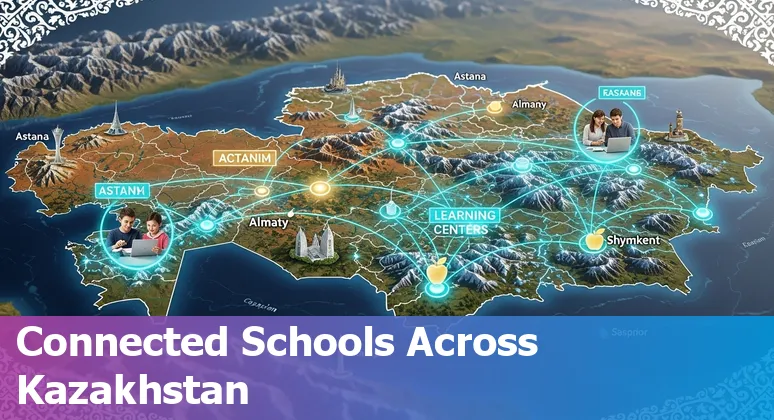
With 7,917 of 8,042 schools already online and a staged “Day of AI” (30–60 minute lessons translated into Kazakh and Russian) designed to reach primary grades, providers can now build reusable content and train staff at scale rather than reinventing the wheel for each district - see the rollout details from the Prime Minister's office and reporting on the broader policy questions in The Astana Times.
Practical training for these transitions matters: employers can fast‑track staff into work-ready AI roles via programs like Nucamp AI Essentials for Work 15‑Week Bootcamp (early-bird $3,582) to turn classroom pilots into sustained, efficient services.
| Metric | Value |
|---|---|
| Total schools | 8,042 |
| Connected to Internet | 7,917 |
| Fiber‑optic connections (FOC) | 4,663 |
| Other technologies | 3,254 |
| Kazakhtelecom plan (2025–2026) | Connect 2,010 more schools (819 in 2025; 1,191 in 2026) |
“Why do I need this? What is the outcome I want to impact?”
Table of Contents
- Kazakhstan's national AI push and market context
- School connectivity and digital delivery savings in Kazakhstan
- Local AI models, infrastructure and cost advantages in Kazakhstan
- Reuseable curricula, translations and licensing savings in Kazakhstan
- Teacher upskilling and talent pipeline reducing operational costs in Kazakhstan
- Automation, AI tools and operational efficiency gains for Kazakhstan companies
- Public–private partnerships, pilots and digital services in Kazakhstan
- Business models, unit economics and practical next steps for Kazakhstan education companies
- Frequently Asked Questions
Understand the impact of major public–private AI partnerships with global tech firms on resources, training, and infrastructure for Kazakh schools.
Kazakhstan's national AI push and market context
(Up)Kazakhstan's national push has moved quickly from strategy to scale: a government-approved AI development concept through 2029, a newly formed Digital Headquarters and the Digital Government Support Center are rolling AI into public services and education while the country stitches high‑speed connectivity and computing power into the plan - including a Central Asian supercomputer cluster and the Kazakh‑language AlemLLM - so local providers can build once and reuse widely.
Universities have already been swept into the reform wave (AI is now a mandatory discipline, with 93 universities integrating courses and 20 institutions launching 25 new tracks), and mass training programs report some 390,000 students completing specialised AI courses with about 3,000 earning certificates; these supply chains of talent and infrastructure cut the cost and time of pilots and make unit‑economics work for tutoring, automated admin and adaptive learning products.
The result is tangible: faster services, measurable budget savings and an ecosystem (18,000+ IT firms, expanding fiber coverage) that turns AI from an experiment into a repeatable business model for education companies in Kazakhstan - a rare pairing of classroom change and national tech ambition that feels as concrete as a local supercomputer humming in the background.
Read more on the university rollout and national strategy in the reporting on AI in higher education and the Astana Times coverage of the national plan.
| Metric | Value |
|---|---|
| Universities with AI integrated | 93 |
| New AI tracks launched | 25 (by 20 institutions) |
| Students completing specialised AI courses | 390,000 |
| Official AI course certificates issued | 3,000 |
| Internet access (population) | 93% |
| IT companies | 18,000+ |
| Fiber reach | 71% of settlements; lines expanded twelvefold in a decade |
“Our projects bring real reductions in timelines, eliminate unnecessary procedures, and create convenient services.”
School connectivity and digital delivery savings in Kazakhstan
(Up)Broad, affordable school connectivity is the linchpin for cutting delivery costs: mapping by UNICEF and Giga shows roughly 7,437 schools in Kazakhstan with mixed internet quality and a student population of about 3.67 million, yet nearly 20,000 students have no access and 1.21 million lack sufficient bandwidth for rich digital learning - gaps that make small rural schools expensive to run (unit costs per student in small‑staffed schools can be about 2.5× higher).
By turning connected schools into community hubs and using aggregated financing and procurement, pilots like the Giga Accelerate effort test low‑cost technologies and business models that let education providers reuse content, centralise admin and deliver remote tutoring at scale; see Giga's work on connecting hardest‑to‑reach schools and UNICEF's accessibility analysis for the underlying data and local hotspots where upgrades will deliver the biggest savings.
Picture a single village school becoming a broadband anchor that powers evening tutoring, teacher training and community access - one connection that multiplies value and trims per‑student costs across an entire district.
| Metric | Value |
|---|---|
| Schools with varying connectivity | 7,437 |
| Student population | 3.67 million |
| Students with no internet access | ~20,000 |
| Students with insufficient bandwidth | 1.21 million |
| People with access to nearby high‑connectivity schools | 14.78 million |
| People without connectivity | 3 million |
“Giga aims to bridge the digital divide between urban and rural education. Supporting Giga is a logical step for us to further expand the access of rural schoolchildren to online educational resources.”
Local AI models, infrastructure and cost advantages in Kazakhstan
(Up)Kazakhstan's plug‑and‑play advantage is now tangible: national capital and telco partnerships are financing data centers and GPU farms so education companies can run fast, local models instead of routing every request overseas, cutting latency and cloud bills while keeping student data in‑country - see the NIC's new AI infrastructure allocations and Kazakhtelecom's Nvidia partnership for details (NIC AI infrastructure investment plan in Kazakhstan).
At the application layer, homegrown models and offline systems - from the multilingual KAZ‑LLM built with 150+ billion tokens to ISSAI's offline assistants like Oylan 2.5 and the Mangitas local server - let providers offer Kazakh‑language tutoring, automated grading and content generation without constant cloud calls, trimming per‑student operating costs and improving access in low‑bandwidth settings (KAZ‑LLM multilingual model addressing the AI language gap; Kazakhstan offline AI tools and token pricing).
The payoff is practical: lower hosting and translation expenses, faster UX for learners, and the option to scale a single Kazakh‑optimized model across thousands of classrooms - imagine one 70‑billion‑parameter model serving instant, local feedback like a patient tutor in every school server.
“This model reflects Kazakhstan's commitment to innovation, self-reliance, and the growth of its technology ecosystem.”
Reuseable curricula, translations and licensing savings in Kazakhstan
(Up)Re-usable, locally translated curricula are a clear cost‑cutting win for Kazakh education providers: the national Coursera partnership created a shared library - 150+ courses localized and dubbed, machine‑aided translation of thousands more, and 8,750 new scientific terms added to Kazakh - so universities can license ready-made content instead of commissioning bespoke materials for every program.
That national approach let institutions replace 116 disciplines with 853 standalone courses and partially integrate 3,244 courses across 1,631 disciplines, while centralized credit recognition, Bilim Media Group's faculty support and a doubled license allocation (to 40,000) shrink per‑student authoring and rollout costs.
The result is repeatable, scalable modules (in Kazakh, Russian and English) that act like plug‑and‑play curriculum blocks - one translated course can serve hundreds of classrooms - see the Coursera national initiative and the government's higher education modernization plan for details.
| Metric | Value |
|---|---|
| Universities transformed | 93 |
| Courses localized (Kazakh/Russian) | 150+ |
| New Kazakh technical terms | 8,750 |
| Disciplines incorporating content | 1,631 |
| License allocation (2024) | 40,000 |
“In the context of globalization and digitalization, amid increasing competition in the global labor market, it is imperative to establish a flexible and open national education system that fosters continuous learning and enhances professional skills. This initiative holds paramount importance for our nation's future, our language, and the overall enhancement of education quality and accessibility.”
Teacher upskilling and talent pipeline reducing operational costs in Kazakhstan
(Up)A national pipeline of trainers and graduates is quietly turning teacher upskilling from a cost center into a competitive advantage: programmes such as the AI‑Sana business acceleration programme are funneling practical AI skills from universities and research labs into schools and startups, while government moves to make AI mandatory in higher education mean more tutors arrive job‑ready (93 universities have integrated AI and 20 institutions launched 25 new tracks).
The scale is striking - about 390,000 students have completed specialised AI courses with roughly 3,000 teachers certified - and the Prime Minister's roadmap even targets mass course rollouts this year to deepen the pool of digital educators.
For education providers, that means lower recruitment and training bills, faster deployment of AI‑enabled lesson plans, and a ready corps of staff who can run adaptive tutoring or teacher‑support systems across multiple small schools; imagine one certified instructor supervising AI‑powered lessons that reach an entire district instead of hiring dozens of local specialists.
See the government AI‑Sana programme and reporting on AI skills training in schools for the rollout and targets.
| Metric | Value |
|---|---|
| Students completing specialised AI courses | 390,000 |
| Teachers with official AI certificates | ~3,000 |
| Universities with AI integrated | 93 |
| New AI tracks launched | 25 (by 20 institutions) |
| Planned students to take special AI courses (this year) | 650,000 |
| Planned AI start-up teams | 1–1,500 |
“Every student will be able to learn how to apply AI in their profession, develop new technologies, or create start-ups in the future.”
Automation, AI tools and operational efficiency gains for Kazakhstan companies
(Up)Automation and lightweight AI tools are turning routine back‑office work into a margin win for Kazakh education companies: research shows Learning Management System use leapt from 25% in 2015 to 100% in 2023, and digital technology implementation correlates strongly with quality indicators (r = 0.78), meaning automating course delivery, enrolment workflows, marketing and basic assessment can both raise quality and shrink operating costs (see the national analysis of digital transformation and the model for digital promotion of educational services).
With only about a third of faculty reporting advanced digital skills, pragmatic automation - chatbots for student queries, rule‑based grading aides, and programmatic promotion funnels - lets scarce digital talent supervise many more processes, not do repetitive ones; picture an admissions inbox that used to take days being triaged automatically overnight.
Practical how‑to prompts and use cases help providers implement these tools without reinventing the wheel, from promotional models to classroom automation (examples and prompts are available for implementers looking for step‑by‑step ideas).
| Metric | Value / Finding |
|---|---|
| LMS implementation (2015 → 2023) | 25% → 100% |
| Faculty with advanced digital skills | 32% |
| Correlation: digital tech & education quality | r = 0.78 (p < 0.001) |
| Survey respondents (EA‑XXI study) | 2,100 (1,500 students; 500 faculty; 100 admins) |
Public–private partnerships, pilots and digital services in Kazakhstan
(Up)Public–private partnerships and pilots are turning Kazakhstan's national AI ambitions into practical services that education companies can buy, reuse and scale: memorandums with Coursera, Huawei and Binance and pilots with Google and NVIDIA have seeded translated course libraries, ICT academies and faculty upskilling so providers don't have to build everything from scratch.
The Coursera Qazaqstan rollout expanded from 25 to 93 universities, localized 150+ courses (and machine‑translated thousands more), and helped integrate online modules into 1,631 disciplines, while Google pilots at Abai and Zhubanov and NVIDIA's DLI ambassadors are sharpening faculty capacity for AI labs and classroom pilots; see reporting on the government's partnerships and Coursera's national case study for the rollout details.
These PPPs come with concrete instruments - AI‑SANA and a $100M Deep Tech Fund - and create repeatable digital services (translated content, GenAI modules, certified ICT academies) so a single pilot can ripple into dozens of campuses: picture a translated Coursera GenAI course playing on a university lab server and immediately feeding local teacher training material.
For education companies, that means lower content costs, faster product-market fit, and ready pathways to run paid pilots that scale into national services via partner channels like universities and telcos.
| Partnership / Pilot | Metric |
|---|---|
| Coursera national initiative | 93 universities transformed; 150+ courses localized |
| ICT academies & Google/NVIDIA pilots | 43 ICT academies; Google GenAI courses across 15 universities (7,000 students) |
| Deep Tech Fund / AI‑SANA | $100M Deep Tech Fund; AI‑SANA target ~100,000 students |
“Kazakhstan is not just adapting to the AI revolution - we are shaping it.”
Business models, unit economics and practical next steps for Kazakhstan education companies
(Up)Kazakh education providers aiming to turn national AI momentum into sustainable units-of-scale should focus on platform-first products, licensed content and pragmatic pricing experiments: the research from regional markets shows subscription deals dominate B2B usage while one-off purchases remain common in B2C, so piloting school- or district-level subscriptions with universities and telcos can stabilise revenue and lower per-student costs; licensing ready-made, translated courses (a proven shortcut to quality content) reduces authoring spend and speeds rollout - learn more about licensing strategies in the Ed Tech content marketing guide - and pairing that content with an AI-ready delivery stack lets one translated course serve hundreds of classrooms rather than hundreds of bespoke lessons.
Practically, start with a lightweight MVP (platform + a few reusable, localized modules), run paid pilots tied to measurable outcomes (completion, placement, engagement), test subscription pricing for schools and licensing bundles for universities, and invest in short, job-focused upskilling so staff can operate GenAI tools efficiently - programs like the Nucamp Nucamp AI Essentials for Work 15-Week Bootcamp are designed to move staff from beginner to productive AI users.
That playbook - platform scale, licensed content, outcome‑tied pilots and staff upskilling - improves unit economics and makes expansion across Kazakh regions and partner channels both cheaper and faster.
| Monetization model | Where it works / Notes |
|---|---|
| Subscription | Mainstream for B2B (schools, districts, corporate L&D) |
| One‑time purchase | Common in B2C (individual learners, short courses) |
| License / Bundles | Useful for universities & localized content; speeds rollout vs. bespoke authoring |
“The subscription model remains the mainstream for B2B projects and is extremely rare in B2C.”
Frequently Asked Questions
(Up)How is AI helping education companies in Kazakhstan cut costs and improve efficiency?
AI is turning one-off pilots into scalable digital services by enabling reusable content, automated administration, remote tutoring and fast teacher upskilling. Local models and infrastructure reduce cloud and translation costs, while centralized licensing and partnerships (Coursera Qazaqstan, AI‑SANA, Deep Tech Fund) let providers reuse modules across districts. The national push combines broad connectivity (7,917 of 8,042 schools online) with talent (93 universities with AI integrated; ~390,000 students completed specialised AI courses), producing faster services, measurable budget savings and repeatable unit economics for tutoring, adaptive learning and admin automation.
What connectivity and infrastructure make digital delivery cost‑effective across Kazakhstan?
Wide school connectivity is the linchpin: 8,042 total schools with 7,917 already online and 4,663 on fiber‑optic links, plus a Kazakhtelecom plan to connect 2,010 more schools in 2025–2026 (819 in 2025; 1,191 in 2026). Nationwide stats (internet access 93% of the population; fiber reaching ~71% of settlements) and mapping by UNICEF/Giga show a student population of about 3.67 million, ~20,000 students with no access and 1.21 million with insufficient bandwidth. These networks let schools act as community hubs (evening tutoring, teacher training), lowering per‑student unit costs - particularly for small rural schools where unit costs can be ~2.5× higher without aggregation.
Why do local AI models and in‑country infrastructure matter for cost and performance?
Running models locally (data centers, GPU farms, Central Asian supercomputer cluster) cuts latency, cloud bills and cross‑border data risks. Kazakhstan has homegrown models and offline tools (examples include KAZ‑LLM/AlemLLM, Oylan 2.5, Mangitas servers) and telco partnerships (e.g., Kazakhtelecom–NVIDIA). These let providers offer Kazakh‑language tutoring, automated grading and content generation with fewer external cloud calls, lowering hosting and translation expenses and improving UX in low‑bandwidth settings.
How do reusable curricula, translations and public–private partnerships reduce content and rollout costs?
Centralized localization and licensing avoid repeated bespoke authoring: the Coursera Qazaqstan rollout localized 150+ courses, machine‑translated thousands more, added ~8,750 Kazakh technical terms, and expanded licenses to 40,000. That program scaled from 25 to 93 universities and helped integrate online modules into 1,631 disciplines. Combined with PPP pilots (Coursera, Google, NVIDIA, Huawei, Binance) and national instruments (AI‑SANA, $100M Deep Tech Fund), providers can license ready modules, plug them into platforms and cut per‑student content and rollout costs dramatically.
What practical business models and next steps should education companies use to capture these savings?
Start platform‑first with a lightweight MVP (platform + a few localized modules), run paid pilots tied to measurable outcomes (completion, engagement, placement), and test school/district subscription pricing for B2B while offering one‑off purchases for B2C. Invest in short, job‑focused upskilling so staff can operate GenAI tools (examples include Nucamp-style programs; early-bird pricing cited around $3,582). Automation pays off: LMS adoption rose from 25% (2015) to 100% (2023), faculty with advanced digital skills is ~32%, and digital tech correlates strongly with quality (r = 0.78). These steps improve unit economics and make regional expansion cheaper and faster.
Explore starter prompts for Kazakh-language chatbot development that make tutoring and feedback accessible in local languages.
From enrolment automation to chatbot front desks, discover why the School and university administrative staff are among the most vulnerable - and how they can transition into AI‑ops and student‑support roles.

Ludo Fourrage
Founder and CEO
Ludovic (Ludo) Fourrage is an education industry veteran, named in 2017 as a Learning Technology Leader by Training Magazine. Before founding Nucamp, Ludo spent 18 years at Microsoft where he led innovation in the learning space. As the Senior Director of Digital Learning at this same company, Ludo led the development of the first of its kind 'YouTube for the Enterprise'. More recently, he delivered one of the most successful Corporate MOOC programs in partnership with top business schools and consulting organizations, i.e. INSEAD, Wharton, London Business School, and Accenture, to name a few. With the belief that the right education for everyone is an achievable goal, Ludo leads the nucamp team in the quest to make quality education accessible