









The Complete Guide to Starting an AI Career in Joliet, IL in 2026
By Irene Holden
Last Updated: March 9th 2026
Key Takeaways
To start an AI career in Joliet in 2026, focus on developing applied AI skills for local industries like logistics and healthcare through programs such as Nucamp's bootcamp, where roles can offer salaries exceeding $140,000. Joliet's lower housing costs and 25% salary premium for AI skills compared to non-AI roles make it a financially smart launchpad, with strong transportation links to Chicago enhancing job opportunities.
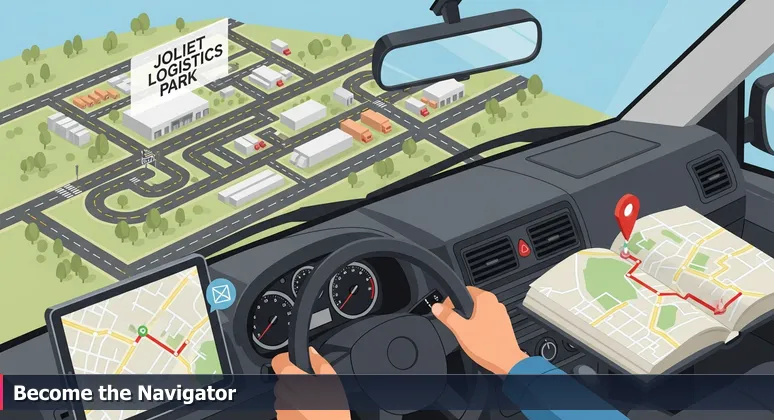
Every morning, as trucks begin their routes through the complex interchanges of I-55 and I-80 in the Joliet Logistics Park, a form of intelligence is already at work that no generic system can replicate. This gap between a simplistic digital map and the nuanced physical terrain is the perfect metaphor for starting an AI career here. The opportunity isn't about following a one-size-fits-all tech GPS; it's about becoming the navigator who can apply artificial intelligence to the specific, high-stakes landscape of Will County's economy.
While Chicago is a major tech hub, Joliet offers a distinct and powerful value proposition: Applied AI. Here, intelligence isn't abstract - it's operational. It's about optimizing a multi-million-dollar supply chain, predicting patient flow at Silver Cross Hospital, or automating a manufacturing line. The most sought-after professionals combine technical AI skills with deep domain expertise in the very industries where Joliet is a national leader.
The region's infrastructure is being supercharged for this future. A transformative development is the proposed Joliet Technology Center, a $20 billion data center campus specifically designed for AI and high-performance computing. This positions Joliet as a strategic headquarters, not just a cheaper alternative. Furthermore, roles mentioning AI skills in the Chicago-Joliet area command a significant premium, paying roughly 25% more (about $18,000 annually) than those that don't, according to local reporting.
With a lower cost of living, massive infrastructure investments, and unparalleled transportation links, Joliet provides the ideal terrain to launch a high-impact, financially savvy AI career rooted in real-world application.
In This Guide
- Joliet: Your 2026 AI Launchpad
- AI Job Landscape in Joliet for 2026
- Core Industries Fueling AI Growth
- Top AI Roles and Essential Skills
- Education and Training Pathways
- AI Salaries and Cost of Living Analysis
- Your 12-Month Plan to Start an AI Career
- Conclusion: Charting Your AI Journey
- Frequently Asked Questions
Nucamp has a strong presence in the Chicagoland area, with an active coding bootcamp community in Joliet that helps online learners connect with employers across Joliet and the surrounding southwest suburbs.
AI Job Landscape in Joliet for 2026
The AI job market in Joliet and the surrounding Chicago metro has matured and specialized, creating distinct opportunities tied directly to the region's economic pillars. According to an analysis of Chicago's tech workforce growth, demand is strongest for professionals who can bridge digital tools and physical industries like logistics and manufacturing.
This specialization is driven by Joliet's unique position as a global inland port and a hub for advanced industry. The shift is away from generic AI development toward what experts call "Industry-Focused AI," where success depends on applying and orchestrating systems within a specific domain. As AI strategist Depa notes in a 2026 career forecast, "Adaptability will become the new job security... the ability to adapt and change is going to be the most important component." In Joliet, adaptability means learning the language of local industry.
The core industries driving AI hiring locally include:
- Logistics, Transportation, & Fulfillment: As ground zero for AI-driven logistics, companies from Amazon to major rail operators seek talent for robotics, predictive modeling, and real-time freight optimization.
- Advanced Manufacturing & Industrials: The sector is undergoing a smart factory revolution, with a 70% talent shortage in robotics and automation creating high-opportunity roles in predictive maintenance and computer vision.
- Healthcare & Life Sciences: Local giants like Silver Cross Hospital invest in AI for clinical decision support and medical imaging, demanding specialists who understand healthcare data and workflows.
- Data Infrastructure: The transformative $20 billion Joliet Technology Center data campus will create roles in network engineering, cloud architecture, and MLOps to support massive AI computing workloads.
This landscape creates a clear runway for professionals who can pair technical AI skills with an understanding of Joliet's industrial terrain.
Core Industries Fueling AI Growth
Logistics, Transportation & Fulfillment
As a global inland port, Joliet is ground zero for AI-driven logistics. Amazon's multiple facilities are at the forefront, using AI for robotic warehouse automation, predictive supply chain modeling, and dynamic delivery routing. Beyond Amazon, major rail operators like Union Pacific and logistics firms seek talent for real-time freight forecasting and autonomous system management, making this sector a constant source of AI roles.
Advanced Manufacturing & Industrials
Joliet's manufacturing base is undergoing a smart factory revolution. Companies are hiring for robotics process automation, predictive maintenance, and computer vision for quality assurance. Research indicates that Robotics and Automation is the sector with the largest AI talent shortage at 70%, making it a high-opportunity field. Firms like Ecolab in Joliet exemplify this, hiring Data Engineers to build "cutting-edge AI for novel solutions" in an industrial context.
Healthcare & Life Sciences
Local healthcare giants like Silver Cross Hospital and major Chicago-based systems are investing heavily in AI for clinical decision support, medical imaging analysis, and patient readmission prediction. This creates demand for AI specialists who understand healthcare data privacy (HIPAA) and can translate clinical needs into technical solutions, applying models directly to improve patient outcomes and operational efficiency.
Data Infrastructure
A transformative development is the planned Joliet Technology Center, a proposed $20 billion data center campus designed specifically for AI and high-performance computing. This infrastructure project, highlighted by industry reports, will create jobs in network engineering, cloud architecture, and MLOps required to power and maintain the region's growing AI ecosystem, cementing Joliet's role as a critical data hub.
Top AI Roles and Essential Skills
Top In-Demand Roles for 2026
The AI skill set has evolved from building models in isolation to orchestrating systems that solve concrete business problems. According to LinkedIn’s analysis of 2026 trends, the shift is decisively toward "Industry-Focused AI." For Joliet, this means roles that interface directly with physical operations and local industry data are most critical.
- Machine Learning Engineer: The backbone role for building, deploying, and maintaining models in production, often for systems interacting with physical sensors and robots.
- AI Solutions Architect: Acts as the crucial translator between business leaders at a plant or hospital and technical teams, designing systems to meet specific operational goals.
- MLOps Engineer: Essential for streamlining the pipeline from model development to deployment and monitoring, ensuring reliability and scalability as local data infrastructure grows.
- Data Engineer: Builds the clean, accessible data pipelines that feed AI systems, a role critically in demand at data-heavy firms like Ecolab.
- AI Product Manager: Defines the vision for AI-powered features, balancing user needs, technical feasibility, and business objectives within local industries.
The 2026 Technical & Professional Skill Stack
Success requires a blend of non-negotiable technical fundamentals and new, application-oriented capabilities. The professional core remains proficiency in Python and libraries like PyTorch and TensorFlow.
The new essentials for 2026 include Prompt Engineering and LLM Orchestration to guide large language models, and Retrieval-Augmented Generation (RAG) for building applications that leverage a company's private data. Understanding AI Ethics & Safety is also paramount as AI integrates into critical local infrastructure and healthcare.
Ultimately, the Joliet Advantage Skill is Domain Expertise. As AI expert Chris Willis notes, professionals should aim to "fill in the blanks" that AI cannot, leveraging curiosity and deep knowledge of specific fields. In Joliet, this means developing fluency in supply chain logistics, manufacturing processes, or healthcare operations to effectively navigate and apply AI within the local terrain.
Education and Training Pathways
Building a career in applied AI doesn't require a four-year computer science degree from a top-tier university, but it does demand a structured, credible, and efficient path to skill acquisition. In 2026, aspiring professionals in Joliet have multiple effective on-ramps tailored to different learning styles and career stages.
Formal University Programs & State Initiatives
Local institutions provide strong theoretical foundations. Lewis University in nearby Romeoville offers degrees in Computer Science and Data Science, while Joliet Junior College (JJC) provides accessible associate degrees and certificates in Computer Information Systems, serving as an affordable starting point. JJC also hosts specific training events in data science. For those earlier in their journey, the Illinois Mathematics and Science Academy (IMSA) launched a free, online AI Credential for Illinois students, providing a fantastic primer.
Bootcamps & Accelerated Learning
This is where career-changers find the most direct route to market-ready skills. Quality bootcamps focus on the applied, project-based learning that local employers value. For example, Nucamp's AI Tech Entrepreneur Bootcamp is a 25-week program focusing on building AI-powered products and LLM integration, ideal for those looking to ship solutions. Its affordability - with programs from $2,124 to $3,980 - and flexible payment plans make it a practical option. Other regional providers like Illinois Valley Community College offer an AI Machine Learning Bootcamp with over 300 hours of training, often including preparation for industry certifications.
Self-Directed Learning & Industry Credentials
Disciplined learners can leverage online platforms to build fundamentals, but the key is to specialize early. Supplementing courses with industry micro-credentials is crucial. Pursuing certifications like the AWS Certified Machine Learning - Specialty, Microsoft Azure AI Engineer Associate (AI-102), or Google Cloud Professional Machine Learning Engineer validates skills in specific cloud platforms widely used by local enterprises and data centers, directly aligning with Joliet's growing tech infrastructure.
AI Salaries and Cost of Living Analysis
Pursuing an AI career in Joliet offers a compelling financial advantage when total cost of living is factored against salary potential. Data shows that roles mentioning AI skills in the Chicago-Joliet area can pay roughly 25% more (about $18,000 annually) than those that don't, according to local market analysis. Salaries are competitive, especially for roles requiring specialized industry knowledge.
| Role | Average Salary Range (Illinois) | Senior/75th Percentile |
|---|---|---|
| Machine Learning Engineer | $112,056 - $156,439 | Up to $194,700 |
| AI Engineer | $116,967 - $160,757 | ~$140,900 |
| Data Scientist | $65,674 - $110,000 | Up to $180,000 |
| Data Engineer | $84,000 - $125,000 | Varies by industry |
The true Joliet advantage emerges in the living calculus. Choosing Joliet as your base lets you command a strong Illinois tech salary while avoiding the steep costs of downtown Chicago. Housing costs are significantly lower, with median home prices and rents for modern apartments often hundreds less per month.
Transportation also favors the local professional. Many Joliet-based roles are hybrid or on-site at industrial parks, eliminating a costly daily commute into the Chicago Loop. When you need to network or interview downtown, you have direct access via the Metra Rock Island District line, I-55, and I-80, with easy connections to O'Hare and Midway airports. This combination of strong earnings power and lower living expenses creates a sustainable, high-quality lifestyle that is perfectly aligned with a focused AI career.
Your 12-Month Plan to Start an AI Career
Launching an AI career requires a strategic, phased approach. This 12-month plan is designed specifically for the Joliet landscape, transforming you from a curious beginner to a job-ready candidate in applied AI.
- Months 1-3: Foundation & Exploration. Begin by building core skills. Enroll in a foundational course like Nucamp's Web Development Fundamentals or a Python bootcamp if starting from zero. Concurrently, explore local industries by following employers like Silver Cross and the Will County Center for Economic Development on LinkedIn. Start networking by attending a virtual or in-person meetup with a Chicago-area tech group to listen for industry challenges.
- Months 4-8: Specialized Training & Portfolio. Commit to an intensive, career-focused program like a comprehensive AI/ML bootcamp. This is where you build the portfolio projects that become your new resume. Define your niche - such as "AI for predictive maintenance in manufacturing" - and apply your skills to a capstone project that solves a hypothetical problem for a Joliet-based company.
- Months 9-12: Job Search & Launch. Polish your portfolio and GitHub, tailoring your resume to highlight applied AI projects. Search strategically using filters for "Joliet," "Remote (IL)," and "Chicago" with keywords like "machine learning" and "automation." Leverage your local insight in interviews; speak knowledgeably about the Joliet Technology Center or specific logistics challenges. This domain expertise sets you apart from candidates with only generic technical skills.
This actionable roadmap turns the complex terrain of Joliet's industrial economy into a clear sequence of achievable steps, guiding you to become the navigator of your own AI career.
Conclusion: Charting Your AI Journey
The terrain of Joliet - with its weaving interchanges, sprawling fulfillment centers, and emerging data campuses - is complex, but for the skilled navigator, it's a map filled with unparalleled opportunity. Starting an AI career here in 2026 means trading the passive role of a passenger for the empowered role of a pilot, expertly steering transformative technology through the heart of American industry.
Your advantage is clear: a focus on Applied AI within leading sectors, a compelling salary-to-cost-of-living ratio, and direct access to infrastructure like the transformative Joliet Technology Center. As industry experts emphasize, success lies not in competing with AI, but in mastering how to apply it. The most valuable professionals will be those who, as AI strategist Chris Willis notes, learn to "fill in the blanks" that technology cannot, using deep domain knowledge to guide its application.
The path forward is no longer theoretical. With a structured 12-month plan, accessible training pathways like targeted bootcamps, and a growing local market, your journey from curiosity to career is actionable. The infrastructure is being built, the demand is real, and the unique navigation skills you develop here will be your greatest asset. Your launchpad is ready.
Frequently Asked Questions
Is starting an AI career in Joliet, IL a smart move for 2026?
Yes, Joliet offers a strategic advantage with applied AI in key industries like logistics and manufacturing, where roles such as data engineers at firms like Ecolab pay $84K-$125K. Combined with a lower cost of living than downtown Chicago and strong transportation links, it's an ideal launchpad for tech professionals.
What AI job opportunities are available in Joliet without needing to commute to Chicago?
Joliet has high demand for AI roles in logistics, healthcare, and manufacturing, with employers like Amazon and Silver Cross Hospital hiring for positions like Machine Learning Engineers. Salaries can range up to $156K, and the proposed $20 billion data center campus will create more local infrastructure jobs.
Do I need a four-year degree to break into AI in Joliet, or are there faster options?
No, bootcamps like Nucamp's AI/ML program provide efficient, practical training for career-changers, and local institutions like Joliet Junior College offer affordable courses. Employers often value hands-on skills and domain expertise in local industries over formal degrees.
How does the salary for AI work in Joliet compare to the overall cost of living?
AI professionals in the Chicago-Joliet area earn about 25% more on average, roughly $18,000 extra annually, while Joliet's housing costs are significantly lower than Chicago's. This balance allows for a higher quality of life with shorter commutes and more disposable income.
What's the best way to get started if I want to pursue an AI career in Joliet next year?
Begin by building foundational skills in Python through programs like Nucamp's bootcamp, then focus on networking with local industries like logistics or healthcare. Developing a portfolio with real-world projects tailored to Joliet's economic landscape will help you stand out in the job market.
Learn about strategic coworking spaces in Joliet for health IT in this comprehensive list.
See the high-placement AI bootcamps in Joliet for 2026 and their job connections.
Explore AI earnings in the Joliet-Chicago metro for 2026, including company tier effects.
Explore the top sectors employing AI experts in Joliet beyond big tech.
Discover tech career opportunities in Joliet, IL and how the city is evolving for 2026.

Irene Holden
Operations Manager
Former Microsoft Education and Learning Futures Group team member, Irene now oversees instructors at Nucamp while writing about everything tech - from careers to coding bootcamps.