









The Complete Guide to Using AI as a HR Professional in Indonesia in 2025
Last Updated: September 8th 2025
Too Long; Didn't Read:
In 2025 Indonesia, HR professionals use AI for predictive screening, onboarding automation, and personalized reskilling - 28% (5.9M) businesses used AI in 2024, national “nine million digital talents” push, projected AI market $10.88B by 2030; practical 15‑week course ($3,582).
For HR professionals in Indonesia in 2025, AI is no longer an experiment but a practical route to strategic people management: platforms like the Darwinbox case study on HR AI in Indonesia show how predictive screening and workforce analytics speed hiring and surface candidate success signals, while national initiatives to build “nine million digital talents” are pushing companies to pair tools with upskilling (Indonesia's digital talent push).
From chatbots that reduce onboarding admin to AI-driven personalized learning, the payoff is clearer decisions and more time for human-centred work; for HR teams wanting hands-on practice, the AI Essentials for Work bootcamp - practical AI skills for the workplace (15 Weeks) teaches tool use, prompt-writing, and on-the-job AI skills in 15 weeks.
| Program | Details |
|---|---|
| AI Essentials for Work | 15 Weeks; early-bird $3,582; syllabus: AI Essentials for Work syllabus (15 Weeks) |
| Registration | Register for AI Essentials for Work |
“AI can help us see employee competence, finding the weaknesses, who, and what to improve. So, this AI can speed up HR work and help be more detailed. We can also practice and continue upskilling because there will be more challenges in the future,” said Rainier Turangan.
Table of Contents
- How does Indonesia use AI? National landscape and sector adoption
- Core AI concepts HR professionals in Indonesia need to know
- How are HR professionals using AI? Recruitment and talent acquisition in Indonesia
- Onboarding, performance, and employee engagement with AI in Indonesia
- Designing the human-machine partnership for Indonesian HR teams
- Implementation roadmap for HR leaders in Indonesia: pilots, tools, and vendors
- Risks, ethics, and data protection for AI in Indonesian HR
- Upskilling, culture change, and the gotong royong approach in Indonesia
- Conclusion and future trends for HR and AI in Indonesia (2025+)
- Frequently Asked Questions
Upgrade your career skills in AI, prompting, and automation at Nucamp's Indonesia location.
How does Indonesia use AI? National landscape and sector adoption
(Up)Indonesia's AI story in 2025 reads like a national sprint: government strategy and giant cloud investments are wiring the country for scale while local startups and sector champions turn use cases into everyday tools for HR and beyond.
The National AI Strategy (2020–2045) and projects such as Sahabat‑AI for Bahasa and 700+ indigenous languages set a clear public direction for healthcare, education, food security and smart cities, while global players - from Microsoft's multi‑billion cloud commitments to NVIDIA's regional GPU hubs - are funding the infrastructure that makes applied AI possible; Introl's reporting even cites deployments of 1,024 H100 nodes and “more than 40,000 miles of fiber optic cable (enough to circle the Earth 1.6 times)” as concrete evidence of that build‑out (Introl Indonesia AI infrastructure deep-dive (2025)).
Adoption metrics vary by lens: AWS finds 5.9 million Indonesian businesses adopted AI in 2024 and 28% of firms have some AI use, while other measures highlight very high workplace uptake - illustrating a two‑tier landscape where startups and digital leaders push transformative models and many firms still focus on basic efficiency use cases (AWS research on AI adoption momentum in Indonesia (2025)).
For HR teams, that means a rich vendor ecosystem (chatbots, talent analytics, logistics and fintech tools), accelerating public digital services, and tangible opportunities to pair automation with reskilling rather than replace human judgement - an infrastructure‑plus‑policy moment that is already reshaping hiring, employee services and workforce planning across the archipelago (Indonesia National AI Strategy and Sahabat‑AI program overview).
| Metric | Value / Year | Source |
|---|---|---|
| Projected AI market (2030) | $10.88B | Introl Indonesia AI infrastructure report (2025) |
| Workplace AI adoption (reported) | 92% | Introl Indonesia AI infrastructure report (2025) |
| Businesses adopting AI (2024) | 5.9 million (28% of businesses) | AWS Indonesia AI adoption research (2025) |
| Estimated AI GDP contribution (2030) | $366B | Introl Indonesia AI infrastructure report (2025) |
“Indonesians are not just users of AI, but creators and innovators.”
Core AI concepts HR professionals in Indonesia need to know
(Up)HR teams in Indonesia should treat core AI concepts as practical tools, not abstract buzzwords: agentic AI - autonomous
agents
that can link tasks, make decisions, and even schedule coaching when gaps appear - moves beyond prompt‑response models to act on insights at scale (see Qualtrics primer on agentic AI for examples like detecting training gaps and predicting churn); generative AI and large language models (LLMs) create content and candidate communications fast (from drafting emails to role templates), while predictive AI turns historical HR data into forecasts for retention and workforce planning; and NLP/RAG pipelines let systems understand resumes, support chatbots, and surface the right documents for decisions.
Equally important are human‑in‑the‑loop controls and responsible AI guardrails - bias, data quality, and privacy risks must be managed so autonomy doesn't outpace accountability (Trend Micro outlines these risk tradeoffs).
Picture a digital foreman that quietly books a coaching session and nudges a hiring manager before a problem escalates -
“so what” moment: smarter, faster HR action without losing human judgement.
| Concept | Core feature | HR-relevant example (from research) |
|---|---|---|
| Agentic AI | Autonomous agents that plan, act, and learn | Detect training gaps and schedule coaching; predict spikes in churn (Qualtrics primer on agentic AI) |
| Generative AI / LLMs | Creates and refines text, code, and content | Draft candidate messages and role communications; power advanced assistants (Northeastern guide to generative AI, agentic AI, and large language models) |
| Predictive AI / NLP | Forecasts outcomes and extracts meaning from language | Forecast retention risks; summarize feedback and route issues for action (Qualtrics primer on agentic AI and Northeastern guide to generative AI and LLMs) |
For practical adoption, focus first on clear goals (reduce time‑to‑hire, improve retention signals), simple pilots, and safeguards that keep sensitive employee data protected and explainable.
How are HR professionals using AI? Recruitment and talent acquisition in Indonesia
(Up)In Indonesia, recruitment teams are leaning on AI to turn passive talent into hires rather than chasing inbound applicants: with studies showing about 70% of the workforce is passive and platforms like LinkedIn hosting some 700 million profiles, a smarter, tool-driven approach wins (start by knowing where your people live online).
Practical steps - identify niche sources (GitHub, Stack Overflow, Dribbble for designers), screen at scale, enrich contact details, then hyper-personalize outreach - are now automated by specialist tools; for example, HeroHunt passive candidate sourcing guide walks recruiters through the five-step playbook from targeted searches to relationship-building, while multichannel talent platforms and LinkedIn‑Recruiter alternatives like Findem LinkedIn Recruiter alternatives guide, SeekOut, and hireEZ consolidate sourcing, CRM and analytics so Indonesian HR teams can build quality pipelines without juggling spreadsheets.
For technical hires, automations that scan GitHub and summarize projects speed screening and enable truly personalized outreach that stands out in a crowded market - Kula's GitHub sourcing primer shows how to convert code contributions into meaningful conversation starters.
The payoff is measurable: fewer low-fit applicants, higher-quality conversations, and more time to sell employer value - so HR leaders in Indonesia can treat AI as an amplifier for thoughtful, relationship‑driven talent acquisition rather than a blunt replacement for recruiter craft.
Onboarding, performance, and employee engagement with AI in Indonesia
(Up)Onboarding, performance reviews, and day‑to‑day engagement in Indonesia are increasingly powered by AI that blends automation with local compliance: platforms like Darwinbox HR onboarding software in Indonesia deliver AI‑driven personalized journeys and predictive analytics to cut time‑to‑productivity, while HRMS vendors such as Asanify HRMS Indonesia payroll and BPJS automation automate critical local steps (auto BPJS registration, NPWP collection and payroll integration) so new hires can be legally onboarded before their first full day.
Message‑first tools and chatbots (Preppio's SMS and MS Teams integrations) lift engagement rates and completion - turning a stack of forms into short, scannable nudges - and agentic automations (UiPath demos) can stitch systems together to create pre‑hire profiles, confirm stakeholders and log execution summaries, speeding the entire cycle.
The result for Indonesian HR teams: fewer administrative bottlenecks, clearer performance signals from integrated OKRs and sentiment tracking, and more bandwidth to coach people - picture a new colleague whose paperwork, payroll, and first‑week learning path are all triggered automatically so managers can focus on human moments that actually matter.
| Tool | What it helps | Indonesia‑specific benefit |
|---|---|---|
| Darwinbox | AI‑driven onboarding, personalized workflows | Predictive analytics and mobile workflows for faster time‑to‑productivity |
| Asanify | HRMS with payroll, attendance, onboarding automation | Auto BPJS/NPWP registration and payroll/THR compliance |
| Preppio | Chatbot + SMS onboarding journeys | High engagement via MS Teams/SMS; faster task completion |
| UiPath (agentic) | Agentic onboarding automations | Integrates HR systems (Workday) to create pre‑hire profiles and logs |
“Preppio's chatbot and SMS deliver 90% read rates, significantly more than using email. Onboarding surveys prove it's a success - most employees rating it 5/5.”
Designing the human-machine partnership for Indonesian HR teams
(Up)Designing the human‑machine partnership for Indonesian HR teams means starting with clear purpose, pragmatic pilots, and rules that protect people first: map which tasks machines should own (scalable reporting, predictive flags) and which must remain human (coaching, judgement, cultural nuance), then redesign roles so middle managers become coaches rather than paper pushers.
Local reality matters - infrastructure and digital skills vary across the archipelago - so pair high‑impact pilots in urban hubs with targeted reskilling and ecosystem partnerships to spread capability through gotong royong; see the practical playbook for HR leaders in Training Indonesia's guidance on role redesign and ethical adoption (Training Indonesia: Indonesian HR strategy to optimize AI adoption).
Guardrails are essential: research on Indonesian HR analytics cautions against treating machines as a human replacement and underscores human‑in‑the‑loop oversight (SSRN case study: Indonesian Genose HR analytics and human-in-the-loop oversight), while public‑sector experience shows that patchy broadband and talent gaps (15.03% broadband penetration; ranked 60th on ICT readiness) shape realistic rollouts (Modern Diplomacy: AI in Indonesian public services case study).
The most effective design pairs small, measurable wins (faster onboarding, clearer retention signals) with transparent algorithms, privacy controls, and a culture that rewards experimentation - imagine a system that flags a coaching need and nudges a manager, freeing human time for the conversation that truly changes outcomes.
| Indicator | Value / Context | Source |
|---|---|---|
| Reskilling need (global estimate) | 40% of workforce may need reskilling (IBM IBV cited) | Training Indonesia: Indonesian HR strategy to optimize AI adoption |
| Broadband penetration (2023) | 15.03% nationally | Modern Diplomacy: AI in Indonesian public services case study |
| ICT readiness rank | ~60th globally (AI skills gap noted) | Modern Diplomacy: AI in Indonesian public services case study |
“AI can help us see employee competence, finding the weaknesses, who, and what to improve. So, this AI can speed up HR work and help be more detailed. We can also practice and continue upskilling because there will be more challenges in the future,” said Rainier Turangan.
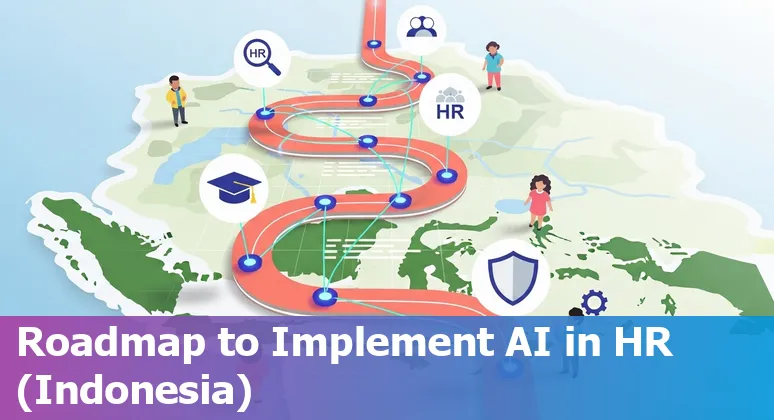
Implementation roadmap for HR leaders in Indonesia: pilots, tools, and vendors
(Up)Turn strategy into steps: begin with a tightly scoped pilot that maps a single value stream (HR or IT) to a clear business outcome - hire faster, improve first‑month retention, or automate a promotion workflow - and run the pilot as a time‑boxed experiment with defined success metrics and a human‑in‑the‑loop fallback; Training Indonesia recommends this
prioritize with clear purpose
approach and shows how digital workers can free managers from paperwork so they can coach instead (Training Indonesia HR strategy to optimize AI in the workplace).
Build an adaptive operating model around those pilots (cross‑functional squads, process mining to spot bottlenecks) and treat reskilling as part of the budget - not an afterthought - especially given IBM IBV's finding that many roles will need reskilling in the near term.
Use national partnerships and funding opportunities: Indonesia's Global Accelerator roadmap (endorsed 10 June 2025) prioritizes human capital development, apprenticeships and sectoral skills councils, making it a natural axis for scaling successful pilots with UN or ministry partners (Indonesia Global Accelerator roadmap for human capital development (Joint SDG Fund)).
Finally, pick vendor types that match the pilot (sourcing platforms like SeekOut for niche hires, onboarding automation, and upskilling partners), measure impact, iterate, and document lessons so wins can be scaled across regions in the spirit of gotong royong (SeekOut deep sourcing guide for HR professionals).
| Step | Focus | Source |
|---|---|---|
| Pilot with clear purpose | One value stream, defined KPIs, human‑in‑loop | Training Indonesia HR strategy to optimize AI in the workplace |
| Adaptive operating model | Cross‑functional squads, process mining | Training Indonesia HR strategy to optimize AI in the workplace |
| Reskilling & partnerships | Invest in talent; leverage Global Accelerator programmes | Indonesia Global Accelerator roadmap for human capital development (Joint SDG Fund) |
| Tools & vendors | Sourcing, onboarding automation, upskilling partners | SeekOut deep sourcing guide for HR professionals |
Risks, ethics, and data protection for AI in Indonesian HR
(Up)For HR teams in Indonesia, the rush to adopt AI must run alongside rigorous data protection and ethics work: the Personal Data Protection Law (PDP Law) now applies across sectors and makes records of processing (RoPA), lawful bases for use, and Data Protection Impact Assessments mandatory for high‑risk or sensitive HR uses such as health or biometric screening (Indonesia Personal Data Protection Law (PDP Law) summary).
Practical implications are concrete - automated hiring decisions trigger data‑subject rights (including the right to object to automated decisions), cross‑border transfers require adequacy, safeguards or consent, and a Data Protection Officer is compulsory in large‑scale or sensitive processing scenarios - so HR must plan who signs off, how DPIAs are run, and how logging and ROPA will be maintained.
Breach rules are strict: controllers must notify regulators quickly (within 72 hours) and alert affected employees (within days), while enforcement ranges from administrative fines (up to a percentage of annual revenue) to criminal penalties and heavy fines for unlawful disclosure - turning any careless spreadsheet into a costly, time‑bound compliance incident.
Pair these legal duties with Indonesia's AI ethics guidance (emphasising fairness, transparency and Pancasila values) to design recruitment and monitoring systems that protect workers' rights while preserving the human judgement that should always sit alongside automated flags (Indonesia data privacy and AI ethics landscape overview).
| Obligation | Key detail |
|---|---|
| Breach notification to authority | Within 72 hours (notify PDP Agency / KOMDIGI interim) |
| Notification to data subjects | Prompt - regulators note notification within days (e.g., 14 calendar days guidance) |
| DPO requirement | Mandatory for public service, large‑scale monitoring, or large‑scale sensitive data processing |
| Cross‑border transfers | Require adequacy, appropriate safeguards, or prior consent |
| Enforcement | Administrative fines (e.g., up to ~2% of annual income) and criminal penalties (up to yrs imprisonment and multi‑billion IDR fines) |
Upskilling, culture change, and the gotong royong approach in Indonesia
(Up)Upskilling in Indonesia must marry technical training with a culture shift - think gotong royong at scale - so HR teams scale learning while protecting local context: targeted programs, incentives for language skills, and AI‑powered learning platforms are core components of that mix (see Kadin's work on AI‑driven English proficiency and ELSA collaboration for practical approaches to reach remote learners and push toward the long‑term goal of raising national language readiness Kadin AI-driven English proficiency program for remote learners (ELSA collaboration)).
National initiatives like STEM Indonesia Cerdas - a Rp 500 billion push to deliver AI and STEM education to 10 million students - give HR leaders a pipeline of digitally literate hires and community partners to scale pilots beyond Jakarta (STEM Indonesia Cerdas Rp 500 billion AI and STEM initiative to reach 10 million students).
Practically, HR should combine cross‑functional learning squads, external providers and local mentors so managers are trained as coaches, not approvers; Training Indonesia's human‑centred playbook shows how small wins, transparent incentives and ecosystem partnerships spread capability in the spirit of gotong royong while keeping reskilling budgets explicit and measurable (Training Indonesia human-centred HR strategy for AI adoption and reskilling).
The immediate “so what?”: a measurable pathway - short, role‑specific pods, language micro‑credentials, and vendor partnerships - turns AI curiosity into workforce readiness that can reach millions, not just a few urban teams.
Conclusion and future trends for HR and AI in Indonesia (2025+)
(Up)Conclusion: Indonesia's HR future is a practical blend of human judgement, targeted pilots, and scalable AI - not a techno‑utopia. Training Indonesia's playbook argues HR must prioritise clear purpose, adaptive operating models, and equal investment in people and platforms to turn automation into strategic capacity (Training Indonesia: Indonesian HR strategy to optimize AI in the workplace); at the same time, market trends point to hyper‑personalisation and agentic assistants that proactively close skill gaps and streamline routine work, freeing managers to coach (see the rise of AI‑driven personalization in 2025 and agentic AI trends via TMS Consulting and dentsu).
Practical next steps for Indonesian HR leaders: run a time‑boxed pilot with human‑in‑the‑loop safeguards, measure retention and time‑to‑productivity gains, invest in short role‑specific reskilling pods, and partner with ecosystem providers so wins spread in the spirit of gotong royong.
For teams that need hands‑on practice, structured training like the AI Essentials for Work syllabus (15-week bootcamp) turns prompts and tools into repeatable workplace skills and measurable ROI. Imagine a hiring manager nudged by a concise, context‑rich coaching prompt instead of buried paperwork - small, measurable shifts like that are the clearest indicator that AI is amplifying human work, not replacing it.
| Program | Length | Early‑bird Cost | Register / Syllabus |
|---|---|---|---|
| AI Essentials for Work | 15 Weeks | $3,582 | Register for AI Essentials for Work | AI Essentials for Work syllabus |
“AI can help us see employee competence, finding the weaknesses, who, and what to improve. So, this AI can speed up HR work and help be more detailed. We can also practice and continue upskilling because there will be more challenges in the future,” said Rainier Turangan.
Frequently Asked Questions
(Up)How are HR teams in Indonesia using AI in 2025 and what measurable benefits can they expect?
By 2025 Indonesian HR teams use AI across recruitment, onboarding, performance and learning: predictive screening and talent analytics speed hiring and surface success signals; chatbots and SMS onboarding cut admin and lift completion rates; agentic automations stitch systems to create pre‑hire profiles and schedule coaching. Adoption metrics in the article include 5.9 million businesses using AI in 2024 (about 28% of firms), a reported 92% workplace AI adoption in some measures, and market projections of roughly $10.88B (2030) with an estimated AI GDP contribution of $366B by 2030. Expected payoffs are faster time‑to‑hire, higher‑quality pipelines, reduced time‑to‑productivity, clearer retention signals and more bandwidth for human‑centred coaching.
What core AI concepts should HR professionals understand and what safeguards are essential?
Key concepts to treat as practical tools include: agentic AI (autonomous agents that plan and act, e.g., scheduling coaching or closing skill gaps), generative AI/LLMs (drafting candidate messages, role templates), predictive AI and NLP (forecast retention, extract meaning from resumes/feedback), and RAG pipelines for document retrieval. Safeguards: human‑in‑the‑loop oversight, bias and fairness checks, data quality controls, explainability for automated recommendations, and privacy protections to prevent misuse of sensitive employee data. Start with clear goals, small pilots, and explicit fallback processes so autonomy never outpaces accountability.
What are the legal and compliance requirements HR must follow under Indonesia's data protection and AI guidance?
HR uses of AI that process personal or sensitive employee data must follow the Personal Data Protection Law (PDP Law) and Indonesia's AI ethics guidance. Practical obligations include maintaining Records of Processing (RoPA), performing Data Protection Impact Assessments (DPIAs) for high‑risk HR use (health, biometrics, automated hiring), and identifying a Data Protection Officer for large‑scale or sensitive processing. Controllers must notify authorities of breaches promptly (within 72 hours) and inform affected data subjects quickly (guidance often cites notification within days or ~14 calendar days). Cross‑border transfers require adequacy, safeguards or consent. Noncompliance can trigger administrative fines (a percentage of revenue) and criminal penalties, so logging, DPIAs and lawful bases for automated decisions are essential.
How should HR leaders begin implementing AI - what roadmap, pilots and vendor types work best?
Begin with a tightly scoped, time‑boxed pilot that maps one value stream to a measurable business outcome (reduce time‑to‑hire, improve first‑month retention, or automate a promotion workflow) and include human‑in‑the‑loop fallbacks. Build an adaptive operating model (cross‑functional squads, process mining), measure defined KPIs, and treat reskilling as budgeted work. Leverage national partnerships and accelerator programmes to scale successful pilots. Choose vendor types to match the pilot: sourcing platforms (SeekOut, hireEZ) for niche hiring, onboarding automation (Darwinbox, Asanify, Preppio) for local compliance (BPJS/NPWP/THR), agentic automation platforms (UiPath) to integrate systems, and upskilling providers for role‑specific learning. Document lessons and iterate to spread wins across regions.
What practical upskilling options exist for HR teams and what training is recommended for hands‑on practice?
Upskilling should combine short, role‑specific pods, language micro‑credentials, and vendor or government partnerships to reach beyond urban centres. National initiatives (STEM Indonesia Cerdas, Global Accelerator) expand pipelines and community partners. For hands‑on practice, structured programs that teach tool use, prompt‑writing and on‑the‑job AI skills are recommended; the article highlights a 15‑week 'AI Essentials for Work' program (early‑bird cost cited at $3,582) as an example of turning prompts and tools into repeatable workplace skills with measurable ROI. Pair technical training with manager coaching training to shift culture toward gotong royong and human‑centred workflows.
Learn how we chose high-impact, low-cost prompts with practical data criteria in the Prompt selection methodology.
Align hiring, learning and performance with the ClearCompany talent management suite and its AI Course Builder to close skill gaps.
Find out why AI literacy for HR professionals is now a must-have skill for HR careers in Indonesia.

Ludo Fourrage
Founder and CEO
Ludovic (Ludo) Fourrage is an education industry veteran, named in 2017 as a Learning Technology Leader by Training Magazine. Before founding Nucamp, Ludo spent 18 years at Microsoft where he led innovation in the learning space. As the Senior Director of Digital Learning at this same company, Ludo led the development of the first of its kind 'YouTube for the Enterprise'. More recently, he delivered one of the most successful Corporate MOOC programs in partnership with top business schools and consulting organizations, i.e. INSEAD, Wharton, London Business School, and Accenture, to name a few. With the belief that the right education for everyone is an achievable goal, Ludo leads the nucamp team in the quest to make quality education accessible