









Top 5 Jobs in Retail That Are Most at Risk from AI in Gainesville - And How to Adapt
Last Updated: August 19th 2025
Too Long; Didn't Read:
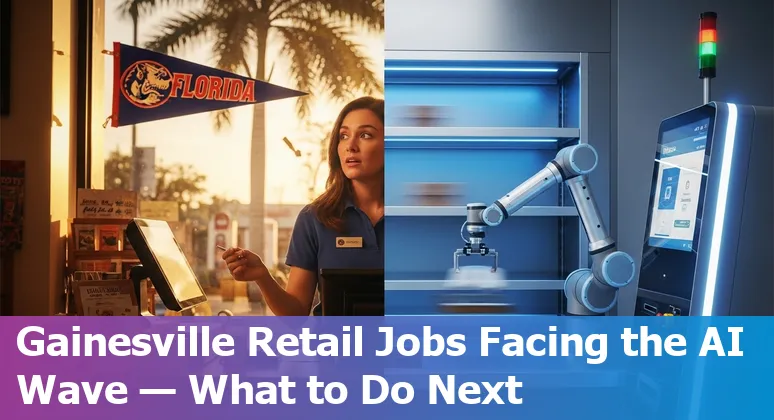
Gainesville retail roles most at risk from AI include cashiers, customer service reps, inventory associates, cash-office admins, and routine sales - studies show generative AI could automate ~40–60% of tasks, cashier jobs may drop ~10% (2021–2031), and 95% of service chats could be AI by 2025.
Gainesville retail workers should watch AI because nationwide tools - AI shopping assistants, hyper-personalization, smart inventory and dynamic pricing - are already changing how customers buy and how stores run, from demand forecasts for game days and storms to automated repricing on crowded items (Insider report on AI shopping assistants and smart inventory trends).
Generative approaches can shift work patterns fast: industry research finds generative AI could automate roughly 40–60% of routine store tasks, meaning roles that handle repetitive checkout, restocking or price checks are most exposed (Oliver Wyman study on generative AI and retail task automation).
The practical takeaway: upskilling pays - Nucamp's 15-week AI Essentials for Work bootcamp teaches prompts, tools, and job-based AI skills so Gainesville associates can move from vulnerable tasks into AI-augmented, higher-value store roles (Nucamp AI Essentials for Work registration).
| Attribute | AI Essentials for Work |
|---|---|
| Description | Gain practical AI skills for any workplace; use AI tools, write prompts, and apply AI across business functions |
| Length | 15 Weeks |
| Courses included | AI at Work: Foundations; Writing AI Prompts; Job Based Practical AI Skills |
| Cost | $3,582 early bird; $3,942 regular (paid in 18 monthly payments) |
| Syllabus / Registration | AI Essentials for Work syllabus | AI Essentials for Work registration |
“After years of profit challenges due to e-commerce, retailers are now finding the right mix of in-store and online operations,” says Simeon Gutman.
Table of Contents
- Methodology: How We Picked the Top 5 Retail Jobs at Risk
- Retail Cashiers / Checkout Clerks - Risk and Next Steps
- Customer Service Representatives (In-store & Contact Centers) - Risk and Next Steps
- Inventory Associates / Stockroom & Merchandising Roles - Risk and Next Steps
- Cash Office & Basic Retail Administrative Staff - Risk and Next Steps
- Sales Associates Focused on Routine Upselling - Risk and Next Steps
- Conclusion: Practical Next Steps for Gainesville Retail Workers
- Frequently Asked Questions
Learn how computer vision for loss prevention in Gainesville stores reduces shrink and improves safety across retail locations.
Methodology: How We Picked the Top 5 Retail Jobs at Risk
(Up)Methodology: roles were selected by triangulating three rigorously documented signals: empirical task-level AI performance from Microsoft Research's occupational study (200,000 anonymized Copilot conversations mapped to O*NET activities), industry-proven retail use cases showing where AI is already replacing or augmenting store tasks, and local Gainesville retail dynamics such as game-day demand spikes and storm-driven inventory shifts.
Priority went to occupations with high AI applicability scores and strong task overlap - customer service reps (applicability ~0.44) and sales roles (~0.46) rank especially high - because the study measures not just capability but task completion rates and scope of impact, which predict real workplace disruption (Microsoft Research occupational AI applicability study (200k Copilot conversations)).
Retail-specific deployments - instant product recommendations, AI agents for store staff, and automated inventory/price signals described by Microsoft's retail workstreams - were used to flag checkout, stocking, basic admin, and routine upselling tasks as most exposed (Microsoft Retail Ready agentic AI use cases for retail), while local examples like inventory forecasting and dynamic pricing for Gainesville game days sharpened the “so what”: workers in repetitive in-store tasks should expect faster task-shifts and should target AI-augmented skills to stay indispensable (Inventory forecasting tuned to Gainesville events and weather - retail AI use cases).
| Method element | Key detail |
|---|---|
| Primary dataset | 200,000 Copilot conversations (Microsoft Research) |
| Core metric | AI Applicability Score; task completion rates & scope of impact |
| High-risk examples | Customer service (~0.44), Sales (~0.46) |
| Local signal | Gainesville inventory & dynamic pricing around UF game days/storms |
“Our research shows that AI supports many tasks, particularly those involving research, writing, and communication, but does not indicate it can fully perform any single occupation. As AI adoption accelerates, it's important that we continue to study and better understand its societal and economic impact.”
Retail Cashiers / Checkout Clerks - Risk and Next Steps
(Up)Retail cashiers in Gainesville face concentrated exposure: nationwide analyses show cashier employment is already shrinking (a projected 10% drop from 2021–2031) and cashiers rank among the highest-risk roles for automation, with routine scanning and payments increasingly handled by AI-driven, checkout-free systems - so the job isn't just changing, it's being redefined (Zippin checkout-free retail systems and job evolution; JobRipper cashier automation and transition strategies).
For Gainesville workers the practical next steps are concrete: learn basic digital-payment and self-checkout troubleshooting, build customer-experience skills (conflict resolution, upselling that requires judgment), and pursue short certificates - examples listed in industry guidance include retail customer-service and digital literacy courses - to move into floor-support, tech-assist, or inventory roles that AI is less likely to replace (AI in retail grocery enabling customer engagement).
One memorable metric: because women hold a large share of cashier jobs, local retraining programs that target digital and interpersonal skills can meaningfully protect household incomes around UF game-day and storm-driven demand spikes.
"This in-depth examination of retail automation gives investors insights as they consider investment risks and opportunities... The shrinking of retail jobs threatens to mirror the decline in manufacturing in the U.S. Workers at risk are disproportionately working poor, potentially stressing social safety nets and local tax revenues."
Customer Service Representatives (In-store & Contact Centers) - Risk and Next Steps
(Up)Customer service representatives in Gainesville face rapid change as AI chatbots and virtual assistants take on routine inquiries - order tracking, returns, and FAQs - freeing human staff for complex, emotional, or escalated cases but reducing demand for one-to-one handling of simple tasks; Wavetec notes AI improves response times and personalization, while industry reporting projects that by 2025 roughly 95% of customer service interactions may be AI-powered, underscoring how quickly call-center and in-store contact roles can shift (Wavetec analysis of AI impact on retail customer service, Tomorrowdesk report on retail and AI trends).
Practical next steps for Gainesville workers: prioritize AI-collaboration skills (prompting, data interpretation), emotional intelligence for high-value interactions, and short technical certificates so staff can operate and supervise bots during UF game-day surges or storm-driven demand spikes - local forecasting and staffing tools can make those transitions measurable and timely (Inventory forecasting tuned to Gainesville events and retail AI use cases).
The so-what: when routine chats move to bots, representatives who combine tech literacy with human problem-solving become the most hireable talent in-store and at contact centers.
| Metric | Value |
|---|---|
| Companies using chatbots | 74% (reported) |
| Projected AI-powered interactions by 2025 | 95% (Gartner projection) |
| Workers already displaced (reported) | 14% |
“By relieving employees of monotonous tasks, AI enables them to pursue more fulfilling work that improves the customer experience.”
Inventory Associates / Stockroom & Merchandising Roles - Risk and Next Steps
(Up)Inventory associates and stockroom merchandisers in Gainesville should expect faster, narrower roles as robotics and AI move routine picking, scanning and cycle counts into machines: industry reports show nearly 50% of large warehouses will deploy robotic systems by the end of 2025 and facilities often see a 25–30% efficiency boost in the first year, meaning repetitive shelf-to-pick tasks are the most exposed (RaymondHC warehouse robotics adoption and benefits report).
Robots and AMRs already handle frequent scanning and auditing with higher accuracy, which reduces return processing and stock discrepancies, so the practical “so what” is immediate - Gainesville associates who learn WMS workflows, RFID/barcode auditing, basic AMR/cobot troubleshooting, and inventory-forecasting signals (especially around UF game days and storm events) can shift into higher-value roles that supervise automation rather than compete with it (automation and inventory best practices for supply chains; Gainesville inventory forecasting for retail events and weather).
Employers usually phase in robots and - when done well - train staff early, so targeted short courses in robotics operation, preventive maintenance, and inventory analytics offer the clearest path to protected hours and better pay.
| Metric | Value |
|---|---|
| Large-warehouse robotics adoption (by end 2025) | Nearly 50% (RaymondHC) |
| Operational efficiency increase (first year) | 25–30% (RaymondHC) |
| Reported productivity gains | Up to 50% (McKinsey, cited in RaymondHC) |
“Move more, faster, with less cost.”
Cash Office & Basic Retail Administrative Staff - Risk and Next Steps
(Up)Cash-office and basic retail admin roles in Gainesville - till reconciliations, deposit batching, invoice entry, payroll prep and simple compliance checks - are among the most exposed as AI moves from proof-of-concept into everyday finance: AI already automates invoice processing, transaction categorization, and reconciliations, cutting errors and turnaround time that once required manual checks (AI bookkeeping automation for invoice processing and reconciliation); payroll systems now handle timesheet processing, tax calculations and anomaly detection with machine-learning assist, reducing repetitive payroll tasks (AI payroll automation and machine learning for payroll).
For Gainesville stores that tighten cash flows around UF game days and storm-driven demand, the practical “so what” is stark: vendors and auditors report invoice error rates dropping as much as 85% and operational efficiency rising up to ~50% when AI workflows are adopted, which directly reduces hours spent on routine reconciliations and shifts employer demand toward oversight, exception-handling, and compliance roles.
Next steps: learn core AI-enabled bookkeeping tools, train to validate model outputs and flag anomalies, pursue short certificates in bookkeeping/payroll tools, and insist on roles that combine finance fundamentals with AI supervision - those skills buy the best protection against displacement while keeping local paychecks secure.
“Current and emerging generations of GenAI tools could be transformative... deep research capabilities, software application development, and business storytelling will impact professional work.”
Sales Associates Focused on Routine Upselling - Risk and Next Steps
(Up)Sales associates who depend on scripted, routine upselling - recommendations like “do you want the warranty?” or fixed add-ons - face clear exposure as AI drives hyper-personalized suggestions both online and in-store: AI decision engines and on‑demand creative generation let retailers deliver tailored product prompts at scale, improving ad and offer performance and reducing the need for one-size-fits-all pitches (Bain report on AI-powered retail personalization).
The business signal is concrete: AI-powered recommenders already drive large shares of purchases in major retail cases - recommender systems are credited with powering up to 35% of Amazon's sales - so routine cross-sell scripts can be replicated by apps, kiosks, and digital signage that surface the right add-on at the right moment (VisionX article on AI product recommendation impact).
For Gainesville specifically, where UF game days and storm-driven demand create predictable spikes, expect retailers to tune offers and pricing dynamically; the practical next steps for associates are to learn to read and act on AI suggestions, master consultative selling that adds judgment beyond an algorithm, and cross-train on personalization/CRMs and exception-handling so pay and hours shift toward supervising AI-driven upsells rather than repeating them (Gainesville dynamic pricing and staffing use cases for retail AI).
| Metric | Value / Source |
|---|---|
| Return on ad spend lift from personalization | 10–25% (Bain) |
| Share of purchases from recommender systems | ~35% (VisionX / Amazon example) |
| Case revenue uplift from AI platform | ~18% (Acropolium case study) |
Conclusion: Practical Next Steps for Gainesville Retail Workers
(Up)Practical next steps for Gainesville retail workers: treat AI like a new coworker and learn the skills it won't fully replace - prompting and AI collaboration, basic self-checkout and payments troubleshooting, inventory-forecast interpretation for UF game days and storms, and exception-handling in finance and sales; those moves make scheduling and pay more secure when stores tune staffing and offers with algorithms.
Start small: a short, focused course in AI-at-work skills or bookkeeping tools, cross-train on RFID/WMS basics, and practice consultative selling that adds judgment beyond algorithmic recommendations.
Employers are already planning bigger AI investments - more than 80% of retailers intend to increase AI this year - so quicker adopters gain the best protection and bargaining power (Retailers to Embrace AI in 2025 - Honeywell survey on retail AI adoption); local, practical prompts and forecasting examples can be learned now to protect hours during game-day surges (Gainesville retail inventory forecasting and AI use cases).
For hands-on, job-focused training that maps directly to store tasks, consider Nucamp's 15-week AI Essentials for Work bootcamp to learn prompts, tools, and job-based AI skills employers need (AI Essentials for Work registration and enrollment).
| Attribute | AI Essentials for Work |
|---|---|
| Description | Gain practical AI skills for any workplace; use AI tools, write prompts, and apply AI across business functions |
| Length | 15 Weeks |
| Courses included | AI at Work: Foundations; Writing AI Prompts; Job Based Practical AI Skills |
| Cost | $3,582 early bird; $3,942 regular (paid in 18 monthly payments) |
| Syllabus / Registration | AI Essentials for Work syllabus and curriculum | AI Essentials for Work registration |
“We are truly in the midst of a new era for the retail sector where evolving AI capabilities will make a positive impact on the shopper's journey, the employee experience and the retailer's supply chain operation. On their journey toward autonomous operations, retailers are looking for AI and automation solutions that provide actionable data and help to upskill their employees.”
Frequently Asked Questions
(Up)Which retail jobs in Gainesville are most at risk from AI?
The article identifies five high-risk roles: retail cashiers/checkout clerks, customer service representatives (in-store and contact centers), inventory associates/stockroom & merchandising roles, cash office and basic retail administrative staff, and sales associates who rely on routine upselling. These roles are exposed because AI and automation can handle repetitive checkout tasks, routine inquiries, robotic picking and cycle counts, invoice and payroll processing, and scripted cross-sell prompts.
What evidence and methodology were used to pick the top 5 at-risk retail jobs?
Selections were made by triangulating three signals: Microsoft Research's dataset of ~200,000 Copilot conversations mapped to O*NET activities (yielding AI applicability scores and task completion rates), observed retail AI use cases (instant product recommendations, AI agents, automated inventory/pricing), and local Gainesville dynamics such as UF game-day and storm-driven inventory and pricing shifts. Priority went to occupations with high AI applicability and strong task overlap (e.g., customer service ~0.44, sales ~0.46).
What practical steps can Gainesville retail workers take to adapt and reduce displacement risk?
Recommended actions include upskilling on AI-collaboration (prompting, interpreting AI outputs), learning technical basics (self-checkout troubleshooting, WMS/RFID, AMR/cobot basics), pursuing short certificates in customer service, digital literacy, bookkeeping/payroll, or inventory analytics, and developing human-centered skills (emotional intelligence, consultative selling, exception-handling and oversight). These moves help workers transition into AI-augmented supervisory or higher-value roles.
How quickly could AI change retail job tasks and what local factors speed change in Gainesville?
Industry research suggests generative AI could automate roughly 40–60% of routine store tasks, and projections show rapid adoption of chatbots and robotics (e.g., nearly 50% large-warehouse robotics by end of 2025). Local factors - UF game-day demand spikes and storm-driven inventory fluctuations - accelerate adoption of dynamic pricing, inventory forecasting, and automated workflows, making task shifts and scheduling changes more immediate for Gainesville stores.
What training does the article recommend and how does Nucamp's AI Essentials for Work help?
The article recommends short, job-focused training in prompting, AI tools, digital payments/self-checkout troubleshooting, inventory forecasting, robotics basics, and bookkeeping/payroll tools. Nucamp's AI Essentials for Work is a 15-week bootcamp (courses: AI at Work: Foundations; Writing AI Prompts; Job Based Practical AI Skills) designed to teach prompts, tools, and job-based AI skills. Early bird cost is $3,582; regular price $3,942 (payable in 18 monthly payments).
Simplify shopping with a Visual search for image-based SKU matching that turns photos into exact product matches and complements.
Discover how AI-driven personalization for Gainesville shoppers can boost sales during UF game days and local festivals.

Ludo Fourrage
Founder and CEO
Ludovic (Ludo) Fourrage is an education industry veteran, named in 2017 as a Learning Technology Leader by Training Magazine. Before founding Nucamp, Ludo spent 18 years at Microsoft where he led innovation in the learning space. As the Senior Director of Digital Learning at this same company, Ludo led the development of the first of its kind 'YouTube for the Enterprise'. More recently, he delivered one of the most successful Corporate MOOC programs in partnership with top business schools and consulting organizations, i.e. INSEAD, Wharton, London Business School, and Accenture, to name a few. With the belief that the right education for everyone is an achievable goal, Ludo leads the nucamp team in the quest to make quality education accessible