









How to Become an AI Engineer in Gabon in 2026
By Irene Holden
Last Updated: April 14th 2026
Quick Summary
Becoming an AI engineer in Gabon by 2026 requires a 24-month journey of mastering Python, math, and AI skills through structured pathways like Nucamp's 25-week bootcamp for 2.4 million XAF. Focus on building a portfolio with projects for local industries such as energy and telecom in Libreville and Port-Gentil, and network at events like Artificial Intelligence Days 2026 to connect with major employers like TotalEnergies.
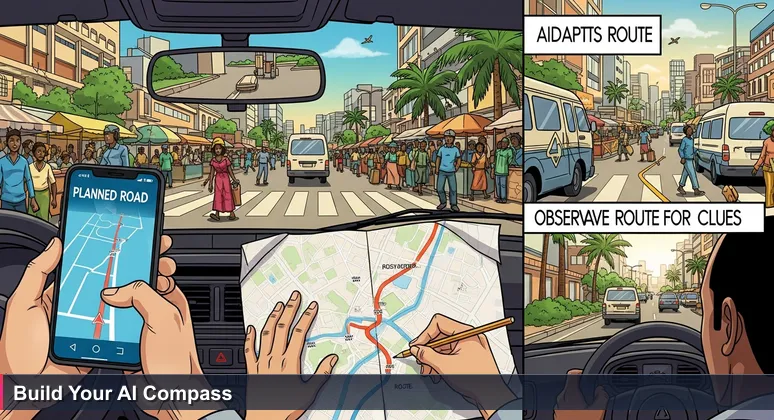
You’re at the wheel, staring at a navigation app that shows a perfect route down Boulevard Triomphal. Yet, the reality is a vibrant blockade of market stalls and minibuses. The first step to becoming an AI engineer in Gabon is recognizing that global tutorials are like that foreign GPS; they give direction but fail without local knowledge. Your real work begins by mastering the universal tools and immediately applying them to the terrain right outside your window.
Your Non-Negotiable Foundation: Python and Git
Fluency in Python is the non-negotiable starting point, as it is the lingua franca of AI and data science. Rushing into advanced libraries without a firm grasp of fundamentals like loops, functions, and object-oriented programming is a critical error that will cripple you later. Simultaneously, learning Git and GitHub for version control is essential for professional collaboration, a skill demanded by employers from BGFIBank to startups in Libreville's emerging tech scene.
Pro Tip: Avoid "tutorial hell." As one expert cautions, "the number of courses you have completed is a bad signal; the number of projects you have actually shipped is a good one." Your key milestone in this first month should be a script that automates a tangible, local task.
Practice on Gabon's Data Landscape
Move from abstract exercises to concrete practice by exploring Gabon's own data. Use your new Python skills with pandas to manipulate datasets from portals like Open Data Gabon. A practical project could involve scraping and consolidating publicly available economic indicators or simulating the organization of forestry reports from different provinces. This grounds your learning in a context that future employers in Port-Gentil or Libreville will immediately recognize and value.
By dedicating 15-20 hours a week, you can build this core competency within a month. This foundational step is your investment in a skillset that commands a premium; junior AI roles in Gabon can see salaries starting around 6,000,000 XAF, with a significant boost for those who demonstrate practical, locally-relevant project experience from day one.
Steps Overview
- Master Python and Core AI Tools
- Build a Strong Mathematical Foundation
- Learn Essential Machine Learning Libraries
- Build Your First End-to-End AI Project
- Conquer Deep Learning Frameworks
- Master Large Language Models and AI Agents
- Evaluate Your AI Education Pathways
- Develop an AI Portfolio with Local Impact
- Engage with Gabon's AI Ecosystem
- Verify Your Readiness as an AI Engineer
- Common Questions
For a step-by-step approach to beginning an AI career in Gabon's tech ecosystem, check this article.
Build a Strong Mathematical Foundation
After mastering Python, you face the real engine room of AI: mathematics. Skipping this is like a chef ignoring heat and chemistry - you’ll be stuck following recipes without the ability to create or debug. As one roadmap emphasizes, this foundation is what allows you to understand how models learn and make decisions, transforming you from a coder into an engineer.
The Three Pillars of AI Mathematics
Your focus for the next 2-3 months should be on three interconnected domains:
- Linear Algebra: The framework for all data structures in ML. Vectors and matrices are how everything from user profiles to satellite imagery is processed.
- Probability & Statistics: Essential for making predictions and quantifying uncertainty. This is the backbone of everything from risk models for banks to demand forecasting for retailers.
- Calculus: Core concepts of derivatives and gradients are crucial for understanding the optimization algorithms that train neural networks.
Learn Concepts, Then Apply Them Locally
Utilize free, world-class resources like Khan Academy or the textbook "Mathematics for Machine Learning" to grasp the theory. Then, immediately ground your learning. Practice by implementing statistical analyses on datasets relevant to Gabon. For instance, use publicly available data from the Ministry of Health to analyze regional disease trends or apply linear regression to historical economic indicators from the Bank of Central African States (BEAC).
This phase, typically taking 3-4 months of part-time study, is your strategic advantage. It enables you to later design models that address specific local challenges - like optimizing logistics for Comilog’s manganese shipments or analyzing telecom network data for Airtel Gabon - with a fundamental understanding that sets you apart from those who only know how to call a library function.
Learn Essential Machine Learning Libraries
With Python and math as your bedrock, you now enter the workshop where theory becomes application. This phase, typically spanning months 4-5, is where you learn to wield the essential tools of the trade: the Python data science stack. As highlighted in many learning roadmaps, proficiency with these libraries is what separates analysts from engineers capable of building predictive systems.
Immerse Yourself in the Core Stack
Your focus should be on achieving fluency with three critical libraries:
- pandas & NumPy: For data manipulation, cleaning, and numerical operations. Practice by cleaning a messy dataset - for example, simulating the consolidation of forestry production reports from different Gabonese provinces or standardizing market price data from Libreville's Marché du Mont-Bouët.
- scikit-learn: Your gateway to classical machine learning algorithms. Start with its robust implementations of regression (e.g., predicting a continuous value like real estate prices in the Libreville metro area) and classification (e.g., predicting a category like customer churn for Airtel Gabon or Moov).
Build a Guided Local Project
The transition from tutorials to competency happens through building. A powerful first project is creating a model to predict housing prices in Libreville. Using synthetic or anonymized data on variables like size, neighborhood (from Haut de Guégué to Batterie IV), and proximity to key infrastructure, you'll apply the full pipeline: data loading with pandas, feature engineering, model training with scikit-learn, and evaluation.
Warning: This is where "Tutorial Hell" awaits. Consuming video after video without building a concrete project leads nowhere. The goal is a working prototype. This hands-on experience is exactly what employers at major national corporations and growing tech startups are looking for, as it demonstrates you can handle the imperfect, real-world data that defines Gabon's industrial landscape.
Build Your First End-to-End AI Project
This is where your training wheels come off. Moving beyond isolated scripts and tutorials, you must now navigate the complete journey from raw data to a functioning application. As experts stress, true value lies in building reliable, production-grade systems, not just training models in a notebook. Your goal for months 6-9 is to ship a complete project that demonstrates this full-stack competency.
Choose a Project with Local Resonance
Select a problem grounded in Gabon’s economic landscape. Two high-impact ideas include:
- Telecom Churn Prediction: Build a model to predict which mobile subscribers (using a synthetic dataset that mimics patterns from Airtel Gabon or Moov) are likely to switch providers. This directly applies to a key industry.
- Agricultural Yield Forecast: Use available historical climate and regional production data to predict crop yields, addressing food security and economic planning.
Execute the Full Pipeline
Your project must move through every critical phase:
- Data Ingestion & Cleaning: Handle missing values, inconsistent formats, and outliers - skills you honed with pandas.
- Feature Engineering & Model Training: Use scikit-learn to create informative features and train your predictive model.
- Evaluation & Deployment: Validate your model's performance and then deploy it using a simple web framework like Flask or Streamlit to create an interactive interface.
Pro Tip: In Port-Gentil, reaching out to professionals at companies like Perenco or GOC can provide insight into real-world data challenges, such as predictive maintenance for industrial equipment - an excellent project template. This end-to-end experience is what transforms a learner into a candidate, proving you can navigate from a chaotic data "roadblock in Owendo" to a clear, deployed solution.
Conquer Deep Learning Frameworks
By month 10, you transition from classical machine learning to the neural networks powering today's most advanced AI. This is where you choose your primary deep learning framework: TensorFlow or PyTorch. Industry trends show PyTorch is increasingly favored in research and development for its flexibility. Mastering one of these is mandatory for tackling complex problems in computer vision and natural language processing.
Specialize with Local Applications
Follow official tutorials, then immediately apply your skills to domains with high local impact. For Computer Vision (CV), a potent project involves using satellite imagery to monitor forest cover or urban development in the Libreville metro area. For Natural Language Processing (NLP), build a sentiment analysis tool for Gabonese social media or a basic French-to-local-language translation assistant.
These projects move you beyond being a user of AI APIs to becoming a builder of tailored solutions. They demonstrate to employers like the revitalized African Institute of Informatics (IAI) or tech teams within national corporations that you can address specific regional challenges.
Beyond Surface-Level Tools
This deep technical skill set is what separates engineers in the 2026 market. As noted in professional discussions, the field is splitting between those who can only "prompt" and those who can build and debug complete systems. True value and job security, as highlighted by senior engineer Ebenezer Don, lie in understanding system design and knowing how to correct models when they fail or "hallucinate." Conquering a deep learning framework is your entry ticket to this higher-value engineering tier.
Master Large Language Models and AI Agents
By 2026, proficiency with Large Language Models is not optional - it's the defining skill for an AI engineer. This phase, spanning months 14-18, is where you move from using AI to architecting sophisticated systems around it. The market is separating those who can merely prompt from those who can build reliable, production-grade applications.
Build Beyond the Chat Interface
Your learning must advance through critical technical layers. Start with LLM fundamentals - understanding transformer architecture and attention mechanisms. Then, master prompt engineering and fine-tuning using techniques like LoRA to efficiently adapt models to specific tasks. The real engineering begins with Retrieval-Augmented Generation (RAG). This architecture is key for building accurate, domain-specific assistants. Learn to create a RAG system that can answer questions based on a custom knowledge base, such as Gabon's oil and gas regulations or the latest WHO and Ministry of Health guidelines.
Engineer Autonomous AI Agents
The frontier is AI agents: systems where LLMs can use tools (like calculators, APIs, or databases) to perform complex, multi-step tasks autonomously. This requires understanding state management and system design. Resources like Andrew Ng’s Agentic AI course on DeepLearning.AI are prime for this. A local project could be an agent that analyzes public tenders and automatically drafts compliance summaries, or one that monitors satellite and sensor data for environmental management.
Your Pathway to Mastery
This advanced specialization requires structured, project-driven learning. Intensive programs like the 25-week Solo AI Tech Entrepreneur Bootcamp from Nucamp, focused on LLM integration and AI product building, are designed to deliver this exact skillset. With tuition around 2,388,000 XAF, such bootcamps provide a practical, financially accessible vehicle to master these modern AI tools, connecting global capabilities directly to entrepreneurial and industrial opportunities in Libreville and Port-Gentil.
Evaluate Your AI Education Pathways
Your technical journey needs a vehicle - a structured pathway that provides credentials, community, and a bridge to Gabon’s job market. Choosing the right one is strategic; it's about matching your timeline, budget, and career goals to the terrain of local opportunities.
| Pathway | Typical Duration | Cost (XAF) | Best For |
|---|---|---|---|
| Local University Degree (e.g., USTM, INPTIC) | 3-5 years | Varies (public subsidized) | Deep theoretical foundation; roles in government or major corps where a Master’s is expected. |
| Pan-African / Int'l Bootcamp (e.g., Nucamp, Le Wagon) | 4-9 months | ~1.2M to 2.4M XAF | Rapid, practical skill-building; career-changers and entrepreneurs in Libreville’s startup scene. |
| Self-Study with MOOCs | 12-24 months | Low cost (course fees) | Extremely disciplined learners; flexibility to follow curated global roadmaps. |
Mapping the Options to Your Compass
A degree from Université Omar Bongo (UOB) or USTM provides a respected credential and deep theory, ideal for R&D roles. In contrast, intensive bootcamps like Nucamp’s Solo AI Tech Entrepreneur Bootcamp (25 weeks, 2,388,000 XAF) focus on shipping AI products and LLM integration - skills directly applicable to launching a venture or contributing to tech teams at companies like TotalEnergies Gabon.
The Critical Metric: Projects Over Certificates
Regardless of path, your portfolio is your true credential. Experts warn against "Tutorial Hell," noting that "the number of courses you have completed is a bad signal; the number of projects you have actually shipped is a good one." Bootcamps excel here by design, with project-focused curricula and career services tailored to the Gabonese market, reporting employment rates around 78%. Your chosen vehicle must propel you from learning to building, turning global skills into local solutions.
Develop an AI Portfolio with Local Impact
Your portfolio is not just a collection of code - it's your professional cartography, mapping global AI capabilities onto Gabon's specific economic and social landscape. By month 18, aim for 3-4 sophisticated projects that serve as tangible proof you can navigate from a problem statement to a deployed solution.
Build Projects That Speak to Local Industries
Choose projects that demonstrate an understanding of key sectors. For the energy sector in Port-Gentil, build a predictive maintenance dashboard using time-series forecasting on simulated sensor data from industrial machinery. For sustainable forestry, develop a computer vision model that analyzes satellite imagery to classify forest health or detect unauthorized activity, a direct application for organizations aligned with Gabon's green economy goals.
Other high-impact ideas include an NLP system to analyze customer service interactions for Gabonese banks, or an AI agent using Retrieval-Augmented Generation (RAG) to provide accurate answers from the latest WHO and Ministry of Health documentation. These projects show you can engineer solutions for real ground truth challenges.
Document and Showcase for Maximum Impact
Each project must be meticulously documented on GitHub with a professional README explaining the problem, your approach, and the results. Include clean, commented code and, if possible, a live demo link using platforms like Streamlit. This level of presentation signals professional rigor to employers, from multinationals like TotalEnergies Gabon to startups in Libreville's growing tech ecosystem.
This portfolio becomes your compass in the job market. It moves the conversation from "what courses did you take?" to "what have you built for our context?" It's the definitive evidence that you can translate the universal language of AI into local value, making you a compelling candidate for roles where starting salaries can reach 8,000,000 XAF or more for proven, project-ready engineers.
Engage with Gabon's AI Ecosystem
The final navigation skill isn't about following a map, but knowing where to find fellow travelers and guides. Transitioning from a solitary learner to a connected professional within Gabon's growing tech landscape is what unlocks opportunities and provides context for your skills.
Connect at Major Events and Institutions
Make it a priority to attend gatherings like Artificial Intelligence Days (AID) 2026 in Libreville, a key forum for regional thought leadership and networking. Simultaneously, follow the revitalization of the African Institute of Informatics (IAI) in Libreville, which is being overhauled to focus on 2026 digital trends and may host workshops or seminars critical for local talent development.
This engagement is further amplified by international partnerships, such as the bilateral AI cooperation agreement between Morocco and Gabon, which aims to nurture innovation talent and may yield new training programs. On a daily basis, join local tech WhatsApp or Telegram groups and participate in hackathons. In Port-Gentil, seek informal conversations with professionals at companies like Perenco or GOC to understand their data challenges firsthand.
This proactive integration does more than expand your contact list; it grounds your technical learning in the realities of Gabon’s economic drivers - energy, forestry, telecom - and provides the crucial context that turns a generic AI engineer into a valuable local asset. It's how you move from having a GPS to understanding the entire terrain.
Verify Your Readiness as an AI Engineer
By now, you've moved from staring at a foreign GPS to developing your own navigator's instincts. But how do you know you're truly ready for the opportunities of 2026? Verification comes when you can affirm these four key benchmarks, merging technical prowess with local acumen.
Your Four-Point Readiness Checklist
First, you must have technical proof: a GitHub portfolio featuring at least one deployed project using a modern AI stack, like a RAG system or fine-tuned model, that solves a problem relevant to Central Africa. Second, demonstrate contextual understanding by articulating how your skills apply to key Gabonese industries and discussing the unique data and ethical considerations of working here.
Third, secure professional recognition through a credential from a respected pathway. This could be a degree from USTM, a certificate from a bootcamp like Nucamp, or a specialization from a global platform. This credential validates your learning in a formal market, especially valuable within initiatives like the Morocco-Gabon digital skills cooperation. Finally, establish a network foundation by building connections with tech professionals in Libreville, Port-Gentil, or across the continent, a critical step for discovering roles in a growing but connected ecosystem.
When you meet these criteria, you’ve succeeded. You’re no longer just following a map; you’ve become a cartographer for Gabon's digital future, equipped with the global compass of AI engineering and the detailed knowledge of your local terrain.
Common Questions
How long will it take me to become a competitive AI engineer in Gabon?
It typically takes 18 months to 5 years, depending on your pathway. For instance, intensive bootcamps like Nucamp's can get you job-ready in 4-9 months, while a university degree from USTM might require 3-5 years for a deeper foundation.
What are the typical costs for AI education in Gabon?
Costs vary; Nucamp's bootcamps are priced around 2,149,200 XAF to 2,388,000 XAF, offering affordable options. Self-study with free MOOCs like Coursera is low-cost but demands high discipline, while local university degrees may have additional fees.
Can I break into AI engineering in Gabon without a formal degree?
Yes, many do through alternative pathways. Bootcamps like Nucamp or Le Wagon provide practical, career-focused training in months, and are valued by employers in sectors like telecom and energy across Gabon.
What kind of AI jobs are available in Libreville and Port-Gentil?
In Libreville, roles exist with telecom operators like Airtel Gabon and in the startup ecosystem. Port-Gentil offers opportunities in energy with companies like Perenco and GOC, focusing on predictive maintenance and data analysis.
Do I need to be a math expert to start learning AI?
Not initially, but a solid grasp of linear algebra, probability, and calculus is essential. You can learn these through resources like Khan Academy and practice on local datasets, such as from Open Data Gabon, to build relevant skills.
Refer to this article for all you need to know about AI networking in Gabon for the upcoming year.
Explore the top 10 tech apprenticeships in Gabon for 2026 to kickstart your career.
Find out about Gabon's leading women in tech groups in 2026 in this detailed article.
Find out which best startups for junior developers in Libreville and Port-Gentil are hiring now.
For a detailed comparison of AI tech bootcamps in Libreville and Port-Gentil, check out this guide.

Irene Holden
Operations Manager
Former Microsoft Education and Learning Futures Group team member, Irene now oversees instructors at Nucamp while writing about everything tech - from careers to coding bootcamps.