









Top 10 AI Prompts and Use Cases and in the Healthcare Industry in Denmark
Last Updated: September 7th 2025
Too Long; Didn't Read:
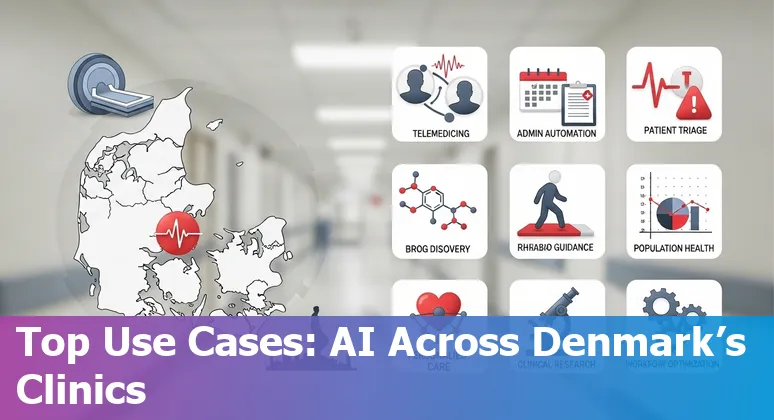
Denmark's top 10 AI prompts and healthcare use cases target radiology, pathology, EHR decision support, remote monitoring, teletriage, genomics, admin automation, robotics, mental health and population risk stratification. National system serves ~5.9M, health spend 9.4% of GDP; Columna Flow: 38,113+ users, 40 hospitals.
Denmark's universal, tax‑funded health system serves roughly 5.9 million people and is organized across national, regional and municipal levels - five regions handle hospital and GP services while 98 municipalities run home care and rehabilitation - delivering mostly free care at the point of use and a nationally visible push toward digital integration and telemedicine; learn more in the WHO Denmark health system summary (2024): WHO Denmark health system summary (2024).
The centralized sundhed.dk portal makes it easy for patients to find providers and hospitals across those layers (details at the Life in Denmark guide to how the system works: Life in Denmark guide to the Danish healthcare system), while workforce pressures and care coordination remain policy priorities - a practical reason why hands‑on AI training like Nucamp's AI Essentials for Work can help clinicians and managers apply prompt engineering and tools to real operational and clinical workflows: Nucamp AI Essentials for Work syllabus and registration.
| Bootcamp | Length | Early bird cost |
|---|---|---|
| AI Essentials for Work | 15 Weeks | $3,582 - Register for Nucamp AI Essentials for Work |
Table of Contents
- Methodology: How CAI‑X and Innovation Centres Shape Use Case Selection
- Radiology: RAIT and Radiobotics - Rapid Image Triage & Anomaly Detection
- Pathology Automation: Centre for Clinical Robotics (CCR) - Tissue Slide Imaging
- Clinical Decision Support: CAI‑X and Columna Flow - Real‑time EHR Analysis
- Remote Monitoring & Home Care: CACHET–Cortrium and Telma - Wearables & Rhythm Monitoring
- Telemedicine Triage: My Doctor and National Virtual GP Rollout - Virtual Consultation Augmentation
- Personalized Medicine: Enversion - Genomics & Treatment Optimization
- Administrative Automation: Systematic and Columna Flow - Scheduling, Billing & Documentation
- Operational Optimization & Robotics: CCR - Logistics, Cleaning & Lab Automation
- Mental Health Digital Interventions: Centre for Digital Psychiatry and Monsenso - Remote Psychiatry
- Population Analytics & Preventive Health: Sundhed.dk and National Registries - Risk Stratification
- Conclusion: Next Steps with CIMT, CAI‑X and CCR for Danish Healthcare AI
- Frequently Asked Questions
Discover how AI in Denmark's healthcare is reshaping patient care and why 2025 is a turning point for beginners and professionals alike.
Methodology: How CAI‑X and Innovation Centres Shape Use Case Selection
(Up)Denmark's method for turning AI ideas into real clinical tools often starts with regional playbooks and innovation centres that make use‑case selection practical and risk‑aware: the CAI‑X project guide (rooted in the Region of Southern Denmark) frames selection around lawful data handling, clear outcome definitions and incremental testing, advising teams to prioritise use cases where plenty of input variables (A) map to a simple, explainable outcome (B) and where data and tooling can realistically sit in the region's own data centre to speed compliance and validation - a concrete rule that removes a lot of downstream friction.
Practical steps include qualifying the specific decision point that needs augmentation, designing a focused test with explicit data fields, and drawing the data flow early so IT, clinicians and data scientists agree on responsibilities.
Ethical and governance checks such as bias mitigation, explainability and algorithmic impact assessment are integral to selection and scaling (see the Adalovelace Institute's algorithmic impact assessment case study and the BMC case study approach for methods to evaluate real‑world complexity).
The result: use cases that are clinically valuable, data‑feasible and easier to move from pilot to operation.
| Phase | Key focus |
|---|---|
| Qualify idea | Find decision point where extra info improves speed/accuracy |
| Design test | Specify measures, hypotheses, and precise data fields |
| IT setup | Draw data flows; prefer regional data centre for compliance |
| Develop & validate | Start simple models; iterate data quality and explainability |
| Disseminate | Plan upscaling, CE marking, security and continuous validation |
Radiology: RAIT and Radiobotics - Rapid Image Triage & Anomaly Detection
(Up)In Denmark's high‑volume radiology departments, AI is carving a practical niche as a rapid triage and anomaly‑detection assistant: RAIT advertises systems able to distinguish normal from abnormal chest X‑rays with high accuracy, making it a natural partner for regional workflows that prioritise quick, safe escalations (RAIT partnering and clinical needs for radiology AI).
Real‑world studies show the promise and the caveats - an autonomous ChestLink implementation flagged abnormal chest radiographs with extremely high sensitivity in multi‑site cohorts, suggesting AI can reliably surface urgent cases, while other Danish work found that radiologists still outperformed several commercial algorithms on nuanced diagnoses, underlining the need for human oversight and careful calibration (Autonomous ChestLink study: higher sensitivity for abnormal chest X‑rays, Danish study comparing radiologists and commercial chest X‑ray AI).
The practical takeaway for Danish hospitals: use AI to filter and prioritise - catching nearly all critical films fast - while keeping radiologists in the loop to prevent false positives from creating unnecessary downstream testing.
"The AI predicted airspace disease where none was present five to six out of 10 times. You cannot have an AI system working on its own at that rate," Plesner said.
Pathology Automation: Centre for Clinical Robotics (CCR) - Tissue Slide Imaging
(Up)Pathology automation - an obvious fit for a Centre for Clinical Robotics (CCR) focused on tissue slide imaging - centres on turning whole‑slide images into reliable, reproducible inputs for faster diagnosis: workflows that detect regions of interest, extract image patches, normalise stains and stitch tumor masks into heatmaps can shrink analyst time and boost consistency, especially for liver, colon and breast specimens described in the whole-slide image tumor segmentation and ROI extraction workflow (Whole-slide image tumor segmentation and ROI extraction workflow).
Easy, secure desktop tools such as HistoMetriX let labs run batch analysis and train models without sending images to the cloud - an attractive data‑sovereignty option for Danish institutions (HistoMetriX histology quantification desktop tool).
Open tools for real‑time whole‑slide visualisation and model deployment (Slideflow) add the transparency regulators and clinicians demand, turning opaque algorithms into traceable visual reports (Slideflow real-time whole-slide visualization and model deployment).
The practical payoff is memorable: imagine a slide transformed into a traffic map of tumour “congestion” that flags where a pathologist should focus first, cutting wasted microscope time and making scaling automation far more defensible.
| Resource | Published | Accesses | Citations | Altmetric |
|---|---|---|---|---|
| Slideflow (BMC Bioinformatics) | 27 Mar 2024 | 6,734 | 38 | 5 |
“To equip researchers and physicians in meeting the challenges of personalized medicine, we have developed an AI-powered histological image analysis software, providing a way to accelerate the discovery of new biomarkers.”
Clinical Decision Support: CAI‑X and Columna Flow - Real‑time EHR Analysis
(Up)Clinical decision support in Denmark is moving from batch reports to live, actionable guidance by combining CAI‑X's careful, regional validation approach with Systematic's Columna Flow suite so clinicians can see real‑time EHR signals and act immediately; Columna Flow's Command Centre and Clinical Tasking aggregate capacity, load and patient progress into a mobile‑ready dashboard that helps prioritise tasks, avoid delays and keep the right people and equipment at the right time (Systematic's Columna Flow hospital care dashboard).
When cross‑sector context is required - home care, municipalities and GPs - Columna Axon stitches recent, role‑tailored records together so a hospital nurse or community carer isn't flying blind during transitions (Columna Axon cross‑sector data exchange).
Denmark's near‑complete digitisation of health communications and large EHR rollouts provide fertile ground for these tools to supply predictive flow insights and reduce readmissions, turning once‑static records into a real‑time “traffic control” of care where bottlenecks show up minutes before they cause harm (see the EOS Intelligence review of Denmark's digital health landscape for context).
| Metric | Value |
|---|---|
| Columna Flow users | 38,113+ |
| Hospitals using Columna Flow | 40 |
| Years implementing healthcare solutions | 12+ |
“It gives citizens great peace of mind to feel that we have a coherent healthcare system, and it is a source of professional pride for employees, who feel that they can do a better job for their patients. It's a win‑win. Columna Axon is the best digital aid we have had for nursing for a long time.” - Gitte Nørgaard, Head of Nursing and Home Care, Herning Municipality
Remote Monitoring & Home Care: CACHET–Cortrium and Telma - Wearables & Rhythm Monitoring
(Up)Remote monitoring and home care in Denmark increasingly lean on wearables to keep rhythm patients safe between clinic visits: consumer smartwatches and single‑lead devices let users capture on‑demand ECGs and alert clinicians to irregular pulses,
putting a clinic‑grade heartbeat recorder on the wrist
for symptomatic episodes (smartwatch ECGs for atrial fibrillation (AFib) patients); large reviews show these devices are highly sensitive for atrial fibrillation but can produce false positives and gaps for complex arrhythmias, so clinical workflows must plan for triage, confirmation and equity of access (consumer‑grade wearable ECG monitors: capabilities and limits).
For longer continuous monitoring or higher diagnostic yield, medical‑grade ambulatory services like iRhythm's Zio combine validated algorithms with clinician‑verified end‑of‑wear reports that are easier to action in home‑care pathways (Zio medical‑grade ambulatory ECG monitoring and reporting).
The practical payoff in Denmark's digital system is simple but powerful: faster confirmation of an otherwise silent AF episode - sometimes only discovered after a stroke - so care teams can move from data accumulation to timely, evidence‑based intervention.
Telemedicine Triage: My Doctor and National Virtual GP Rollout - Virtual Consultation Augmentation
(Up)Telemedicine triage in Denmark increasingly leans on structured digital check‑ins and patient questionnaires to make virtual GP consultations smarter and safer: standardized forms that capture specific symptoms, health‑related quality of life and daily activities can flag deterioration before a clinician even opens the chart, helping direct urgent cases to same‑day care and routine issues to asynchronous follow‑up (Denmark digital patient questionnaires improving medical care).
Evidence from systematic reviews shows digital check‑in and triage kiosks can reduce variability in assessments and reliably surface high‑risk individuals when embedded into workflow, provided pathways for confirmation and escalation are defined (Systematic review: safety and efficacy of digital check-in and triage kiosks).
Pairing these tools with patient‑reported outcome dashboards that display symptoms and goals alongside clinical data closes the loop - turning remote symptom reports into focused, actionable virtual consultations rather than longer, unfocused calls (Patient-reported outcome dashboards in the electronic health record study), so triage becomes a precise gatekeeper instead of a blunt redirect.
Personalized Medicine: Enversion - Genomics & Treatment Optimization
(Up)Denmark's push for precision oncology leans heavily on pharmacogenomics to turn genomic signals into safer, more effective care: pharmacogenomic testing can predict cancer susceptibility, tumour behaviour and - critically - who will respond or suffer toxicity from specific chemotherapies and monoclonal antibodies (see the practical Pharmacogenomics Guide for Oncology Treatments).
Concrete examples matter in clinic: a small trastuzumab cohort found the HER2‑655Val/Ile phenotype linked to cardiotoxicity, and CYP2D6 or CYP2C19 metaboliser status directly affects anti‑nausea choices, opioid safety and antifungal prophylaxis - granisetron stands out as a 5HT3 option that avoids CYP2D6 interactions.
Platforms that package tumour genotypes, drug‑metabolism variants and treatment pathways into clinician‑facing reports (commercial pharmacogenomics services offer practical testing models) can help Danish oncologists personalise dosing, choose targeted agents and pre‑empt severe side effects, turning a once‑trial‑and‑error journey into a roadmap where a single gene result can spare hours of suffering and avoid ineffective therapy (DrOmics Labs Pharmacogenomics Testing).
For teams designing evidence and trials that regulators will accept, integrated guidance on genomic assays and workflows is essential (Designing Clinical Trials and Evidence Generation in Denmark).
Administrative Automation: Systematic and Columna Flow - Scheduling, Billing & Documentation
(Up)Administrative automation is where Denmark's digital health strengths pay off in everyday clinics: national momentum behind vendors and public‑private pilots means companies like Systematic are now highlighted as leading the charge to automate scheduling, billing and documentation for hospitals and municipal care (Systematic AI healthcare innovation in Denmark); at the practice level, patient‑facing booking platforms such as moCal show how online appointment scheduling, real‑time calendar integration and automated reminders can streamline front‑desk work and reduce chaos during busy mornings (moCal patient booking platform for Denmark).
The operational payoff is concrete: automation that handles intake, claim checks and reminders frees clinicians from paperwork and can cut no‑shows substantially - automated reminders have been shown to reduce missed visits by up to 38% - so administrative AI isn't just efficiency theatre, it's tangible time reclaimed for patient care (study on automation reducing administrative burden and missed visits).
Operational Optimization & Robotics: CCR - Logistics, Cleaning & Lab Automation
(Up)Denmark's Centre for Clinical Robotics (CCR) is turning everyday hospital chores into high‑value clinical time by co‑designing robots that handle logistics, cleaning and lab automation alongside clinicians and engineers - a living‑lab approach that favours small, testable steps and SME partnerships so solutions fit real workflows (Invest in Denmark: healthcare automation, digitalisation, AI and robotics).
At Odense University Hospital CCR prototypes include compact service robots that deliver samples, sanitise surfaces and guide patients (see the modular HospiBot modular hospital robot), and entrepreneur teams are already developing bed‑moving robots to spare porters from walking up to 100 kilometres a day between wards (Essential Robotics bed‑moving robot prototype).
The centre's plug‑and‑play testbed, close clinical governance and TRL‑focused partnerships mean pilots move faster from concept to CE‑marked demo, and the practical result is simple: automation that removes the “dull, dirty and dangerous” tasks so staff can spend more time on direct patient care.
| Attribute | Detail |
|---|---|
| Founded | 2021 |
| Location | Odense University Hospital |
| Focus | Treatment, logistics, cleaning, lab automation |
| Key partner | Maersk Mc‑Kinney Møller Institute, SDU |
| Programme Manager | Søren Udby |
“Automation is about eliminating the Three Ds - ‘dull, dirty and dangerous.'”
Mental Health Digital Interventions: Centre for Digital Psychiatry and Monsenso - Remote Psychiatry
(Up)Denmark's Centre for Digital Psychiatry is turning internet‑based therapy into a scalable, AI‑guided pathway for people with depression by partnering with Monsenso on the Innovation Fund–backed “Personae” project, which uses patient‑reported outcomes and machine learning inside Monsenso's platform to screen patients, tailor programs and flag early signs of drop‑out so resources - automated modules, psychologist support or face‑to‑face care - match each person's needs quickly; the approach both eases pressure on a strained psychiatric workforce and promises to shorten long waiting lists by routing patients to the right level of help from the start (Personae - personalised digital treatment for depression, Centre for Digital Psychiatry partners and role).
Complementary moves - Monsenso's nationwide Carelink partnership - aim to make remote self‑help, monitoring and clinician follow‑up a routine part of Danish care so more citizens get timely, evidence‑aligned mental health support.
| Project | Total budget | Innovation Fund DK | Monsenso net contribution | Duration |
|---|---|---|---|---|
| Personae – Personalised Digital Treatment of Depression | DKK 22.1 mio. | DKK 16.5 mio. | DKK 3.9 mio. | 4 years |
“The project enables us to use artificial intelligence, which, in collaboration with Monsenso's digital health solution and the Internetpsykiatrien, can ensure that more people can quickly get access to the right treatment. This next generation of digital treatment will make it much easier to offer a fully or partially digital treatment that matches each individual's needs.”
Population Analytics & Preventive Health: Sundhed.dk and National Registries - Risk Stratification
(Up)Denmark's centralized health data architecture - anchored by the Sundhed.dk portal and national registries - gives population analytics real bite: by linking personal medical records, municipal and regional feeds and standardized exchange via Medcom and the Danish Health Data Authority, clinicians and planners can stratify risk across cohorts and target preventive outreach before small problems become hospital admissions; see the overview of Denmark's national platform and Sundhed.dk on the G_NIUS site (Overview of Digital Healthcare in Denmark - Sundhed.dk and Registries (G_NIUS)) and the Commonwealth Fund profile noting differentiated public and clinician access (Denmark Health System Profile - Sundhed.dk Access (Commonwealth Fund)).
That capability carries governance trade‑offs - big‑data reuse raises ethics and oversight questions that demand stronger research‑ethics involvement and training, as argued in the literature on governance challenges in mixed data economies (Big Data and Health Research Governance Challenges (PubMed)) - so practical risk stratification in Denmark blends technical power with clear consent, monitoring and ROI for prevention programmes; imagine registries behaving like an early‑warning map that nudges outreach teams to high‑risk neighbourhoods before clinics fill up.
| Attribute | Detail |
|---|---|
| Population | ~5.8M |
| Administrative regions | 5 |
| Health spend (2023) | 9.4% of GDP |
| National platform | Sundhed.dk - personal & aggregated health data |
Conclusion: Next Steps with CIMT, CAI‑X and CCR for Danish Healthcare AI
(Up)Denmark's clear next steps for scaling hospital AI are pragmatic: stitch CIMT's decade of telehealth and wearable experience, CAI‑X's clinician‑embedded AI scoping and TRL 3–7 development pipeline, and CCR's bedside robotics testbeds into one pragmatic innovation pathway so ideas move quickly from problem discovery to a hospital demo and regulatory‑ready proof - an approach that invites SMEs and international partners to co‑design rather than hand over finished products (see Denmark's innovation platforms for healthcare automation: Invest in Denmark healthcare automation insights, and CAI‑X's OUH/SDU collaboration listing: Access Platform CAI‑X OUH/SDU collaboration listing).
Success depends on tight governance, hands‑on clinician feedback loops and practical training so teams translate prototypes into safe workflows; short, applied courses like Nucamp's Nucamp AI Essentials for Work bootcamp equip clinical managers and vendors with prompt‑engineering and deployment skills that make those loops faster and less risky.
The payoff is simple: automation and AI that remove tedious work, surface the right patients, and leave clinicians time for the care only humans can provide.
| Centre | Primary focus |
|---|---|
| CAI‑X | Clinical AI, machine learning, scoping & project support (OUH/SDU) |
| CIMT | Apps, telemedicine, home monitoring, wearables (established centre) |
| CCR | Clinical robotics: logistics, cleaning, lab automation, bedside support |
"We are not looking for final products or ready-made solutions. We want partners to work with us to develop solutions that fit into our workflows and operations. This ensures the innovations offer real value to patients and staff, and we know they work because they solve specific challenges." - Peter Børker Nielsen, Manager, CAI‑X Centre for Clinical Artificial Intelligence
Frequently Asked Questions
(Up)What are the top AI use cases and example prompts in Denmark's healthcare industry?
Key AI use cases in Denmark include: 1) Radiology triage and anomaly detection (e.g., prompts to prioritise abnormal chest X‑rays - tools: RAIT, Radiobotics, ChestLink); 2) Pathology automation and whole‑slide analysis (prompts to highlight regions of interest - tools: Slideflow, HistoMetriX); 3) Real‑time clinical decision support from EHR streams (prompts to surface at‑risk patients and capacity bottlenecks - tools: CAI‑X approaches, Columna Flow); 4) Remote monitoring and rhythm detection (prompts to flag AF episodes from wearable ECGs - tools: CACHET–Cortrium, iRhythm Zio); 5) Telemedicine triage and structured digital check‑ins (prompts to capture key symptoms and escalation needs - tools: My Doctor, national virtual GP rollout); 6) Personalized medicine and pharmacogenomics (prompts to match genotype to drug options - example: Enversion); 7) Administrative automation (prompts to auto-schedule, bill, reduce no‑shows - tools: Systematic, moCal); 8) Operational robotics for logistics and cleaning (prompts to optimise routes and tasks - CCR prototypes); 9) Digital mental‑health interventions (prompts to tailor internet‑based therapy and detect drop‑out - Monsenso Personae project); and 10) Population risk stratification using Sundhed.dk and national registries (prompts to prioritise outreach to high‑risk cohorts).
How is Denmark's health system organised and why does that support AI adoption?
Denmark has a universal, tax‑funded system serving roughly 5.8–5.9 million people, organised across national, five regional and 98 municipal levels (regions run hospitals and GPs; municipalities run home care and rehabilitation). A centralised portal (Sundhed.dk), extensive EHR digitisation and national registries create integrated data flows that make pilots and region‑level AI solutions practical. The system's scale, unified platforms and public–private innovation centres (CIMT, CAI‑X, CCR) lower friction for pilots while enabling population analytics. Public health spend was about 9.4% of GDP (2023), which underpins ongoing digitisation and innovation.
What methodology and governance steps are recommended for selecting and scaling clinical AI in Denmark?
Denmark often follows CAI‑X and regional innovation centre playbooks that prioritise clinically valuable, data‑feasible and low‑friction use cases. Typical phased steps: 1) Qualify idea - identify the exact decision point where AI adds speed/accuracy; 2) Design test - define measures, hypotheses and precise data fields; 3) IT setup - draw data flows and prefer regional data centres for compliance; 4) Develop & validate - start with simple, explainable models and iterate on data quality; 5) Disseminate - plan upscaling, CE marking, security and continuous validation. Governance checks (bias mitigation, explainability, algorithmic impact assessments and research‑ethics review) are integral before moving from pilot to operation.
What are the main safety, data‑sovereignty and clinical oversight concerns when deploying AI in Danish healthcare?
Key concerns include: 1) False positives and diagnostic errors (example: some chest X‑ray algorithms produced high false‑positive rates - human oversight is required); 2) Data sovereignty - many Danish projects prefer regional data centres or on‑prem/desktop tools (e.g., HistoMetriX) to keep images and patient data local; 3) Regulatory readiness - CE marking, security assessments and continuous post‑deployment validation are needed; 4) Ethical governance - algorithmic impact assessments, bias mitigation and clear consent/secondary‑use rules for registry data; 5) Operational integration - defining responsibilities across IT, clinicians and data scientists, plus training and escalation pathways to avoid workflow disruption.
How can clinical managers and clinicians get hands‑on training to implement AI and prompt engineering in Danish healthcare?
Applied short courses focused on prompt engineering and deployment skills are recommended. Example: Nucamp's 'AI Essentials for Work' bootcamp (15 weeks, early‑bird cost cited at $3,582) teaches practical prompt design, tooling and workflow integration so clinicians and managers can move prototypes through CAI‑X‑style pipelines into safe demos. Training emphasises clinician‑embedded validation, governance checklists and real operational workflows to reduce downstream risk and speed adoption.
Joining trials shapes future practice - the smartest move is to participate in national AI trials to influence deployment and learn new competencies.
ROBERT co-therapist increases rehabilitation capacity, letting hospitals serve more patients without proportional staffing increases.

Ludo Fourrage
Founder and CEO
Ludovic (Ludo) Fourrage is an education industry veteran, named in 2017 as a Learning Technology Leader by Training Magazine. Before founding Nucamp, Ludo spent 18 years at Microsoft where he led innovation in the learning space. As the Senior Director of Digital Learning at this same company, Ludo led the development of the first of its kind 'YouTube for the Enterprise'. More recently, he delivered one of the most successful Corporate MOOC programs in partnership with top business schools and consulting organizations, i.e. INSEAD, Wharton, London Business School, and Accenture, to name a few. With the belief that the right education for everyone is an achievable goal, Ludo leads the nucamp team in the quest to make quality education accessible