









The Complete Guide to Using AI in the Government Industry in Cyprus in 2025
Last Updated: September 6th 2025
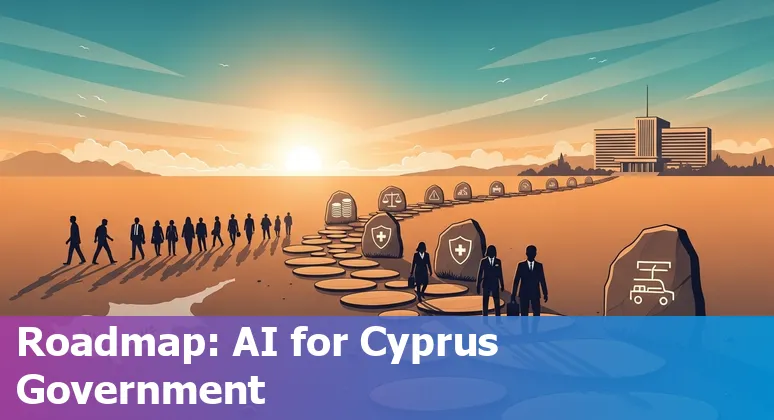
Too Long; Didn't Read:
Cyprus in 2025 is fast‑tracking government AI (meteorology/early‑warning): a National AI Taskforce, RIF's two‑phase “AI in Government” funding (Phase A up to 9 months, Phase B up to 27; deadline 17 Oct 2025), IP Box effective tax ~2.5%, EU AI Act fines up to €35M/7%.
Cyprus in 2025 is at a pivot point: a newly formed National AI Taskforce is steering ethical, practical adoption while the Research and Innovation Foundation prepares a two‑phase “AI in Government” funding programme - now pre‑announced - to back prototype and real‑world pilots (first challenges target meteorology and early‑warning systems) (RIF pre‑announcement of the AI in Government funding programme).
Experts like Sotirios Chatzis and Chief Scientist Demetris Skourides are pushing a pragmatic playbook - aligning with the EU AI Act, building sovereign compute and data infrastructure, and prioritising tourism, energy and healthcare use cases that can reduce costs and speed services to citizens (Interview: Inside Cyprus's AI Taskforce with Sotirios Chatzis).
For public servants and partners who need concrete skills fast, practical courses such as Nucamp's AI Essentials for Work teach prompt craft and workplace AI application in 15 weeks, bridging policy ambitions to operational projects (Nucamp AI Essentials for Work registration), so Cyprus can turn pilots into everyday, trustworthy services.
| Bootcamp | Length | Early bird cost | Key courses | Register |
|---|---|---|---|---|
| AI Essentials for Work | 15 Weeks | $3,582 | AI at Work: Foundations; Writing AI Prompts; Job Based Practical AI Skills | Register for Nucamp AI Essentials for Work (15 Weeks) |
"I am the country's only researcher trained (and having worked for two decades exclusively) on end-to-end multimodal generative models, which form the foundation of any (modern) generative AI system. Thus, I bring hands-on knowledge of how to design, train, and deploy these systems safely."
Table of Contents
- Cyprus AI Market & Strategic Advantages for Government Projects
- Funding, Grants and Procurement: How Cyprus Government Pays for AI
- Regulatory and Legal Landscape for AI in Cyprus
- Data, IP and Liability: Legal Practicalities for Cyprus Public Agencies
- Building Infrastructure & Strategic Partnerships in Cyprus
- Practical Roadmap for Deploying AI in Cyprus Government
- High-Impact Use Cases for Cyprus Public Services
- Talent, Skills and Organisational Change in Cyprus
- Risks, Governance and Next Steps for Cyprus Government (Conclusion)
- Frequently Asked Questions
Nucamp's Cyprus community brings AI and tech education right to your doorstep.
Cyprus AI Market & Strategic Advantages for Government Projects
(Up)Cyprus presents a surprisingly strong commercial backdrop for government AI projects in 2025: the island's IP Box can pare tax on qualifying AI software, patents and other innovation down to an effective 2.5% by exempting 80% of qualifying IP profits, a powerful incentive for public‑private pilots and for hosting algorithmic IP locally (Cyprus IP Box: 2.5% effective rate); at the same time key enablers like the Notional Interest Deduction and enhanced R&D allowances (including a 120% R&D deduction) make in‑country R&D and procurement partnerships cheaper and more attractive for global vendors and local SMEs.
Policy watchers should note the looming tax reform discussion - the statutory corporate rate is being reviewed (current 12.5% with a proposal to move toward 15%), but many targeted incentives (IP Box, NID, dividends/sale exemptions and green/digital transition support) are being retained in the proposals, which helps preserve Cyprus's appeal for innovation projects that need predictable economics (Cyprus tax reform update).
For government leaders this combination means lower lifecycle costs for AI pilots, easier co‑funding with private partners, and a clear tax route to scale successful pilots into citizen‑facing services - imagine an early‑warning AI whose IP lives in Cyprus and benefits from a tax bill that's essentially cut by four‑fifths on that income.
| Incentive | Key point |
|---|---|
| IP Box | 80% exemption on qualifying IP profits → effective tax rate as low as 2.5% (software and patents eligible) |
| Corporate Tax | Standard rate 12.5% (proposal under consultation to increase to 15%) |
| R&D Deduction | Enhanced deductions (e.g., 120% on qualifying R&D costs) |
| Notional Interest Deduction (NID) | Retained - supports equity financing for innovation projects |
| Royalties & Dividends | Favourable treatment (no withholding on many royalties; dividend exemptions retained) |
Funding, Grants and Procurement: How Cyprus Government Pays for AI
(Up)Cyprus's approach to financing AI in government is practical and stacked: the Research and Innovation Foundation's flagship “AI in Government” programme offers two‑phase support (prototype then real‑world pilot) for Cypriot businesses tackling public‑sector challenges - starting with two meteorology challenges - and sets a firm proposal deadline of 17 October 2025, with eligible costs from personnel to equipment and overheads (see the Research and Innovation Foundation AI in Government programme details Research and Innovation Foundation AI in Government programme details); complementary grant schemes can be generous (RIF grants are listed among top government options and in some streams can cover up to 85% of invested capital, easing cashflow for SMEs and startups pursuing pilots) and projects are designed to move from prototype to live installation within a combined maximum of 36 months, so a winning idea today can be a tested early‑warning service before the next storm season.
Beyond RIF, national digital transformation funding also backs AI readiness at scale - the EU Digital Decade country report highlights EUR 274 million from the Recovery and Resilience plan and EUR 113 million from Cohesion funds allocated to digital measures that can underwrite infrastructure and procurement platforms - and the RIF calls deliberately encourage iterative procurement and close collaboration with the relevant public authority, making co‑funded tenders and public–private pilots the default route to scale.
For procurement teams, that means bidding on defined challenges, designing proposals that match Phase A (prototype) and Phase B (pilot) milestones, and using grant leverage to lower vendor lifecycle costs while preserving public oversight and data safeguards; the outcome is clear: targeted grants plus EU backing create a fast, funded path from concept to citizen‑facing AI.
| Funding Source | Key detail |
|---|---|
| RIF “AI in Government” | Two phases (Phase A up to 9 months; Phase B up to 27 months), proposal deadline 17 Oct 2025 |
| RIF grants | Top government grants (some streams cover up to 85% of invested capital) |
| EU / National digital funds | EUR 274M (Recovery & Resilience) + EUR 113M (Cohesion) supporting digital transformation |
“Artificial intelligence is here. It is not just in one industry. And what we are going to be having to rethink is how do we actually identify where we can use it across the different industries and capture that value.”
Regulatory and Legal Landscape for AI in Cyprus
(Up)Cyprus's legal landscape for AI in 2025 is being shaped less by domestic statutes and more by the EU's new Artificial Intelligence Act, which now functions as the default rulebook and brings a strict, risk‑based regime with concrete deadlines and heavy penalties - think mandatory transparency, machine‑readable labels for synthetic content and fines reaching €35 million or 7% of global turnover (EU Artificial Intelligence Act: timeline and penalties (Chambers & Co.)).
At home, authorities have moved quickly to prepare: the Deputy Ministry notified the Commission of three national public authorities (the Commissioner for Personal Data Protection, the Ombudsman and the Attorney‑General) to supervise fundamental‑rights compliance, and a National AI Taskforce (set up in 2025) is advising an update to Cyprus's 2020 AI strategy (Cyprus government press release on AI Act implementation; Global Legal Insights: chapter on Cyprus AI laws).
Practically this means EU obligations (from transparency rules in 2025 to high‑risk conformity from August 2026) will drive procurement, documentation and data governance for public‑sector pilots; regulators are prioritising sandboxes, capacity building and clear points of contact so that a government AI project - say an early‑warning model - must carry the same audit trail and human‑oversight guarantees as any medical or infrastructural system.
| Milestone / Authority | Detail |
|---|---|
| EU AI Act (entry into force) | Entered into force 1 Aug 2024; direct effect across Member States |
| Prohibitions & governance | Unacceptable‑risk bans effective 2 Feb 2025; GPAI transparency from 2 Aug 2025 |
| High‑risk obligations | Risk management, documentation, human oversight mandatory from 2 Aug 2026 |
| Cyprus designated authorities (notified) | Commissioner for Personal Data Protection; Commissioner for Administration & Human Rights (Ombudsman); Attorney‑General (notified 6 Nov 2024) |
| Notifying / Market Surveillance Authority | Communications Commissioner identified to act as notifying and market surveillance authority / single point of contact (per GLI) |
Data, IP and Liability: Legal Practicalities for Cyprus Public Agencies
(Up)For Cyprus public agencies the legal checklist for any AI project is clear: GDPR rules and local Law 125(I)/2018 remain the baseline, so controllers must demonstrate purpose limitation, data minimisation, robust security and, where required, DPIAs and a designated DPO for public authorities or large‑scale special‑category processing (Cyprus personal data protection rules and Personal Data Commissioner); critically, Cyprus imposes a prior‑notification requirement to the Personal Data Commissioner before transferring sensitive personal data outside the EEA, a procedural step that applies to health, biometric or criminal data.
IP and ownership follow EU/Cyprus practice: computer programs and databases can attract copyright in the employer/commissioning context, AI‑generated output is unlikely to qualify for copyright without meaningful human authorship, and patents exclude mere computer programs though genuinely inventive AI inventions may still be patentable (Global Legal Insights - AI, IP and liability in Cyprus).
On liability, contract and tort law govern most claims today, the EU AI Act layers regulatory obligations for high‑risk systems, and recent EU product‑liability updates extend strict liability into the software era - so procurement docs must marry contractual warranties, audit‑ready documentation and insurer‑friendly indemnities.
In practice: map data flows, run DPIAs early, use SCCs/adequacy or BCRs for transfers, lock down trade‑secret protections for valuable datasets, and specify human‑oversight and audit trails in every public‑sector AI tender.
| Legal area | Practical takeaway for Cyprus agencies |
|---|---|
| Data protection (GDPR & Law 125(I)/2018) | DPIA where high risk, appoint DPO if required, keep records and implement security measures |
| Cross‑border transfers | Prior notification to Commissioner for sensitive data; use adequacy, SCCs, BCRs and Transfer Impact Assessments |
| IP (copyright & patents) | Software/copyright normally vests with author/employer; AI‑only outputs uncertain; patents exclude mere programs but inventive AI may be patentable |
| Liability | Contract/tort law applies; EU AI Act adds compliance obligations; defective product rules now extend to software |
| Trade secrets & data governance | Protect curated big datasets via confidentiality, access controls and clear contractual terms |
Building Infrastructure & Strategic Partnerships in Cyprus
(Up)Building Cyprus's AI stack means coupling national connectivity targets with sectoral research hubs and international partners: the Digital Connectivity plan pushes Fibre‑to‑the‑Home and island‑wide 5G (backed by Component 4.1's EUR 45M for very high capacity networks) so ministries can rely on low‑latency links for real‑time models (Cyprus Digital Connectivity Broadband Plan 2021–2025); research infrastructure already supplies the data and compute - the ERATOSTHENES Centre's CARO facility runs PollyXT lidar, a 35 GHz Doppler cloud radar, Doppler wind lidar and a new computing cluster at CUT to ingest atmospheric and earth‑observation streams in near real time (ERATOSTHENES CARO infrastructure and computing cluster); complementary space capabilities are emerging via the Cyprus Space Research and Innovation Centre, which plans mission control, data monitoring/storage and space situational‑awareness monitoring to support satellite downlinks and maritime or meteorological services (Cyprus Space Research and Innovation Centre (C‑SpaRC)).
The result: interoperable fibre/5G backbones feeding specialised observatories and a CUT data centre, with international contractors (e.g., Safran, DLR, Cyta partners on the DAS) already in tender pipelines - imagine a storm‑nowcast model pulling lidar returns, satellite downlinks and 5G telemetry together so a coastal municipality gets a two‑hour, hyperlocal evacuation alert instead of a generic forecast.
| Initiative | Key capability | Notes / partners |
|---|---|---|
| Digital Connectivity Plan | FTTH, island‑wide 5G, VHCN targets | Component 4.1: EUR 45M for VHCN deployment |
| ERATOSTHENES CARO | PollyXT lidar, 35 GHz cloud radar, Doppler wind lidar, computing cluster | National facility in Limassol; CUT Data Centre hosting compute |
| Earth Observation DAS | S/X/Ka band satellite downlink, NRT EO products | Hosted at Cyta teleports; contract awarded to Safran Data Systems (tender partners include DLR, Cyta) |
| C‑SpaRC | Mission control, data monitoring & storage, SSA monitoring | Space research & innovation centre for Cyprus |
Practical Roadmap for Deploying AI in Cyprus Government
(Up)Start with a compact, risk‑aware plan: classify a proposed system under the EU AI Act, then design the project to satisfy transparency and high‑risk gates (transparency rules from August 2025; high‑risk obligations from August 2026) so procurement, documentation and human‑oversight are baked in from day one (EU AI Act implementation guidance for Cyprus).
Next, map data flows and run a DPIA early, lock down cross‑border transfer approvals and trade‑secret protections, and match technical milestones to RIF's two‑phase funding model: Phase A (prototype, up to 9 months) focused on feasibility using open or synthetic data, followed by Phase B (pilot, up to 27 months) running real‑world tests with the partnering public authority - a structure designed to turn an idea into a live government service within the programme's 36‑month ceiling (RIF AI in Government pre-announcement and funding programme).
Parallel tracks should cover workforce readiness (leverage the National Digital Decade roadmap and its targeted skilling investments through 2026), infrastructure alignment with national connectivity plans and local compute/data hosting, and clear procurement clauses for warranties, audit logs and liability apportionment.
Time the proposal to funding windows (RIF calls and workshops are publicised in mid‑2025) and treat each pilot as an iterative, measurable step: short prototype sprints, formal conformity checks against EU rules, then scaled piloting with trained staff - a pragmatic sequence that turns legal and technical complexity into a predictable pipeline from prototype to trusted public service.
| Step | Detail | Source / Timeline |
|---|---|---|
| Classify & comply | Assess AI Act risk category; plan for transparency and human oversight | GLI: transparency 2 Aug 2025; high‑risk 2 Aug 2026 |
| Phase A – Prototype | Feasibility & prototype (can use open/synthetic data) | RIF: up to 9 months |
| Phase B – Pilot | Real‑world installation with public authority collaboration | RIF: up to 27 months; combined max 36 months |
| Skills & capacity | Upskill teams and public servants via national programmes | National Digital Decade roadmap; skilling investments to 2026 |
High-Impact Use Cases for Cyprus Public Services
(Up)High‑impact, near‑term AI use cases for Cyprus's public services cluster naturally around meteorology, agriculture and smarter shared services: the RIF “AI in Government” programme's first two challenges explicitly target an early‑warning system for extreme weather and agrometeorological support for farmers, creating a funded pathway to machine‑assisted forecasts and tailored irrigation or pest advisories that local growers can act on (RIF AI in Government programme pre-announcement; Cyprus Mail coverage of early‑warning and agrometeorology challenges).
On the public‑safety front, AI‑augmented nowcasting and multi‑source models - aligned with the WMO's Early Warnings for All agenda - can turn satellite feeds, local sensors and social signals into hyperlocal push alerts that reach communities and emergency managers faster and with clearer action guidance (WMO AI‑powered meteorology and Early Warnings for All; OpenWeather's push‑alerts model shows how geo‑targeted notifications are delivered in practice).
Beyond weather, government‑wide platforms for data‑driven procurement, fraud detection and shared analytics can compress decision cycles, lower lifecycle costs and help scale pilots into trusted services - so the “so what?” is simple: funded meteorology pilots can directly protect lives and livelihoods, while shared AI platforms squeeze inefficiency across ministries, from procurement to frontline helpdesks (Cyprus government data‑driven procurement and shared AI platforms case study), turning lessons from prototype sprints into everyday, measurable public value.
“We must harness the power of prediction. We must mainstream AI-powered weather and climate intelligence into every early warning and decision-making system - because lives depend on it.”
Talent, Skills and Organisational Change in Cyprus
(Up)Talent and skills are the hinge between Cyprus's AI ambitions and real delivery: only 27.5% of enterprises employ ICT specialists (22.8% in small firms versus 85.8% in large ones), and just 15.3% of organisations provide training to those specialists, so public agencies must plan for rapid upskilling, targeted recruitment and practical bootcamps to avoid bottlenecks (see the Cystat ICT & e‑commerce survey 2024 Cystat ICT & e‑commerce Survey 2024).
AI uptake is climbing - 7.9% of businesses used AI in 2024 (34.9% of large firms) - but uneven skills and patchy training risk stalling pilots unless government, academia and industry coordinate on apprenticeships, incentives and fast‑track reskilling tied to funding windows such as RIF programmes; the Cyprus 2025 Digital Decade Country Report stresses the same need to close digital skills gaps while leveraging strong connectivity and targeted measures (Cyprus 2025 Digital Decade Country Report).
Practically, combine short, role‑focused courses, cross‑agency rotation programmes and clear career paths for data/AI roles so a trained operations officer - not an external contractor - can own a pilot's audit trail and human‑oversight duties from day one.
| Indicator | Value |
|---|---|
| Enterprises employing ICT specialists (total) | 27.5% |
| Enterprises employing ICT specialists - Small / Medium / Large | 22.8% / 49.6% / 85.8% |
| Enterprises providing ICT training to ICT specialists | 15.3% |
| Enterprises using AI (2024) | 7.9% (34.9% large enterprises) |
“The vision of establishing Cyprus as a regional hub for innovation and technology is closely linked to the country's digital transformation and the creation of a comprehensive digital ecosystem.”
Risks, Governance and Next Steps for Cyprus Government (Conclusion)
(Up)Risks are real but manageable: Cyprus must now pair the EU's risk‑based AI rulebook with hard governance and fast capacity building so pilots don't become compliance problems - remember the AI Act brings transparency duties from August 2025 and heavy penalties (up to €35 million or 7% of global turnover) for breaches, and high‑risk systems will carry full conformity obligations from August 2026 (EU AI Act timeline and implementation in Cyprus).
At the same time, limited domestic regulatory depth, SME resource constraints and estimated compliance costs for high‑risk systems (noted in expert commentary) mean Cyprus needs pragmatic steps: designate and empower competent authorities, scale regulatory sandboxes, and fund operator upskilling so public servants can own audit trails and human‑oversight duties.
The National AI Taskforce and Cyprus's 2020 strategy give a roadmap for next steps - update the national plan, lock in data‑sharing rules, and use targeted skilling (short courses and role‑focused bootcamps) to turn requirements into operational capability (Cyprus national AI strategy & public‑sector priorities).
Practically, pair tight procurement clauses (warranties, logging, indemnities) with funded pilots and accessible training - Nucamp's AI Essentials for Work is one practical skilling route for quick competence in prompt craft and workplace AI use (Nucamp AI Essentials for Work registration).
Picture a well‑documented early‑warning pilot: clear risk classification, DPIA completed, trained ops staff on duty, and a sandboxed live test - governance turned from checklist into a service‑guarantee that protects citizens and innovation alike.
| Risk / Constraint | Priority next step |
|---|---|
| EU AI Act fines & phased obligations | Classify systems early; plan conformity & transparency documentation (GLI) |
| Limited domestic AI regulation & institutional capacity | Empower National Taskforce, designate competent authorities, run sandboxes (AI Watch) |
| Skills & SME readiness gaps | Fund short, role‑focused training and bootcamps; embed DPOs and DPIAs into project plans |
| Liability and product rules (software & safety) | Draft procurement clauses with warranties, logs and indemnities; align with new defective‑product rules (GLI) |
“What we have been working on is the transformation of data into relevant information for strategic decisions that we can make. This will improve immensely the governance and the efficiency of the city and ultimately the transparency of the decisions made by politicians or by public authorities.”
Frequently Asked Questions
(Up)What funding and procurement routes are available for AI projects in Cyprus government in 2025?
The Research and Innovation Foundation (RIF) runs an “AI in Government” programme with two phases: Phase A (prototype) up to 9 months and Phase B (pilot) up to 27 months, with a combined maximum of 36 months. The RIF call pre‑announced targets meteorology challenges first and sets a firm proposal deadline of 17 October 2025. RIF grants can be generous (some streams cover up to 85% of invested capital). Complementary EU/national digital funds (e.g., EUR 274M from the Recovery & Resilience plan and EUR 113M from Cohesion funds) support infrastructure and procurement platforms. Practical advice: design proposals that map Phase A feasibility milestones to Phase B real‑world tests, include public‑authority collaboration in tenders, and use grant leverage to lower vendor lifecycle costs while retaining public oversight and data safeguards.
Which regulatory obligations apply to government AI systems and what are the key dates under the EU AI Act?
The EU AI Act (entry into force 1 Aug 2024) is the primary rulebook: unacceptable‑risk prohibitions applied from 2 Feb 2025, mandatory transparency rules take effect from 2 Aug 2025, and high‑risk conformity obligations (risk management, documentation, human oversight) apply from 2 Aug 2026. Penalties can reach €35 million or 7% of global turnover. Cyprus has notified three national authorities (Commissioner for Personal Data Protection, the Ombudsman, and the Attorney‑General) for fundamental‑rights supervision and identified a Communications Commissioner as the market surveillance/single‑point contact. For projects, classify the system early under the AI Act, bake in transparency and human‑oversight measures, and maintain audit‑ready documentation for procurement and conformity checks.
What are the legal, data‑protection and IP practical steps public agencies must take before deploying AI?
Baseline rules include GDPR and Cyprus Law 125(I)/2018: run a Data Protection Impact Assessment (DPIA) for high‑risk processing, appoint a DPO when required, implement purpose limitation, data minimisation and strong security, and keep records of processing. Cyprus requires prior notification to the Personal Data Commissioner before transferring sensitive personal data outside the EEA; use adequacy decisions, Standard Contractual Clauses or Binding Corporate Rules for transfers and perform Transfer Impact Assessments. For IP, software and databases usually vest with the employer/commissioning party; AI‑only outputs may lack copyright without meaningful human authorship; patents exclude mere programs though inventive AI inventions can be patentable. For procurement, combine contractual warranties, audit logs, insurer‑friendly indemnities and trade‑secret protections for valuable datasets.
Which infrastructure and high‑impact use cases should Cyprus prioritise for government AI?
Priorities are meteorology/early‑warning, agriculture (agrometeorology), and shared analytics for procurement and fraud detection. The island is building connectivity (FTTH and island‑wide 5G; Component 4.1 includes EUR 45M for very‑high‑capacity networks) and research/compute assets (ERATOSTHENES CARO with PollyXT lidar, 35 GHz cloud radar, Doppler wind lidar and a CUT computing cluster; the Earth Observation DAS with satellite downlinks hosted at Cyta teleports). These assets enable hyperlocal nowcasting and multi‑source early warnings (e.g., combining lidar, satellite and 5G telemetry to deliver targeted evacuation alerts). Plan pilots that exploit these facilities and align technical milestones with funding and procurement timelines.
How can government teams close the skills gap quickly and what practical training options exist?
Skills gaps are material: only 27.5% of enterprises employ ICT specialists (22.8% in small firms) and just 15.3% provide ICT training; 7.9% of businesses used AI in 2024 (34.9% for large firms). Rapid, role‑focused upskilling, apprenticeships and short bootcamps are essential so public servants can own audit trails and human‑oversight duties. Practical courses such as Nucamp's AI Essentials for Work (15 weeks; early bird cost listed at $3,582 in the article) teach prompt craft and workplace AI application and are designed to bridge policy ambitions to operational projects. Combine short courses with cross‑agency rotations and clear career paths for data/AI roles to embed capability in public agencies.
Understand how Data governance and AI audit readiness helps create inventories, gap analyses and remediation timelines aligned to the EU AI Act.
Scaling AI responsibly requires training and scaling AI for Cypriot public sector - targeted upskilling and phased pilots deliver measurable ROI in 6–18 months.
As Routine IT support and code assistants automate low‑complexity work, staff should upskill toward cloud, SRE, and cybersecurity roles.

Ludo Fourrage
Founder and CEO
Ludovic (Ludo) Fourrage is an education industry veteran, named in 2017 as a Learning Technology Leader by Training Magazine. Before founding Nucamp, Ludo spent 18 years at Microsoft where he led innovation in the learning space. As the Senior Director of Digital Learning at this same company, Ludo led the development of the first of its kind 'YouTube for the Enterprise'. More recently, he delivered one of the most successful Corporate MOOC programs in partnership with top business schools and consulting organizations, i.e. INSEAD, Wharton, London Business School, and Accenture, to name a few. With the belief that the right education for everyone is an achievable goal, Ludo leads the nucamp team in the quest to make quality education accessible