









The Complete Guide to Using AI in the Healthcare Industry in Cleveland in 2025
Last Updated: August 16th 2025
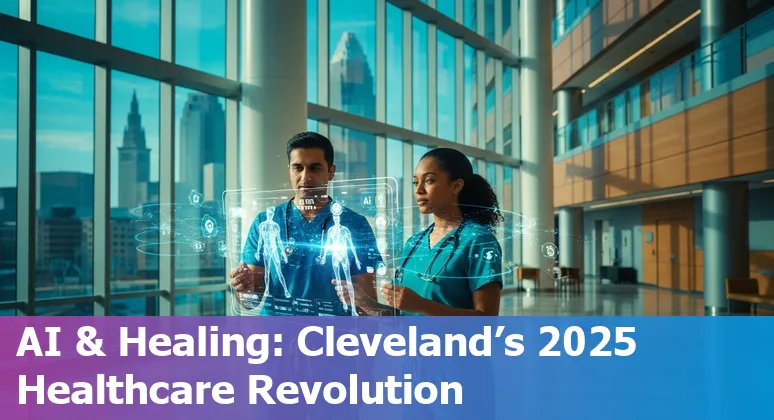
Too Long; Didn't Read:
In 2025 Cleveland embeds AI across care: Cleveland Clinic's July AI Summit drew 650+ attendees; ambient scribes documented ~1M encounters saving ~14 minutes/clinician/day; Viz.ai cut LVO diagnosis time by 44.13% and trimmed treatment by 31 minutes - scale pilots, governance, and workforce training.
Cleveland's health ecosystem is at the center of practical AI adoption in 2025: the Cleveland Clinic hosted its inaugural AI Summit on July 11, 2025 with more than 650 clinicians and administrators, is a founding member of the global AI Alliance, and has launched strategic partnerships (including with G42) and pilots - like ambient AI scribes and a multi-vendor evaluation that led to Ambience - to cut documentation time, reduce clinician burnout, and speed diagnostics across Ohio hospitals; see coverage of Cleveland Clinic's summit and its work on Cleveland Clinic AI Summit coverage (July 11, 2025) and an explainer of how AI is being used in healthcare - Cleveland Clinic explainer; Ohio providers and staff who want workplace-ready AI skills can get practical training via Nucamp's AI Essentials for Work bootcamp registration - Nucamp, a 15-week course designed to build prompt-writing and applied AI skills for nontechnical clinical teams.
| Program | Length | Early Bird Cost | Registration |
|---|---|---|---|
| AI Essentials for Work | 15 Weeks | $3,582 | AI Essentials for Work bootcamp registration - Nucamp |
“You want the company to have passion for health care. This is not a technology play when all is said and done; this is a health care play.” - Rohit Chandra, Ph.D.
Table of Contents
- How AI Is Being Used in Healthcare in 2025
- Which Types of AI Are Currently Used in Medical Care Today?
- How Cleveland Clinic Is Using AI in 2025
- Clinical Imaging & Diagnostics: AI as a Second Pair of Eyes
- Emergency Triage, Workflow Automation & Time-Sensitive Care
- Research, Precision Medicine & Cleveland's Discovery Accelerator
- Operations, Patient Services, Workforce & Education in Cleveland
- Ethics, Regulation, and Policy: What Ohio Lawmakers and WHO Recommend
- Conclusion: Three Ways AI Will Change Healthcare by 2030 and Next Steps for Cleveland
- Frequently Asked Questions
Explore hands-on AI and productivity training with Nucamp's Cleveland community.
How AI Is Being Used in Healthcare in 2025
(Up)Across Ohio in 2025, AI is no longer pilot-only - it's embedded in triage, imaging, telehealth and patient-facing services to speed decisions and offload routine work: the Cleveland Clinic describes AI and ML running chatbots, ambient scribes, bedside tools, diagnostic testing and a 10‑year Discovery Accelerator with IBM to accelerate biomedical discovery (Cleveland Clinic explainer on AI in healthcare); in practice that means radiology tools acting as a
second pair of eyes,
automated stroke detection (Viz.ai) that shortens minutes-to-treatment, and a virtual triage program reporting ~94% diagnostic accuracy with typical physician connection times under two minutes - faster, more accurate routing that keeps low‑acuity visits out of crowded EDs (Netguru analysis of AI virtual triage accuracy in telehealth).
Conversational AI and hybrid chatbots also handle scheduling, reminders and basic follow‑up - reducing callbacks, improving adherence and lowering readmissions - while documentation tools cut clinician charting time substantially, freeing staff for direct care (Master of Code blog on conversational AI use cases in healthcare).
The so‑what: Ohio systems gain faster diagnoses, higher patient access and measurable relief from administrative burden, creating room for clinicians to focus on complex care.
Which Types of AI Are Currently Used in Medical Care Today?
(Up)The types of AI already in Ohio clinical care span simple rule-based chatbots and robotic process automation to advanced machine learning and deep learning systems used for imaging, triage, documentation and research: Cleveland Clinic's AI Summit frames the landscape as AI → ML → deep learning for pattern recognition and decision support (Cleveland Clinic AI Summit for Healthcare Professionals), while the Clinic's explainer highlights everyday deployments such as conversational chatbots, predictive models for monitoring and personalized treatment planning, and neural networks that act as a “second pair of eyes” in radiology and automated stroke triage (e.g., Viz.ai) to shave minutes off time‑sensitive care (Cleveland Clinic explainer on AI in healthcare).
Ambient AI - speech‑to‑summary systems evaluated in a multi‑vendor pilot and rolled out with Ambience's AI Scribe - adds interpretive summarization to transcription and has been used to document roughly 1 million encounters while saving clinicians about 14 minutes per day, directly reducing after‑hours charting (Cleveland Clinic ambient AI scribe rollout).
Other active categories include generative and large‑scale models powering the Discovery Accelerator with IBM for biomedical discovery, and generative AI pilots for revenue‑cycle coding (AKASA) to improve accuracy and efficiency.
The so‑what: these varied AI types move beyond novelty into operational tools that speed diagnosis, cut administrative burden and channel clinician time back to bedside care.
| AI Type | Clinical examples / Cleveland use |
|---|---|
| Machine learning / Deep learning | Radiology “second pair of eyes”; automated image reads and nodule tracking (Cleveland Clinic explainer on AI in healthcare) |
| Neural networks / Triage AI | Stroke detection and rapid alerting (Viz.ai) to reduce minutes‑to‑treatment (Cleveland Clinic explainer on AI in healthcare) |
| Ambient AI / AI scribe | Automated visit summaries in Epic; ~1M encounters documented, ~14 minutes/day saved per clinician (Cleveland Clinic ambient AI scribe rollout) |
| Generative / Large models | Discovery Accelerator with IBM for biomedical research; pilots for coding and revenue cycle (AKASA) |
“People are getting their documentation done faster and are spending less time after hours. And patients love the detailed notes and instructions.” - Eric Boose, MD
How Cleveland Clinic Is Using AI in 2025
(Up)In 2025 Cleveland Clinic is pairing targeted research with operational programs so AI moves from lab to bedside in Ohio: a partnership with IBM and the Hartree Centre launched research projects using artificial intelligence and quantum computing to study epilepsy and the impact of hospital interventions (Cleveland Clinic, IBM, and Hartree Centre collaboration on AI and quantum computing), while employer-facing efforts such as the Clinical Review program aim to improve outcomes, patient experience and reduce costs for covered populations (Cleveland Clinic Clinical Review program for employers); complementary work - including the Clinic's 2025 women's health survey that flags gaps in care - feeds data into pragmatic studies and recruitment pipelines, where trial‑recruitment prompt templates can match EHR cohorts to study criteria faster (Nucamp AI Essentials for Work trial-recruitment prompt templates and healthcare use cases).
The so‑what: concentrating AI efforts on defined conditions and employer/population programs creates clear, actionable data flows that shorten the time from model development to measurable clinical change in Ohio.
Clinical Imaging & Diagnostics: AI as a Second Pair of Eyes
(Up)In Cleveland-area practice, medical imaging AI is increasingly a “second pair of eyes,” triaging scans, highlighting subtle findings and guiding follow-up so clinicians find disease earlier without replacing judgment: Cleveland Clinic frames deep learning as a shoulder‑to‑shoulder partner in radiology that improves detection when combined with human oversight (Cleveland Clinic explainer on AI in healthcare), University Hospitals has deployed the FDA‑cleared qXR‑LN chest X‑ray algorithm to flag pulmonary nodules - calling out suspected lesions roughly 6–30 mm for radiologist review - and is running a trial to see how many flagged patients need CTs or biopsies (University Hospitals press release on qXR-LN deployment); cardiology and ECG analytics extend the same “second‑eyes” model - Viz.ai's Viz HCM flagged 1,265 of 45,873 ECGs (2.76%) in a large study and helped prompt new HCM diagnoses - showing that AI can surface otherwise unrecognized disease and accelerate imaging or specialty referral.
The so‑what: by reliably catching subtle signals (nodules, evolving breast changes, or ECG patterns) and directing scarce imaging resources, these tools shorten time to diagnostic imaging and biopsy, improving chances for earlier, treatable detection while keeping the radiologist or cardiologist as the final arbiter.
| Tool / Study | Clinical role / Cleveland example |
|---|---|
| Viz HCM (Viz.ai) | AI‑ECG screening flagged 1,265 of 45,873 ECGs (2.76%) and prompted new HCM diagnoses in study cohorts |
| qXR‑LN (Qure.ai) at UH | FDA‑cleared chest X‑ray AI acting as second read to flag 6–30 mm pulmonary nodules for follow‑up CT/biopsy |
| Radiology AI (Cleveland Clinic) | Deep learning tools used daily as a second pair of eyes to highlight fractures, nodules and other subtle abnormalities |
“AI serves as an additional set of eyes for radiologists, enhancing detection by flagging lung nodules that may require further evaluation. This AI-driven approach may aid in identifying more nodules which we hope supports patient care and enables us to evaluate the broader impact of medical imaging AI.” - Amit Gupta, MD
Emergency Triage, Workflow Automation & Time-Sensitive Care
(Up)Emergency triage and workflow automation in Ohio are shifting from manual callbacks to machine‑fast alerts: AI platforms for stroke and cardiology have demonstrated real-world reductions in time-to-treatment and faster specialist routing, with Viz.ai studies reporting a 44.13% cut in time from arrival to large‑vessel occlusion (LVO) diagnosis and an average 31‑minute reduction in treatment time - changes that translate directly into better functional outcomes and fewer futile transfers (Viz.ai stroke solution study on treatment times - EVToday).
At the same time, AI‑ECG screening (Viz HCM) embedded into workflows flagged 1,265 of 45,873 ECGs (2.76%) in a major study and shortened median time from ECG to diagnostic imaging to 7.5 days in prospective work, helping cardiology teams prioritize patients who otherwise might wait months or years for diagnosis (Viz.ai hypertrophic cardiomyopathy AI-ECG detection and triage study - Viz.ai).
The so‑what for Cleveland and Ohio hospitals: automated alerts move the right patient to the right level of care faster - saving minutes in stroke care and days to definitive cardiac imaging - so clinical teams can focus scarce procedural capacity on patients most likely to benefit.
| Metric | Result | Source |
|---|---|---|
| Reduction in time to LVO diagnosis | 44.13% reduction | Viz.ai stroke solution study on treatment times - EVToday |
| Average treatment time reduction (post‑implementation) | 31 minutes faster | Viz.ai stroke solution study on treatment times - EVToday |
| Median ECG→diagnostic imaging for suspected HCM | 7.5 days | Viz.ai hypertrophic cardiomyopathy AI-ECG detection and triage study - Viz.ai |
“Every 1-minute delay to endovascular therapy has been associated with 4 additional days of disability-adjusted life‑years.” - James Siegler, MD
Research, Precision Medicine & Cleveland's Discovery Accelerator
(Up)The Cleveland Clinic–IBM Discovery Accelerator has turned precision medicine in Ohio from promise into an operational engine by combining the Clinic's clinical datasets and trial pipelines with IBM's high‑performance hybrid cloud, AI and on‑site quantum hardware; the partnership's stated goal is to close the roughly 17‑year gap from laboratory discovery to approved clinical tests or therapies and to do it in ways that preserve privacy and clinical rigor Cleveland Clinic Discovery Accelerator: precision medicine partnership and research initiatives.
Concrete projects span quantum‑enhanced drug and biomarker discovery, biomedical foundation models for immunotherapies and Alzheimer's repurposing work, and digital‑health studies that use wearables and AI to monitor high‑risk infants and chronic disease - all supported by the first private‑sector, on‑site IBM Quantum System One at the Lerner Research Institute, which the partners say is dedicated to healthcare research and enables quantum simulation, quantum ML and optimization workflows that were previously infeasible IBM Research: IBM Cleveland Clinic on‑site Quantum System One installation and healthcare research.
The so‑what for Cleveland: researchers, startups and clinicians can iterate on candidate drugs, screening models and trial designs orders of magnitude faster than with classical compute alone, while education and startup programs create a local talent and commercialization pipeline to turn those discoveries into Ohio‑based care improvements.
| Initiative | Purpose / Notable detail |
|---|---|
| On‑site IBM Quantum System One | Dedicated quantum hardware at Lerner Research Institute for simulation, quantum ML and optimization |
| Accelerated Discovery & BMFM projects | Drug/biomarker discovery, cancer immunotherapy, Alzheimer's repurposing using biomedical foundation models |
| Digital health & education | Wearables, sentinel analytics for infants; workforce training and startup Catalyzer access |
"Quantum and other advanced computing technologies will help researchers tackle historic scientific bottlenecks and potentially find new treatments for patients with diseases like cancer, Alzheimer's and diabetes." - Dr. Tom Mihaljevic
Operations, Patient Services, Workforce & Education in Cleveland
(Up)Operations and patient services in Cleveland are shifting from paper‑heavy triage to AI‑first workflows that free staff for direct care and create clear training paths for clinicians: ambient listening pilots (a multi‑vendor evaluation that selected Ambience) documented roughly 1 million encounters, produced active use by thousands within weeks and saved clinicians an average of about 14 minutes per day - time many providers report using to reduce after‑hours charting or even postpone retirement - while rollout policies require physician review and patient consent to protect safety and trust (Cleveland Clinic ambient AI scribe rollout).
At the same time, Cleveland Clinic's A.I. Summit brings clinicians, nurses, pharmacists and educators together for practical sessions on AI tools, ethics and workflow integration so Ohio teams can adopt validated use cases (scheduling bots, virtual assistants, RPA) without sacrificing care quality (Cleveland Clinic AI Summit for healthcare professionals); the so‑what: operational gains from modest per‑visit time savings scale across large systems to increase access, reduce burnout and create a workforce-ready pipeline for AI competency in Ohio health systems (Cleveland Clinic AI in healthcare explainer).
“People are getting their documentation done faster and are spending less time after hours. And patients love the detailed notes and instructions.” - Eric Boose, MD
Ethics, Regulation, and Policy: What Ohio Lawmakers and WHO Recommend
(Up)Ohio policymakers shaping AI rules for hospitals and health systems should ground state oversight in the World Health Organization's ethics and governance framework - an 18‑month consensus that defines six core principles (protect autonomy; promote well‑being and safety; ensure transparency and explainability; foster responsibility and accountability; ensure inclusiveness and equity; and promote responsiveness and sustainability) and recommends rigorous evaluation and governance before clinical deployment (WHO ethics and governance framework for AI in health).
WHO also warns that generative and large multi‑modal models can produce plausibly authoritative but incorrect outputs, leak sensitive data, and amplify bias, so the agency's targeted guidance on LMMs urges extra caution, testing and public‑interest safeguards (WHO guidance on large multimodal models for health).
For Ohio hospitals that must also meet privacy rules and protect patient trust, combining WHO's principles with local HIPAA‑aware controls, vendor auditing and transparent reporting - see practical risk‑mitigation and HIPAA considerations for AI - creates a path that preserves patient safety while allowing responsible innovation (AI risk mitigation and HIPAA considerations for Cleveland healthcare providers).
The so‑what: adopting these governance guardrails now prevents harmful, trust‑eroding rollouts and keeps Cleveland's health systems eligible to scale validated AI that measurably improves care.
Conclusion: Three Ways AI Will Change Healthcare by 2030 and Next Steps for Cleveland
(Up)By 2030 three clear, practical shifts will reshape Ohio care: precision medicine that personalizes treatments from genomics and biomarkers, predictive analytics that surface high‑risk patients before crises, and pervasive automated workflows that free clinicians from paperwork so they can treat more patients - trends mapped in the forward‑looking review on AI and healthcare: AI and Healthcare in 2030: Predictions and Pathways (JAPMI review).
Cleveland's playbook should match that arc: (1) scale validated pilots that deliver measurable clinical gains, (2) pair deployment with strong policy and device oversight so innovation meets regulatory expectations (follow industry roadmaps like the AdvaMed AI Policy Roadmap for medical device AI governance), and (3) build local capacity fast - train nontechnical clinicians and staff with short, practical programs (for example, a 15‑week workplace AI course) so teams can write prompts, operate AI assistants and audit outputs reliably via the AI Essentials for Work bootcamp - Nucamp registration).
The so‑what: combining targeted pilots, clear governance, and rapid workforce upskilling gives Cleveland a realistic pathway to turn AI's promise into earlier diagnoses, fewer administrative hours per clinician, and faster, measurable patient benefit by 2030.
| By 2030 | What Cleveland should do next |
|---|---|
| Precision medicine | Scale Discovery Accelerator–style projects and integrate validated genomic/biomarker models |
| Predictive analytics | Deploy triage and risk models with clinician oversight and outcome tracking |
| Automated workflows | Adopt approved automation, pair with policy guidance, and upskill staff via targeted bootcamps |
Frequently Asked Questions
(Up)How is AI being used in Cleveland's healthcare system in 2025?
AI in Cleveland in 2025 is embedded across triage, imaging, telehealth, documentation and patient‑facing services. Examples include ambient AI scribes (Ambience) that documented roughly 1 million encounters and saved clinicians ~14 minutes/day, automated stroke detection (Viz.ai) that shortens minutes‑to‑treatment, AI‑assisted radiology tools acting as a “second pair of eyes,” virtual triage with ~94% diagnostic accuracy and fast physician connection times, revenue‑cycle pilots for coding (AKASA), and the Cleveland Clinic–IBM Discovery Accelerator using large models and on‑site quantum hardware for biomedical discovery.
What types of AI technologies are currently in clinical use in Ohio?
Ohio clinical deployments span rule‑based chatbots and robotic process automation to machine learning, deep learning, neural networks, ambient AI and generative/large models. Use cases include conversational chatbots and scheduling bots, predictive monitoring models, deep learning for radiology reads and nodule detection, neural‑network triage for stroke and ECG screening (Viz.ai, Viz HCM), ambient speech‑to‑summary AI scribes, and generative models for biomedical research and revenue‑cycle automation.
What measurable clinical and operational impacts have Cleveland hospitals reported?
Reported impacts include substantial reductions in clinician documentation time (~14 minutes saved per day with ambient scribes), faster stroke care (studies reporting a 44.13% reduction in time to LVO diagnosis and an average 31‑minute treatment time reduction), faster routing and diagnostic pathways (median ECG→diagnostic imaging shortened to 7.5 days in some work), and improved access through virtual triage (~94% diagnostic accuracy and <2‑minute physician connection times). These changes translate to quicker diagnostics, reduced administrative burden, and greater clinician availability for complex care.
How is Cleveland Clinic integrating research and advanced computing into AI-driven healthcare?
The Cleveland Clinic partnered with IBM to form the Discovery Accelerator, combining clinical datasets, hybrid cloud AI and an on‑site IBM Quantum System One at Lerner Research Institute. Projects include quantum‑enhanced drug and biomarker discovery, biomedical foundation models for immunotherapy and Alzheimer's repurposing, and digital‑health studies using wearables. The aim is to shorten the 17‑year gap from discovery to clinical tests while preserving privacy and clinical rigor.
What governance, ethical and workforce steps should Cleveland health systems take when deploying AI?
Cleveland systems should adopt WHO ethics and governance principles (protect autonomy; promote well‑being and safety; ensure transparency/explainability; foster accountability; ensure inclusiveness/equity; promote responsiveness/sustainability), apply HIPAA‑aware controls and vendor auditing, require clinician review and patient consent for ambient tools, and pair deployments with measurement and oversight. For workforce readiness, scale practical, short training like the 15‑week 'AI Essentials for Work' course to build prompt‑writing and applied AI skills for nontechnical clinical teams.
pharmacy automation and CDS systems are streamlining dispensing and checks, prompting pharmacy technicians to develop patient-facing and compounding skills.
Understand how predictive deterioration alerts help clinicians catch patient decline earlier in local ICUs.
Get practical AI pilot steps for healthcare leaders to begin small, measure ROI, and scale responsibly in Ohio.

Ludo Fourrage
Founder and CEO
Ludovic (Ludo) Fourrage is an education industry veteran, named in 2017 as a Learning Technology Leader by Training Magazine. Before founding Nucamp, Ludo spent 18 years at Microsoft where he led innovation in the learning space. As the Senior Director of Digital Learning at this same company, Ludo led the development of the first of its kind 'YouTube for the Enterprise'. More recently, he delivered one of the most successful Corporate MOOC programs in partnership with top business schools and consulting organizations, i.e. INSEAD, Wharton, London Business School, and Accenture, to name a few. With the belief that the right education for everyone is an achievable goal, Ludo leads the nucamp team in the quest to make quality education accessible