









How AI Is Helping Financial Services Companies in Bolivia Cut Costs and Improve Efficiency
Last Updated: September 6th 2025
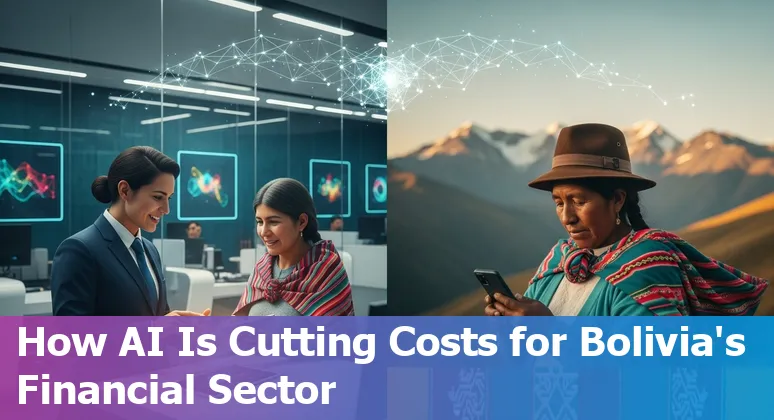
Too Long; Didn't Read:
AI is helping Bolivian financial services cut costs and boost efficiency - global studies show up to 30% lower operating/risk costs, loan approvals 30–50% faster, local pilots report 95%+ fraud accuracy, ~80% fund‑freeze time reduction and document extraction up to 99%.
AI matters for Bolivian financial services because it turns data-heavy, paper-bound processes into scalable, lower-cost operations: global studies project AI can cut operating and risk costs by as much as 30% while practical tools - from OCR document processing and fraud detection to 24/7 chatbots - have shortened loan approval times by 30–50% in some deployments.
That matters in Bolivia where smarter credit decisioning and microfinance automation can extend loans to underserved communities and reduce cash-handling costs in remote regions; see examples of credit decisioning and microfinance automation in Bolivia (Credit decisioning and microfinance automation in Bolivia).
Policymakers and banks should pair tech pilots with skills development - practical programs like Nucamp's AI Essentials for Work (Nucamp 15-week bootcamp) teach prompts and use cases so teams can move from pilots to production and turn promise into measurable savings (Roland Berger - The AI transformation in banking study).
| Bootcamp | Length | Early Bird Cost | Registration |
|---|---|---|---|
| AI Essentials for Work | 15 Weeks | $3,582 | Register for AI Essentials for Work (Nucamp) |
"When a technology is poised to transform an entire industry, you can't call that hype. The problem is not that banks expect too much of AI: Most of them still underestimate the impact it will have on business models." - Michael Pieper, Partner, Frankfurt Office, Central Europe
Table of Contents
- Digital payments and automation in Bolivia: cutting cash costs
- Fraud prevention and compliance in Bolivia: using AI to lower losses
- Alternative credit scoring and lending in Bolivia: expanding access efficiently
- Customer service and sales automation in Bolivia: scale cheaply
- Back-office efficiency and AI ops in Bolivia: document processing and MLOps
- Serving remote and rural Bolivia: resilience and reach with AI
- Regulation, partnerships and ecosystem support in Bolivia
- Concrete cost-saving examples and mini case studies for Bolivia
- Implementation challenges and practical steps for Bolivian firms
- Future outlook and recommendations for Bolivia's financial sector
- Conclusion: next steps for stakeholders in Bolivia
- Frequently Asked Questions
Find out how partnerships with global vendors and local banks are accelerating AI adoption across Bolivia.
Digital payments and automation in Bolivia: cutting cash costs
(Up)Digital payments and automation are rapidly cutting the real cost of cash in Bolivia by moving everyday transactions - from street vendors to bill payments - onto mobile wallets and interoperable platforms.
This shift lowers currency handling, security, and reconciliation expenses while creating transparent digital records. For a detailed overview of how QR codes, bank apps, and offline-capable tools are designed to reach rural areas, see the report linked below.
“Bolivia Advances Digital Payment Systems” - detailed overview of Bolivia digital payment systems, including QR codes, bank apps, and offline-capable tools: Bolivia digital payment systems overview (QR codes, bank apps, offline tools)
Mobile money providers such as Tigo Money are already central to that shift.
The Tigo Money wallet lets users send and receive funds, pay bills, use QR payments, and top up at more than 3,500 Tigo Money points nationwide, turning cash into immediately usable digital balances and reducing costly cash logistics (Tigo Money mobile wallet (Google Play) - send/receive funds & QR payments in Bolivia).
Public–private efforts and partnerships - like collaborations with Visa reported in regional coverage - accelerate onboarding and merchant acceptance, so that one vendor's scanned QR code can replace a heavy cash box and hours of manual reconciliation, trimming costs while widening access.
Fraud prevention and compliance in Bolivia: using AI to lower losses
(Up)Bolivian banks and fintechs are turning AI from promise into pocketbook savings by catching fraud earlier and cutting compliance cycles: homegrown startup LlamitAI,
Made in Bolivia • Built for the World
reports AI agents that automate fund-freezing and microcredit checks with 95%+ processing accuracy and measurable wins - an 80% cut in fund-freezing time (from multi-day queues to under a few hours) and six-figure annual savings for pilots - showing how local tooling can close costly manual gaps (LlamitAI AI agents for automated fund freezing and microcredit processing).
Those local gains mirror global patterns: adaptive, behavior-based models and real‑time scoring catch deepfakes, synthetic IDs and unusual transaction velocity in milliseconds, reducing false positives and staffing costs while preserving customer experience (see real‑time fraud detection use cases and tech approaches for banks and digital payments) (Banking AI real-time fraud detection use cases and technical approaches).
The net effect for Bolivia: fewer losses, faster regulatory reporting, and the ability to stop suspicious transfers before a vendor's heavy cash box is emptied - turning prevention into a practical advantage for both urban banks and rural payments networks.
| Metric / Use Case | Result (from research) |
|---|---|
| Processing accuracy (LlamitAI) | 95%+ |
| Fund freezing automation | ~80% processing time reduction; processing cut to under 2 hours; $80K annual savings |
| Microcredit automation | Loan approvals 5x faster; 40% lower default rate; 150% portfolio growth |
| Institutions onboarded / ARR (LlamitAI) | 10 institutions; $100K+ ARR |
Alternative credit scoring and lending in Bolivia: expanding access efficiently
(Up)Expanding credit access in Bolivia means moving past thin or missing bureau files and tapping the rich digital footprints Bolivians already leave: with only 12.64% of adults holding a credit card but 70.2% online, platforms that analyze app usage, delivery history or mobile top‑ups can let lenders say “yes” where rules once said “no.” RiskSeal's Bolivia solution combines 400+ alternative signals from 200+ channels - including local sources like PedidosYa, Hugo and TENGO - to deliver real‑time digital scores and localized onboarding support (RiskSeal alternative credit scoring for Bolivia), while industry evidence shows layering alternative data can cut the pool of “unscorable” applicants drastically and lift approvals by double digits (Equifax guide to using alternative data to evaluate credit risk).
The practical payoff is clear: lenders can underwrite a rural entrepreneur using delivery‑app behavior instead of a missing statement, turning informal cash flows into measurable creditworthiness and trimming both manual reviews and default risk.
| Metric | Value / Impact (from research) |
|---|---|
| Alternative signals per applicant | 400+ |
| Credit card penetration (Bolivia) | 12.64% |
| Bolivians online | 70.2% |
| Reduce unscorable applicants | up to 60% (Equifax) |
| Increase approvals | over 20% (Equifax) |
Customer service and sales automation in Bolivia: scale cheaply
(Up)Customer service and sales automation lets Bolivian banks and fintechs scale support without hiring at the same pace: conversational AI and voicebots can handle KYC queries, loan eligibility checks and routine transactions 24/7 so human agents focus on complex cases and sales follow‑ups.
Global vendors and guides show the payoff - Convin's banking bot research finds bots can offload up to 65% of routine queries and deliver roughly 70% faster response times, while loan‑bot examples let a customer asking
Am I eligible?
at 2AM get an instant, accurate answer (Convin banking bot research, Verloop loan chatbot guide).
Practical cost choices matter: prebuilt platforms like Emitrr AI chatbot for financial services start at around $99/month for SaaS deployments, and custom builds range widely - developers cite one‑time projects from a few thousand to >$25k and monthly running costs in the low hundreds to a few thousand - so Bolivian teams can pilot cheaply with SaaS, add local language voice support and scale to full integrations when ROI is clear (chatbot cost guide).
Back-office efficiency and AI ops in Bolivia: document processing and MLOps
(Up)Back‑office efficiency in Bolivia's banks and microfinance sector gets a practical lift from Intelligent Document Processing (IDP): by combining OCR, NLP and machine learning, IDP turns stacks of scanned KYC forms, income proofs and loan folders into structured data that plugs directly into underwriting, compliance and audit workflows, cutting manual review and reconciliation delays that still plague many regional operations.
Bolivian teams can adopt the six‑stage document pipeline - capture, classify, extract, enrich, validate and consume - used in production-grade MLOps to route low‑risk cases straight through while escalating exceptions to human reviewers, speeding approvals and improving audit trails (see the IDP overview at RaftLabs Intelligent Document Processing overview and the pipeline patterns at InfoQ six-stage document pipeline and MLOps patterns).
Real deployments show big wins - up to 99% extraction accuracy in leading systems and document handling time cut as much as 80% - so pilots often pay back in months rather than years and improve compliance readiness for ASFI/BCB reporting.
Start with a focused use case (KYC or loan intake), keep a human‑in‑the‑loop for edge cases, and iterate your models so straight‑through processing climbs steadily over time (RaftLabs Intelligent Document Processing for Banking and Financial Services, InfoQ six-stage document pipeline and MLOps for OCR and AI document processing, Docupile Intelligent Document Processing benefits and results).
| Metric | Typical Result (from research) | Source |
|---|---|---|
| Extraction accuracy | Up to 99% | KlearStack Intelligent Document Processing overview |
| Document handling time | Reduced up to 80% | Docupile Intelligent Document Processing results and case studies |
| ROI timeline | Often within 6–9 months | KlearStack ROI and Intelligent Document Processing article |
“IDP is not just about automation - it's about empowering roles across your organization to move faster, think smarter, and stay compliant.”
Serving remote and rural Bolivia: resilience and reach with AI
(Up)Reaching Bolivia's highlands and Amazon plains means designing financial services that survive thin or intermittent networks, and AI-powered solutions are already being paired with connectivity-first thinking to do just that: offline-capable digital payment systems and hybrid architectures let mobile wallets and QR payments queue and reconcile transactions when a signal returns (Bolivia offline-capable digital payment systems), while national programs such as PRONTIS and targeted infrastructure work have driven base‑station installs and fiber rollouts aimed at nearly 9,000 previously unserved places, shrinking the access gap needed for AI to scale (PRONTIS rural connectivity program and rural connectivity best practices).
Practical resilience comes from small wins on the ground - a shared satellite hub model that kept connectivity alive for 11 remote communities shows how combined satellite, mobile and AI mapping can extend fraud detection, offline KYC capture and loan decisioning to places where a vendor's cash box used to be the only record of value.
“In Bolivia, most of the population [concentrated in urban areas] that accesses an internet connection does so through mobile phones”.
Regulation, partnerships and ecosystem support in Bolivia
(Up)Bolivia's recent regulatory shift is turning a once–grey fintech landscape into a clearer path for scale: ASFI's Resolution 540/2025 (in force July 8, 2025) codifies rules for Financial Technology Companies - from digital payments and remittances to tokenized assets and blockchain-enabled services - and explicitly governs both domestic firms and foreign players that partner with local entities (ASFI Resolution 540/2025 Bolivia financial technology regulations); the new framework pairs licensing and disclosure requirements with a supervised Regulatory Sandbox (Entorno Controlado de Pruebas - ECP) so innovators can test services under real but limited conditions, lowering legal risk while regulators learn alongside them (Bolivia regulatory sandbox (Entorno Controlado de Pruebas) and fintech authorization).
Regional research shows sandboxes are one of the most effective “innovation facilitators” to reduce uncertainty and encourage convergence across markets (IDB report on regulatory sandboxes in Latin America and the Caribbean), so practical partnerships - compliance-savvy local teams, ASFI engagement, and pilot-stage alliances with banks or telcos - are now the fastest route for fintechs to turn pilots into licensed, cost-cutting services that reach urban centers and the most remote communities alike.
Concrete cost-saving examples and mini case studies for Bolivia
(Up)Concrete cost savings in Bolivia often come from combining practical tech choices with local operations: Tigo launched Tigo Money in January 2013 to reach remote customers where a vendor's cash box was once the only ledger, and researchers found that 98% of Bolivians have mobile access - so scaling digital wallets can hit many users quickly while serving areas where travel is a day‑long ordeal (one community must ride an hour and forty‑five minutes over rough roads to reach the nearest city) (Tigo Money rural Bolivia case study).
Interoperability with banks via a central switch avoids repeated cash‑in/cash‑out steps that add handling costs (bank‑to‑wallet flows grew notably in regional data), so fewer conversions mean lower logistics and security expense (Mobile money interoperability in Bolivia (GSMA case study)).
Operational improvements also pay: Tigo's service quality program cut premium churn by ~15% and lifted willingness to recommend by over 5%, showing that smarter CX, not just tech, protects revenue and trims support costs (Tigo Bolivia service quality initiative (ContactCenterPipeline)).
| Metric | Value / Impact | Source |
|---|---|---|
| Mobile access (Bolivia) | ~98% | IMTFI eScholarship mobile access in Bolivia |
| Rural extreme poverty | ~40% of rural population | IMTFI eScholarship rural poverty in Bolivia |
| Bank↔wallet transaction share (trend) | Noted growth; interoperability reduces cash conversions | GSMA mobile-money interoperability case study (Bolivia) |
| Customer outcomes from CX program | Premium churn ↓ ~15%; willingness to recommend ↑ >5% | ContactCenterPipeline: Tigo service-quality initiative |
Implementation challenges and practical steps for Bolivian firms
(Up)Implementation in Bolivia often starts with hard realities: mountainous terrain and patchy networks make seamless rollouts a technical and user‑experience challenge, so firms should architect for intermittent connectivity - offline‑capable apps, queued QR payments and satellite or shared hub fallbacks - rather than assuming constant coverage (see the Beaumont Capital Markets overview on digital payments in Bolivia).
Operationally, practical steps include launching narrow pilots (KYC intake or a single microloan product), partnering early with telcos and agents to extend cash‑in/out reach, and building local change programs to close digital literacy and trust gaps - BancoSol's CIBSOL and gamified GanaSol experience show how an innovation hub plus incentives can move customers from skepticism to regular digital use (Accion case study on CIBSOL and GanaSol).
Track adoption with clear KPIs (logins, bill payments, timely repayments), keep a human‑in‑the‑loop for edge cases while models learn, and use phased integrations so legacy systems aren't disrupted; these choices turn pilots into sustained savings and bring services to vendors who once relied on a cash box and a two‑hour ride to the nearest city.
“Private and public investment in digital connectivity can stimulate new sectors and jobs, offer new areas of trade, and increase the efficiency, quality and inclusiveness of government programs ranging from education to agricultural extension in remote rural areas.” - William Maloney, World Bank
Future outlook and recommendations for Bolivia's financial sector
(Up)Bolivia's financial sector can move from pilot projects to measurable savings by treating AI as an operational toolbox rather than a one-off experiment: prioritize tight pilots in payments, alternative credit scoring and fraud detection that demonstrate ROI, pair those pilots with strong data governance and sandboxed regulatory engagement, and invest in workforce retraining so teams can run and tune models in production.
Regional evidence shows rapid AI momentum - CAF reports that by 2023 nearly 47% of firms had implemented AI and many more were exploring it - so Bolivian banks and fintechs should tap public‑private channels that fund training, cloud credits and scaling support (CAF blog: Artificial Intelligence for Financial Inclusion), while policy papers urge clearer data frameworks and interoperability to unlock full value (IIF report: AI and Financial Services in Latin America and the Caribbean).
The practical next steps: start small, measure impact, embed human‑in‑the‑loop controls for edge cases, and use regulated sandboxes and telco partnerships to extend services where a vendor's heavy cash box still rules the day - doing so helps Bolivia capture a slice of the region's AI opportunity and deliver cheaper, more reliable services to urban and remote customers alike.
| Metric | Value | Source |
|---|---|---|
| Firms with AI in production (LAC) | ~47% (by 2023) | CAF blog: Artificial Intelligence for Financial Inclusion |
| Firms exploring AI (LAC) | ~40% | CAF blog: Artificial Intelligence for Financial Inclusion |
| Regional service‑economy opportunity | US$100 billion (estimate) | J.P. Morgan analysis: Harnessing Generative AI to revolutionize Latin America's service economy |
“AI has ‘tremendous capacity to scale faster, new business models to address lack of efficiency and cost of essential services, improving affordability, access, and convenience,'” - Irene Arias Hofman, IDB Lab (quoted in J.P. Morgan analysis)
Conclusion: next steps for stakeholders in Bolivia
(Up)Next steps for Bolivian stakeholders are practical and sequential: pick narrowly scoped pilots (payments, fraud detection, alternative credit scoring) that can show ROI in months, pair each pilot with clear compliance controls - turning regulatory updates into automated checks with Proactive Compliance Monitoring - and lock in human‑in‑the‑loop reviews so models learn without disrupting customers who still rely on a vendor's heavy cash box; see Nucamp's guide to credit decisioning and microfinance automation for deployment ideas (Guide to credit decisioning and microfinance automation in Bolivia).
Parallel investments in workforce reskilling are critical - practical courses such as Nucamp's AI Essentials for Work give teams the prompt‑writing and operational skills to run models in production (AI Essentials for Work bootcamp - 15 Weeks) - and regulators plus firms should explore Bolivia's newly regulated crypto corridor as a testbed for lower‑cost remittances under supervised channels (Bolivia crypto policy and regulation 2024).
Start small, measure defined KPIs (approval time, charge-offs, cash‑handling cost), and scale only when pilots show clear savings - this sequence turns promise into sustained efficiency across urban and remote Bolivia.
| Bootcamp | Length | Early Bird Cost | Registration |
|---|---|---|---|
| AI Essentials for Work | 15 Weeks | $3,582 | Register: AI Essentials for Work bootcamp - Nucamp |
Frequently Asked Questions
(Up)How is AI cutting costs and improving efficiency for financial services in Bolivia?
AI is turning data-heavy, paper-bound processes into scalable, lower-cost operations. Global studies project AI can cut operating and risk costs by as much as 30%. Practical tools - OCR document processing, real-time fraud detection, automated microcredit decisioning and 24/7 chatbots - have shortened loan approval times by 30–50% in some deployments and reduced manual reconciliation, cash-handling and staffing expenses.
What concrete results have Bolivian deployments shown (examples and metrics)?
Local pilots show measurable savings: Tigo Money scaled digital wallets to reduce cash logistics across 3,500+ points; LlamitAI reports 95%+ processing accuracy, ~80% reduction in fund‑freezing time (from multi-day queues to under two hours) and six-figure annual pilot savings (~$80K), plus microcredit automation that made approvals 5x faster, cut defaults by ~40% and enabled ~150% portfolio growth. Broader reach is possible: mobile access in Bolivia is cited at ~98%.
How do alternative credit scoring and fraud detection with AI expand access and reduce losses?
Alternative scoring taps hundreds of digital signals (examples cite 400+ signals from 200+ channels) to underwrite people with thin bureau files - Bolivia has low credit card penetration (12.64%) but ~70% online - letting lenders replace missing statements with app, delivery or top‑up behavior. Layering alternative data can reduce unscorable applicants by up to 60% and increase approvals by double digits. Fraud solutions use behavior-based, real-time scoring to catch synthetic IDs and unusual velocity in milliseconds, lowering false positives and staffing costs.
What back-office and customer-service efficiencies should Bolivian firms expect, and what's the typical ROI?
Intelligent Document Processing (OCR + NLP + ML) can reach extraction accuracies up to ~99% and cut document handling time by as much as 80%, with many pilots paying back in 6–9 months. Conversational AI and voicebots can offload up to ~65% of routine queries and deliver ~70% faster responses. SaaS pilot options start at low monthly fees (examples around $99/month) while custom projects vary from a few thousand to >$25k one-time; ongoing costs are typically in the low hundreds to a few thousand per month. Pairing pilots with workforce training accelerates production readiness.
What practical steps should banks, fintechs and policymakers in Bolivia take to scale AI safely and effectively?
Start with tightly scoped pilots (payments, KYC intake, fraud detection, alternative scoring), keep a human‑in‑the‑loop for edge cases, and measure KPIs like approval time, charge-offs and cash‑handling cost. Partner early with telcos and agents to support cash‑in/out and offline-capable apps (queued QR, satellite fallbacks) for rural areas. Use Bolivia's supervised Regulatory Sandbox under ASFI (Resolution 540/2025) to test services with lower legal risk, and invest in reskilling (for example, practical courses such as Nucamp's AI Essentials for Work) so teams can move pilots into production and realize measurable savings.
Understand why conversational AI replacing routine call center tasks makes language and escalation skills more valuable than ever.
Strengthen real‑time defenses with Dynamic Fraud Detection & AML Monitoring designed for high‑cash and cross‑border flows common in Bolivia.

Ludo Fourrage
Founder and CEO
Ludovic (Ludo) Fourrage is an education industry veteran, named in 2017 as a Learning Technology Leader by Training Magazine. Before founding Nucamp, Ludo spent 18 years at Microsoft where he led innovation in the learning space. As the Senior Director of Digital Learning at this same company, Ludo led the development of the first of its kind 'YouTube for the Enterprise'. More recently, he delivered one of the most successful Corporate MOOC programs in partnership with top business schools and consulting organizations, i.e. INSEAD, Wharton, London Business School, and Accenture, to name a few. With the belief that the right education for everyone is an achievable goal, Ludo leads the nucamp team in the quest to make quality education accessible