









How AI Is Helping Healthcare Companies in Bangladesh Cut Costs and Improve Efficiency
Last Updated: September 5th 2025
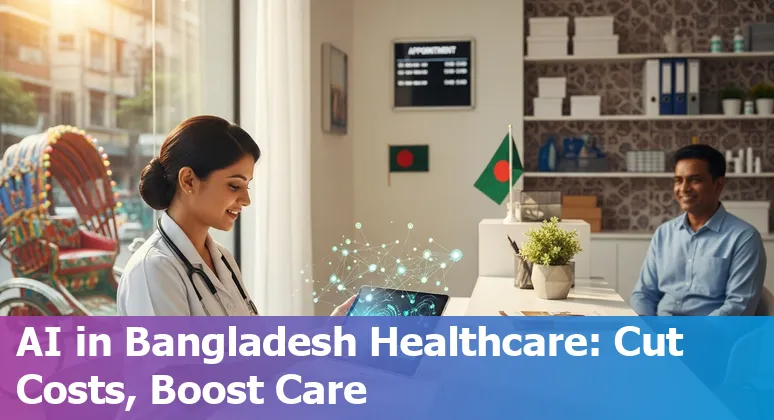
Too Long; Didn't Read:
AI is helping healthcare companies in Bangladesh cut costs and boost efficiency by automating admin tasks (about 30% of spending), expanding telemedicine/mobile triage (87% household phone reach), and speeding diagnostics - e.g., AI mammogram reads 30× faster with ~99% accuracy.
Bangladesh's National Digital Health Strategy 2023–2027 is turning talk into targets - nationwide EHRs, AI-based decision support for frontline workers, and telehealth across upazilas - to tackle long waits, staffing shortages and rising costs by using data and automation at scale (Bangladesh Digital Health Strategy 2023–2027).
Local innovators and labs are already proving the case: CMED Health and university groups are piloting AI CDSS, telemedicine and Susastho.ai to expand screening, referrals and SAM-equipped remote care, and AI tools can evaluate mammograms “30 times faster with ~99% accuracy,” cutting diagnostic delays and costly follow-ups (see analysis of AI for health in Bangladesh).
With as much as 30% of health spending tied to administrative work, practical upskilling matters - programs like Nucamp's 15-week AI Essentials for Work teach nontechnical teams how to use AI tools and prompts to streamline workflows and lower operating costs (AI for Health overview, Nucamp AI Essentials registration).
| Bootcamp | Length | Early Bird Cost | Focus |
|---|---|---|---|
| AI Essentials for Work | 15 Weeks | $3,582 | Practical AI skills, prompts, workplace use |
I feel my confidentiality is maintained. It's a blessing.
Table of Contents
- How AI-powered diagnostics lower costs in Bangladesh
- Predictive analytics, outbreak forecasting and resource planning in Bangladesh
- Big Data, hospital operations and supply chain savings in Bangladesh
- AI-enabled telemedicine, chatbots and remote monitoring in Bangladesh
- Automation in labs, pharmacies and prescribing in Bangladesh
- Startups, research groups and partnerships driving AI in Bangladesh
- Benefits for population health and equity in Bangladesh
- Challenges, regulation and data privacy in Bangladesh
- How healthcare companies in Bangladesh can start with AI (practical steps)
- Conclusion - future outlook for AI in Bangladesh healthcare
- Frequently Asked Questions
See how telemedicine growth in Bangladesh is being amplified by conversational AI and remote monitoring.
How AI-powered diagnostics lower costs in Bangladesh
(Up)AI-powered diagnostics are already shaving costs in Bangladesh by moving fast, accurate tests out of crowded hospitals and into communities where they cut delays and downstream expenses: AI-enabled mammogram evaluation can be “30 times faster with ~99% accuracy,” which helps avoid unnecessary biopsies and repeat visits (AI for Health overview: AI-powered diagnostics transforming healthcare); mobile, backpack-style X‑ray units now run images through CAD4TB and return a TB probability score in about 60 seconds, letting clinicians triage and confirm cases faster (one site doubled pediatric TB diagnoses and saw X‑ray throughput jump from “just a few” to five–seven children a day) (Devex report on mobile AI-powered X‑rays and pediatric TB detection in Bangladesh).
Local platforms and startups - CMED Health's CDSS, Susastho.ai and smartphone BScan screening - layer AI into referral pathways so high-risk patients get earlier care and lower-cost outpatient management instead of costly late-stage interventions, and open tools like Ark+ suggest easier, equitable rollout of robust chest X‑ray models into district clinics (Medical Xpress article on Ark+ chest X‑ray AI tool for district clinics).
The result is tangible: quicker reads, fewer unnecessary procedures, and more care delivered where people live - sometimes from a rucksack in a schoolyard, with a clear score in under a minute that decides the next step.
“This is just the beginning,” said Dr. Senjuti Kabir.
Predictive analytics, outbreak forecasting and resource planning in Bangladesh
(Up)Predictive analytics is turning weather, satellite feeds and routine case counts into practical early warnings for Bangladesh - most notably a BMC Infectious Diseases study that used Stochastic Bayesian Downscaling (SBD) plus 13 meteorological predictors to convert sparse monthly reports into nearly 390,000 daily signals and push Random Forest accuracy to 95.8%, a 28.5% lift over monthly models and an 89.3% cut in MAPE, even projecting a 2024 daily dengue peak near 1,382 cases between August and October (BMC Infectious Diseases study: multivariate dengue forecasting with stochastic Bayesian downscaling); complementary work finds LSTM sequence models also perform strongly (≈87.98% accuracy) in multiyear, meteorology‑aware forecasts, giving planners multiple algorithmic options (IEEE comparison of LSTM, GRU, and RNN models for dengue forecasting).
These methods matter because higher‑resolution forecasts translate into time to preposition staff, target larval‑source campaigns and issue district advisories - turning a monthly blob on a dashboard into a precise early warning that can be acted on days or weeks earlier.
For implementers, local guides on predictive surveillance show how to connect models to routine workflows and district response plans (Predictive surveillance systems implementation guide for Bangladesh healthcare).
| Model | Data Type | Reported Accuracy |
|---|---|---|
| Random Forest (RF) | SBD downscaled daily | 95.8% |
| Decision Tree (DT) | Actual monthly | 74.6% |
| LSTM | Multivariate time series (2000–2022) | 87.98% |
Big Data, hospital operations and supply chain savings in Bangladesh
(Up)Big Data is proving to be the practical lever for cutting costs across Bangladeshi hospitals: by turning patient histories, admission flows and stock levels into real‑time signals, administrators can optimize bed allocation, shrink stockouts and reduce costly last‑minute purchasing, a direction encouraged by the country's push to scale AI and data tools in health (see Inspira's overview: future of digital healthcare in Bangladesh - Inspira overview).
Simple mobile tools that let ward staff update bed status from any smartphone - rather than queuing at a shared PC - have already shown usefulness and acceptance in studies, speeding turnover and smoothing patient flow (mobile bed management usability study - ETASR).
Market dynamics also point to increasing investment: the global hospital bed management systems sector is forecast at about $2.39B in 2025 with robust growth, underscoring why hospitals that harness analytics for procurement, staffing and patient flow can capture outsized savings and operational resilience (Hospital Bed Management Systems global market report).
| Indicator | Value |
|---|---|
| Bangladesh healthcare industry (2025 estimate) | $14 billion; 10.3% CAGR |
| Hospital Bed Management Systems market (2025) | $2.39 billion; ~9.7% CAGR |
| Mobile bed management app usability (study) | Usefulness 3.45; Ease of use 3.40; Satisfaction 3.42 (Likert 1–5) |
The payoff can be as tangible as fewer emergency holds and a pharmacy that reorders just in time - saving money while freeing clinicians to care.
AI-enabled telemedicine, chatbots and remote monitoring in Bangladesh
(Up)AI-enabled telemedicine, chatbots and remote monitoring are knitting care into people's daily lives across Bangladesh, turning long clinic queues into quick, local interactions: CMED Health's apps link simple devices to Health Visitors (Smart Sastho Kormi) so a village worker can capture vitals, launch a teleconsult and route a patient into an AI‑guided referral pathway in minutes - an example of the Virtual Hospital and IoT home monitoring described in the AI for Health overview: AI for Health overview on virtual hospitals and IoT home monitoring.
Chatbot engines like Susastho.ai offer Bangla health education and risk triage for sexual, reproductive and mental health, while practical tools for virtual symptom triage in Bengali can cut needless clinic visits and concentrate scarce doctors' time where it counts: Bengali virtual symptom triage for telemedicine in Bangladesh.
The payoff is concrete: fewer avoidable trips, earlier referrals for high‑risk patients, and remote monitoring that keeps chronic care out of costly hospitals - sometimes initiated by a single pulse‑ox reading and a chat window on a community health worker's phone.
Automation in labs, pharmacies and prescribing in Bangladesh
(Up)Automation in Bangladesh's clinical labs and hospital pharmacies is a practical, near-term way to cut costs and reduce errors: integrated informatics like the BD Synapsys™ informatics platform for microbiology dashboards and workflow automation gives microbiology teams on‑demand dashboards and workflow rules that speed finalization and traceability, while modular hardware such as BD Kiestra™ Total Lab Automation for automated inoculation, incubation, imaging and digital culture reading automates inoculation, incubation, imaging and digital culture reading to shrink manual handling and turnaround time.
In pharmacies, robotic dispensers and integrated inventory systems cut picking and counting work, reduce stockouts and can dispense pouches or boxes in seconds - freeing scarce pharmacists for clinical checks rather than repetitive tasks (see regional experience in the pharmacy and lab automation in Asian hospitals: regional experience and efficiency gains piece).
The payoff for Bangladesh is concrete: fewer lab bottlenecks, faster antibiotic stewardship decisions, and pharmacy accuracy that protects patients - think of a robotic “highway” moving plates or pouches so staff no longer play traffic cop in the lab.
“The number one thing to keep in mind is that efficiency should be based on good accuracy. If you are giving out prescriptions as fast as you can but they are the wrong ones, you will cause harm to your patients and ruin your reputation. Accuracy should always come first,” said Mr Lu Liang.
Startups, research groups and partnerships driving AI in Bangladesh
(Up)Startups, university labs and cross‑sector partnerships are rapidly converting Bangladesh's policy momentum into concrete AI projects that cut costs and sharpen care: a high‑profile example is United International University's BDT 13 crore HEAT grant from the UGC and World Bank to pilot health AI at scale - funding three projects that directly target everyday waste and risk in clinics, from SmartAMR's AI tools to reduce prescription errors and antimicrobial resistance to AIMScribe's automated scribing and counseling systems that aim to shrink documentation burdens and speed safe prescribing (details via UIU's HEAT announcement).
These research teams, incubated through UIU's IRIIC, create the building blocks hospitals and startups need to replace repetitive admin work with validated models and faster triage, helping clinics redeploy staff to patient care rather than paperwork.
For implementers and managers planning pilots, Nucamp's practical guide to AI in Bangladesh healthcare lays out operational steps for connecting campus prototypes to district workflows and telemedicine pathways.
| Project | Lead(s) | Primary Focus |
|---|---|---|
| SmartAMR | Dr. Tahmina Foyez; Dr. Ohidujjaman Tuhin | Improve adherence, reduce prescription errors, tackle AMR |
| AIMScribe | Prof. Mohammad Nurul Huda; Prof. Kaled Masukur Rahman | AI scribing, prescription counselling, streamline clinical documentation |
| Modular Amphibious Homes | Dr. Md. Saiful Islam; Nazmus Sakib Pallab | Climate‑resilient housing for vulnerable communities |
Benefits for population health and equity in Bangladesh
(Up)Benefits for population health and equity in Bangladesh show up when practical AI tools meet everyday needs: virtual symptom triage in Bengali can reduce unnecessary clinic visits in rural districts, keeping scarce clinicians available for higher‑risk patients and lowering travel burdens (Bengali virtual symptom triage for Bangladesh healthcare); predictive surveillance systems could transform outbreak response across Bangladesh's districts by turning routine data into actionable alerts that steer vaccines, staffing and vector control where they're needed most (predictive surveillance systems for outbreak response in Bangladesh).
Crucially, these gains depend on inclusive workforce upskilling - practical courses in EHR management and SQL basics help clinic staff use data tools rather than be sidelined by them (EHR management and SQL training for Bangladeshi clinic staff) - so that a timely, local AI interaction benefits entire communities instead of just tech‑savvy centers.
Challenges, regulation and data privacy in Bangladesh
(Up)Deploying AI across Bangladesh's health system promises real savings, but the legal and privacy terrain is uneven and urgent: the Cyber Al Security Act 2023 (CA 2023) is now the primary law, with a very broad Section 26 that treats common identifiers (name, photo, national ID, passport, bank account, etc.) as “identity information” and makes unauthorised collection or use an offence carrying up to two years' imprisonment or a fine of Taka 5,00,000, while core definitions (like “sensitive personal data”) and the meaning of “lawful authority” remain unclear - an ambiguity that makes routine choices (what to store in an EHR, how to share a scan for an AI read) legally fraught (see a practical summary of the CA 2023 at DLA Piper).
There is no statutory duty to appoint a DPO, no mandatory breach notification rule, and few explicit security or cross‑border transfer rules outside sectoral limits for banks and telcos, so health teams must balance innovation with caution.
Policymakers and implementers will need clearer patient‑data rules and enforcement pathways - echoed in calls for a dedicated data protection framework and targeted safeguards for sensitive health records - to ensure AI reduces costs without putting patients or frontline staff at legal risk (see the policy brief on personal health data and the draft Data Privacy Act overview).
| Item | Current position in Bangladesh |
|---|---|
| Primary law | Cyber Al Security Act 2023 (CA 2023) |
| Defines identity information | Yes (Section 26: wide terms) |
| Defines sensitive personal data | No |
| Data protection authority | Cyber Security Agency |
| DPO / registration required | No |
| Breach notification | No statutory requirement |
| Sectoral transfer limits | Banks/telcos have specific restrictions |
How healthcare companies in Bangladesh can start with AI (practical steps)
(Up)Healthcare companies in Bangladesh can start with AI by choosing pragmatic, locally anchored pilots: partner with government and university teams (the APRU/IPUR collaboration shows how joint research with policy-makers and Google support can move pilots toward national use), focus on mobile‑first tools because 87% of households have a phone and nearly half have internet access, and build pilots that center stakeholders - pregnant women, community health workers and clinicians - so solutions like chatbots for expecting mothers and wearable vital‑sign monitors answer real needs rather than tech curiosities; invest in workforce upskilling (EHR management and SQL basics are foundational) and data‑literacy programs that deliberately include women and community users, and link models to operational workflows using pragmatic guides for predictive surveillance and deployment.
Start with a tight, measurable use case (triage, referral routing or stock reordering), run short iterative pilots that track safety and adoption, and scale only when clinical teams, regulators and patients trust the path forward - imagine a chatbot in a mother's pocket answering a late‑night worry and routing her to the right clinic by morning.
See the IPUR maternal‑health study for partnership lessons and Nucamp AI Essentials for Work syllabus (practical AI training and deployment guides) for hands‑on next steps.
| Practical step | Evidence / source |
|---|---|
| Partner with government & universities | IPUR APRU maternal health AI adoption study in Bangladesh |
| Start mobile‑first pilots and stakeholder testing | Mobile reach + chatbots/wearables (IPUR findings) |
| Upskill staff; connect models to workflows | EHR management and SQL basics training resources for Bangladesh healthcare staff and Predictive surveillance deployment guide for healthcare AI in Bangladesh |
“This approach aims to achieve real transformative impact going beyond traditional research outputs and benefits,” said Christina Schönleber.
Conclusion - future outlook for AI in Bangladesh healthcare
(Up)Bangladesh's AI moment looks practical and immediate: national strategies, local pilots like Susastho.ai and CMED Health, and new quality‑improvement momentum mean tools that speed diagnoses, trim admin work (about 30% of spending) and push care into communities are shifting from experiments to operations - for example AI mammogram reads that are “30 times faster with ~99% accuracy” and mobile triage that routes patients to the right level of care.
Success will hinge on pairing technology with governance, workforce upskilling and finance: clear data rules, reliable connectivity and trained staff are the linchpins that turn faster reads and chatbot triage into real cost savings and equity.
Policymakers and providers should follow the Quality Improvement Convention's call for collaborative action while scaling pilots that measure safety, adoption and return; practical training programs such as Nucamp's AI Essentials for Work help nontechnical teams adopt prompt‑driven workflows and operationalize AI across clinics and supply chains.
With focused pilots, accountable rules and deliberate upskilling, AI can help Bangladesh deliver the right care, at the right place, at the right time - without leaving communities behind (AI for Health: Revolutionizing Healthcare through Innovation - The Coronal, Nucamp AI Essentials for Work syllabus - practical AI skills for the workplace, Bangladesh Quality Improvement Convention 2025 - IHI summary).
| Program | Length | Early Bird Cost | Focus |
|---|---|---|---|
| AI Essentials for Work | 15 Weeks | $3,582 | Practical AI skills, prompts, workplace use |
“It is a milestone for us all to host the Bangladesh Quality Improvement Convention, bringing together partners and stakeholders united in our commitment to safe, effective, and people-centered health services.”
Frequently Asked Questions
(Up)How is AI cutting costs and improving efficiency in Bangladesh's healthcare system?
AI is lowering costs and raising efficiency by automating diagnostics and administrative tasks, expanding telemedicine, and improving supply‑chain and bed management. Examples include AI‑assisted mammogram reads (far faster with high accuracy), mobile CAD4TB X‑ray triage that returns TB probability scores in about 60 seconds, AI clinical decision support systems (CDSS) and chatbots for local triage in Bangla. These tools move care into communities, reduce unnecessary referrals and procedures, shrink turnaround times, and cut repetitive admin work that accounts for roughly 30% of health spending.
What measurable performance improvements have AI models and pilots shown in Bangladesh?
Local pilots and studies report large, quantifiable gains: AI mammogram evaluation has been reported as up to 30 times faster with approximately 99% accuracy; mobile X‑ray CAD4TB sites doubled pediatric TB diagnoses and increased throughput from a few children per day to about five–seven; a Random Forest model using stochastic Bayesian downscaling achieved 95.8% accuracy (a 28.5% lift over monthly models) for downscaled daily infectious‑disease signals, while an LSTM sequence model reached about 87.98% accuracy in multiyear forecasts. Administratively, roughly 30% of health spending is tied to administrative work, indicating large potential savings when workflows are automated.
What regulatory and data‑privacy risks should implementers consider in Bangladesh?
The primary law is the Cyber Al Security Act 2023 (CA 2023). Section 26 broadly defines identity information (name, photo, national ID, passport, bank account, etc.) and makes unauthorized collection/use an offense with penalties up to two years' imprisonment or a fine of Taka 500,000. Important gaps remain: there is no statutory definition of 'sensitive personal data', no mandatory data‑protection officer (DPO) or breach‑notification requirement, and the Cyber Security Agency is the enforcement body. Implementers must therefore balance innovation with caution, minimize sharing of identifiable health data, seek legal guidance, and push for clearer sectoral rules and safeguards.
How can healthcare companies in Bangladesh start practical, low‑risk AI pilots?
Begin with tight, measurable use cases (triage, referral routing, stock reordering or bed allocation), run short iterative pilots, and focus mobile‑first designs because ~87% of households have a phone. Partner with government and university teams for legitimacy and scale, include stakeholders (community health workers, pregnant women, clinicians) in design, and link models to operational workflows. Invest in workforce upskilling (practical EHR management and basic SQL) and monitor safety, adoption and return before scaling. Practical training offerings such as Nucamp's 15‑week AI Essentials for Work (early‑bird cost listed at $3,582) can help nontechnical teams adopt prompt‑driven workflows.
Which local startups, research groups and partnerships are driving AI adoption in Bangladesh healthcare?
Notable local actors include CMED Health (CDSS and telemedicine), Susastho.ai (Bangla chatbots and triage), smartphone BScan screening pilots, and university projects incubated at United International University (UIU) supported by a BDT 13 crore HEAT grant. Research teams and pilots such as SmartAMR (prescription/AMR reduction), AIMScribe (automated scribing and counselling), and IPUR/APRU collaborations help move prototypes into district workflows. These startups and partnerships are the primary channels translating national strategy into operational pilots.
Understand how AI in radiology risks could shift technician roles toward oversight and interventional specialties.
Imagine the impact of AI-assisted robotic surgery planning for tertiary hospitals in Dhaka and Chittagong.

Ludo Fourrage
Founder and CEO
Ludovic (Ludo) Fourrage is an education industry veteran, named in 2017 as a Learning Technology Leader by Training Magazine. Before founding Nucamp, Ludo spent 18 years at Microsoft where he led innovation in the learning space. As the Senior Director of Digital Learning at this same company, Ludo led the development of the first of its kind 'YouTube for the Enterprise'. More recently, he delivered one of the most successful Corporate MOOC programs in partnership with top business schools and consulting organizations, i.e. INSEAD, Wharton, London Business School, and Accenture, to name a few. With the belief that the right education for everyone is an achievable goal, Ludo leads the nucamp team in the quest to make quality education accessible