









Top 10 Industries Hiring AI Talent in San Marino Beyond Big Tech in 2026
By Irene Holden
Last Updated: April 23rd 2026
Too Long; Didn't Read
Healthcare and fintech lead San Marino's AI hiring in 2026, with senior roles in biotech paying over €85,000 and fraud detection analysts earning up to €100,000. These industries offer competitive salaries, lower cost of living than Milan, and the chance to solve real-world problems in a nation with a rich data heritage.
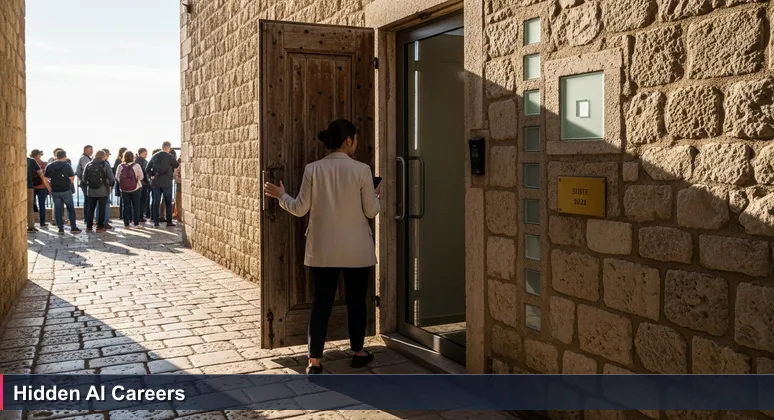
Every tourist on Via Basilicius looks up at the Rocca Guaita fortress, phones raised toward the castle. One young professional turns the opposite way. She steps through a weathered wooden door set into a 14th-century stone wall, walks toward an unmarked glass door built into the adjoining façade. A small brass plate reads only a suite number. Inside, a team is training fraud-detection models on transaction data from Cassa di Risparmio di San Marino. None of them work for a Silicon Valley giant. They earn competitive salaries in euros, enjoy a lower cost of living than Milan, and solve problems that matter to a real economy.
This is the hidden truth of AI careers in 2026: the most urgent hiring isn’t happening in glass campuses. It’s happening in bank vaults, hospital wings, factory floors, and state archives. The Republic of San Marino and the surrounding Emilia-Romagna corridor - Rimini, Bologna, Urbino - are quietly becoming a laboratory for domain-specific AI. Thanks to initiatives like San Marino Innovation and proximity to the Bologna Technopole, the region offers fertile ground for professionals who want impact over prestige.
Below are ten industries hiring AI talent beyond big tech, ranked by relevance, salary potential, and growth trajectory. Each entry includes concrete roles, salary bands in EUR, local employers, and the unique skills that make these roles different from a generic ML engineer job. As Pangea.ai notes, even traditional Italian industries are now embracing AI - and in San Marino, the embrace happens right behind those weathered wooden doors.
Table of Contents
- Introduction: Beyond Big Tech
- Healthcare and Biotech
- Fintech and Banking
- Manufacturing and Precision Engineering
- Tourism and Hospitality
- Logistics and Supply Chain
- Energy and Utilities
- Retail and E-commerce
- Real Estate and Proptech
- Education and Edtech
- Government and Cultural Heritage
- Conclusion: The Quiet Movement
- Frequently Asked Questions
Healthcare and Biotech
The strongest non-tech sector for AI in San Marino is healthcare and biotech. Local employers like the Azienda Sanitaria (ISS) and a growing network of biotech startups are integrating machine learning into predictive diagnostics, genomic modeling, and resource optimization. The sector benefits directly from partnerships with the Università degli Studi della Repubblica di San Marino for digital health initiatives, and from proximity to Bologna’s Technopole - one of Italy’s premier biomedical research clusters. Growth is high, supported by state funding through the San Marino Innovation initiative.
Salaries reflect the specialised nature of the work: entry-level Medical Data Scientists and AI Bio-informaticians earn €38k-€45k, mid-level roles command €55k-€70k, and senior positions reach €85k+. These figures are competitive with Milan but benefit from a significantly lower cost of living. The skill demands differ sharply from consumer-facing AI. Professionals must master HIPAA/GDPR compliance, medical imaging standards (DICOM), and model explainability sufficient for clinical trust - because errors in this domain carry life-or-death consequences.
For career changers with clinical backgrounds - doctors, nurses, lab technicians - the transition is remarkably natural. You already understand the data and the stakes; the missing piece is fluency in deep learning and regulatory frameworks. According to Schiller International University’s 2026 salary analysis, healthcare AI roles are among the fastest-growing and best-compensated in Europe. IABAC similarly identifies healthcare as a primary driver of AI hiring beyond big tech. In San Marino, the unmarked glass door leads not to a generic tech lab, but to a place where models literally save lives.
Fintech and Banking
The same young professional who walked past the tourists on Via Basilicius now sits inside a glass-walled lab training fraud-detection models. She works for Cassa di Risparmio di San Marino, one of several local banks fueling an aggressive AI transformation. San Marino’s traditional banking sector is evolving into an AI-native environment, with employers like Banca di San Marino and Banca Agricola Commerciale racing to automate compliance, detect anomalies in real time, and deliver personalised wealth management at scale.
Mid-level Fraud Detection Analysts now earn €60k-€80k, while senior Risk Quants surpass €100k+. Entry-level roles start at €40k-€48k, competitive with Milan but with far less competition for openings. The skills that differentiate these roles from generic ML engineering include deep knowledge of AML/KYC directives, secure multi-party computation for handling sensitive financial data, and the ability to deploy models that monitor millions of transactions without violating privacy laws. For career changers from finance or accounting, this is one of the smoothest paths into AI - you already understand the regulatory landscape.
The Selby Jennings report on fintech hiring confirms that risk quant roles globally are among the best-paying in 2026. Local banks are matching those trends, offering slightly lower nominal salaries than London but dramatically less competition and the chance to shape an entire nation’s financial infrastructure. According to Paylab’s San Marino salary data, AI engineers in the republic earn competitive local rates that, combined with the lower cost of living, make these roles genuinely attractive. The unmarked glass door in the medieval wall doesn’t lead to a generic fintech startup - it leads to the command centre of a banking system in transformation.
Manufacturing and Precision Engineering
The manufacturing corridor stretching from San Marino's Rovereta industrial zone to Rimini is filled with family-owned precision engineering firms hungry for AI. Companies like Colombini Group and Allied Group are deploying computer vision for quality control and predictive maintenance to reduce costly downtime. The unique challenge lies in running AI on edge devices inside noisy, dusty factory environments - a far cry from clean server rooms. According to early adopters in manufacturing, these systems achieve a 15-minute faster average troubleshooting time per asset and 10% fewer repeat failures.
Salaries in this sector are competitive: entry-level Computer Vision Engineers earn €35k-€42k, mid-level Predictive Maintenance Specialists command €50k-€65k, and senior roles reach €80k+. Growth is high, linked directly to Industry 5.0 digital transition grants flowing through the Emilia-Romagna region. The Infor Industry AI 2026 release shows how deeply artificial intelligence is now integrating into enterprise ERP systems, a trend hitting local SMEs hard. For engineers with a mechanical or industrial background, upskilling in TensorFlow Lite and sensor fusion opens a direct and well-compensated path, with salaries that often outpace those in generic software roles due to the specialised domain knowledge required.
Tourism and Hospitality
San Marino receives millions of tourists annually, and the State Tourism Agency is investing heavily in AI to manage overcrowding, personalise recommendations, and forecast demand across the historic centre. Multilingual Natural Language Processing is the core skill here: models must handle Italian, English, German, and often Chinese to analyse visitor reviews, chat interactions, and real-time sentiment data. The travel industry increasingly relies on AI to navigate complex itineraries and manage dynamic pricing, a trend that Amex GBT calls "the underpinning of the global travel network" in 2026.
Salaries span €32k-€38k at entry level for Personalisation Specialists and Dynamic Pricing Analysts, rising to €45k-€58k at mid-level, and reaching €75k+ for senior roles at luxury hotel groups. While entry pay is lower than fintech or healthcare, the multilingual NLP expertise required creates a strong barrier to entry - and a premium for professionals who speak three or more languages fluently. For those with backgrounds in hospitality, tourism management, or linguistics, this represents a uniquely accessible path into AI work that directly shapes the visitor experience of an entire republic.
The growth trajectory is steady rather than explosive, but Indeed's Hiring Lab confirms that AI job postings in travel-related sectors are growing amid broader hiring shifts. San Marino's "Smart Tourism" initiatives, funded in part through regional Emilia-Romagna digitalisation grants, aim to optimise visitor flows through the cobblestone streets and reduce bottleneck crowding at landmarks. For the professional looking for a role where soft skills become technical - and where the office view includes Mount Titano - this sector is one of the republic's hidden doorways.
Logistics and Supply Chain
The logistics sector in San Marino and the Rimini hinterland is scrambling to automate. With fuel price volatility and persistent labour shortages, route optimisation and warehouse automation are no longer optional investments - they are survival mechanisms. Local employers like Poste San Marino and distribution hubs near Rimini are adopting AI to handle challenges unique to the region: narrow medieval streets, delivery time windows, and cross-border customs checkpoints that complicate every route. Gusto's 2026 analysis of AI hiring confirms that logistics firms are among the fastest-growing adopters of machine learning among small and medium enterprises.
Salaries reflect this urgency: entry-level Route Optimisation Engineers earn €35k-€42k, mid-level Warehouse Automation Specialists command €50k-€65k, and senior roles reach €80k+. Growth is rapid, driven by the need to counter rising operational costs that squeeze margins. The Mashable list of fastest-growing tech jobs identifies supply chain AI roles as some of the most in-demand across Europe in 2026. The unique skill requirement is building real-time dynamic rerouting models that account for regulations and terrain constraints that don't exist in flat, grid-based cities.
For career changers from operations, logistics management, or supply chain backgrounds, this is a natural fit: you already know the terrain, the regulations, and the bottlenecks. The missing piece is Python and basic ML deployment, which local bootcamps and upskilling programmes at nearby universities can fill within months. The work is concrete - fewer kilometres driven, lower fuel costs, faster deliveries - and the impact is visible on the road every day.
Energy and Utilities
San Marino's public utility, the Azienda Autonoma di Stato per i Servizi Pubblici (AASS), is modernising the electrical grid with AI to balance renewable supply and demand. The core technical challenge is classic time-series forecasting - predicting solar and wind generation hours ahead - but with a regulatory twist: every model must comply with both Italian and Sammarinese energy directives. This creates a niche where domain knowledge of local energy markets is as valuable as a deep learning credential. Gallup's 2026 workforce survey highlights energy utilities as a sector experiencing rapid AI-driven transformation.
Salaries for Smart Grid Analysts and Renewable Energy Forecasters start at €36k-€43k for entry-level roles, climb to €52k-€68k at mid-level, and reach €85k+ for senior positions. This is a strategic priority for the republic, tied directly to San Marino's green energy independence goals. The Glassdoor salary data for AI engineers in Emilia-Romagna shows that energy-sector roles are among the best-compensated in the region, often exceeding manufacturing and logistics due to the specialised forecasting and grid-stability skills required.
For engineers with a background in electrical or environmental engineering, this is a direct and rewarding path into AI. Reskilling programmes at the Università di Bologna offer specialisations in smart grid analytics that bridge the gap between traditional engineering and machine learning. The work carries genuine purpose: helping a small state achieve energy independence while building models that keep the lights on across the republic. Behind another unmarked door, this time at the AASS headquarters, professionals are quietly building the intelligent grid that will power San Marino's future.
Retail and E-commerce
Retail AI in San Marino looks nothing like the recommendation engines powering global e-commerce giants. The republic's luxury sector - anchored by the San Marino Outlet Experience and local high-end retailers - deals with fewer SKUs but significantly higher margins. The technical challenge shifts from scaling to millions of users to small-data modelling: extracting meaningful signals from sparse, niche datasets. This demands strong feature engineering and seamless integration with existing point-of-sale systems, making domain knowledge of luxury retail as valuable as ML fluency.
Supply Chain Optimizers and Churn Prediction Analysts earn €34k-€40k at entry level, €48k-€62k at mid-level, and €75k+ in senior roles. Growth is moderate, driven by the integration of AI into high-end physical retail experiences rather than flashy consumer apps. The Remotely Talents salary comparison for 2026 confirms that European retail AI salaries trail major tech hubs, but the trade-off in San Marino includes exceptional work-life balance and the chance to shape how luxury brands interact with customers in a post-pandemic world.
For career changers from retail management, this is one of the most accessible entry points into AI. Learning Python and basic ML through structured programmes can bridge the gap between floor-level retail expertise and technical capability. Gusto's analysis of AI hiring trends highlights that small businesses - the backbone of San Marino's economy - are rapidly adopting machine learning for inventory and customer retention. The models may not be flashy, but they deliver real value to the shop owners and customers who walk through the doors of the republic's historic retail corridors.
Real Estate and Proptech
Proptech is a nascent but promising AI sector in San Marino. The State Land Registry is digitising centuries of historical property records and exploring automated valuation models (AVMs) to streamline assessments. The key technical challenge is handling noisy, handwritten historical data - a skill that overlaps heavily with archival AI. For career changers from surveying, architecture, or urban planning, this is a low-competition entry point with fascinating work.
| Role | Salary (EUR) | Key Skill | Local Employer |
|---|---|---|---|
| AVM Developer | €32k-€38k entry, €45k-€55k mid, €70k+ senior | Geospatial data analysis, land registry integration | State Land Registry |
| Smart Building Architect | €32k-€38k entry, €45k-€55k mid, €70k+ senior | ESG reporting AI, energy optimisation models | Real estate investment firms |
Growth is emerging, with interest accelerating as ESG regulations tighten across Europe. Paylab's San Marino salary data confirms that while entry-level pay starts modest, senior roles command competitive rates. The sector is expected to expand significantly as commercial property owners seek AI tools to reduce energy consumption and comply with new environmental reporting standards. Behind the unmarked doors of the State Land Registry, professionals are building the models that will value - and optimise - the republic's built heritage.
Education and Edtech
Edtech in San Marino is about personalising learning for deliberately small class sizes. The Università degli Studi della Repubblica di San Marino and regional private education providers are developing adaptive learning platforms that must work with sparse student data - a stark contrast to the massive datasets powering American Edtech giants. Models need to be robust to small samples while maintaining pedagogical alignment and strict privacy protections for minors. The university collaborates with the Bologna Technopole on several adaptive learning pilots, giving local professionals access to one of Italy's premier research ecosystems.
Entry-level Adaptive Learning Developers and Education Data Analysts earn €30k-€36k, mid-level roles command €42k-€55k, and senior positions reach €70k+. Growth is moderate, driven by a focus on hybrid learning models and administrative automation rather than flashy product launches. For career changers from teaching, this is a particularly powerful transition: you already understand pedagogy and student behaviour; the missing piece is learning to express that understanding in code. Schiller International University's analysis highlights that education-focused AI roles are gaining recognition as a distinct career path in 2026.
The impact is direct and visible - your model might help a struggling student master fractions or free a teacher from hours of administrative work. Companies like Cognizant are launching AI-native workforce training platforms that mirror the micro-learning needs of small institutions. In San Marino, the classroom - whether physical or virtual - becomes the unmarked door where AI shapes the next generation.
Government and Cultural Heritage
Perhaps the most surprising entry on this list, government and cultural heritage AI is experiencing an accelerating hiring push in San Marino. The Museo di Stato and the State Archives are actively recruiting AI specialists to digitise centuries of manuscripts, maps, and property registers. The technical challenge is formidable: models must handle deteriorated documents, irregular handwriting, and multiple historical languages. This niche combines computer vision, natural language processing, and curatorial sensitivity in ways that no generic tech role can match.
Archival AI Specialists and AI Policy Advisors earn €30k-€35k at entry level, €45k-€55k at mid-level, and €70k+ in senior positions. The skills that differentiate these roles include preservation ethics, metadata standards, and experience working with damaged or incomplete historical datasets. For historians, archivists, and cultural heritage professionals, this is a dream role that rarely exists outside major national museums - yet San Marino's compact size means these specialists can impact the entire republic's historical record. According to Schiller International University's analysis, heritage AI is a growing subfield globally, and San Marino's richness in historical records gives local talent a genuine head start.
Growth is tied directly to the "Digital San Marino" administrative upgrade programme, a multi-year initiative to digitise government services and cultural assets. San Marino Innovation funds several pilot projects in this space, creating a pipeline of meaningful work for the professionals who step through the unmarked doors of the State Archives. The models they build won't recommend products or optimise ad revenue. They will preserve the republic's collective memory for the next century - a purpose that rivals any big tech mission.
Conclusion: The Quiet Movement
The woman stepping through that weathered wooden door on Via Basilicius isn't chasing a FAANG salary. She's chasing something rarer: the chance to apply AI to problems that are concrete, local, and deeply human. Whether she ends up at a bank training fraud-detection models on transaction data, at the AASS headquarters building smart grid forecasts, or at the State Archives digitising centuries-old manuscripts, she's part of a quiet movement reshaping the republic's economy. The tourists still crowd the viewpoint, phones raised toward the Rocca Guaita. The professionals who know where to look - and what skills to bring - are walking through unmarked glass doors built into medieval stone walls.
This is the defining career insight of 2026 in San Marino: the most urgent AI hiring isn't happening in the glass campuses you see on LinkedIn. It's happening in bank vaults, hospital wings, factory floors, and state archives. The salaries are competitive - from €30k entry-level in education and cultural heritage to €100k+ for senior risk quant roles in banking - and the cost of living remains significantly lower than Milan or Rome. The Gusto analysis of AI hiring trends confirms that small and medium organisations are the fastest-growing source of AI jobs in 2026. San Marino's compact economy, rich with SMEs and public institutions, is perfectly positioned to benefit from this shift.
The recurring pattern across all ten sectors is the same: domain expertise matters as much as coding fluency. A former nurse can become a medical data scientist. A retail manager can pivot to churn prediction. An archivist can train computer vision models on handwritten manuscripts. The unmarked doors are everywhere - you just have to stop looking at the castle and start noticing which entrances people are quietly walking through. In 2026, that's where the real AI careers are hiding. LinkedIn's AI hiring predictions call this the year of domain-specific AI talent. San Marino is already living it.
Frequently Asked Questions
Which industry offers the highest AI salaries in San Marino?
Fintech and banking lead with senior roles exceeding €100k, followed by healthcare at €85k+ and energy at €85k+. However, fintech roles demand expertise in AML/KYC and secure computation, while healthcare requires regulatory compliance and model explainability.
What skills do I need to transition into AI from a non-tech background like finance or healthcare?
Domain knowledge is highly valued. For finance, learn Python, ML basics, and anti-money laundering regulations; healthcare workers should focus on medical imaging standards (DICOM) and GDPR compliance. Bootcamps like Nucamp offer targeted upskilling for career changers.
Is there demand for entry-level AI roles in San Marino?
Yes, but competition varies. Healthcare and manufacturing offer entry salaries of €35k-€45k, while tourism pays €32k-€38k. Most industries value hands-on projects over degrees, making it accessible for self-taught professionals.
How does the cost of living in San Marino compare to other tech hubs like Milan?
San Marino offers a lower cost of living than Milan, especially housing, while salaries for AI roles often match or exceed those in larger Italian cities. Combined with fewer competitors per role, it's a cost-effective entry point into AI careers.
What local employers in San Marino are actively hiring AI talent?
Key employers include Cassa di Risparmio di San Marino and Banca di San Marino (fintech), Azienda Sanitaria (healthcare), Colombini Group (manufacturing), and the State Archives (cultural heritage). Many collaborate with the University of San Marino and Bologna Technopole.
Read our San Marino salary vs rent analysis for entry-level to senior workers.
Learn about top AI startups in San Marino for 2026 and how they use the High Technology Enterprise framework.
For a comprehensive list, see the top 10 women in tech groups and resources in San Marino for 2026.
For a comprehensive overview of scholarships and grants, read our San Marino tech training funding guide.
Explore the best no-degree tech positions in San Marino for career changers.

Irene Holden
Operations Manager
Former Microsoft Education and Learning Futures Group team member, Irene now oversees instructors at Nucamp while writing about everything tech - from careers to coding bootcamps.