









Top 10 Industries Hiring AI Talent in Norway Beyond Big Tech in 2026
By Irene Holden
Last Updated: April 20th 2026
Too Long; Didn't Read
In Norway, the top industries hiring AI talent beyond big tech in 2026 are Energy & Utilities and Maritime & Offshore Services, where AI integrates into critical operations like renewable energy and autonomous shipping with high impact. Senior energy roles can exceed NOK 1.2 million, while maritime positions offer solid salaries around NOK 950,000, leveraging Norway's industrial heritage and research hubs like SINTEF and NTNU. This demand highlights the value for AI professionals who can blend tech expertise with domain knowledge in Norway's foundational sectors.
The most important work in Norway's AI revolution isn't happening in glass tech hubs. It’s happening where centuries of domain knowledge in energy, maritime, and industry are being quietly rewired from the inside. As public narrative focuses on global giants, the most sustainable careers are emerging where code meets concrete, physical reality.
This shift has created a "diamond-shaped" talent hierarchy, where the highest demand and compensation are for experienced professionals who can bridge deep machine learning with specialized industry knowledge. According to insights from KiTalent, the hardest searches are for those who combine ML expertise with domain knowledge in heavy industry, not for generic software engineers.
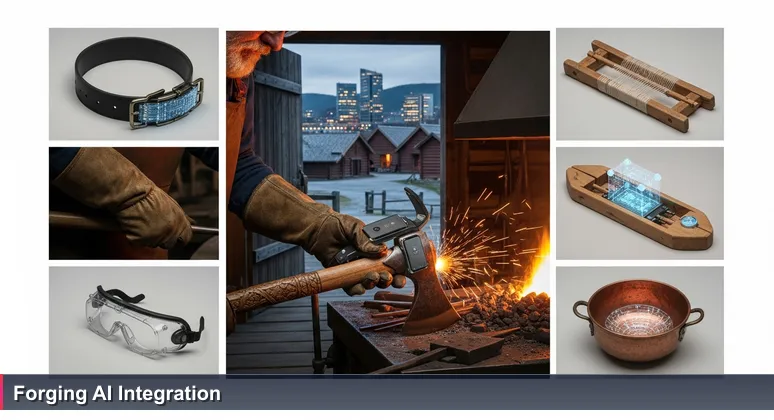
The opportunity is stark: Deloitte's State of AI in the Nordics 2026 report warns that overall talent preparedness has fallen to just 14%. With Oslo hosting 54% of AI activity and salaries ranging from NOK 700,000 to over 1,250,000, the market rewards integrators who can act as the essential sensor in the handle of Norway's industrial forge.
Table of Contents
- Introduction
- Energy & Utilities
- Maritime & Offshore Services
- Fintech & Banking
- Healthcare & Biotech
- Retail & E-commerce
- Defence & Aerospace
- Government & Public Sector
- Logistics & Supply Chain
- Real Estate & Proptech
- Gaming & Media
- Conclusion
- Frequently Asked Questions
Learn more about starting an AI career in Norway with this expert guide.
Energy & Utilities
Norway's energy sector, led by giants like Equinor, is using AI as the linchpin for a dual transformation: optimizing existing oil and gas assets while building world-leading renewable infrastructure.
The problems are intensely physical, requiring physics-informed machine learning for reservoir modeling, computer vision drones for maintaining remote offshore rigs, and digital twins of entire energy grids. This work is safety-critical, relying on models that process noisy, sensor-fused IoT data from harsh environments.
"The hardest searches in Oslo are not for software engineers... they are for professionals who combine deep machine learning expertise with domain knowledge in heavy industry." - KiTalent
Direct links to cutting-edge research at NTNU and SINTEF enable immediate industrial application. Salaries reflect the critical nature of this work, with senior roles often exceeding NOK 1,200,000, especially in energy hubs like Stavanger where pay matches Oslo premiums.
This sector prioritizes integrators with backgrounds in physics, geoscience, or engineering who can master ML, offering a career path with direct impact on Norway's energy transition.
Maritime & Offshore Services
Building on centuries of seafaring expertise, Norway's maritime cluster is a global leader in autonomous shipping and intelligent offshore operations. Companies like Kongsberg Maritime and DNV are tackling distinct AI problems, from developing edge AI systems for low-connectivity environments at sea to fusing sonar, radar, and lidar data for navigation.
The Norwegian advantage is an unparalleled ecosystem where shipowners, classified societies, tech vendors, and world-class research - such as NTNU’s Department of Marine Technology in Trondheim - operate in close proximity. This collaborative environment accelerates the move from R&D to real-world deployment of robotics and embodied AI on vessels and subsea robots.
Salaries for these specialized integrators are strong, with mid-level AI roles commanding NOK 900,000 to 1,050,000. For tech professionals, this field offers a fascinating, less-saturated entry into robotics with tangible consequences. It is also a prime opportunity for career changers from naval architecture or marine engineering, whose intrinsic understanding of vessel dynamics and maritime regulations becomes highly valuable when combined with new data science skills.
Fintech & Banking
Norwegian finance, characterized by high digital penetration and stringent oversight, is where AI meets rigorous regulation. Led by DNB and innovative platforms like Vipps MobilePay, the sector demands advanced applications like real-time fraud detection across billions of transactions and fully transparent credit scoring.
The critical differentiator is Norway's strong consumer protection laws, which mandate that AI systems cannot be "black boxes." This creates high demand for professionals skilled in explainable AI (XAI) and fairness auditing, with specialized roles like AI Ethics & Compliance Officers emerging as crucial. According to Onward Search's analysis of top AI jobs, there is a massive shift toward AI-driven personalized wealth management tools in this environment.
Salaries reflect the need for this specialized integration, with average total compensation in Oslo's finance hubs at NOK 950,000+. For data scientists, it offers a chance to work with vast, high-quality datasets while navigating complex ethical frameworks. The mission extends beyond profit to maintaining the integrity and efficiency of the Nordic financial system, offering a distinct sense of stewardship.
Healthcare & Biotech
Norway's universal, digitalized healthcare system provides a unique, ethically-grounded foundation for AI innovation. Centralized health registries enable large-scale research for applications ranging from diagnostic imaging at hospitals like Oslo University Hospital to bioinformatics for personalized medicine.
The critical constraint is an extreme focus on privacy and ethics. Work here heavily involves techniques like federated learning, where models train on decentralized data without compromising patient confidentiality. As noted by the OECD AI Observatory, AI in medical coding and diagnostics is a stated national priority, with the market projected for growth through 2033.
Salaries for these integrator roles reflect the sector's blend of mission and stability, ranging from NOK 750,000 to 1,100,000. Public sector positions offer unparalleled job security, often at the lower end of that scale. This field is ideal for career changers from clinical or biomedical research who can ensure AI solutions are clinically relevant, while tech professionals must become fluent in health data regulations like GDPR and the Norwegian Patient Rights Act to succeed.
Retail & E-commerce
Facing fierce competition from global platforms, Norway's retail conglomerates are investing heavily in AI to defend their home turf. Companies like NorgesGruppen and Coop Norge have shifted focus from basic analytics to building autonomous systems for hyper-local demand forecasting, dynamic pricing, and robotic warehouse management.
The Norwegian challenge is unique: optimizing complex, sustainability-focused supply chains across a long, sparsely populated country with distinct consumer habits. AI solutions must navigate a highly competitive, low-margin environment while meeting stringent environmental, social, and governance (ESG) goals. The Norwegian AI market is seeing significant growth in these practical applications.
For tech professionals, this sector offers a chance to work on large-scale recommendation and logistics systems with direct, everyday impact. The work prioritizes robust, reliable optimization over blue-sky research. Mid-level integrator roles command solid salaries of NOK 850,000 to 980,000. It is a prime field for career changers from supply chain, logistics, or merchandising, whose operational wisdom is crucial for guiding effective AI development.
Defence & Aerospace
Driven by geopolitical shifts and national security strategy, Norway's defence sector is a high-stakes incubator for relentlessly reliable AI. Companies like Kongsberg Gruppen and the Norwegian Defence Research Establishment (FFI) work on frontier applications, from autonomous drone swarms and advanced signal processing to AI-powered cybersecurity in GPS-denied environments.
This domain is defined by unparalleled constraints on robustness, security, and performance under adversarial conditions. The AI systems developed here must function perfectly in unpredictable, real-world scenarios, requiring rigorous development and testing protocols far beyond civilian standards.
Consequently, compensation reflects these demands. Senior roles frequently reach NOK 1,150,000+, supplemented by premiums for security clearances. As noted in analyses of Oslo's tech talent gap, this is a niche but rapidly growing field. It is ideal for AI specialists with backgrounds in robotics, signal processing, or cybersecurity who are drawn to mission-driven work and are comfortable operating within strict regulatory and secrecy frameworks.
Government & Public Sector
Norway is proactively deploying AI to modernize its renowned public sector, with a national strategy aimed at solving critical "efficiency gaps" by 2030. Agencies like NAV and Skatteetaten are at the forefront, hiring integrators to automate citizen services, optimize resource allocation, and enhance policy analysis through data.
The defining feature of this work is an unwavering focus on transparency, fairness, and public trust. As outlined in The Digital Norway of the Future, AI deployment here is less about competitive advantage and more about equitable service delivery and democratic accountability. This necessitates skills in explainable AI, bias auditing, and public data governance.
Salaries offer stability alongside mission, ranging from NOK 700,000 to 950,000, often accompanied by superior pension schemes and work-life balance. For professionals from tech, it's a chance to see AI drive broad social benefit; for those from public policy or administration, it's an opportunity to digitize deep institutional knowledge and shape public service automation that serves all citizens.
Logistics & Supply Chain
Norway's challenging geography of fjords, mountains, and sparse population makes it a natural laboratory for logistics AI. Companies like Posten Bring and ASKO are building what they term "Autonomous Value Engines" - AI systems for real-time route optimization around terrain and weather, managing automated fulfillment centers, and predicting supply chain disruptions.
The work is characterized by the tight integration of AI with physical robotics and IoT sensors in warehouses and on vehicles. This is embodied AI solving the tangible, daily problems of distance and time, requiring models that can interact reliably with the physical world.
Mid-level salaries for these integrator roles are a solid NOK 800,000 to 950,000. This sector is an excellent fit for tech professionals fascinated by the intersection of software and hardware, offering a focused environment with direct access to implementing companies. Compared to more saturated logistics tech scenes in Berlin or Amsterdam, Norway provides unique, complex puzzles. It also suits operations research experts who can formalize these logistical challenges for AI systems to solve efficiently.
Real Estate & Proptech
With a national focus on sustainability and smart cities, Norway's real estate sector leverages AI as a tool for environmental and social responsibility. Firms like OBOS and Eiendom Norge, alongside tech creators like Spacemaker, use computer vision for architectural analysis and data science for dynamic property valuation and investment modeling.
The Norwegian context adds a critical layer: AI is deployed to model and minimize a building's lifetime carbon footprint, directly aligning with the country's strict national ESG goals. This represents Norway's pragmatic approach to industrial AI, applying intelligence to meet concrete regulatory and ethical targets.
Salaries for integrators in this hybrid field range from NOK 750,000 to 1,000,000, with salary insights for specialized roles confirming competitive compensation. It's a compelling field for AI specialists interested in sustainability, urbanism, or climate tech, and offers a strategic pivot for professionals from architecture or civil engineering who can bring indispensable domain context to AI teams shaping future living spaces.
Gaming & Media
Norwegian media giants and game studios are evolving from content creators to AI orchestrators, leveraging technology to scale creativity. Companies like Schibsted and Funcom are at the forefront, applying generative AI for personalized content, developing sophisticated non-player character behavior, and building next-generation recommendation engines.
As noted by industry analysis of top AI jobs, the fundamental shift is from "authorship" to "orchestration." The unique Norwegian angle is the fusion of strong storytelling traditions with a pragmatic, engineering-focused approach to technology, creating a distinct niche within the growing domestic AI market.
Salaries in this creative-tech hybrid field are competitive, ranging from NOK 750,000 to 1,050,000. For AI professionals, this industry is a natural fit for creative technologists and researchers fascinated by generative models and natural language processing. While the ecosystem is smaller than in Stockholm or Helsinki, it is tightly knit, offering significant creative freedom and the unique opportunity to directly shape Nordic digital culture through intelligent systems.
Conclusion
The landscape of AI opportunity in Norway reveals a consistent truth: the highest value is placed on the integrator. This professional serves as the essential "sensor in the handle" of Norway's industrial forge, seamlessly embedding intelligence into the nation's physical and social infrastructure, from energy grids to public services.
The trade-off is clear. While you may not receive the headline-grabbing stock packages of Silicon Valley, you gain mission-driven work with tangible impact, broader cross-functional influence, and the stability of industries central to Norway's identity. This path is especially critical given the severe talent preparedness gap identified by Deloitte, where demand for these hybrid skills far outpaces supply.
With its unique blend of deep industrial heritage, world-class research, and a pragmatic approach to innovation, Norway offers a distinct and rewarding career forge. It’s a path for AI talent ready to build a sustainable future by mastering the complex frameworks of the past, securing not just a job, but a vital role in the nation's next evolution.
Frequently Asked Questions
What are the top industries in Norway hiring AI talent beyond Big Tech in 2026?
Key industries include Energy & Utilities, Maritime & Offshore Services, Fintech & Banking, and Healthcare & Biotech. For instance, energy leaders like Equinor are driving AI for renewables, while maritime firms like Kongsberg focus on autonomous shipping, all requiring domain expertise beyond pure tech skills.
Which industry in Norway offers the highest salaries for AI professionals?
Senior roles in Defence & Aerospace and Energy & Utilities top the list, with salaries exceeding NOK 1,150,000 to 1,200,000 due to critical applications. In contrast, public sector roles average NOK 700,000 to 950,000 but offer stability and societal impact.
I have a background in engineering or healthcare; can I transition into AI in Norway?
Absolutely. Industries like Energy and Healthcare value domain knowledge, with career changers from fields like geoscience or clinical research in high demand if they upskill in data science. For example, healthcare AI roles pay NOK 750,000 to 950,000 and focus on privacy-preserving techniques like federated learning.
What unique advantages does the Oslo area provide for AI careers in Norway?
Oslo offers proximity to major employers like DNB and Schibsted, world-class research at the University of Oslo and SINTEF, and a thriving AI startup ecosystem. This integrated environment supports innovation in sectors from Fintech to Logistics, with mid-level salaries often around NOK 850,000 to 1,050,000.
How does working in AI in Norway's public sector compare to private industries?
Public sector roles, such as at NAV or Skatteetaten, emphasize transparency and societal benefit, with salaries from NOK 700,000 to 950,000 and better work-life balance. Private sectors like Fintech offer higher pay, averaging NOK 950,000+, but require navigating strict regulations and competitive markets.
Discover the best artificial intelligence bootcamps in Norway to boost your career prospects.
For insights into innovative spaces for tech professionals in Norway, this list covers key hubs across Oslo, Trondheim, and Bergen.
Get insights into free digital skills training in Norway for 2026.
Check out AI innovation in Norway's core sectors for 2026.
Explore scholarships and grants for tech training in Norway to fund your education.

Irene Holden
Operations Manager
Former Microsoft Education and Learning Futures Group team member, Irene now oversees instructors at Nucamp while writing about everything tech - from careers to coding bootcamps.