









The Complete Guide to Using AI in the Government Industry in Yakima in 2025
Last Updated: August 31st 2025
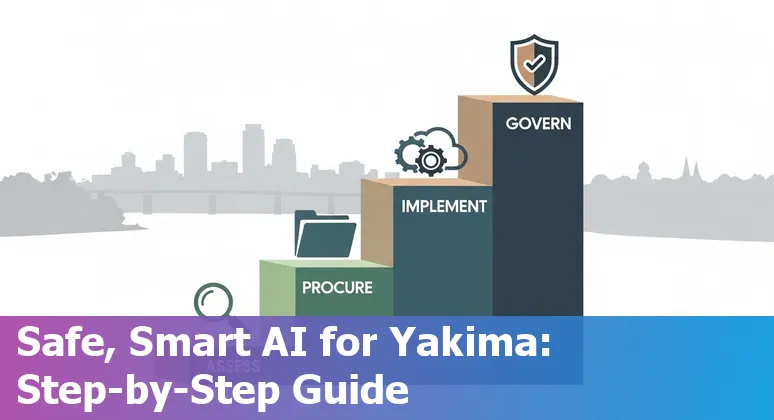
Too Long; Didn't Read:
Yakima should move AI from pilots to everyday services in 2025: expect federal pushes (America's AI Action Plan), 21.3% rise in legislative mentions, GSA-listed models for safe procurement, human-in-the-loop pilots to cut permit times (months to days) and require AI impact assessments.
Yakima's city leaders face 2025 as a moment to move AI from experiment to everyday tool: national forecasts show governments are ramping tech spend and grappling with “real-world” AI impacts that change resident service expectations and internal workflows (see state and local government tech trends for 2025: state and local government tech trends for 2025), while public-sector thought leaders highlight multimodal AI, virtual agents, and tighter AI-driven security as immediate opportunities to improve permitting, emergency response, and constituent experience (AI trends shaping the future of the public sector in 2025).
Local guidance also urges governance, transparency, and human oversight before scaling. Practical training - like Nucamp's AI Essentials for Work bootcamp - can help Yakima staff learn prompt writing and safe tool use so pilots turn into trusted services; imagine permit backlogs shrinking the way Honolulu's pilot cut months to days, freeing staff to meet residents in person rather than chase paperwork.
Register for Nucamp's AI Essentials for Work bootcamp
| Attribute | AI Essentials for Work |
|---|---|
| Description | Gain practical AI skills for any workplace; prompts, tools, apply AI across business functions |
| Length | 15 Weeks |
| Courses included | AI at Work: Foundations; Writing AI Prompts; Job Based Practical AI Skills |
| Cost (early bird) | $3,582 (after: $3,942); 18 monthly payments, first due at registration |
| Registration | Nucamp AI Essentials for Work registration page |
“What an amazing time to be a public servant,” Dustin said.
Table of Contents
- What will happen with AI in 2025? Trends and local impacts for Yakima, Washington
- What is the AI regulation in the U.S. in 2025? Federal landscape and implications for Yakima, Washington
- What is the WA government AI policy? Washington EO 24-01 and local guidance for Yakima, Washington
- Popular AI tools in 2025: which tools Yakima, Washington should know
- Practical use cases for Yakima, Washington government
- Procurement, contracting, and tech fees in Yakima, Washington
- Risk management, records, and accessibility for Yakima, Washington
- Implementation roadmap: pilots, governance, and community engagement in Yakima, Washington
- Conclusion: Next steps for Yakima, Washington government leaders in 2025
- Frequently Asked Questions
Connect with aspiring AI professionals in the Yakima area through Nucamp's community.
What will happen with AI in 2025? Trends and local impacts for Yakima, Washington
(Up)Expect 2025 to accelerate what city managers already sense: AI is moving from promising demo to mission-ready tool, and Yakima will feel that shift in concrete ways - Stanford HAI's 2025 AI Index documents rapid performance gains and wider adoption (legislative mentions of AI rose 21.3% across 75 countries and private investment surged), signaling stronger federal and state focus on governance and capability (Stanford HAI 2025 AI Index report); at the same time, public-sector trends point to multimodal systems, AI agents, and assistive search that can help local teams process permits faster, surface insights from messy city data, and give residents 24/7, multilingual help (Google Cloud public sector AI trends for 2025).
For Yakima that means realistic near-term wins - smarter routing of service requests, AI-assisted transcription and document processing to cut paperwork, and predictive analytics to prioritize infrastructure repairs - balanced by growing expectations for transparency, security, and workforce reskilling highlighted in government trend analyses (Deloitte Government Trends 2025 analysis).
Picture a resident snapping a photo of a pothole and an AI agent pre-filling the work order, assigning urgency, and notifying crews - small, visible gains that build trust if pilots keep humans in the loop and follow clear governance and training plans.
What is the AI regulation in the U.S. in 2025? Federal landscape and implications for Yakima, Washington
(Up)The federal AI landscape in 2025 blends strong principles with a decidedly pro‑innovation tilt, and Yakima leaders should track both threads: the White House's OSTP “Blueprint for an AI Bill of Rights” sets clear expectations - safe and effective systems, protections against algorithmic discrimination, privacy by design, notice and explanation, and timely human fallback - that apply whenever automated systems can meaningfully affect people (OSTP Blueprint for an AI Bill of Rights); at the same time, the new federal push - most visibly the July 23, 2025 “America's AI Action Plan” - prioritizes accelerated AI infrastructure and streamlined permitting for data centers, federal procurement reforms, and a deregulatory posture to speed adoption (America's AI Action Plan - White House announcement, July 23, 2025).
Practical instruments to watch: OMB's M-25-21 and M-25-22 memos reframe federal use and procurement of AI (pre-deployment testing, AI impact assessments for “high‑impact” systems, chief AI officers and governance boards, and tighter contracting rules), which can affect grant conditions, procurement terms, and how federal partners judge local projects (Summary of OMB memos M-25-21 and M-25-22).
For Yakima that means practical steps now: build basic AI governance, expect requests for AI impact assessments on grant-eligible systems, and align permitting and procurement workflows so federal funding and new infrastructure pipelines - like accelerated data‑center permitting - don't catch the city flatfooted; imagine a council packet arriving with a required AI impact assessment attached before a federal grant is approved, turning governance from abstract policy into an everyday checklist for local staff.
| Federal Instrument | Key Direction (2025) | Implication for Yakima |
|---|---|---|
| Blueprint for an AI Bill of Rights (OSTP) | Principles: safety, anti‑discrimination, privacy, notice, human fallback | Use as a policy touchstone for resident‑facing pilots and equity checks |
| America's AI Action Plan (White House, Jul 23, 2025) | Accelerate innovation, build AI infrastructure, streamline permits | Expect federal emphasis on permitting and infrastructure criteria affecting local approvals |
| OMB memos M-25-21 / M-25-22 (Apr 3, 2025) | Agency AI strategies, CAIOs, AI impact assessments, procurement rules | Prepare governance, documentation, and procurement clauses for federal partnerships |
“Winning the AI race will usher in a new golden age of human flourishing, economic competitiveness, and national security for the American people.”
What is the WA government AI policy? Washington EO 24-01 and local guidance for Yakima, Washington
(Up)Washington's Executive Order 24-01, signed by Gov. Jay Inslee on Jan. 30, 2024, instructs state agencies to develop concrete policies for generative AI and to study how the technology may affect the workforce, educational institutions, and vulnerable populations - turning high‑level concern into an actionable state agenda.
To carry this out, WaTech is leading cross‑agency work to identify practical generative AI initiatives, issue interim guidelines that encourage purposeful, responsible use, and produce procurement and risk tools that Yakima should watch when planning pilots; those interim guidelines already note early, careful experiments such as using generative AI to summarize text and rewrite documents in plain language for accessibility.
For Yakima officials that means preparing governance checklists, vendor contract clauses, and simple human‑in‑the‑loop pilots so a permit notice can be rewritten into plain English by an approved tool and actually help a resident take the right next step - small operational wins that build public trust when paired with clear oversight and risk assessments.
| Deliverable (EO 24-01) | Purpose / Notes |
|---|---|
| State of Washington Generative Artificial Intelligence Report | Catalog potential state AI initiatives and findings |
| Initial Procurement Guideline for GenAI | Standardize vendor terms and contract clauses for generative AI |
| Implementing risk assessments for high-risk AI systems | Framework for pre-deployment evaluation and monitoring |
| Guidelines for Deployment of Generative AI | Operational guidance for agency rollouts and oversight |
| Report of impact of GenAI on state workforce | Study workforce shifts and reskilling needs |
| AI risk guidance | Practical risk mitigation and governance recommendations |
Popular AI tools in 2025: which tools Yakima, Washington should know
(Up)Yakima's IT and policy teams should start with a short watchlist: major large language and multimodal models now sit on the federal buying shelf - GSA added Anthropic's Claude, Google's Gemini, and OpenAI's ChatGPT to its Multiple Award Schedule to speed government access to enterprise-grade capabilities (GSA Multiple Award Schedule additions: Anthropic Claude, Google Gemini, and OpenAI ChatGPT) - and the GSA's USAi sandbox lets federal staff safely experiment with those same vendors' models under cloud controls that prevent agency data from being used to retrain the public models (GSA USAi sandbox and government experimentation coverage).
Equally important for Yakima: pick tools that bake in governance and auditability, since compliance and explainability are now central to public-sector deployments - market offerings like Credo AI, Centraleyes, IBM's Watsonx, and Darktrace are examples of the governance, risk, and security toolsets commonly used in 2025 to document model behavior, track vendor risk, and create audit trails (Survey of top AI compliance tools including Credo AI, Centraleyes, IBM Watsonx, and Darktrace).
Start small with a human-in-the-loop pilot that pairs a trusted model (from the GSA list) with a compliance checkpoint and watch for quick wins - e.g., a permit notice drafted in plain language in minutes - while keeping records and vendor documentation ready for audits and community questions.
| Tool / Category | Relevance for Yakima, WA |
|---|---|
| Anthropic Claude, Google Gemini, OpenAI ChatGPT | Now on GSA MAS - easier route to experiment with enterprise-grade chat and multimodal models |
| GSA USAi (sandbox) | Platform for government staff to safely test popular models with cloud safeguards |
| Credo AI, Centraleyes | Governance and compliance platforms to produce audit-ready model documentation and risk registers |
| IBM Watsonx, Darktrace | Enterprise AI tooling for compliance documentation and AI-driven cybersecurity monitoring |
Practical use cases for Yakima, Washington government
(Up)Practical AI and automation for Yakima city government means focusing on fast, visible wins that free staff for higher‑value work: automate permit intake, licensing approvals, and online service requests so residents get real‑time status and fewer callbacks; deploy accounts‑payable automation to improve budget monitoring, audit trails, fraud detection, and digital payments; and use process automation and intelligent document processing to shrink backlogs and speed inspections and repairs.
These use cases are already playing out regionally - Yakima's own manufacturing scene shows how automation can boost capacity without replacing people (Rankin Equipment bought a large welding robot, invested about $300,000 with an expected ROI under two years, and trained an employee to program and operate it), while cobots add safety by slowing when a person approaches - concrete evidence that machines can raise productivity and create new jobs in maintenance and programming (Washington manufacturers embracing robotics and automation).
For finance teams, AP automation delivers transparency and faster payments that protect public funds and reduce manual toil (accounts payable automation use cases for government finance teams), and low‑code/process platforms can unify licensing, procurement, and citizen engagement so data drives decisions (local government automation with low-code platforms to improve citizen experience).
Start with a human‑in‑the‑loop pilot, measure time‑to‑service and auditability, then scale what residents notice most - faster permits, clearer communication, and fewer missed maintenance requests - all of which build trust as Yakima modernizes.
| Use Case | Yakima Example / Benefit |
|---|---|
| Permitting & licensing automation | Faster approvals, status updates, reduced backlogs |
| AP automation | Budget monitoring, audit trails, fraud detection, secure digital payments |
| Online service requests & routing | Quicker crew dispatch, predictive prioritization for repairs |
| Intelligent document processing | Auto‑summaries, plain‑language notices, fewer manual entries |
| Workforce & manufacturing automation | Robots/cobots increase capacity, create upskilling roles (programming, maintenance) |
“It's a really good opportunity,” Alexander Gaytan said.
Procurement, contracting, and tech fees in Yakima, Washington
(Up)Procurement for AI in Yakima will look less like a lowest‑bid race and more like a careful negotiation where legal rules meet technical guardrails: state law (Washington RCW 39.04.270 competitive negotiation statute) explicitly lets municipalities purchase electronic data processing, telecommunications systems, software, or services through competitive negotiation instead of strict low‑bid procurement, which gives the city room to set requirements for privacy, explainability, vendor audits, and staged rollouts (MRSC competitive bidding exemptions guidance and documentation rules).
Practical next steps for Yakima's leaders: use the competitive‑negotiation path to insist on human‑in‑the‑loop pilots, clear service and fee schedules, and vendor transparency up front - start with a short, documented pilot and public notice so the city can prove value while preserving oversight (human‑in‑the‑loop AI pilot guidance for Yakima).
| Procurement Route | What it Enables / Key Note |
|---|---|
| Competitive negotiation (RCW 39.04.270) | Buy EDP/telecom/software/services with negotiated terms tailored to AI governance |
| Competitive bidding exemptions (MRSC) | Emergency, sole source, special market conditions, insurance, auctions; must document resolution or policy and make basis public |
| Human-in-the-loop pilot | Allows staged rollout, testing, and vendor accountability before full deployment |
Risk management, records, and accessibility for Yakima, Washington
(Up)Risk management for AI in Yakima must center on clear records practices, privacy safeguards, and accessibility so automated tools augment public service without undermining legal duties: Washington's rules on public records and data privacy are tracked by state rulemaking resources - see the Department of Labor's overview
Laws and rules: Public records and data privacy
for current law and rulemaking activity - and every AI pilot should be designed to meet the Washington Public Records Act (RCW 42.56) requirements reflected in Yakima County's public records guidance; the county's Public Records Officer (Patricia Andersen) and online Public Records Request Portal are the front line for resident requests and questions (contact details and common request types are published on the Yakima County page).
Pair those legal guardrails with documented privacy and bias safeguards and human‑in‑the‑loop pilots so systems remain explainable and accessible to all residents - the practical goal is a transparent record trail and plain‑language notices that make AI decisions auditable and understandable to the public.
| Resource | What to use it for |
|---|---|
| Washington Department of Labor & Industries: laws and rules on public records and data privacy (rulemaking overview) | Track rulemaking activity and state requirements for records and data privacy |
| Yakima County Public Records portal and contacts (submit requests and contact Public Records Officer Patricia Andersen) | Submit requests, contact Public Records Officer Patricia Andersen, and find common record types and submission guidance |
| Nucamp AI Essentials for Work bootcamp - privacy and bias safeguards guidance (practical AI skills for any workplace) | Design human-in-the-loop pilots and documentation practices to protect residents while deploying AI |
Implementation roadmap: pilots, governance, and community engagement in Yakima, Washington
(Up)Yakima's next practical step is a narrow, measurable implementation roadmap that starts with short, human‑in‑the‑loop pilots, then wraps those tests into governance, procurement, and community engagement so proven gains scale responsibly; the Department of Homeland Security's AI Roadmap and FEMA pilot - where generative models helped draft hazard mitigation plan elements so communities could better compete for grants - offers a direct playbook for local resilience planning (DHS AI Roadmap and pilot details), while practical CIO guides like “From Pilot to Policy” show how to prioritize ROI, staging, and vendor risk as pilots move toward routine services (From Pilot to Policy: A CIO's roadmap to kick-start AI).
Make room in each pilot for operator feedback - surveys, focus groups, and observational testing - to surface adoption barriers as RAND recommends, and publish clear governance checklists, AI impact assessments, and plain‑language notices so residents see what changed.
Start with one visible win - imagine a planner receiving a draft mitigation section in hours, not weeks - and pair it with vendor audit logs, staff training, and public town‑halls; that cycle of pilot → evidence → community review is how small tests become trusted city services.
For immediate steps, launch a short human‑in‑the‑loop pilot with transparent evaluation metrics and public reporting to build momentum and trust (Human‑in‑the‑Loop Pilots for Local Government).
“The unprecedented speed and potential of AI's development and adoption presents both enormous opportunities to advance our mission and risks we must mitigate,” said Secretary of Homeland Security Alejandro N. Mayorkas.
Conclusion: Next steps for Yakima, Washington government leaders in 2025
(Up)Next steps for Yakima's leaders in 2025 are practical and immediate: build leadership capacity, professionalize governance, and train staff so pilots scale without surprises.
Enroll one or two city executives in the Partnership for Public Service AI Government Leadership Program to fast‑track cohort-based skills (an 18‑hour program delivered across six half‑day sessions) and bring back an actionable AI roadmap (Partnership for Public Service AI Government Leadership Program); pair that leadership path with the IAPP AI Governance Profession Report guidance showing that nearly half of organizations now treat AI governance as a top strategic priority and that hiring or dedicating governance talent reduces deployment risk (IAPP AI Governance Profession Report 2025).
Meanwhile, launch a short human‑in‑the‑loop pilot tied to a visible resident benefit (for example, a permit or service‑request workflow that a trained operator reviews) and invest in practical upskilling - Nucamp's AI Essentials for Work bootcamp provides hands‑on prompt, tool, and pilot design training for staff who will operate these services (Nucamp AI Essentials for Work registration).
Together these steps - executive cohorts, a formal governance hire or team, documented pilots, and targeted staff training - turn policy into day‑to‑day practice and make AI a tangible service improvement for Yakima residents instead of an abstract project.
| Action | Quick detail |
|---|---|
| Executive training | Partnership for Public Service AI Government Leadership Program - 18 hours across six half‑day sessions (cohort model) |
| Governance baseline | IAPP AI Governance Profession Report: prioritize AI governance, hire/dedicate staff, integrate privacy & compliance |
| Staff upskilling & pilots | Nucamp AI Essentials for Work - practical prompt and pilot training for operational teams |
“The sessions provided valuable lessons to navigate through the complex federal bureaucracy to implement solutions.”
Frequently Asked Questions
(Up)What immediate AI opportunities should Yakima pursue in 2025?
Prioritize human-in-the-loop pilots that produce visible resident benefits: permitting and licensing automation to cut backlogs and provide status updates; intelligent document processing to create plain-language notices and auto-summaries; online service-request routing with predictive prioritization for repairs; and AP automation to improve budget monitoring and fraud detection. Start small, measure time-to-service and auditability, then scale what residents notice most.
What federal and state AI rules will affect Yakima's projects in 2025?
At the federal level, principles like those in the OSTP 'Blueprint for an AI Bill of Rights', OMB memos (M-25-21 / M-25-22) requiring pre-deployment testing, AI impact assessments for high-impact systems, and the White House 'America's AI Action Plan' (Jul 23, 2025) will shape procurement, grant conditions, and permitting expectations. At the state level, Washington EO 24-01 and WaTech interim guidance require generative AI policy, procurement guidelines, risk assessments, and attention to workforce impacts. Yakima should plan governance, vendor contract clauses, and expect requests for AI impact assessments on grant-eligible systems.
Which tools and vendor categories should Yakima evaluate first?
Begin with enterprise-grade models available through GSA (e.g., Anthropic Claude, Google Gemini, OpenAI ChatGPT) and use the GSA USAi sandbox for safe testing. Complement models with governance, risk, and security platforms such as Credo AI, Centraleyes, IBM Watsonx, and Darktrace to provide audit trails, vendor risk tracking, and compliance documentation. Choose vendors that support human-in-the-loop workflows and provide documentation needed for audits and procurement.
How should Yakima structure procurement and contracts for AI projects?
Use Washington's competitive-negotiation procurement path (RCW 39.04.270) to set terms for privacy, explainability, vendor audits, staged rollouts, and human oversight rather than lowest-bid contracting. Document pilot scope and public notice, require vendor audit logs and IA assessments, include fee schedules and staged deliverables, and preserve records to meet public-records obligations. For emergencies or sole-source needs, use documented exemptions per MRSC guidance.
What practical first steps and training should Yakima leaders and staff take?
Launch a short, measurable human-in-the-loop pilot tied to a visible resident benefit (e.g., permit intake automation), publish evaluation metrics and public reporting, and collect operator feedback. Build a governance baseline (AI impact assessments, plain-language notices, vendor clauses) and invest in upskilling - examples include executive cohort training (Partnership for Public Service AI Government Leadership Program), governance guidance (IAPP AI Governance Profession Report), and operational training like Nucamp's AI Essentials for Work bootcamp to teach prompt writing, safe tool use, and pilot design.
Identify the right KPIs for AI success in Yakima to measure savings, accuracy, and citizen satisfaction.
Discover multilingual accessibility via AI chatbots to serve Yakima's diverse communities with accurate translations.
City hall should address front-line service desk vulnerabilities where chatbots can handle routine benefit inquiries.

Ludo Fourrage
Founder and CEO
Ludovic (Ludo) Fourrage is an education industry veteran, named in 2017 as a Learning Technology Leader by Training Magazine. Before founding Nucamp, Ludo spent 18 years at Microsoft where he led innovation in the learning space. As the Senior Director of Digital Learning at this same company, Ludo led the development of the first of its kind 'YouTube for the Enterprise'. More recently, he delivered one of the most successful Corporate MOOC programs in partnership with top business schools and consulting organizations, i.e. INSEAD, Wharton, London Business School, and Accenture, to name a few. With the belief that the right education for everyone is an achievable goal, Ludo leads the nucamp team in the quest to make quality education accessible