









The Complete Guide to Using AI in the Education Industry in Worcester in 2025
Last Updated: August 31st 2025
Too Long; Didn't Read:
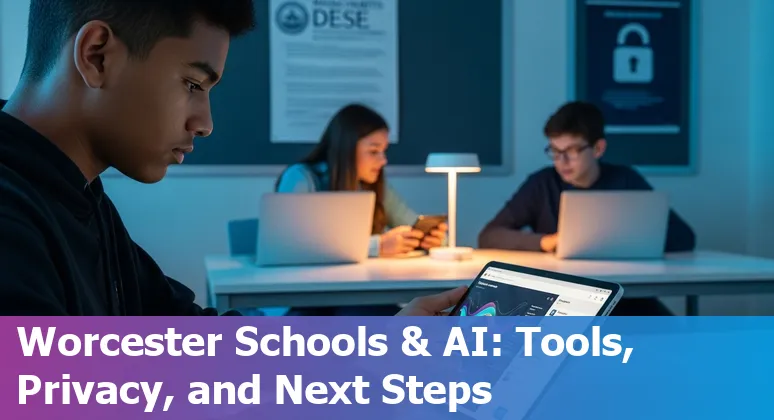
Worcester schools are implementing DESE's AI roadmap and a 45‑classroom pilot serving 1,600+ students. Priorities for 2025: privacy vetting, bias audits, teacher PD, redesigned assessments, and procurement standards - use pilots, require Algorithmic Impact Assessments, and scale only tools that demonstrably improve learning.
Worcester schools are at the center of Massachusetts' statewide push to make AI a classroom tool - not a mystery - after DESE released a Generative AI Policy Guidance and an AI Literacy Module to help districts weigh equity, privacy, academic integrity, and human oversight; see the DESE guidance summary in the Worcester coverage of the Worcester Business Journal's “Mass.
issues statewide AI guidance for educators” for details on those five guiding values (Worcester Business Journal summary of DESE Generative AI Policy Guidance for educators).
The Healey‑Driscoll administration also launched the hands‑on “Future Ready: AI in the Classroom” pilot supporting 45 classrooms and more than 1,600 students - an example of state investment turning policy into teacher training and classroom practice (MassTech's Future Ready: AI in the Classroom pilot details).
For Worcester leaders, the takeaway is practical: decide which tools pass privacy vetting, teach students to spot “AI fictions,” and treat AI literacy as a civic skill that shapes future careers and classroom fairness.
| Bootcamp | Length | Early‑bird Cost |
|---|---|---|
| AI Essentials for Work | 15 Weeks | $3,582 |
| Solo AI Tech Entrepreneur | 30 Weeks | $4,776 |
| Cybersecurity Fundamentals | 15 Weeks | $2,124 |
| Web Development Fundamentals | 4 Weeks | $458 |
“AI already surrounds young people. It is baked into the devices and apps they use, and is increasingly used in nearly every system they will encounter in their lives.”
Table of Contents
- Quick Primer: What Is AI and How It's Used in Worcester Classrooms
- Massachusetts AI Ecosystem in 2025: Why Worcester Benefits and Can Lead
- New AI Tools for Education in 2025: What Worcester Educators Should Know
- DESE Guidance and Policies: The Multi-Year Roadmap Impacting Worcester Schools
- Classroom Strategies: Creativity with AI in Education 2025 Report Applied in Worcester
- Practical Steps for District Leaders: Tool Selection, Privacy, and Equity in Worcester
- How to Start Learning AI in 2025: Resources and Pathways for Worcester Educators and Students
- Case Studies: Worcester Classrooms and Districts Using AI in 2025
- Conclusion and Next Steps for Worcester in 2025, Massachusetts
- Frequently Asked Questions
Connect with aspiring AI professionals in the Worcester area through Nucamp's community.
Quick Primer: What Is AI and How It's Used in Worcester Classrooms
(Up)At its simplest, AI in Worcester classrooms today often means generative tools - ChatGPT, Gemini and Claude - that answer questions in a conversational way, help draft text, and even create images, but which can also invent facts or reflect biased patterns unless used carefully; the College of Wooster's practical primer on “GenAI and your classroom” explains how models like InstructGPT better follow prompts and why educators must teach source-checking and critical thinking (College of Wooster GenAI classroom primer).
Worcester Public Schools is already turning those lessons into hands-on learning: kindergarteners at Union Hill used text‑to‑speech to prompt AI image generation in Canva, fourth graders explored machine‑learning fundamentals, Burncoat students examined racial bias in algorithms, and Doherty High used AI to help students visualize writing and expand vocabulary - concrete examples of how AI can personalize creativity while also demanding new assessment designs like alternative projects, discussion‑based checks, and “cheater's exams” that build research skills rather than just catch misuse (This Week in Worcester coverage of Danish educators learning classroom AI from WPS).
The takeaway: treat AI as a classroom partner whose outputs require verification, design assignments that reveal student thinking, and create clear, co‑created policies so technology enhances learning instead of undermining it - one vivid classroom moment shows how a simple image prompt can turn a kindergarten group into collaborative technologists and critical thinkers.
“Artificial intelligence can be scary, but it is here and beginning to rapidly change the lives of our scholars,” said WPS Superintendent Rachel H. Monárrez, Ph.D.
Massachusetts AI Ecosystem in 2025: Why Worcester Benefits and Can Lead
(Up)Massachusetts's 2024 launch of the Massachusetts AI Hub has turned high‑level strategy into tangible resources that Worcester schools and local edtech startups can actually use: the Hub serves as a neutral convener to connect K–12, higher education, and industry, while Governor Healey's major investments - including a $31 million grant to expand sustainable high‑performance computing and a public‑private incubator with IBM and Red Hat - are creating on‑ramps for applied AI projects and workforce pipelines (Massachusetts AI Hub overview and mission).
The state is already seeding innovation with programs such as the MassTech Models Innovation Challenge and targeted grants (including Sector Spark funding for LabCentral's “Applied AI” program), and the new Artificial Intelligence Compute Resources (AICR) at MGHPCC will provide compute and data capacity for universities, startups, businesses, and residents - a practical boost that makes it realistic for Worcester districts and local entrepreneurs to run larger, more responsible AI experiments close to home (Governor Healey announces major AI investments, public-private incubator with IBM and Red Hat).
For Worcester, that combination of capital, compute, and convening means not just catching up but shaping regional curricula, internships, and equitable procurement practices so local schools can both benefit from and help lead Massachusetts's AI ecosystem.
New AI Tools for Education in 2025: What Worcester Educators Should Know
(Up)Worcester educators choosing new AI tools in 2025 should focus on fit, evidence, and classroom workflows: practical platforms range from Google's NotebookLM and Gemini (which can summarize course packs, answer questions grounded in uploaded sources, and even create “Audio Overviews” that turn a stack of readings into an on‑demand listening guide) to institution‑wide systems like SchoolAI that promise automated grading, progress tracking, and personalized practice; for quick hands‑on options see a short roundup of AI‑powered classroom tools such as SchoolAI, Snorkl, and NotebookLM (Cult of Pedagogy: 6 Ed Tech Tools to Try in 2025) and Google's educator guide to Gemini, NotebookLM, and Chromebook AI features (Google: 11 ways Google AI can help educators and students in 2025); prioritize tools that integrate with your LMS, protect student data, and support assessment designs that reveal student thinking - one vivid classroom win is using NotebookLM's audio summaries to prep a Socratic seminar so every student arrives with the same scaffolded background knowledge.
| Tool | Primary classroom use |
|---|---|
| NotebookLM | Summarize/upload course materials, Q&A, Audio Overviews for student study |
| Gemini (Google) | Workspace/Chromebook AI for lesson drafting, videos, vocabulary lists, LMS integration |
| SchoolAI | Automated grading, progress tracking, personalized recommendations |
“Not all kids use it [GenAI] to cheat in school.”
DESE Guidance and Policies: The Multi-Year Roadmap Impacting Worcester Schools
(Up)DESE's Multi‑Year AI Roadmap gives Worcester schools a clear timetable and practical guardrails to move from discussion to classroom practice: after the K–12 AI Task Force wrapped its initial recommendations in Fall 2024, the Department partnered with ISTE+ASCD to build resources slated for Spring–Summer 2025 and then implementation supports - workshops, webinars, tool recommendations, and technical assistance - arriving in the 2025–2026 school year so district leaders can adopt vetted tools with shared policies rather than piecemeal pilots; the plan then shifts toward embedding AI into MA Curriculum Frameworks and educator preparation in 2026–2027.
Local leaders should note the Roadmap's three priority supports - resource creation and curation, comprehensive professional development, and local/state policy guidance - which means Worcester educators will soon have curated AI literacy modules, practical one‑pagers and professional learning options to use when approving classroom tools and designing assessments.
Read DESE's Multi‑Year AI Roadmap for K–12 details and the press coverage summarizing the guidance and rollout timeline to help plan district training and privacy vetting in tandem with state supports.
| Timeline | Key actions |
|---|---|
| Aug 2024 | Engage Task Force; produce recommendations |
| Spring–Summer 2025 | Create AI literacy resources, guidelines, student data privacy materials |
| 2025–2026 school year | Implementation support: workshops, trainings, tool recommendations, technical assistance |
| 2026–2027 school year | Policy considerations: embed AI into MA Curriculum Frameworks & educator preparation |
“The rise of AI tools in education brings opportunities for educators to personalize learning experiences. Therefore, effective strategies to build AI literacy must include a multifaceted approach that includes curriculum development support, ongoing professional development and coaching, allows community engagement, as well as clear policy and guidance for responsible and effective use of AI-powered tools.”
Classroom Strategies: Creativity with AI in Education 2025 Report Applied in Worcester
(Up)Worcester classrooms can turn the Creativity with AI in Education 2025 Report's findings into everyday practice by pairing a “pedagogy of wonder” with concrete, grade‑level projects: encourage teachers to use AI as a brainstorming partner and design tool (not a shortcut), teach prompt‑crafting and source‑checking, and map creative AI activities to standards so assessments reveal student thinking rather than just polished outputs.
Adobe's report shows strong outcomes - 91% of educators saw enhanced learning when students used creative AI - and urges using durable, industry‑standard tools (95% preference), a practical reminder for districts vetting vendors against privacy and equity checks; see the Adobe Creativity with AI in Education 2025 Report for classroom examples and guidance (Adobe Creativity with AI in Education 2025 Report).
Combine that with a wonder‑based approach to stimulate curiosity and iterative refinement, as described in AACSB's AI and Creativity - A Pedagogy of Wonder (AACSB AI and Creativity - A Pedagogy of Wonder), and borrow ready‑to‑run, age‑appropriate projects - story starters, multimodal portfolios, and media production - from practical roundups for K–12 teachers such as Screencastify's AI creative classroom ideas for K–12 (Screencastify AI creative classroom ideas for K–12).
The goal is vivid and equitable: lower technical barriers so every student - regardless of drawing or coding skill - can prototype, iterate, reflect, and present work that shows learning, not just polished AI output.
“AI can support student academic outcomes with creativity by allowing students to bring their learning to life. Students can use AI to help develop their ideas into pictures that represent their image, and they are no longer limited by their drawing ability to be creative, making new learning opportunities endless for any student at any ability level, including students with learning disabilities. I hope AI can help level the playing field for academic success and career outcomes.” - Rebecca Yaple, high school STEM teacher in Virginia
Practical Steps for District Leaders: Tool Selection, Privacy, and Equity in Worcester
(Up)District leaders in Worcester looking to buy classroom AI should borrow playbooks from modern procurement: start with a clear problem statement, require vendors to demonstrate data governance and explainability, and insist on auditability - ask for decision logs, Algorithmic Impact Assessments (AIAs), and third‑party bias testing before signing contracts (see Georgia Procurement of AI Tools Guidelines for Responsible Use (RFP language and auditability)).
Treat pilots as mandatory: run limited trials to validate outputs, measure real classroom impact, and surface data‑quality and integration gaps that procurement teams often find hamstringing deployments, as explored in the State of AI in Procurement in 2025 (common pitfalls and lessons)).
Protect equity by adding concrete contract terms and checklists - require vendors to share bias‑audit results and remediation plans and use institutional prompts for bias audits when vetting models so tools don't amplify existing disparities (Institutional AI bias‑audit prompts for education).
Finally, bake in workforce change management: demand vendor training schedules, plan district professional learning so educators can interpret model outputs, and set up continuous monitoring and feedback loops that let a school trace any score or recommendation back to source data and model logic - small, disciplined steps that turn powerful procurement promises into classroom practice without sacrificing privacy or fairness.
“Procurement teams using AI are 2.3x more likely to act on data in real time, rather than retrospectively.”
How to Start Learning AI in 2025: Resources and Pathways for Worcester Educators and Students
(Up)Getting started with AI in Worcester classrooms in 2025 means following the practical path the Commonwealth has laid out: begin at the Massachusetts DESE AI in K‑12 resources hub for the upcoming AI literacy modules, tool guidance, and student‑data privacy resources that will be published in Summer 2025 and pair those state materials with hands‑on training and local supports (the DESE roadmap emphasizes resource creation, professional learning, and policy supports; see the Massachusetts DESE AI in K‑12 resources hub for details Massachusetts DESE AI in K‑12 resources).
Complement state modules with free classroom curricula such as Common Sense Education and Code.org (listed on DESE's resource page), tap Worcester State University's local LibGuide for K–12 lesson plans and ChatGPT guidance to localize lessons, and sign up for practice‑focused events like the DLCS Summit workshop at Worcester State that offers UNESCO competency frameworks and MIT App Inventor hands‑on sessions to build ethical, student‑centered projects (see the DLCS Summit 2025 App Inventor workshop details DLCS Summit 2025 App Inventor workshop details and the Worcester State University AI and ChatGPT LibGuide for K‑12 Worcester State University AI & K‑12 LibGuide).
Start small - pilot one classroom tool, require privacy vetting (local Amira reading pilots showed both potential and privacy questions when the system records student responses), iterate based on teacher feedback, and use the state's fall 2025–26 implementation supports to scale what truly improves learning.
| Resource / Event | What to expect |
|---|---|
| DESE AI in K‑12 hub | AI literacy modules, guidelines & student data privacy resources (Summer 2025) |
| DLCS Summit (May 29, 2025) | Hands‑on UNESCO competency & MIT App Inventor workshop at Worcester State |
| Implementation support | Workshops, trainings, and tool recommendations during 2025–26 school year |
| Local pilots (e.g., Amira) | Classroom trials of reading tools that record responses; raises privacy considerations |
“AI already surrounds young people. It is baked into the devices and apps they use, and is increasingly used in nearly every system they will encounter in their lives.”
Case Studies: Worcester Classrooms and Districts Using AI in 2025
(Up)Concrete Worcester examples show both the promise and the pitfalls of classroom AI in 2025: a spring pilot of the speech‑guided Amira reading tool in Worcester elementary schools - which listens to students say words, records those responses, and gives instant feedback - sparked urgent privacy questions and parent conversations about how permissive districts should be with student recordings (Worcester Telegram & Gazette report on the Amira pilot and privacy concerns); at the same time, local teachers are turning accessible AI into everyday learning aids - Worcester Magazine chronicles classroom wins like using Meta's Animated Drawings to animate student artwork, a GPT‑powered quiz generator that helped build assessments for 40 student‑selected novels (and even earned participants a pizza party), and Canva image tools that make student poetry come alive (Worcester Magazine column on classroom AI tools that work).
Higher‑ed practitioners are experimenting too: a University of Worcester technical note shows how AI can enrich case teaching, create visual cues, and support in‑class tutoring while urging an ethical framework for use (University of Worcester technical note on managing AI for case teaching).
The takeaway for Worcester districts is practical and vivid - pilot boldly, vet privacy and equity first, and redesign assessments so AI becomes a scaffold for student thinking rather than a shortcut to a finished product; one clear classroom moment - students critiquing AI‑generated quizzes before earning a pizza - captures why process matters as much as tech.
“We shouldn't sleepwalk into a ‘tech knows best' approach to university teaching”
Conclusion and Next Steps for Worcester in 2025, Massachusetts
(Up)Conclusion - Worcester's next steps are practical and urgent: use DESE's Multi‑Year AI Roadmap and new educator modules as the organizing framework, vet tools against the five guiding values (data privacy, transparency, bias mitigation, human oversight, and academic integrity) called out in statewide guidance, and run tight classroom pilots that pair teacher training with clear family notifications so communities aren't surprised when tools like speech‑to‑text or reading aides record student work; see the DESE AI in K–12 resources hub for the roadmap and upcoming modules (DESE AI in K–12 resources and Multi‑Year AI Roadmap) and read the Worcester Business Journal summary of the Generative AI Policy Guidance for practical context on those five values (Worcester Business Journal: Mass. issues statewide AI guidance for educators).
Prioritize vendor privacy agreements and bias audits, require short pilots to validate classroom impact (and save budget by scaling only what improves learning), and invest in teacher PD so educators can turn AI into a scaffold for student thinking - not a shortcut; local wins (students critiquing an AI‑generated quiz before earning a pizza) show process matters.
For staff and leaders looking to build workplace AI skills that support district implementation, Nucamp's AI Essentials for Work bootcamp offers a practical 15‑week pathway to learn prompt design and tool workflows (Nucamp AI Essentials for Work bootcamp - 15 weeks).
| Bootcamp | Length | Early‑bird Cost |
|---|---|---|
| AI Essentials for Work | 15 Weeks | $3,582 |
| Solo AI Tech Entrepreneur | 30 Weeks | $4,776 |
| Cybersecurity Fundamentals | 15 Weeks | $2,124 |
| Web Development Fundamentals | 4 Weeks | $458 |
“AI already surrounds young people. It is baked into the devices and apps they use, and is increasingly used in nearly every system they will encounter in their lives.”
Frequently Asked Questions
(Up)What is DESE's guidance for using AI in Worcester classrooms and what values should districts follow?
Massachusetts DESE issued Generative AI Policy Guidance and a Multi‑Year AI Roadmap that prioritize five guiding values for K–12: data privacy, transparency, bias mitigation, human oversight, and academic integrity. The Roadmap sequences resource creation (AI literacy modules, one‑pagers, and privacy materials) in Spring–Summer 2025, implementation supports (workshops, trainings, and technical assistance) in the 2025–26 school year, and policy embedding into curriculum and educator prep in 2026–27. Worcester districts should use these materials to vet tools, design co‑created classroom policies, and plan professional learning before scale.
How are Worcester schools using AI in classrooms and what teaching practices work best?
Worcester classrooms use generative tools (ChatGPT, Gemini, NotebookLM), image and audio tools (Canva, Meta Animated Drawings), and targeted edtech (Amira, SchoolAI) for personalization, creativity, and formative feedback. Best practices include treating AI as a partner whose outputs require verification, designing assessments that reveal student thinking (alternative projects, Socratic seminars, discussion checks, “cheater's exams”), teaching prompt‑crafting and source‑checking, co‑creating usage policies with families, and running short, monitored pilots to evaluate real classroom impact.
What should Worcester district leaders require when selecting and procuring AI tools?
District leaders should start with a clear problem statement, require vendors to demonstrate robust data governance, explainability, and auditability (decision logs, Algorithmic Impact Assessments, third‑party bias testing), include contract terms for bias remediation and privacy protections, require vendor training schedules, and run limited pilots to validate outputs, integration, and equity impacts. Procurement should prioritize LMS integration, student data protections, and alignment with assessment designs that surface student thinking.
What state and local resources can Worcester educators use to learn AI and support classroom implementation in 2025?
Key resources include DESE's AI in K‑12 hub (AI literacy modules and privacy guidance released Summer 2025), the DESE Multi‑Year AI Roadmap, Massachusetts AI Hub and AICR compute resources, local events like the DLCS Summit and Worcester State University LibGuide, free curricula from Common Sense Education and Code.org, and practical vendor and classroom tool guides (NotebookLM, Gemini, SchoolAI). Educators should combine state modules with hands‑on training, small pilots, and local professional learning to scale effective practices.
What are practical next steps Worcester schools should take now to implement AI responsibly?
Immediate steps: use DESE's Roadmap and upcoming modules as the organizing framework; vet tools against the five guiding values (privacy, transparency, bias mitigation, human oversight, academic integrity); run short, documented classroom pilots with family notification; require vendor privacy agreements and bias audits; redesign assessments to surface student thinking rather than polished AI outputs; and invest in teacher professional development (e.g., short bootcamps or district PD) so educators can interpret and supervise AI use effectively.
Our approach explains how we measured automation risk locally, combining Stanford research with Worcester employment data.
Prioritize privacy and ethical safeguards for student data when deploying AI solutions in Worcester districts to protect learners and institutions.
Imagine how vision-assist accessibility apps can help visually impaired Worcester students navigate campus and course materials.

Ludo Fourrage
Founder and CEO
Ludovic (Ludo) Fourrage is an education industry veteran, named in 2017 as a Learning Technology Leader by Training Magazine. Before founding Nucamp, Ludo spent 18 years at Microsoft where he led innovation in the learning space. As the Senior Director of Digital Learning at this same company, Ludo led the development of the first of its kind 'YouTube for the Enterprise'. More recently, he delivered one of the most successful Corporate MOOC programs in partnership with top business schools and consulting organizations, i.e. INSEAD, Wharton, London Business School, and Accenture, to name a few. With the belief that the right education for everyone is an achievable goal, Ludo leads the nucamp team in the quest to make quality education accessible