









How AI Is Helping Government Companies in Visalia Cut Costs and Improve Efficiency
Last Updated: August 31st 2025
Too Long; Didn't Read:
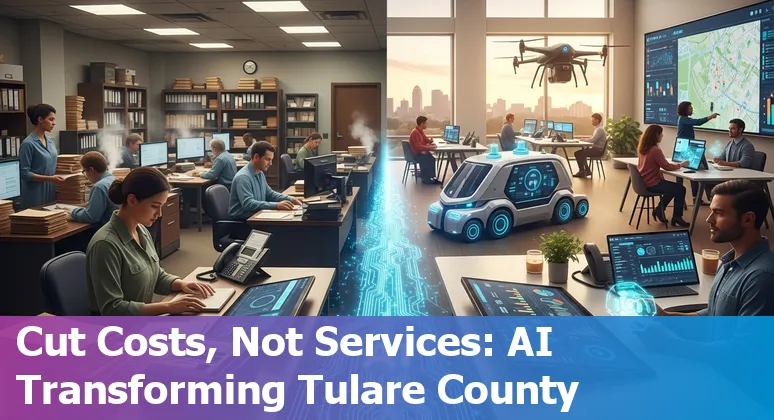
Visalia and Tulare County are piloting Microsoft 365 Copilot and website chatbots, aiming to cut paperwork, speed permit approvals, and reduce backlogs. FedRAMP 20x and state training pipelines promise faster procurement and upskilling; pilots target measurable time and cost savings with clear governance.
Visalia and Tulare County are at the forefront of practical AI adoption in California: Tulare County has convened an Tulare County AI task force pilot of Microsoft 365 Copilot and chatbots to pilot Microsoft 365 Copilot and website chatbots while wrestling with ethics and human oversight, and local leaders are exploring how automation can cut paperwork, speed permit approvals, and reduce service backlogs.
Practical guides for municipalities show how routing requests, automating routine approvals, and using chatbots can free staff for higher‑value work and improve citizen response times, delivering measurable cost and time savings for Visalia's agencies (best practices for streamlining local government services with AI and automation).
For contractors and agency staff ready to lead these pilots, workforce training matters - programs like the Nucamp AI Essentials for Work bootcamp: practical AI skills for the workplace teach promptcraft, safe workflows, and practical metrics so communities can modernize without losing the human touch.
| Bootcamp | Details |
|---|---|
| AI Essentials for Work | 15 weeks; practical AI skills for any workplace; early bird $3,582; registration: Register for Nucamp AI Essentials for Work |
“AI shouldn't do our job for us, but how do we use AI as a really excited intern or assistant that can help us get it done better? We've got to be really efficient and smart to serve people appropriately. So how do we do that responsibly and ethically, doing the work ourselves and taking care of our constituents? We can't just say, ‘Everything you need is online,' and never have a real conversation. That is too cold and it's not appropriate.”
Table of Contents
- Local governance: Tulare County AI task force and early steps in Visalia, California
- State context: California initiatives driving AI adoption for Visalia government companies
- Cost-savings through modernization: cloud, APIs, and winding down legacy systems in Visalia, California
- Operational gains: automation, chatbots, and AI-assisted citizen services in Visalia, California
- Sector examples: waste collection, policing, and social services impact in Visalia, California
- Measuring ROI: metrics and pilot design for Visalia, California government companies
- Policy and ethics: transparency, oversight, and public communication in Visalia, California
- Steps for local leaders: practical roadmap for Visalia, California agencies and contractors
- Conclusion and next steps for Visalia and Tulare County, California
- Frequently Asked Questions
Discover how simple explanations of AI basics for local governments can help Visalia staff make informed decisions in 2025.
Local governance: Tulare County AI task force and early steps in Visalia, California
(Up)Local leaders in Visalia and across Tulare County have moved quickly from talk to structure, forming a cross‑departmental AI task force to write an employee AI policy and run practical pilots - most notably a Microsoft 365 Copilot proof‑of‑concept and a review of website chatbots - to understand where automation can responsibly boost productivity without replacing human judgment; every county department has a representative, and the group plans monthly meetings with a draft policy and targeted Copilot rollouts slated for the next fiscal year (the first meeting was held July 24).
The task force is explicitly wrestling with ethics and transparency questions - how much human intervention is needed, when AI may touch decisions that affect the public, and which use cases actually save time - so contractors and agency staff in Visalia can align pilots with clear governance and workforce training (see the Tulare County AI task force coverage and local planning resources in the complete guide for Visalia government services).
| Focus | Details |
|---|---|
| Proof of concept | Microsoft 365 Copilot pilot across departments |
| Chatbots | Review of website chatbot use and ethics |
| Timeline | Monthly meetings; draft policy and Copilot deployment next fiscal year; first meeting July 24 |
“AI shouldn't do our job for us, but how do we use AI as a really excited intern or assistant that can help us get it done better? We've got to be really efficient and smart to serve people appropriately. So how do we do that responsibly and ethically, doing the work ourselves and taking care of our constituents? We can't just say, ‘Everything you need is online,' and never have a real conversation. That is too cold and it's not appropriate.”
State context: California initiatives driving AI adoption for Visalia government companies
(Up)State actions are tilting the playing field so Visalia's agencies and contractors can move from cautious pilots to broader, governed deployments: Governor Newsom's recent executive order and the California Breakthrough Project - which convened tech leaders to advise agencies on speeding efficiency and met at Ripple headquarters - direct agencies to hunt for modernization wins, streamline hiring and procurement, and test GenAI in safe sandboxes (Governor Newsom executive order on government effectiveness and the Breakthrough Project); parallel memoranda with Google, Adobe, IBM, and Microsoft are seeding workforce training and no‑cost tools across K–12, community colleges and the CSU system so local staff and contractors can upskill quickly (California state–industry AI workforce partnerships for training and tools); and the California Report on Frontier AI Policy supplies practical guardrails - transparency, third‑party verification, and adverse‑event reporting - that help municipalities deploy chatbots, Copilot pilots, and backend automation with clearer oversight (California Report on Frontier AI Policy guidance for local AI deployments).
Together these moves create training pipelines, faster procurement options like RFI2 trials, and policy expectations Visalia can mirror to scale pilots that save time and reduce backlogs without losing human accountability.
| Initiative | What it means for Visalia |
|---|---|
| Executive order & Breakthrough Project | Directs agencies to modernize operations, use RFI2 procurement trials, and consult industry experts |
| State–industry MOUs | Free workforce training and tools from Google, Adobe, IBM, Microsoft for schools and community colleges → local upskilling |
| California Report on Frontier AI Policy | Transparent guardrails, third‑party verification, and reporting rules to guide safe local deployments |
“AI is the future - and we must stay ahead of the game by ensuring our students and workforce are prepared to lead an AI-ready workforce.”
Cost-savings through modernization: cloud, APIs, and winding down legacy systems in Visalia, California
(Up)Cost savings in Visalia come from pragmatic modernization: moving services to FedRAMP‑authorized cloud platforms, exposing clean APIs to stitch new AI tools into existing workflows, and methodically winding down aging on‑prem systems so staff aren't wasting time babysitting servers.
Federal momentum around FedRAMP 20x is lowering the barrier - the GSA has accelerated authorizations (adding over 120 new services to the marketplace) and shortened approval timelines from many months to roughly five weeks, which means city IT and contractors can buy vetted cloud AI faster and avoid costly, bespoke integrations (GSA FedRAMP 20x prioritization for AI authorizations).
FedRAMP's public, cloud‑native approach also emphasizes automated validation and reuse of commercial security frameworks so compliance work becomes more API‑driven and less paperwork‑heavy, freeing budgeted labor for frontline citizen services instead of legacy maintenance (FedRAMP guidance and community working groups).
The result is predictable: faster procurement, smaller integration bills, and fewer sunk costs as Visalia transitions from brittle legacy apps to scalable cloud services that let staff solve problems instead of fighting infrastructure.
“FedRAMP 20x is removing the historic blockers that stopped innovative companies from selling to government. If you're deployed on modern cloud infrastructure and following industry best-practices then FedRAMP 20x is designed for you,” said GSA Deputy Administrator Stephen Ehikian.
Operational gains: automation, chatbots, and AI-assisted citizen services in Visalia, California
(Up)Operational wins for Visalia's agencies can look a lot like Estonia's Bürokratt story: one interoperable, well‑trained assistant that routes questions, reduces repetitive customer‑service loads, and gives citizens faster, 24/7 access to the right department - in other words, “chat with only one bot” instead of chasing multiple hotlines.
Bürokratt's open‑source components (translation, speech‑to‑text, NLP toolkits) and its focus on voice, messaging and authenticated national‑cloud access show how multi‑channel chatbots plus process automation can free staff to handle complex cases while routine queries are resolved instantly (Bürokratt: a single chatbot for Estonia).
At the same time, careful rollout is essential: integrative reviews of generative‑AI chatbots flag technical limits, privacy, bias and organizational hurdles that Visalia should test for in pilots and governance checks (Challenges of Generative AI Chatbots in Public Services).
The payoff is tangible - fewer repeated inquiries, faster permit navigation, and staff time reclaimed for higher‑value, human work - but success depends on interoperability, reuse of tested components, and clear oversight so automation amplifies service rather than obscures it.
| Operational Benefit | Implementation Caution |
|---|---|
| Lower citizen support loads; 24/7 access | Technical complexity; need for cross‑agency collaboration |
| Multichannel (voice, chat, messaging) and authenticated access | Privacy, bias, and legal/regulatory checks required |
“Bürokratt is not just an IT project but a concept of how digital services and the state could operate in the age of artificial intelligence.”
Sector examples: waste collection, policing, and social services impact in Visalia, California
(Up)Sector-specific pilots show how AI can multiply savings across waste collection, policing, and social services in Visalia: for waste, decentralizing collection and giving community operators better data and routing tools can cut costs and create jobs - case studies show home composting can cost as little as USD 1.69–19.12 per tonne and community groups in Indonesia report USD 28–63 per tonne, so targeted automation and monitoring could squeeze inefficiencies out of collection and boost organic‑waste diversion (CPI report on scaling organic waste management).
Large-scale examples like Brazil's CTTR waste‑to‑energy/biomethane project demonstrate how separated feedstocks and integrated logistics can turn waste into low‑carbon fuel and water reuse - but they also underscore that infrastructure, licensing, and collection systems must be aligned before energy benefits arrive (Mongabay analysis of Brazil's CTTR biomethane project).
For policing and social services, AI prompts, forecasting tools, and role‑risk methodologies from local guides help agencies identify which jobs to augment, where to retrain staff, and how to deploy chatbots and analytics so officers and caseworkers spend more time on complex, human tasks (Nucamp Job Hunting bootcamp methodology for identifying at‑risk government roles); the combined effect is smarter routing of field crews, faster benefits determinations, and clearer financing cases for low‑cost, community-centered waste solutions.
| Model | LCOW (USD/tonne) |
|---|---|
| Home composting (Brazil) | 1.69–19.12 |
| Waste picker cooperatives (Brazil) | 17.63–20.90 |
| Community groups (Indonesia) | 28–63 |
| Private operators (Indonesia) | 11–92 |
“Biomethane is CO2-neutral, but burning gas emits some pollutants; energy efficiency helps reduce this impact.”
Measuring ROI: metrics and pilot design for Visalia, California government companies
(Up)Measuring ROI for Visalia's AI pilots means starting small, measuring what matters, and tying results to real county services: pick high‑volume workflows from the Tulare County service list (permits, benefits, property tax queries) and benchmark baseline times and costs before any Microsoft 365 Copilot or chatbot rollout described by the Tulare County AI task force report.
Use governance‑aligned KPIs - fairness, explainability, incident detection, audit readiness, and human‑override rates - as recommended in practical KPI guides so measurements speak to both efficiency and risk controls.
Design pilots with a clear owner for each metric, automated dashboards for real‑time tracking, and a pre‑registered evaluation window so staff can see “minutes shaved from permit approvals” translate into reclaimed workweeks; pair those operational gains with qualitative user feedback from the county's front lines to capture the full value of automation and ensure ethical deployment across services catalogued by local agencies.
Tulare County AI task force report (Visalia Times Delta), KPIs for AI governance: practical KPI guide, Tulare County service inventory and agency catalog
| KPI | Why it matters |
|---|---|
| Time‑to‑resolution | Shows direct citizen time savings from automation |
| Human override rate | Indicates where AI needs more supervision or is misclassifying cases |
| Explanation coverage | Measures transparency delivered to affected residents |
| Incident detection time | Tracks speed of identifying bias, failures, or drift |
| Audit readiness | Ensures documentation and compliance for oversight |
“AI shouldn't do our job for us, but how do we use AI as a really excited intern or assistant that can help us get it done better? We've got to be really efficient and smart to serve people appropriately. So how do we do that responsibly and ethically, doing the work ourselves and taking care of our constituents? We can't just say, ‘Everything you need is online,' and never have a real conversation. That is too cold and it's not appropriate.”
Policy and ethics: transparency, oversight, and public communication in Visalia, California
(Up)Policy and ethics in Visalia hinge on clear transparency, robust oversight, and plain‑spoken communication: the Tulare County AI task force is wrestling with exactly how much human intervention is required, when to label AI outputs, and what to tell residents before automation affects them (Tulare County AI task force guidance on transparency and oversight).
California's state guidance raises the bar further - requiring agencies to designate continuous monitors, run risk assessments, submit generative‑AI contracts for review, and train staff so tools don't quietly reshape benefits or enforcement decisions (California state guidelines for government AI purchasing) - a necessary precaution given past harms like the unemployment‑benefits algorithm that contributed to hundreds of thousands of denied claims.
Federal playbooks underline the same essentials: lawfulness, explainability, human oversight, testing, and periodic review to keep systems auditable and accountable (DHS responsible AI principles and guidance).
The practical takeaway for Visalia: embed named owners for monitoring and incident reporting, clearly mark AI outputs for the public, and pair any pilot with a communications plan - because one opaque denial or unexplained recommendation can undo public trust faster than a server outage ever could.
“AI shouldn't do our job for us, but how do we use AI as a really excited intern or assistant that can help us get it done better? We've got to be really efficient and smart to serve people appropriately. So how do we do that responsibly and ethically, doing the work ourselves and taking care of our constituents? We can't just say, ‘Everything you need is online,' and never have a real conversation. That is too cold and it's not appropriate.”
Steps for local leaders: practical roadmap for Visalia, California agencies and contractors
(Up)Local leaders should follow a clear, practical roadmap: assemble a cross‑departmental task force (every county department already has representation in Tulare County's effort) and draft a concise charter that defines scope, owners, and monthly milestones; pick focused proofs‑of‑concept - start with the Microsoft 365 Copilot pilot and a website chatbot review highlighted by the Tulare County AI task force - so departments can evaluate real use cases and ethical tradeoffs (Tulare County AI task force pilot and policy planning (Visalia Times‑Delta)); create working subgroups for procurement, training, and risk assessment (a university checklist offers a handy template for team composition and chartering - University AI task force checklist for launching an AI task force); and pair each pilot with named metric owners, a short evaluation window, and a communications plan that brings staff and the public along.
Complement the task force with practical guides to use cases and workforce upskilling so contractors can align procurement and training with county goals (Nucamp AI Essentials for Work bootcamp syllabus).
Treat AI like “a really excited intern” - use it to surface research and automate routine steps, but keep named human owners, review gates, and a draft policy ready for board review and Copilot deployment next fiscal year.
| Step | Immediate Action (from research) |
|---|---|
| Team formation | Cross‑departmental task force with monthly meetings and representatives from every department |
| Pilot selection | Microsoft 365 Copilot proof‑of‑concept; website chatbot review |
| Governance | Draft AI policy, assign owners, set ethics and human‑override rules |
| Evaluation | Short evaluation window, named metric owners, and a communications plan |
“AI shouldn't do our job for us, but how do we use AI as a really excited intern or assistant that can help us get it done better? We've got to be really efficient and smart to serve people appropriately. So how do we do that responsibly and ethically, doing the work ourselves and taking care of our constituents? We can't just say, ‘Everything you need is online,' and never have a real conversation. That is too cold and it's not appropriate.”
Conclusion and next steps for Visalia and Tulare County, California
(Up)The path forward for Visalia and Tulare County is clear: keep the Tulare County AI task force's monthly momentum (first meeting July 24) and turn its work into the draft employee AI policy and Copilot rollout planned for next fiscal year, while aligning local guardrails with California's broader frontier‑AI roadmap so transparency, oversight, and tiered risk rules guide deployments (Tulare County AI task force pilot and policy planning - Visalia Times-Delta, California frontier AI policy roadmap - FBM).
Practical next steps include naming metric owners for each pilot, embedding human‑override rules in procurement decisions, and investing in fast, role‑focused training so staff and contractors can run safe, measurable pilots - training like the Nucamp AI Essentials for Work 15-week bootcamp that teaches promptcraft and workplace AI workflows in 15 weeks.
That combination - a monthly task‑force cadence, state policy alignment, and targeted upskilling - turns ethical questions into operational wins; one small detail matters more than most: a single clear policy line about human oversight can prevent confusion and protect public trust long before cost savings appear on the ledger.
| Bootcamp | Length | Early bird cost | Register |
|---|---|---|---|
| AI Essentials for Work | 15 weeks | $3,582 | Register for Nucamp AI Essentials for Work bootcamp (15 weeks) |
“AI shouldn't do our job for us, but how do we use AI as a really excited intern or assistant that can help us get it done better? We've got to be really efficient and smart to serve people appropriately. So how do we do that responsibly and ethically, doing the work ourselves and taking care of our constituents? We can't just say, ‘Everything you need is online,' and never have a real conversation. That is too cold and it's not appropriate.”
Frequently Asked Questions
(Up)What concrete AI pilots are Visalia and Tulare County running to cut costs and improve efficiency?
Tulare County has convened a cross‑departmental AI task force that is piloting Microsoft 365 Copilot across departments and reviewing website chatbots. The task force meets monthly (first meeting July 24) and plans a draft employee AI policy and targeted Copilot rollouts in the next fiscal year. Pilots focus on routing requests, automating routine approvals, and freeing staff for higher‑value work.
How do AI and cloud modernization produce measurable cost savings for Visalia agencies?
Cost savings come from moving services to FedRAMP‑authorized cloud platforms, exposing APIs for integration, and winding down legacy on‑prem systems. FedRAMP 20x accelerates procurement and authorization (cutting approval timelines to roughly five weeks), reducing bespoke integration bills, lowering maintenance labor, and enabling faster purchases of vetted cloud AI - translating into smaller integration costs and reclaimed staff time for frontline services.
What operational benefits should Visalia expect from chatbots and automation, and what risks must be managed?
Operational benefits include lower citizen support loads, 24/7 access, faster permit navigation, and reclaimed staff time for complex cases - especially when chatbots are interoperable across channels (voice, chat, messaging) and tied to authenticated services. Risks to manage include technical complexity, cross‑agency collaboration needs, privacy, bias, legal/regulatory compliance, and ensuring human oversight so automation amplifies service rather than obscures it.
How should Visalia measure ROI and design pilots to ensure ethical, accountable AI deployments?
Start with high‑volume workflows (permits, benefits, property tax queries), benchmark baseline times and costs, and use governance‑aligned KPIs: time‑to‑resolution, human override rate, explanation coverage, incident detection time, and audit readiness. Assign metric owners, use short evaluation windows with automated dashboards, collect qualitative user feedback, and predefine human‑override rules and reporting procedures to tie efficiency gains to risk controls.
What practical steps should local leaders and contractors take now to deploy AI responsibly in Visalia?
Assemble or join the cross‑departmental task force, draft a concise charter and employee AI policy, select focused proofs‑of‑concept (Microsoft 365 Copilot and a website chatbot review), create subgroups for procurement, training, and risk assessment, name owners for monitoring and incident reporting, pair each pilot with a communications plan and evaluation metrics, and invest in role‑focused workforce training (promptcraft and safe workflows) so staff and contractors can run measurable, ethical pilots.
Explore how the Visalia Benefit Fraud Monitor flags anomalous claims to protect city resources.
Investing in skills to adapt for call center staff - like escalation handling and AI supervision - can secure future work.

Ludo Fourrage
Founder and CEO
Ludovic (Ludo) Fourrage is an education industry veteran, named in 2017 as a Learning Technology Leader by Training Magazine. Before founding Nucamp, Ludo spent 18 years at Microsoft where he led innovation in the learning space. As the Senior Director of Digital Learning at this same company, Ludo led the development of the first of its kind 'YouTube for the Enterprise'. More recently, he delivered one of the most successful Corporate MOOC programs in partnership with top business schools and consulting organizations, i.e. INSEAD, Wharton, London Business School, and Accenture, to name a few. With the belief that the right education for everyone is an achievable goal, Ludo leads the nucamp team in the quest to make quality education accessible