









Top 10 AI Prompts and Use Cases and in the Education Industry in United Arab Emirates
Last Updated: September 5th 2025
Too Long; Didn't Read:
With AI mandatory K–12 in the UAE from 2025–26, top prompts enable personalized lessons, automated grading, Arabic NLP, AR/VR STEM labs and predictive early‑warning systems - freeing ≈13 teacher hours/week. Prioritise privacy (federated learning), pilot small, train teachers (≈1,000) and scale internships (≈500).
With the UAE rolling out AI as a mandatory K–12 subject from 2025–26, clear, age‑appropriate prompts will be the classroom's operating system: they tell AI tutors how to personalise lessons, help teachers automate meaningful feedback, and frame ethics and data‑literacy discussions from kindergarten storytime to senior‑year command‑engineering projects.
The national push - including teacher training and ready‑made materials - is designed to turn AI literacy into everyday practice (UAE mandates AI curriculum in schools), so crafting precise prompts is as important as the models they drive; a ten-minute story can become an interactive data lesson with the right instruction.
For educators and school leaders who need hands‑on prompt skills for workplaces and classrooms alike, practical courses like Nucamp's Nucamp AI Essentials for Work bootcamp syllabus teach prompt writing, tool use, and ethical application across roles - the practical bridge between policy and day‑to‑day learning.
| Bootcamp | AI Essentials for Work |
|---|---|
| Length | 15 Weeks |
| Courses | Foundations, Writing AI Prompts, Job‑Based Practical AI Skills |
| Early bird cost | $3,582; Register for Nucamp AI Essentials for Work bootcamp |
“Introducing AI across all public school levels is a strategic step that modernises teaching tools and supports a generation of young people who understand tech ethics and can create smart, locally relevant solutions to future challenges.” - Sarah Al Amiri, Minister of Education
Table of Contents
- Methodology: How we selected the Top 10 Prompts and Use Cases
- Personalized Lesson Generation with MBZUAI-aligned Prompts
- GPT-powered AI Tutor Prompts (ASI prototype & ChatGPTEdu use cases)
- Automated Grading and Feedback Prompts for UAE Rubrics
- Teacher-assistant Prompts for Professional Development (UAE AI micro-credentials)
- Predictive Early-warning Prompts using Ministry of Education Data
- Arabic-language Learning Prompts (Argot & Arabic NLP best practices)
- Immersive AR/VR Lesson Scripts Prompts for STEM (DEWA/Expo City demos)
- Accessibility and Inclusive Education Prompts (AAC & simplified-language)
- EdTech Vendor Evaluation Prompts (SuperbCompanies list & procurement)
- Curriculum Design Prompt for the UAE AI Curriculum (MBZUAI + MIT ReACT)
- Conclusion: Start Small, Iterate, and Prioritize Ethical AI in UAE Classrooms
- Frequently Asked Questions
See how the National AI Strategy 2031 aligns education reforms with national economic goals.
Methodology: How we selected the Top 10 Prompts and Use Cases
(Up)Selection focused on practical prompts that are research‑backed, privacy‑aware, and aligned with UAE policy and workforce needs: priority went to approaches proven to protect sensitive data (in line with MBZUAI's federated and split‑learning work on privacy-preserving vision models and decentralized training), to prompts that map to national priorities and cross‑sector impact (healthcare, energy, climate, and education as highlighted in MBZUAI–Sorbonne Abu Dhabi partnership plans), and to use cases that support cost‑savings and rapid teacher upskilling for classroom rollout.
Each candidate prompt was scored for privacy risk, curricular fit with the UAE AI mandate, and operational feasibility so districts and vendors can pilot small, iterative deployments - effectively letting models learn “on site” without exporting raw student data.
Sources used to weight those criteria include MBZUAI's research on federated and split learning, the MBZUAI–SUAD MoU on joint education and upskilling, and analyses of cost and efficiency trends in UAE education AI adoption.
| Criterion | Why it mattered | Source |
|---|---|---|
| Privacy‑preserving design | Minimise data transfers and legal risk | MBZUAI article: “A Prescription for Privacy” on federated learning and privacy-preserving models |
| Policy & partnership alignment | Supports national strategy and academic upskilling | MBZUAI–SUAD partnership announcement: AI research, innovation, and education collaboration |
| Cost & deployment feasibility | Enables pilots and teacher training at scale | Analysis: UAE AI strategy and cost-efficiency in education adoption |
“Federated learning introduces a new paradigm for machine learning by bringing training directly to clients where the original data never leaves the device with the goal to mitigate risks of centralized data collection, Horváth said.”
Personalized Lesson Generation with MBZUAI-aligned Prompts
(Up)MBZUAI‑aligned prompts make personalized lesson generation practical for UAE classrooms by translating curriculum goals into clear, machine‑readable instructions - specify grade, language (Arabic/English), scaffolding, assessment type and accessibility needs and the model returns a ready lesson, differentiated materials, and formative checks that teachers can adapt; MBZUAI's work and Ekaterina Kochmar's research frame this as a hybrid system that “democratizes education” for remote or disadvantaged learners and helps reclaim routine time (MBZUAI cites research suggesting teachers could redirect roughly 13 hours per week to higher‑impact work).
Ready prompt libraries illustrate the nuts‑and‑bolts: Teaching Channel's 65 prompts show how to request unit plans, scripts, and rubrics while Panorama's 30+ prompts demonstrate district‑level, privacy‑aware intervention and assessment templates - use these as blueprints for UAE pilots, start with one unit, gather teacher feedback, and iterate with human oversight to ensure cultural fit and factual accuracy.
| Prompt use | Example output | Source |
|---|---|---|
| Unit planning | 5‑day unit outline with daily objectives and formative checks | Teaching Channel: 65 AI prompts for K‑12 lesson planning |
| Differentiate instruction | Tiered activities and scaffolds for ELL and special needs | Panorama Education: 30+ AI prompts for K‑12 education and interventions |
| Feedback & grading | Actionable, standards‑aligned comments and rubrics | MBZUAI: Research on hybrid human-and-AI powered education systems |
“I strongly believe that AI should help teachers, should help students, and should seamlessly be integrated in the learning process.”
GPT-powered AI Tutor Prompts (ASI prototype & ChatGPTEdu use cases)
(Up)GPT‑powered classroom tutors for the UAE work best when designed like the “ChemBot” prototype: use a scaffolded PROMPT workflow - Purpose, Role, Organize, Model, Parameters, Tweak - to give the bot a clear instructional hat, upload unit materials, and iterate until it behaves like a steady, Socratic coach that offers one or two targeted practice items before prompting the next student attempt (Edutopia article on designing a GPT-powered classroom tutor (ChemBot prototype)).
Combined with ready-to-use formative‑assessment prompts, schools can generate quick checks, quizzes, and standards‑aligned feedback that turn every independent task into actionable data for teachers (Monsha.ai guide to generating meaningful formative assessment tasks).
In UAE classrooms this pattern supports bilingual differentiation and scalable tutoring models: think of a chatbot that nudges a struggling reader with two hints, logs the interaction for the teacher, and frees up precious small‑group minutes for higher‑impact instruction - start with one lesson, monitor student use, and iterate with human oversight (Nucamp AI Essentials for Work bootcamp syllabus: practical AI skills for the workplace).
Automated Grading and Feedback Prompts for UAE Rubrics
(Up)Automated grading and feedback prompts translate UAE rubrics into consistent, machine‑readable templates that produce standards‑aligned comments and scaffolded next steps in Arabic and English - turning routine marking into actionable insights teachers can review and personalise, and freeing up precious small‑group minutes for mentorship and inquiry.
When prompts are crafted to mirror local rubrics and cultural expectations, they generate bite‑size, copy‑paste feedback for report cards and formative checks while preserving teacher oversight; this also ties directly to efficiency gains and cost reductions seen when schools adopt classroom AI and edtech tools in the UAE (Guide to classroom AI and edtech tools in UAE education (2025)).
At the same time, the rise of AI language tools underscores the need for staff upskilling so grading automation augments rather than replaces pedagogical roles (AI language tools and workforce adaptation in UAE education), and it pairs naturally with cost‑saving innovations like AR/VR virtual labs that reallocate resources toward high‑impact teaching (AR/VR virtual labs and simulations for UAE schools).
Teacher-assistant Prompts for Professional Development (UAE AI micro-credentials)
(Up)Teacher‑assistant prompts can turn professional development into a practical, on‑demand coaching system that matches the UAE's project‑based AI curriculum rollout: use a short, structured prompt to generate a workshop agenda tied to grade bands, convert a project brief into scaffolded student tasks, or produce evidence packages for micro‑credential portfolios - capabilities already in demand as the Ministry prepares for AI lessons in 2025–26 and has trained roughly 1,000 AI teachers (Complete AI Training: UAE schools launch AI curriculum with project-based learning).
Local certificate programs like Abu Dhabi University's AI‑Enhanced Teaching and Learning Certificate give teachers a recognised pathway to validate those skills, while practical PD models (policy, hands‑on sessions, coaching and evaluation) show how prompts can be embedded into ongoing support (Abu Dhabi University AI‑Enhanced Teaching and Learning Certificate (ADU), Banyan Global Learning: AI professional development for teachers).
Start PD pilots with one prompt library, measure teacher uptake, and scale what saves time and improves classroom impact - picture a teacher pulling a one‑line prompt and getting a week's worth of age‑appropriate, culturally aligned project steps ready for class.
| Program | Provider | Key features |
|---|---|---|
| Ministry AI teacher training | UAE Ministry (reported) | Project‑based AI curriculum rollout; ~1,000 teachers trained |
| AI‑Enhanced Teaching & Learning Certificate | Abu Dhabi University | Faculty certificate on AI integration, analytics, and curriculum design |
| AI PD formats | Banyan (PD model) | Policy development, hands‑on workshops, coaching/mentoring, evaluation |
“The AI‑Enhanced Teaching and Learning Certificate reflects our commitment to providing exceptional training programs for our faculty and staff members at ADU, supporting them in delivering excellence in education.” - Dr. Hamad Odhabi, ADU
Predictive Early-warning Prompts using Ministry of Education Data
(Up)Predictive early‑warning prompts turn routine school data into timely action: by translating attendance dips, grade trends and behaviour logs into clear, ranked “risk” prompts for teachers and counsellors, systems can surface students who need help before a term breaks down - think of a morning dashboard that names the handful of learners trending toward trouble and suggests the next three practical steps.
Research shows early identification yields measurable gains (schools using evidence‑based EWS saw reductions in chronic absence and course failure), and practitioners recommend a cycle of indicator validation, local customization, and continuous improvement to keep alerts useful and fair (AIR report on Early Warning Systems in Education).
AI‑powered dashboards add nuance by combining signals and learning from outcomes, but successful deployment requires clean data integration, staff training, and bias monitoring so prompts augment human judgement rather than replace it - a pragmatic approach UAE districts can pilot alongside existing edtech investments (Solved Consulting guide to AI early warning dashboards for at‑risk students).
“Without the AI tool, those kids would have flown under our radar until they perhaps failed a class. Now we know their names, their stories, and we're working with them proactively.”
Arabic-language Learning Prompts (Argot & Arabic NLP best practices)
(Up)Arabic-language learning prompts for UAE classrooms need to be explicit about register, dialect, and orthography so AI gives students useful, culturally appropriate output: specify whether the task should use Modern Standard Arabic or a Gulf dialect, ask for diacritization or undiacritized text, and include desired scaffolds (vocab lists, transliteration, or sentence frames) and assessment format so models avoid brittle, literal answers.
Arabic NLP poses well-documented challenges - complex morphology, right‑to‑left script, and missing vowels can turn a single undiacritized form into multiple meanings (e.g., رسم) - so prompts that request tokenization, lemmatization, and example‑based correction help tools behave predictably; see a practical guide to Arabic preprocessing and tools for tokenization, stemming, POS and NER at Practical Arabic NLP preprocessing and tokenization tools.
When choosing back‑end models, test for localization: recent comparisons of LLMs show big differences between MSA, dialect handling, and domain accuracy, so run side‑by‑side trials with classroom samples (Localazy's LLM Arabic localization benchmark tests and evaluations are a useful benchmark).
Finally, pair automated prompts with human review and iterative prompt tuning so AI supplements language teaching - start with one unit, measure errors in dialectal and undiacritized text, and scale what reduces teacher workload without losing cultural nuance (Practical Arabic NLP preprocessing and tokenization tools, LLM Arabic localization benchmark tests and evaluations, UAE classroom AI and edtech tools guide for 2025).
Immersive AR/VR Lesson Scripts Prompts for STEM (DEWA/Expo City demos)
(Up)Immersive AR/VR lesson‑script prompts turn abstract STEM concepts into hands‑on experiments that are especially relevant in the UAE: build a virtual smart‑grid lab that mirrors DEWA's automation and interoperability goals, lets students explore AI‑based forecasting from the Virtual Power Plant, and experiment with real component specs - 200 kW PV inverters, 120 kW battery stores or 44 kW EV chargers - so a class can see how generation and storage interact without costly hardware (DEWA's smart grid roadmap and VPP work provide the technical blueprint: DEWA Smart Grid strategic initiatives, DEWA Virtual Power Plant overview).
Pairing these simulations with local professional development - DEWA's Campus offers AI, 3D printing and smart‑learning training - helps teachers translate scripts into safe, curriculum‑aligned experiences for secondary and vocational learners (DEWA Campus for Occupational and Academic Development program page), while AR/VR virtual labs and simulations can reduce equipment costs and travel burdens so districts pilot deeper, repeatable STEM modules before investing in physical rigs.
Accessibility and Inclusive Education Prompts (AAC & simplified-language)
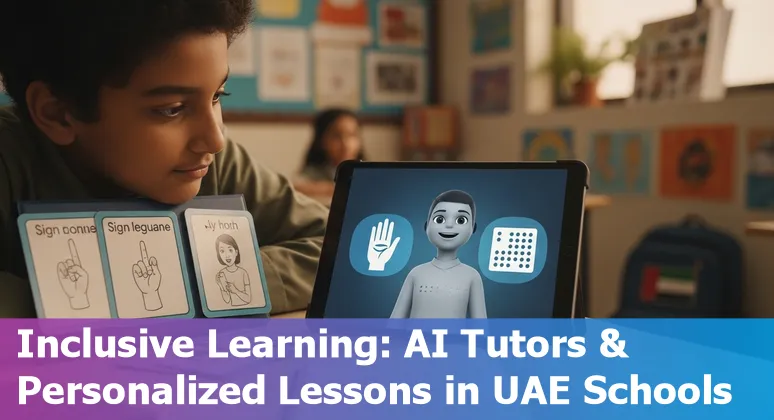
(Up)Accessibility and Inclusive Education prompts for UAE classrooms should translate Ministry policy into usable instructions that generate assistive, culturally aligned learning materials - prompts that request IEP‑aligned lessons, AAC-friendly sentence frames, simplified‑language summaries, and TTS‑ready outputs with simultaneous word highlighting so one tool benefits a student with vision impairment, an EAL learner, and a gifted reader at once; the legal framework and the Ministry's People of Determination (POD) guidance require inclusion in the “least restrictive environment,” so prompts must also produce individualized accommodations, alternate formats, and evidence packages teachers can review (UAE Ministry of Education Inclusive Education policy for People of Determination).
Practical edtech features to target in prompts include adjustable text presentation, transliteration or simplified vocabulary, and exportable IEP notes that match inspection standards - tools advocated in sector overviews and edtech guides that show how TTS and assistive tech scale inclusion across diverse classrooms (ReadSpeaker overview of inclusive education and edtech in the UAE, UAE education technology profile and digital learning overview).
Start with a single, one‑line prompt that produces a narrated, highlighted worksheet plus an IEP summary to see immediate time savings and clearer accommodations for people of determination.
“…the process through which schools develop systems, classrooms, programmes, and activities so that all students are able to learn, develop, and participate together. In an inclusive school, the curriculum, physical surroundings, and school community should reflect the views and characteristics of its students. An inclusive school honors diversity and respects all individuals.”
EdTech Vendor Evaluation Prompts (SuperbCompanies list & procurement)
(Up)Selecting safe, effective EdTech for UAE schools starts with precise vendor‑evaluation prompts that mirror local procurement priorities: ask for a rubric‑based score across curriculum alignment, data ownership and student privacy, LMS/SIS and interoperability support, accessibility for People of Determination, cybersecurity/uptime guarantees, pilot terms and vendor longevity.
Use a UAE‑compliant template to ensure legal and regulatory fit (UAE-compliant vendor evaluation template for EdTech procurement), embed the Pear Deck procurement rubric's detailed criteria to demand export/import frequency, SSO, and evidence of efficacy (Pear Deck procurement rubric for effective EdTech selection and data interoperability), and automate continuous due diligence with tools that produce a traffic‑light vendor score and process maps for DPIAs and SARs (9ine vendor management platform for automated due diligence).
For UAE districts, the pragmatic play is to standardise prompts used in RFI/RFPs, run short pilots, and require machine‑readable answers to interoperability and privacy questions so procurement panels can compare vendors objectively rather than trusting polished demos - think of a dashboard that surfaces vendor risk at a glance and speeds decisions without sacrificing student safety.
| Evaluation criterion | Why it matters / source |
|---|---|
| Curriculum alignment | Pear Deck procurement rubric: ensures pedagogical fit |
| Data ownership & student privacy | Pear Deck + EDDS governance recommendations |
| Interoperability (LMS/SIS) | Pear Deck criteria; ISTE pillars on interoperability |
| Accessibility & inclusion | UAE procurement should require POD compliance and accessibility testing |
| Cybersecurity, uptime & pilot terms | 9ine vendor assessments and traffic‑light monitoring |
“They felt like an extension of our IT support team for the time they were with us and were never judgemental on the approach we take with our systems and security. I'd have no concerns about recommending them (and using their services) again in the future.”
Curriculum Design Prompt for the UAE AI Curriculum (MBZUAI + MIT ReACT)
(Up)Designing a curriculum‑generation prompt for the UAE's national AI rollout should ask an LLM to output a co‑curricular, experiential BSc pathway that mirrors MBZUAI's new undergraduate model: specify degree streams (AI‑Engineering and AI‑Business), embed industry collaborations, cooperative placements and mentorships, require hands‑on modules in ML, NLP, computer vision and robotics, and include explicit learning outcomes for AI for health, sustainable living and mixed reality so students graduate with both technical depth and sectoral fluency; the prompt should also request integration of a “co‑pilot” learning model that gives students practicum access to state‑of‑the‑art LLMs like JAIS and K2 and cross‑disciplinary training in business, ethics and communication, plus rubrics for internships and capstone projects to ensure alignment with UAE workforce goals (see MBZUAI's program launch and its emphasis on experiential learning).
For practical pilots, require the generator to emit a week‑by‑week syllabus, assessment types, partner‑industry role descriptions, and a short pilot evaluation plan so districts can trial one stream before scaling across grades (MBZUAI undergraduate AI program announcement, MIT Sloan Middle East article on MBZUAI undergraduate AI program launch).
“Our students won't just be taught theory and programming. They will graduate with critical understandings of society and people, of markets and the economy, and the practical experience and confidence to drive and lead AI initiatives, whether within established companies or through their own entrepreneurial ventures.”
Conclusion: Start Small, Iterate, and Prioritize Ethical AI in UAE Classrooms
(Up)Closing the loop in UAE schools means starting small, learning fast, and making ethics non‑negotiable: run short pilots that test a single prompt or tutor, invest in focused teacher upskilling, then scale what demonstrably saves time and improves learning.
National programmes already show the playbook - the UAE's AI initiatives include an internship effort (in partnership with Dell EMC) to train 500 Emirati students and a staged teacher programme from ADEK and 42 Abu Dhabi that combines pre‑bootcamp learning, an in‑person bootcamp and a capstone (pilot cohorts posted a 97% NPS) - practical steps that turn policy into classroom practice (AI in UAE education: strategic investments & internships, Abu Dhabi launches AI for Teachers programme).
Pair those pilots with short, applied courses that teach prompt craft and workplace AI fluency - for example, Nucamp's AI Essentials for Work - and embed privacy, bias checks and human review from day one so AI augments good teaching rather than replaces it.
| Bootcamp | AI Essentials for Work (Nucamp) |
|---|---|
| Length | 15 Weeks |
| Includes | AI at Work: Foundations; Writing AI Prompts; Job‑Based Practical AI Skills |
| Early bird cost | $3,582; Register for AI Essentials for Work (Nucamp) |
“We should not demonize AI.” - His Excellency Dr. Ahmad Belhoul Al Falasi
Frequently Asked Questions
(Up)What are the top AI prompt use cases for the education industry in the UAE?
The article highlights ten practical classroom and system-level use cases: personalized lesson generation (grade‑ and language‑specific units and formative checks), GPT‑powered AI tutors (scaffolded coaching workflows), automated grading and feedback aligned to UAE rubrics, teacher‑assistant prompts for PD and micro‑credentials, predictive early‑warning systems using school data, Arabic‑language learning prompts (MSA/dialect handling and preprocessing), immersive AR/VR STEM lesson scripts, accessibility and inclusion prompts (IEP/AAC/TTS outputs), edtech vendor‑evaluation prompts for procurement, and curriculum‑generation prompts for national AI programs.
When does AI become a mandatory K–12 subject in the UAE and what does that mean for classrooms?
AI is being introduced as a mandatory K–12 subject starting in the 2025–26 school year. Practically this means teachers will use age‑appropriate, ethically framed prompts as classroom 'operating instructions' - to personalise lessons, automate formative feedback, support bilingual instruction, and teach data literacy and AI ethics. The rollout includes teacher training and ready‑made materials, with emphasis on human oversight, cultural fit, and staged pilots.
How were the Top 10 prompts and use cases selected and what privacy safeguards were prioritised?
Selection prioritized practical, research‑backed prompts that align with UAE policy and protect student data. Candidates were scored on privacy risk, curricular fit with the national AI mandate, and deployment feasibility. Key sources and safeguards include MBZUAI research on federated and split learning (to keep raw data local), MBZUAI–Sorbonne Abu Dhabi partnership guidance, and cost/efficiency analyses. The recommended approach includes DPIAs, minimizing raw data export, bias monitoring, and iterative, on‑site pilots so models learn without centralising sensitive student data.
How should schools pilot, evaluate, and scale AI prompt deployments safely in UAE classrooms?
Start small and iterative: run short pilots that test one prompt, one tutor, or one unit; collect teacher and student feedback; measure time savings and learning impact; and refine prompts with human review. Upskill staff through focused PD and micro‑credentials, validate indicators for early‑warning systems, run side‑by‑side model tests for Arabic and dialect accuracy, and require machine‑readable vendor answers on data ownership, interoperability and accessibility during procurement. Embed ethics, DPIAs, and continuous bias monitoring before scaling.
What training options teach prompt writing and practical AI skills for UAE educators?
Practical bootcamps and certificates are recommended to bridge policy and classroom practice. Example: Nucamp's "AI Essentials for Work" bootcamp (15 weeks) includes Foundations, Writing AI Prompts, and Job‑Based Practical AI Skills; early bird cost listed at $3,582. Local programs and micro‑credentials from institutions like Abu Dhabi University and Ministry teacher training also support project‑based PD tied to the 2025–26 rollout.
With the UAE's ambitious AI curriculum rollout (2025–26), education staff must rethink roles that can be automated.
Discover how AR/VR virtual labs and simulations replace costly physical infrastructure and travel in the UAE.

Ludo Fourrage
Founder and CEO
Ludovic (Ludo) Fourrage is an education industry veteran, named in 2017 as a Learning Technology Leader by Training Magazine. Before founding Nucamp, Ludo spent 18 years at Microsoft where he led innovation in the learning space. As the Senior Director of Digital Learning at this same company, Ludo led the development of the first of its kind 'YouTube for the Enterprise'. More recently, he delivered one of the most successful Corporate MOOC programs in partnership with top business schools and consulting organizations, i.e. INSEAD, Wharton, London Business School, and Accenture, to name a few. With the belief that the right education for everyone is an achievable goal, Ludo leads the nucamp team in the quest to make quality education accessible