









How AI Is Helping Retail Companies in Tyler Cut Costs and Improve Efficiency
Last Updated: August 31st 2025
Too Long; Didn't Read:
AI helps Tyler retailers cut costs and boost efficiency via AI price optimization, inventory forecasting (25% fewer stockouts), automation with 15–20% accuracy gains, smart-shelf speed (10,000 price updates in ~60s), and pilots showing 20% lower inventory costs and 15% sales lift.
For retailers in Tyler, Texas, AI is no longer a futuristic luxury - it's a practical tool to cut costs and stay competitive in a market where shoppers often compare prices on mobile before they even walk through the door.
AI-driven price optimization can tune prices and promotions in near real time to protect margins and respond to local demand (see AI price optimization research), while broader AI use cases - from inventory forecasting to cashier-free checkout - help reduce waste, speed replenishment, and personalize in-store and online experiences (review 16 AI use cases & examples).
Local merchants can use generative AI for hyper-local marketing and product copy that speaks to Tyler search behavior, turning neighborhood events into measurable sales lift.
With studies showing meaningful gains in supply-chain performance and pricing accuracy, investing in skills matters too - programs like the AI Essentials for Work bootcamp registration offer hands-on training so teams can apply these tools responsibly and effectively in small-to-mid-sized Texas retailers.
| Attribute | Information |
|---|---|
| Course | AI Essentials for Work bootcamp syllabus: AI at Work, Writing AI Prompts, Job-Based Practical AI Skills |
| Length | 15 Weeks |
| Includes | AI at Work: Foundations; Writing AI Prompts; Job Based Practical AI Skills |
| Cost (early bird) | $3,582 (paid in 18 monthly payments) |
Table of Contents
- How AI Automates Repetitive Workflows in Tyler Retail
- Personalization and Customer Experience Improvements in Tyler Stores
- Inventory, Supply Chain, and Pricing Optimization for Tyler Retailers
- Fraud Detection, Security, and Trust for Tyler Businesses
- In-Store Automation and Emerging Tech for Tyler Retail Locations
- Measurable Business Outcomes and Case Examples Relevant to Tyler
- Common Challenges and How Tyler Retailers Can Overcome Them
- Ethics, Governance, and Vendor Choices for Tyler Retailers
- Step-by-Step Beginner Roadmap for Tyler Retail Companies
- Future Trends: What Tyler Retailers Should Watch in Texas, US
- Conclusion: Getting Started with AI in Tyler, Texas, US Retail
- Frequently Asked Questions
Find out which jobs and upskilling opportunities in Tyler retail will grow as AI reshapes roles in 2025.
How AI Automates Repetitive Workflows in Tyler Retail
(Up)Tyler retailers can shave hours off mundane back-office work by borrowing the same intelligent document processing and AI agents that courts and counties are using to automate classification, OCR, extraction and RPA-driven data entry - think invoices, receipts, supplier forms and returns handled with far less human retyping.
Solutions like Tyler Technologies Document Automation solution show how AI document understanding speeds review, expands processing hours and improves accuracy (reported gains around 15–20%), while government case studies highlight 24/7 processing that cut intake from days to minutes and even yielded multimillion-dollar savings in large deployments - lessons summarized in an AI-driven savings and staff satisfaction case study from Tyler Technologies.
At the same time, industry coverage explains how modern AI agents make classification resilient to messy formats like receipts and invoices, reducing manual checks and scaling capacity in articles such as How AI Agents Transform Document Classification Workflows.
The payoff for Tyler shops: faster restocking, fewer errors on margins, and more staff time freed for the customer-facing moments that matter.
- AI document classification & OCR: Tyler's Document Automation and industry examples from FinTech Global.
- Automated data extraction & RPA: Document Automation speeds review and automates data entry.
- Processing hours: Expanded to 24/7 in government cases (Tarrant County).
- Accuracy & savings: 15–20% accuracy gains; Palm Beach reported $1.9M annual savings.
“It's more than keeping things the way they are,” said Henry Sal, senior director of AI Automations at Tyler Technologies in a recent webinar, “[AI] is going to improve [workflows] dramatically.”
Personalization and Customer Experience Improvements in Tyler Stores
(Up)Tyler stores can turn everyday visits into genuinely personal moments by using the same playbook experts describe in industry guides: unify first‑party data into single customer profiles at POS, test hyper‑personalization triggers like back‑in‑stock alerts or birthday offers, and let associates use mobile POS to suggest the perfect add‑on - small moves that boost loyalty and conversion without heavy infrastructure.
Local examples at Connect 2025 underscore the point: Tyler-area retailers can borrow cloud and AI best practices highlighted at the conference to improve client experience and even tie offers to neighborhood events (remember the Kendra Scott pop-up in San Antonio where 20% of sales were donated).
Practical guides from Shopify tailored product recommendations guide explain how tailored product recommendations and segmented promotions lift engagement, while Nucamp AI Essentials for Work generative AI marketing examples show how generative AI crafts product copy and promotions tuned to Tyler search behavior.
Start with one measurable test - send a targeted, time‑limited offer to a defined segment - and learn: personalization is less about magic and more about disciplined data, repeatable experiments, and a local touch that makes each shopper feel like the store was built just for them.
“If we have 4.5 million customers, we shouldn't have one store; we should have 4.5 million stores.”
Inventory, Supply Chain, and Pricing Optimization for Tyler Retailers
(Up)Tyler retailers can use AI to stop guessing and start orchestrating inventory, supply-chain flows, and pricing so stores carry what locals actually buy: tools like SmartPMX from Driveline Retail bring AI-powered demand forecasting, real-time updates and space-optimization to reduce waste and make shelf space work harder, while cloud projects that centralize inventory and predictive analytics have cut stockouts by about 25% in client work and sped replenishment for Texas-area deployments (Applaudo's case study includes Austin, TX).
Granular merchandising platforms such as Syrup report outcomes like a 10% lift in full-price sell-through, 30% reductions in on-hand inventory, and margin improvements - real metrics that let a single seasonal item be moved to the right Tyler store before it becomes a markdown.
Combine these inventory signals with dynamic pricing and dealer-style VIN targeting where appropriate, and small chains can defend margin and improve cash flow without massive IT projects; local pilots - one targeted SKU, one supplier - are an easy, measurable start.
| Provider / Study | Key Outcomes |
|---|---|
| Driveline Retail SmartPMX retail inventory optimization | AI forecasting, real-time updates, space optimization |
| Applaudo AI inventory optimization case study (Austin, TX) | Reduced stockouts by 25%; faster replenishment; lower ops costs (includes Austin, TX) |
| Syrup granular merchandising platform | 10% lift full-price sell-through; 30% lower on-hand inventory; 5% margin increase; >10x ROI |
“It's magical, what would typically take us years to implement...we did in the same quarter. I've never seen anything like this.”
Fraud Detection, Security, and Trust for Tyler Businesses
(Up)For Tyler retailers, AI-driven fraud detection is becoming a practical shield that protects revenue and customer trust: large platforms now use real-time AI to scan listings for policy breaches and counterfeit sellers, a capability highlighted in coverage of Walmart's marketplace monitoring (Walmart's AI marketplace monitoring), while guides from specialists explain how machine learning reduces false positives, spots account takeover or card-testing rings, and adapts to new attack patterns before they cascade into chargebacks or reputational damage (AI in e‑commerce fraud detection).
For a small chain in Tyler, that means real‑time scoring to block suspicious orders, behavioral fingerprints to catch bots, and tuned thresholds so loyal customers aren't needlessly declined - concrete steps that cut losses and keep checkout friction low.
Vendors that publish outcomes - like improved detection rates and fewer false alarms - offer an evidence-based starting point for pilots: begin with one channel (online checkout or returns), log outcomes, then scale.
The payoff is simple and visceral: fewer surprise chargebacks and more customers who trust the brand at every point of sale.
| Metric | Feedzai Reported Value |
|---|---|
| Consumers protected | 1B |
| Events processed / year | 70B |
| Payments secured / year | $8T |
| Example outcomes | 62% more fraud detected; 73% fewer false positives; 25% faster model deployment |
“The sophistication of the AI now to be able to help us accurately figure out what's a good order and what's a bad order.”
In-Store Automation and Emerging Tech for Tyler Retail Locations
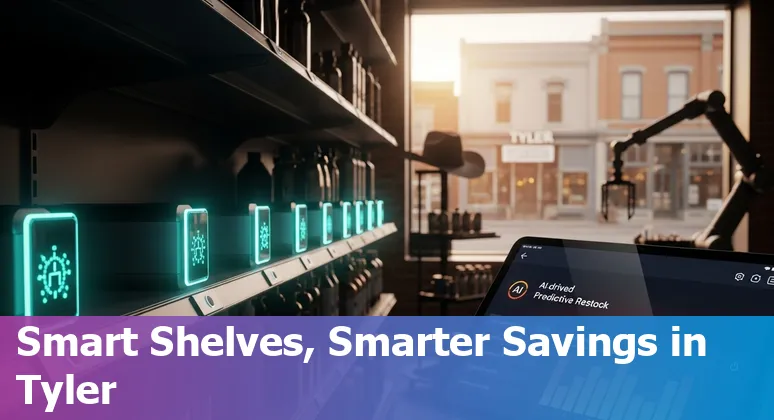
(Up)For Tyler retailers ready to modernize the sales floor, smart shelves are a practical next step: sensors, RFID and electronic shelf labels automate price updates and restock alerts so a downtown grocer or small pharmacy can cut hours of shelf‑tag work and reduce shrink, while a boutique furniture showroom can display dynamic bundles and QR‑linked 3D product views that boost conversion; the smart shelves market is growing fast (see the smart shelves market report from Grand View Research smart shelves market report) and early adopters report striking efficiency gains - Datallen notes examples like updating 10,000 price points in about 60 seconds instead of roughly 40 human hours - making pilots in one aisle or a single SKU a low‑risk, high‑learning move for Tyler stores.
Besides labor savings and faster replenishment, smart shelves feed real‑time analytics into local inventory systems so small chains can fine‑tune assortments before markdowns pile up, but deployment should include clear signage and privacy choices to keep shoppers comfortable as IoT sensors become part of the shopping rhythm.
| Source | Notable stat |
|---|---|
| Grand View Research | Global market ~USD 3,312.7M (2023); projected ~USD 14,685.7M by 2030 |
| GlobeNewswire (2025) | Global market ~US$4.4B (2024); projected US$15.4B by 2030 (CAGR ~23%) |
| Datallen | Adoption under 20% mainstream; example: 10,000 price updates in ~60 seconds vs ~40 human hours |
“Information from RFIDs is complemented by insights from store managers into why certain items didn't perform well on certain days, as well as from salespeople who've been trained to engage with customers and give feedback about what they've learned to designers.”
Measurable Business Outcomes and Case Examples Relevant to Tyler
(Up)Texas examples make the business case for AI concrete: a Travis County retailer reported rapid, measurable gains after phasing in AI for inventory, personalization and forecasting - within a few months the pilot showed a 20% reduction in inventory costs, a 15% lift in sales revenue and a 25% improvement in customer retention (read the Travis County case study at AI4MainStreet).
Energy and demand-forecasting pilots in Texas add to the evidence: a thinkbridge engagement for a retail energy provider delivered a $1M+ savings with a 35% cut in overhead from over-purchasing, a 40% boost in forecasting accuracy and a 20% increase in revenue per customer, illustrating how tighter forecasts directly protect margins.
Industry compilations of supply-chain case studies also show where forecasting and dock-scheduling gaps create real dollar risk for U.S. retailers and where AI pilots can be targeted for fast wins - use these Texas-specific outcomes as a blueprint for a one‑SKU, one‑channel pilot that proves ROI before scaling.
| Case / Source | Measurable Outcome(s) |
|---|---|
| AI4MainStreet Travis County retailer case study | 20% reduction in inventory costs; 15% sales increase; 25% improvement in customer retention |
| thinkbridge AI software for electricity markets case study | ~$1M savings; 35% reduction in overhead; 40% better forecasting accuracy; 20% higher revenue per customer |
Common Challenges and How Tyler Retailers Can Overcome Them
(Up)Tyler retailers face predictable hurdles when bringing AI in-house - an acute skills gap, patchy frontline training, and anxiety about job changes - but practical, local fixes exist.
Data shows AI proficiency is uneven (a Randstad analysis notes a wide gender and generational divide and that many workers haven't had recent AI training), so start with targeted skilling rather than a big-bang rollout: invest in AI-enhanced roleplay and on-the-job simulations to speed onboarding and preserve institutional knowledge (see the MyTotalRetail guide on AI training), and recruit or collaborate with nearby talent pipelines and faculty who are already teaching applied AI at UT Tyler (KLTV coverage).
Pilot one measurable workflow (one SKU, one checkout channel) to limit risk and prove ROI, and use that success to fund broader upskilling - local innovation already shows the payoff (a Tyler student startup's AI fire detector was 2 minutes, 15 seconds faster than a traditional unit).
Focusing on inclusive, repeatable training and small pilots turns the “skills problem” into a competitive advantage for Texas stores that want lower costs and sturdier margins.
| Metric | Value |
|---|---|
| AI talent gender split | 71% men / 29% women |
| Companies adopting AI | 75% |
| Talent offered recent AI training | 35% |
| Gen gap: Baby Boomers offered AI skilling | 22% |
“One key thing to remember is AI is not going to take away jobs it's more about aligning our skills to work with AI.”
Ethics, Governance, and Vendor Choices for Tyler Retailers
(Up)For Tyler retailers, ethics and governance aren't optional add-ons - Texas law and active enforcement mean vendor choices can carry real legal and reputational risk, so pick partners with transparent data practices and clear disclosures.
The Texas Responsible Artificial Intelligence Governance Act (TRAIGA) will take effect January 1, 2026 and requires transparency, risk assessments, and limits on manipulative or discriminatory AI uses, while offering a 36‑month regulatory sandbox for controlled testing (Texas Responsible Artificial Intelligence Governance Act (TRAIGA) overview - Spencer Fane); retailers that accept AI tools for health‑adjacent services or customer support should demand vendor attestations and clear user notices.
The Texas AG is already scrutinizing developers - an August 18, 2025 probe targeted chatbots allegedly misleading children about mental‑health services - underscoring why contracts must prohibit deceptive claims and specify data use and retention (Texas AG investigation into AI-generated mental-health services - Hudson Cook enforcement alert).
Enforcement is driven by the Attorney General (no private right of action) and penalties can reach into the tens or hundreds of thousands per violation, so a practical playbook for Tyler shops is vendor due diligence, written SLAs on privacy and bias testing, and a lightweight internal AI governance checklist to spot red flags before a pilot becomes a headline; think of it as insurance that prevents one small experimental chatbot from costing a downtown boutique both customers and serious fines (TRAIGA summary and compliance guidance - Perkins Coie).
| TRAIGA Element | Implication for Tyler Retailers |
|---|---|
| Effective date | Jan 1, 2026 - prepare now |
| Disclosure & transparency | Require vendor notices; disclose AI use for health-related services |
| Regulatory sandbox | Opportunity to test under supervision (up to 36 months) |
| Enforcement | Texas AG exclusive authority; no private right of action |
| Penalties | $10,000–$200,000 per violation (varies by curability) |
Step-by-Step Beginner Roadmap for Tyler Retail Companies
(Up)Start small, practical, and people‑first: follow a clear five‑step roadmap that begins with an AI readiness audit to map current skills, systems, and customer pain points, then build a communication plan that explains “why” and creates feedback channels so staff don't feel blindsided; next, deploy role‑based training for associates, managers, and planners so learning is immediate and relevant, launch an AI champions pilot (give a respected store manager early access to lead a one‑store or one‑SKU test) and finally measure usage, reward wins, and iterate - a process laid out in Del Mar College SBDC's on‑demand session on building an AI implementation roadmap and the practical, people‑centered five‑step plan from Wair.ai.
Back the plan with a concise business case - Bryj cites McKinsey findings showing strong profitability upside when AI is adopted thoughtfully - so leadership funds the training and pilots that turn resistance into advantage; this sequence keeps risk low, proves ROI fast, and makes the first pilot a memorable local success story staff will actually want to repeat.
| Step | Action (short) |
|---|---|
| 1. Readiness audit | Assess skills, systems, and champions |
| 2. Communication roadmap | Leadership messaging + feedback channels |
| 3. Role‑based training | Tailored modules for associates, managers, planners |
| 4. Champions pilot | Small group/one‑store test with early adopters |
| 5. Measure & reward | Track outcomes, celebrate wins, iterate |
“The key part is realizing what you have today and how you can use it as an asset.”
Future Trends: What Tyler Retailers Should Watch in Texas, US
(Up)Tyler retailers should watch a tight set of 2025 trends that will reshape local retail operations and customer moments: autonomous shopping agents and virtual assistants that guide discovery and lift AOV, deep hyper‑personalization and predictive engagement (Insider's trend roundup even highlights a Slazenger case with dramatic ROI), conversational and voice commerce for hands‑free, mobile customers, AI‑powered visual search and smart inventory/demand forecasting to cut stockouts, dynamic pricing and competitive‑intelligence engines, stronger AI fraud detection, and generative AI that speeds creative work and enables hyper‑local campaigns (see Nucamp AI Essentials for Work course syllabus for localized marketing examples: https://url.nucamp.co/aiessentials4work).
These developments aren't theoretical - industry surveys show strong business confidence (Appinventiv notes ~97% of business owners expect positive impact from tools like ChatGPT) - so the practical “so what?” for Tyler is simple: run one small pilot (an assistant, a pricing test, or a localized gen‑AI campaign), measure lift, then scale the winner to protect margins and make every storefront feel like it was tuned to the neighborhood.
| Trend | Why Tyler retailers should care |
|---|---|
| Insider report on AI shopping agents and virtual assistants | Reduce search friction and increase AOV with real‑time guidance |
| Insider analysis of hyper‑personalization and predictive engagement | Targeted offers and back‑in‑stock alerts that drive measurable lift (Insider case examples) |
| Appinventiv overview of conversational commerce and voice shopping | Hands‑free checkout and lower service costs - important for mobile shoppers |
| Generative AI for localized marketing examples and prompts | Fast, local copy and promos tuned to Tyler search behavior |
Conclusion: Getting Started with AI in Tyler, Texas, US Retail
(Up)Getting started with AI in Tyler retail is all about small, practical bets: run one measurable pilot (one SKU, one checkout channel, or a local gen‑AI marketing test), pair it with role‑based training, and use plain vendor checks so pilots don't become headlines.
Local resources make that pathway easier - Tyler Technologies' beginner guide to AI breaks down core concepts and safe uses for automation and document understanding, while neighborhood providers like Omni AI Systems AI solutions in Tyler can help stitch together chatbots, CRM automations and appointment flows without huge IT lift.
For teams that need hands‑on skills, the AI Essentials for Work bootcamp registration teaches promptcraft, practical AI tools and job‑based applications in a 15‑week format so staff can run pilots responsibly and measure ROI - turning a cautious experiment into a repeatable advantage that keeps Tyler stores competitive and trusted in the community.
| Attribute | Information |
|---|---|
| Program | AI Essentials for Work |
| Length | 15 Weeks |
| What it teaches | AI at Work: Foundations; Writing AI Prompts; Job‑Based Practical AI Skills |
| Cost (early bird) | $3,582 (paid in 18 monthly payments) |
| Register / Syllabus | AI Essentials for Work registration | AI Essentials for Work syllabus |
Frequently Asked Questions
(Up)How is AI helping Tyler retailers cut costs and improve operational efficiency?
AI helps Tyler retailers cut costs and boost efficiency through price optimization that adjusts prices and promotions in near real time, AI forecasting that reduces stockouts and speeds replenishment, automated document processing (OCR/classification/RPA) that reduces manual back‑office work, smart-shelf and RFID solutions that speed price updates and restocking, and fraud detection systems that lower chargebacks. Reported outcomes from similar deployments include 15–20% accuracy gains in document processing, ~25% fewer stockouts, 10%–30% improvements in sell‑through or inventory levels, and multimillion‑dollar savings in large cases.
What specific pilots or starting points should a small Tyler shop use to test AI?
Start small and measurable: run one‑SKU or one‑channel pilots such as (1) a demand‑forecasting pilot for a high‑turn SKU, (2) a dynamic pricing test during a local event, (3) an AI document automation pilot for invoices/receipts to cut processing time, or (4) a localized generative AI marketing campaign targeted to Tyler search behavior. Measure clear KPIs (stockouts, sell‑through, processing time, sales lift) and scale winners. The article recommends role‑based training and an AI champions pilot (one store/one manager) to accelerate adoption.
How can AI improve personalization and the in‑store customer experience in Tyler?
By unifying first‑party POS and customer data into single profiles, testing hyper‑personal triggers (back‑in‑stock, birthday offers), enabling mobile POS recommendations by associates, and using generative AI to craft hyper‑local product copy and promotions. Practical tests - like time‑limited targeted offers - drive measurable lifts in conversion and loyalty. Conference and case examples show these approaches increase engagement without large infrastructure overhauls.
What legal, ethical, and governance considerations should Tyler retailers know before deploying AI?
Tyler retailers must pick vendors with transparent data practices and disclosures, perform risk assessments, and include bias/privacy clauses in contracts. The Texas Responsible Artificial Intelligence Governance Act (TRAIGA) takes effect Jan 1, 2026, requiring transparency, risk assessments, and limiting manipulative or discriminatory uses; it also offers a 36‑month regulatory sandbox. Enforcement is via the Texas Attorney General, with penalties that can be significant, so maintain written SLAs, vendor attestations, user notices for AI use, and a lightweight internal governance checklist before scaling pilots.
What training or programs are recommended for Tyler retail teams to implement AI responsibly?
Invest in targeted, role‑based training and hands‑on programs that teach practical AI skills and promptcraft. The article highlights a 15‑week 'AI Essentials for Work' program (includes AI at Work: Foundations; Writing AI Prompts; Job‑Based Practical AI Skills) offered with an early bird cost of $3,582 (payable over 18 months). The recommended rollout sequence is: readiness audit, communication plan, role‑based training, champions pilot, then measure & reward - helping teams apply AI responsibly and prove ROI with small pilots.
Cut labor costs and improve coverage using AI-driven labor planning that generates smart schedules and productivity recommendations for Tyler teams.
The rise of cashier automation in Tyler means many frontline roles must evolve toward technical troubleshooting and people-first service.

Ludo Fourrage
Founder and CEO
Ludovic (Ludo) Fourrage is an education industry veteran, named in 2017 as a Learning Technology Leader by Training Magazine. Before founding Nucamp, Ludo spent 18 years at Microsoft where he led innovation in the learning space. As the Senior Director of Digital Learning at this same company, Ludo led the development of the first of its kind 'YouTube for the Enterprise'. More recently, he delivered one of the most successful Corporate MOOC programs in partnership with top business schools and consulting organizations, i.e. INSEAD, Wharton, London Business School, and Accenture, to name a few. With the belief that the right education for everyone is an achievable goal, Ludo leads the nucamp team in the quest to make quality education accessible