









AI Meetups, Communities, and Networking Events in Tucson, AZ in 2026
By Irene Holden
Last Updated: March 30th 2026
Key Takeaways
Tucson's AI networking scene in 2026 thrives with events like the bi-weekly Artificial Intelligence Trailblazers meetups and the University of Arizona's AI Insights Series, connecting grassroots communities to industry leaders such as Raytheon. This layered ecosystem, centered around the UA Tech Park and downtown startups, provides affordable pathways to build a career in AI while leveraging the region's strengths in defense and optics.
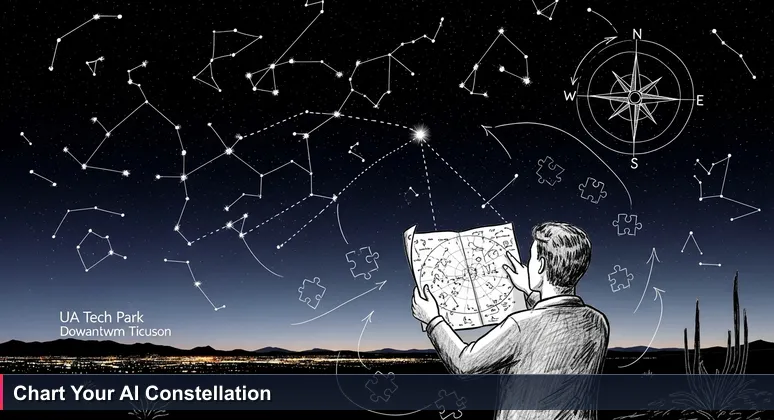
Under Tucson’s famously dark skies, the difference between understanding a field of stars and simply seeing them is a map. In 2026, our local artificial intelligence scene presents the same critical choice. A newcomer faces a dazzling but overwhelming array of bright spots: bi-weekly meetups, university talks, corporate briefings, and hackathons. The challenge isn't a lack of events, but seeing the grand, navigable structure that connects them.
True networking success in Tucson means moving from simply attending events to mapping the unique layers of our ecosystem. This growth is strategically characterized by experts as "layering AI" onto established local strengths in defense, optics, and aerospace, rather than trying to replicate Silicon Valley. This creates a powerful, interconnected constellation where the University of Arizona’s academic rigor, Raytheon’s defense applications, and a burgeoning startup scene at the UA Tech Park align for your career.
Without this map, even diligent attendance can leave you an outsider. One professional who spent 30 days attending every AI event in Tucson they could find highlighted the risk of fragmentation despite the activity. The transformed perspective is becoming a celestial navigator. You stop chasing random bright spots on an event calendar and start strategically plotting a course through Tucson's unique ecosystem, where relationships are the lines drawn between the stars, and the region's lower cost of living and high-quality talent become your strategic advantages.
In This Guide
- Beyond the Event Calendar: Tucson's AI Constellations
- The Grassroots & Community Engine
- The Academic & Research Core
- The Industry & Professional Nexus
- Navigating Tucson's AI Rhythm by Season
- Networking Tips for Introverts and Newcomers
- Networking Strategies for Career-Changers
- Networking for Established Professionals and Entrepreneurs
- Becoming a Celestial Navigator in Tucson's AI Sky
- Frequently Asked Questions
For a comprehensive resource, see The Complete Guide to Starting an AI Career in Tucson, AZ in 2026.
The Grassroots & Community Engine
This is the vibrant engine of peer-to-peer learning and entrepreneurial hustle, often centered in coffee shops and co-working spaces downtown and around the university. It’s where theory meets the street, focused on applied knowledge and collaborative problem-solving.
Key Communities to Connect With
- Artificial Intelligence Trailblazers: Operating as a 501(c)(3) nonprofit, this group hosts bi-weekly gatherings that are a nexus for business owners and entrepreneurs. The focus is on operationalizing AI, with topics ranging from generative AI tools to tackling AI's social implications. The networking value is high for those looking to transform business processes. Find their events on the Artificial Intelligence Trailblazers Meetup page.
- Claude Coders Meetup: Part of a global network, this is Tucson's hub for deeply technical, hands-on developers. Sessions dive into AI pair programming, Claude Code workflows, and building software with LLMs. It’s ideal for software engineers and AI tool enthusiasts looking for a community of practice. Connect via the Claude Coders Meetup site.
- AI & ML Learning Circle: For consistent, skill-building practice, this weekly group focuses on live Python coding, breaking down ML concepts, and building GenAI agents. The environment is collaborative, perfect for practitioners who learn by doing. Join through the AI & ML Learning Circle Meetup.
Actionable Takeaway: For newcomers, start here. These groups are low-barrier, welcoming, and focused on applied knowledge. Attend with a simple goal: meet one person working on a problem that genuinely interests you. This peer layer is where you build the foundational relationships that can connect you to the broader ecosystem.
The Academic & Research Core
Fueled by the University of Arizona, this layer provides the depth, ethical grounding, and pipeline of cutting-edge research that distinguishes Tucson's ecosystem. It’s where theoretical innovation meets tangible application, offering a crucial bridge between academia and industry.
Key Programs & Access Points
The AI Insights Series, hosted by the university's Office of the Chief AI Officer, offers recurring lunchtime sessions that blend high-level research with practical application. For foundational knowledge on ethics and implementation, the spring AI Info Sessions provide dedicated Zoom discussions on Responsible AI, covering crucial topics like copyright, privacy, and AI for project management.
Beyond formal talks, initiatives like Research Bazaar (ResBaz) Arizona foster a vibrant culture of data and compute literacy through "Coffee and Code" sessions and an annual festival. These are perfect for students, researchers, and professionals wanting to collaborate on data-intensive problems in an open, workshop-style environment.
Actionable Takeaway: Leverage these resources to build credibility and contextual understanding. Mentioning a concept from a recent "AI Insights" talk can be a powerful conversation starter at a grassroots meetup, demonstrating you’re engaged with the field's foundational issues. This layer equips you with the language and frameworks needed to engage meaningfully in Tucson's specialized industry discussions.
The Industry & Professional Nexus
This is where Tucson's layered strategy shines, integrating AI into the high-value sectors that define our regional economy: defense, aerospace, healthcare, and advanced manufacturing. Here, community connections translate into professional opportunities and applied innovation.
Key Access Points and Events
Raytheon Technologies (RTX) and the broader defense network are active participants, not just employers. They engage in tech briefings and "Lunch & Learn" sessions on AI for national security, often through partnerships with organizations like the Arizona Technology Council. The premier event for enterprise strategy is the Council's TechFusion Conference, which in 2026 focuses on AI strategy and workforce development, while the annual Aerospace, Aviation, Defense and Manufacturing (AADM) Conference showcases applied innovations.
"Successful AI adoption requires alignment at the executive level to solve specific problems." - Srikanth Balusani, CTO of MST Solutions
Specialized professional workshops, such as those on "AI for Business" or "Communicating Authentically Through AI," cater to specific verticals like marketing or project management, providing targeted networking within industry frameworks.
Actionable Takeaway: Before attending an industry event, research the specific AI challenges in Tucson's key sectors. Ask informed questions about AI in optical systems at the UA Tech Park, predictive maintenance for aerospace, or diagnostics at Banner Health. This demonstrates you understand the local playing field and moves conversations beyond generic AI talk into actionable, Tucson-specific solutions.
Navigating Tucson's AI Rhythm by Season
While specific dates may change, the annual rhythm of Tucson's AI community follows a predictable, strategic pattern. Understanding this cadence allows you to plan your networking and skill-building efforts for maximum impact throughout the year.
Spring: The Season of Conferences & Outreach
March through May is when the ecosystem bursts into activity. The University of Arizona ramps up its public-facing AI Info Sessions, and major conferences like the Arizona Technology Council's TechFusion cluster in this period. Networking Tip: Use spring to cast a wide net - attend a major conference to scan the landscape, then follow up with targeted meetup attendance.
Summer: Deep Dive & Skill Building
As the heat rises, the focus shifts to consistent practice. Weekly community meetups continue, often with more project-based formats. This is the prime time for immersive, cohort-based programs like Saturdays.AI Tucson, whose 14-week cohorts often culminate in a Demo Day that attracts local hiring managers. Networking Tip: Use the slightly slower pace to build deeper relationships in one or two core communities by joining a study group or committed project.
Fall: Re-engagement & Strategy
When the academic year resumes in September, so does structured programming. The AI Insights Series kicks off again, and business-focused groups like the Artificial Intelligence Trailblazers are highly active, planning for the year ahead. Networking Tip: Fall is for strategic follow-ups. Reconnect with contacts made in spring, share what you built or learned over the summer, and explore concrete collaborative possibilities.
Winter: Planning & Digital Engagement
In-person events may slow from December to February, but online communities thrive. This is the ideal time to audit your connections, set goals, and participate in discussions on platforms like the Phoenix AI Developers Discord, which has a strong Southern Arizona contingent. Networking Tip: Plan your must-attend conferences for the coming spring and solidify your online presence to maintain momentum.
Networking Tips for Introverts and Newcomers
Entering a new professional community can feel overwhelming, but Tucson's AI ecosystem offers multiple on-ramps designed for gradual, meaningful engagement. The key is shifting from quantity to quality of interactions.
Start with a simple, achievable goal: the "Plus-One" rule. Before any event, commit to having just one meaningful exchange rather than collecting business cards. This reduces pressure and focuses your energy. When you do connect, move past surface-level questions. After asking "What do you do?", follow up with "What's a specific problem you're trying to solve with AI right now?" This shifts conversations to substance and reveals shared interests.
Leverage the structured environments Tucson provides. The University of Arizona's AI Info Sessions offer a lecture-style format that lets you learn and observe before participating in mixer-style events. Similarly, the initial meetings of groups like the Artificial Intelligence Trailblazers are often focused on content, providing a shared topic that can ease the start of conversations.
Remember, consistency trumps intensity. Attending one event regularly allows you to become a familiar face, which naturally lowers social barriers over time. This approach builds the foundational confidence needed to eventually navigate the larger constellations of Tucson's professional and industry layers.
Networking Strategies for Career-Changers
For those transitioning into AI, your portfolio and project experience become your most valuable credentials. Tucson's community-oriented ecosystem is uniquely positioned to value demonstrated skills over traditional pedigrees.
Your first strategy should be to lead with projects. Events like the Saturdays.AI Tucson Demo Day or collaborative sessions at the AI & ML Learning Circle are perfect venues to discuss what you're building. This tangible proof of capability speaks louder than a resume.
Next, strategically target the grassroots layer. Groups like the Artificial Intelligence Trailblazers are filled with small business owners and entrepreneurs who need practical solutions. Here, you can offer your newly built skills to solve real, local problems, creating immediate relevance and potentially freelance or project work that builds your professional narrative.
Finally, transform networking into learning through informational interviews. After meeting someone from Raytheon or Banner Health at an Arizona Technology Council event, respectfully ask for 20 minutes to learn about their team's specific technical challenges. This builds authentic relationships without the pressure of a job interview and provides insider knowledge about the skills and problems that truly matter in Tucson's key industries.
Networking for Established Professionals and Entrepreneurs
For leaders and founders, networking in Tucson's AI ecosystem shifts from seeking opportunity to creating it. The most effective approach is to enter events with a problem-solving mindset. As noted by local experts, successful integration requires "alignment at the executive level to solve specific problems" rather than pursuing technology for its own sake.
Your unique position allows you to bridge the layers of the ecosystem. Use academic talks at the University of Arizona to source cutting-edge research, then bring those concepts to industry conferences like TechFusion to gauge practical application and identify collaboration opportunities with established sectors like defense and healthcare.
Ultimately, your highest-value contribution is building the community itself. Follow the example of local leaders who view events as being "about building community and supporting entrepreneurship," as noted in reviews of gatherings like the SATEC Open House. This can take three forms: mentoring emerging talent from bootcamps or university programs, sponsoring a meetup to ensure its sustainability, or hosting a problem-solving roundtable focused on a pressing local industry challenge. This active stewardship strengthens the entire constellation, creating a richer environment for everyone.
Becoming a Celestial Navigator in Tucson's AI Sky
The ultimate transformation is becoming a celestial navigator of your own career. You cease chasing random bright spots on an event calendar and start charting a deliberate course through Tucson's unique AI constellation. This means seeing how the academic rigor of the University of Arizona, the applied challenges at giants like Raytheon (RTX), and the agile innovation at UA Tech Park startups form a single, navigable system for professional growth.
This navigator's perspective allows you to leverage Tucson's distinct advantages strategically. You're not just building an AI career; you're building one layered onto the region's world-class strengths in optics, aerospace, and defense, with the ethical grounding of a top-tier research institution. The city's lower cost of living compared to coastal hubs becomes a tangible advantage, freeing resources for continued learning, entrepreneurship, or simply a higher quality of life while you build your portfolio.
The communities are active and waiting, from grassroots meetups to major events like the 2026 TechFusion Conference. Your next connection is more than a point of light; it's a star in your own expanding constellation. By mapping your path through this interconnected ecosystem, you build a career that is not about AI in the abstract, but about AI as it is uniquely applied under the vast, opportunity-filled skies of Southern Arizona.
Frequently Asked Questions
What AI networking events in Tucson should I prioritize for advancing my career in 2026?
Focus on major industry events like the Arizona Technology Council's TechFusion Conference for enterprise AI strategy and the AADM Conference for aerospace applications, which connect you with employers like Raytheon. Complement these with grassroots meetups such as the Artificial Intelligence Trailblazers' bi-weekly gatherings to build practical skills and local relationships in Tucson's cost-effective ecosystem.
How can I find free or affordable AI networking opportunities in Tucson?
Leverage no-cost resources like the University of Arizona's AI Info Sessions on Responsible AI, available via Zoom every spring, and weekly community groups such as the AI & ML Learning Circle for hands-on practice. Tucson's lower cost of living compared to coastal hubs makes it easier to participate in events like the Claude Coders Meetup without breaking the bank.
Are there Tucson AI communities tailored to specific industries like defense or healthcare?
Yes, Tucson's layered ecosystem includes industry-focused access points: attend Raytheon's tech briefings on AI for national security through the Arizona Technology Council and specialized workshops like 'AI for Business' for healthcare professionals at Banner Health. The UA Tech Park also hosts startups integrating AI into optics and aerospace, offering targeted networking for those fields.
As a beginner or career-changer, what's the best way to start networking in Tucson's AI scene?
Begin with low-barrier grassroots groups like the Artificial Intelligence Trailblazers or the AI & ML Learning Circle, where you can learn by doing and connect with peers. Attending University of Arizona events like the AI Insights Series can provide foundational knowledge, making it easier to engage in conversations at industry meetups and build your portfolio.
How does Tucson's AI networking compare to larger tech hubs, and what unique advantages does it offer?
Unlike Silicon Valley, Tucson's scene is more intimate and cost-effective, with a lower cost of living that allows deeper engagement in events without high expenses. Its unique advantage lies in the layered integration of AI with local strengths - proximity to the University of Arizona for research, Raytheon for defense applications, and a growing startup ecosystem at UA Tech Park fosters specialized, collaborative opportunities.
This comprehensive guide explains the process of securing grants for tech training in Tucson, AZ.
Get insights into Tucson's leading startups seeking junior talent for the upcoming year.
Learn about complete guide to AI compensation in Tucson for professionals navigating the local market.
Learn about women in tech support networks in Tucson for professional growth and networking.
For a comprehensive guide to Tucson's tech incubators in 2026, refer to this detailed list.

Irene Holden
Operations Manager
Former Microsoft Education and Learning Futures Group team member, Irene now oversees instructors at Nucamp while writing about everything tech - from careers to coding bootcamps.