









The Complete Guide to Using AI in the Hospitality Industry in Stamford in 2025
Last Updated: August 28th 2025
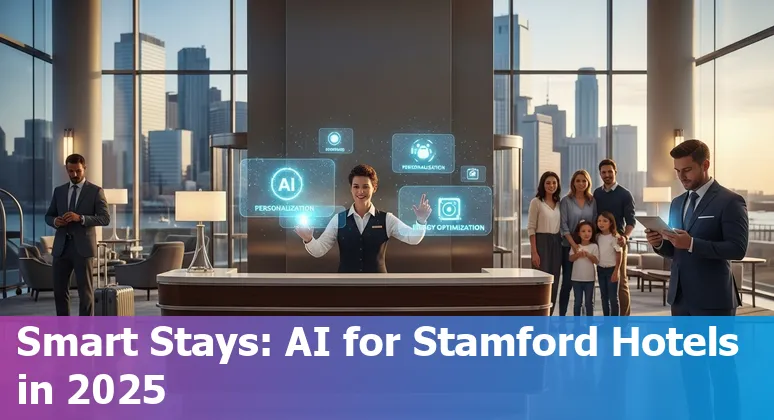
Too Long; Didn't Read:
Stamford hotels should prioritize AI pilots in 2025: sector value rises from $0.15B (2024) to $0.23B (2025), with personalization, predictive staffing, multilingual virtual concierges and contactless check‑in improving RevPAR, cutting response time ~70%, and boosting automation/revenue.
Stamford hoteliers should pay attention to AI in 2025 because the sector is moving fast - from an estimated $0.15B in 2024 to $0.23B in 2025, with multi‑year growth projections showing dramatic expansion - meaning guest-facing and back‑of‑house tools will be cheaper, smarter, and more common (Global AI in Hospitality market report (The Business Research Company)).
Industry leaders are shifting from experimentation to practical rollouts - 73% of hoteliers now say AI will be transformative and 61% see immediate impact - so local properties can win by prioritizing personalization, predictive staffing and contactless check‑in to boost revenue and reduce friction (AI in Hospitality practical adoption strategies (Alliants)).
For Stamford teams looking to build internal skills quickly, the AI Essentials for Work curriculum lays out promptcraft and workplace AI use cases in a 15‑week, job‑focused format (AI Essentials for Work bootcamp syllabus (Nucamp)), a practical step toward turning these market trends into repeatable hotel wins.
| Bootcamp | Length | Early Bird Cost |
|---|---|---|
| AI Essentials for Work | 15 Weeks | $3,582 |
Table of Contents
- What is the AI trend in hospitality technology in 2025?
- Top high-impact AI use cases for Stamford hotels
- Practical benefits: revenue, operations, and guest experience in Stamford
- AI regulation in the US in 2025: what Stamford hoteliers must know
- How to start: building practical AI pilots in Stamford hotels
- Integration, data quality, and vendor selection for Stamford properties
- Staff training, change management, and ethical safeguards in Stamford
- Measuring ROI and scaling AI across Stamford hotels
- Conclusion: The future of the hospitality industry with AI in Stamford by 2030
- Frequently Asked Questions
Unlock new career and workplace opportunities with Nucamp's Stamford bootcamps.
What is the AI trend in hospitality technology in 2025?
(Up)In 2025 the AI story in hospitality is about practical muscle more than magic: hotels are moving from pilots to real-time personalization, predictive forecasting, and workforce and revenue optimization that actually shave costs and smooth guest journeys - think smarter demand forecasts, pre-arrival room environment setup, and virtual concierges that answer questions in dozens of languages.
Industry research highlights this shift: EHL points to AI‑driven personalization, predictive maintenance and contactless services as core trends (EHL hospitality industry trends 2025: AI-driven personalization and contactless services), Snowflake forecasts broader adoption across workforce management, revenue optimization and secure data collaboration, so bookings, flights and hotel stays can adjust together in real time (Snowflake AI predictions for travel and hospitality in 2025: workforce and revenue optimization), and vendor case studies show tangible wins from virtual concierges, AI messaging and predictive scheduling that reduce front‑desk bottlenecks (Canary Technologies case study: virtual concierges and predictive scheduling for hotels).
For Stamford properties this means local teams can prioritize cloud integrations, secure data flows and multilingual guest messaging to compete - picture a guest arriving to find the room warmed, lighting set and a tailored dinner suggestion waiting on their phone - and those small, anticipatory touches are proving to drive loyalty and incremental revenue.
| AI Trend | Primary Source |
|---|---|
| Personalization & real-time analytics | EHL Hospitality Industry Trends (2025) |
| Workforce & revenue optimization | Snowflake AI predictions (2025) |
| Virtual concierges, multilingual chatbots, contactless check‑in | Canary Technologies (2025) |
“The future and higher purpose of hospitality is its people-centric focus, emphasizing the pivotal role of social connections and human interaction.” - Dr Meng‑Mei Maggie Chen
Top high-impact AI use cases for Stamford hotels
(Up)For Stamford hotels aiming for pragmatic gains in 2025, start with AI guest messaging and virtual concierges that handle routine questions, create service tickets and speak dozens of languages - Canary's Canary AI Guest Messaging platform, for example, automates a large share of guest comms, personalizes recommendations and can surface upsells at the right moment; industry data shows rapid adoption - Hospitable reported a 45% jump in AI messaging use and nearly 60% of suggested replies are now sent without edits, which means fewer repetitive tasks for staff and faster guest responses (Hospitable AI messaging adoption report).
High-impact extensions include multilingual 24/7 AI agents that never miss an inquiry (ideal during Stamford conference weekends), automated upsell and ancillary-offer engines that lift per-stay revenue, and unified guest profiles that power hyper-personalized timing for upgrades and on-property offers - platforms built around guest data report measurable boosts in ancillary revenue, satisfaction and front-desk efficiency (LasoExperience AI-driven automation case study).
Operational use cases to prioritize next: AI triage for housekeeping and maintenance (auto-ticketing), predictive staffing and revenue management, contactless check‑in/room controls, and review/feedback automation - these let Stamford teams convert saved hours into higher‑touch service that guests remember (think a guest who texts in, gets an instant local-dining suggestion in their language, and a seamless upsell prompt while still at the table).
Choose pilots that integrate with your PMS, track conversion and guest-sentiment metrics, and escalate to humans when nuance matters so technology protects - not replaces - the local hospitality touch.
| High‑Impact Use Case | Primary Benefit | Source |
|---|---|---|
| AI Guest Messaging / Virtual Concierge | Automate routine inquiries, 24/7 responses, personalized suggestions | Canary, HelloShift |
| Multilingual Support | Serve international travelers without staffing delays | Canary, TrustYou |
| Automated Upsells & Ancillary Offers | Increase per-stay revenue and conversion | Canary, LasoExperience |
| Predictive Staffing & Revenue Optimization | Reduce costs, match staffing to demand | LasoExperience |
| Auto-ticketing for Ops (housekeeping/maintenance) | Faster issue resolution, less front-desk load | Canary, Hotelogix |
“AI is moving from being a nice-to-have to becoming a trusted partner in the day-to-day reality of running a short-term rental business. We're seeing a shift where technology isn't competing with the human side of hospitality, it's protecting it.” - Pierre-Camille Hamana, CEO & Founder, Hospitable
Practical benefits: revenue, operations, and guest experience in Stamford
(Up)Stamford hotels that move from theory to action can see clear, practical wins across revenue, operations and guest experience by using AI to execute proven RevPAR strategies: dynamic pricing and real‑time rate adjustments to capture higher ADR on busy conference weekends, combined with tactics that nudge more profitable direct bookings and ancillary spend (think targeted pre‑arrival emails offering a $5 daily coffee or a $50 room upgrade) that boost per‑stay revenue without discounting the brand (OnRes: The Ultimate Guide to Improve Hotel RevPAR, Preno: 16 Simple Upsells and Email Automations to Increase RevPAR).
Operationally, automated inventory rules, yield management and automated upsell/order‑bump flows cut front‑desk friction, lower cancellation losses and free staff to deliver high‑touch moments; revenue management platforms and channel managers keep rates synchronized across OTAs and direct channels so Stamford properties don't leave margin on the table (Revnomix: Top RevPAR Strategies).
The guest payoff is tangible: faster, contactless arrivals, timely personalized offers, and instant local recommendations in the guest's language - small, anticipatory touches (a guaranteed morning coffee, a curated dinner suggestion) that drive loyalty and measurable RevPAR uplift.
AI regulation in the US in 2025: what Stamford hoteliers must know
(Up)Stamford hoteliers need a clear compliance playbook for 2025: at the federal level the White House's America's AI Action Plan signals a push to accelerate innovation and scale US infrastructure while stepping back from heavy-handed federal mandates, but that hands the ball to states - several, including Connecticut, already have AI bills under active consideration - creating a patchwork of rules you must track (Alvarez & Marsal analysis of America's AI Action Plan).
Practically, this means build governance now: log inferences, version models, document training data and bias testing, and insist on vendor-side transparency so a multilingual chatbot or dynamic-pricing model can prove its decisions if regulators ask; guidance on governance, risk and data controls is echoed in hospitality-focused AI playbooks that recommend model traceability and strong data pipelines (MobiDev guide to AI in hospitality integration strategies).
Don't forget privacy and fairness: hospitality consultants urge hotels to pair ambition with policies that protect guest data and preserve the human touch - steps like clear guest disclosures, biometric limits and explainability reduce legal risk and build guest trust, a practical advantage when business is soft and every loyal return matters (EY insights on AI in hospitality guest experiences).
How to start: building practical AI pilots in Stamford hotels
(Up)Getting started in Stamford means treating AI pilots like tight, measurable experiments: form a small cross‑functional working group (operations, front desk, IT and a business sponsor), use Info‑Tech's “Scalable + value‑aligned + right‑sized + ready” filter to turn a longlist into a shortlist, then pick one or two narrowly scoped pilots - think a multilingual virtual concierge for conference weekends or AI triage for housekeeping - that can run at a single property or department and produce clear KPIs within 3–6 months; follow Kanerika's checklist for data prep, timeline and budget, choose tools that integrate with existing systems, and apply MobiDev's 5‑step roadmap to match priority pain points to feasible AI features so the pilot proves value fast and leaves room to iterate.
Track adoption, accuracy and revenue or time‑saved metrics from day one, require vendor traceability for model changes, and be ready to walk away if the ROI isn't there - small, well‑documented wins make it easy to scale across Stamford's portfolio without disrupting guest service (GenAI copilot use cases for hoteliers - HospitalityNet, Info‑Tech pilot selection methodology, MobiDev's AI roadmap for hospitality).
| Pilot Step | Practical Action |
|---|---|
| Longlist → Shortlist | Gather ideas from stakeholders; score value & readiness |
| Select Pilot | Pick a right‑sized use case (single dept/property) |
| Run & Measure | Define KPIs (accuracy, hours saved, revenue); monitor for 3–6 months |
| Decide | Scale if ROI is clear; otherwise iterate or sunset |
“The most impactful AI projects often start small, prove their value, and then scale. A pilot is the best way to learn and iterate before committing.” - Andrew Ng
Integration, data quality, and vendor selection for Stamford properties
(Up)Integration is the unsung hero that turns Stamford properties from data islands into a single operating flow: start by mapping every rate code, folio field and POS outlet so a sold‑out room doesn't mysteriously vanish from OTAs during a busy Stamford conference weekend, and plan weekly audits (not just quarterly) to catch mis‑mappings early, as HSMAI recommends for PMS/CRS connections (HSMAI PMS/CRS connection best practices).
Prioritize vendors that offer robust two‑way PMS↔POS APIs, real‑time folio posting, PCI‑compliant payments and out‑of‑the‑box channel manager support so restaurant charges, spa sales and group bookings flow automatically into accounting and revenue systems - Hotelogix and Jonas Chorum-style feature sets are a useful checklist when evaluating partners (Hotelogix guide to PMS–POS integration benefits, Jonas Chorum: required POS features for hotels).
Clean master data and tight vendor SLAs also protect any AI pilots (multilingual virtual concierges or predictive housekeeping) by ensuring the models get accurate guest profiles and transaction streams; insist on documentation of mappings, audit logs, and middleware options so Stamford teams can switch vendors or scale without rebuilding the data pipeline.
“Your system is only as good as what you put into it - it's junk in, junk out - so choose carefully.” - Todd Farber
Staff training, change management, and ethical safeguards in Stamford
(Up)Staff training and change management in Stamford should treat AI adoption as a people-first program: start by setting clear, role-specific objectives and use microlearning, hands-on simulations and peer “tech ambassadors” so front desk agents, housekeepers and ops staff gain confidence fast; RelayPro's eight best practices emphasize tailored, bite-sized modules and ongoing support to avoid the 70% adoption gap many properties face (RelayPro training best practices for hospitality staff).
Invest in AI-driven simulations and AR overlays to rehearse high-pressure scenarios - HospitalityTech shows these lifelike, voice-based practices boost learning retention and can make training up to four times faster while standardizing service quality (HospitalityTech on AI-driven hospitality training and AR simulations).
Pair learning with practical safeguards: document training data, version models, require vendor explainability, and build simple escalation flows so staff know when to hand complex guest issues to a human.
For language and frontline coaching, mobile, gamified platforms like Lingio let Stamford properties run compliance, language and guest‑service refreshers between shifts - so a night audit or morning turnover becomes a quick learning moment, not a disruption (Lingio mobile gamified learning for hospitality teams).
“Scandic Hotels are partnering with Lingio because they generate great value for our employees... and as a result for our organization as well. Not only that, Lingio are really enjoyable and easy to work with – they help us to be successful and we have a truly genuine partnership.” - Pia Nilsson Hornay, HR Manager Scandic Hotels
Measuring ROI and scaling AI across Stamford hotels
(Up)Measuring ROI and scaling AI across Stamford hotels means treating every pilot as a business experiment: define revenue and operational KPIs up front (revenue uplift, time saved, CSAT/NPS, automation rate), instrument them in your PMS and ops tools, and report weekly during the 3–6 month pilot so leadership can decide fast.
Stanford's 2025 AI Index underscores why this matters - the U.S. is pouring capital into AI and adoption is widespread - while Beam's analysis warns that 42% of AI projects get scrapped and 88% of pilots never reach production unless tied to clear metrics and tight integrations, so track adoption, cost-per-query and compute usage (inference costs have dropped dramatically, making more experiments affordable) and build dashboards that combine financial impact, operational efficiency and guest experience in one view.
Use a phased playbook (chatbots → reasoners → agents) from the AI Atlas, keep humans in the loop for edge cases, and demand vendor SLAs and audit logs so models stay auditable as you scale across Connecticut properties.
A good rule: if a multilingual concierge pilot can shrink first-response time by 70% and free staff for high‑touch upsells - document it, standardize it, and roll it to the next property with the data to prove the lift (Stanford AI Index 2025 report, Beam AI report on AI project ROI, AI Atlas Q2 2025 report).
| Metric | Why it matters | Source |
|---|---|---|
| Adoption rate | Shows real usage vs pilot curiosity | Stanford AI Index / AI Atlas |
| Financial impact (revenue / cost saved) | Direct ROI for exec decisions | Beam AI |
| Time saved / automation rate | Operational efficiency and redeployable labor | Beam AI |
| Cost per query / inference usage | Controls ongoing cloud costs as scale grows | Stanford AI Index |
| Governance maturity & audit logs | Regulatory readiness and trust | AI Atlas / Stanford |
“AI is not going to replace workers, but workers that know how to use AI are going to replace workers that don't know how to use AI.”
Conclusion: The future of the hospitality industry with AI in Stamford by 2030
(Up)By 2030 Stamford's hospitality scene will reflect a pragmatic balance: rapid market growth and new infrastructure will make advanced AI tools affordable and powerful, but local priorities - energy, jobs, and the human touch - will steer adoption.
State and city moves to attract data centers and an AI Innovation Institute at UConn Stamford signal serious capacity building for compute-heavy services that hotels will rely on (see coverage of Connecticut's data‑center push Connecticut data center and AI expansion coverage by CT Public), while market forecasts show the sector scaling fast (global AI in tourism is projected from about $3.37B in 2024 to $13.86B by 2030, with steep CAGR estimates) - meaning Stamford operators who invest in clear governance, staff reskilling and traceable vendors can capture new revenue without sacrificing service.
Expert panels warn replacement rates will vary by market and role, so the realistic path for Connecticut hotels is augmentation not wholesale substitution: automate repetitive tasks, redeploy staff to high‑touch moments, and train teams in practical AI skills now (the AI Essentials for Work curriculum offers a 15‑week, job‑focused route to build those capabilities AI Essentials for Work 15-week curriculum (Nucamp)).
The result by 2030: smarter pricing, faster multilingual service and fewer bottlenecks - all supported by local compute and a workforce that knows when to hand the guest back to a person who can add warmth and judgment.
| Source | 2024 Market Value | 2030 Projection | Reported CAGR |
|---|---|---|---|
| ResearchAndMarkets (AI in Tourism) | $3.37B | $13.86B | 26.7% |
| IndustryARC (Travel & Hospitality AI) | - | $8,347.0M | 15.2% |
“We're prepared to double down in terms of quantum computing, a major center down here in Fairfield County, an AI center as well in the Stamford area.” - Governor Ned Lamont
Frequently Asked Questions
(Up)Why should Stamford hoteliers prioritize AI in 2025?
AI adoption in hospitality is shifting from pilots to practical rollouts: the market grew from an estimated $0.15B in 2024 to $0.23B in 2025 and shows strong multi‑year expansion. 73% of hoteliers say AI will be transformative and 61% see immediate impact. For Stamford properties, this means cheaper, smarter guest‑facing and back‑of‑house tools that can boost personalization, enable predictive staffing, support contactless check‑in, increase revenue, and reduce operational friction.
What high‑impact AI use cases should Stamford hotels pilot first?
Start with guest-facing and operational pilots that integrate with your PMS: multilingual AI guest messaging/virtual concierges, automated upsell and ancillary-offer engines, predictive staffing and revenue optimization, and auto-ticketing for housekeeping and maintenance. These deliver measurable benefits - 24/7 responses, higher per‑stay revenue, reduced staffing costs, faster issue resolution - and are good 3–6 month pilots when scoped to a single property or department.
What compliance and governance steps must Stamford hotels take for AI in 2025?
With federal direction encouraging innovation and states (including Connecticut) advancing AI bills, hotels should build governance now: log model inferences, version models, document training data and bias testing, require vendor transparency and audit logs, and implement privacy controls and clear guest disclosures. These practices support regulatory readiness and preserve guest trust while enabling safe AI use in multilingual chatbots and pricing systems.
How should Stamford hotels measure ROI and scale successful AI pilots?
Treat pilots as experiments with defined KPIs up front (revenue uplift, time saved, CSAT/NPS, automation rate). Instrument PMS and ops tools to track adoption, accuracy, cost‑per‑query and inference usage, and report weekly during a 3–6 month pilot. Document results and playbooks; if a pilot (e.g., multilingual concierge) reduces first‑response time substantially and frees staff for upsells, standardize and roll it out to other properties with vendor SLAs, audit logs and integration checks in place.
How can Stamford teams build AI skills and operationalize pilots quickly?
Form a small cross‑functional working group (operations, front desk, IT, business sponsor), use a filter to shortlist right‑sized, value‑aligned pilots, and run narrowly scoped experiments with clear KPIs. Invest in practical training such as the 15‑week AI Essentials for Work curriculum (promptcraft and workplace AI use cases), microlearning, simulations, and tech ambassadors. Prioritize integrations, master data quality, vendor SLAs, and escalation flows so pilots prove value fast and protect the human touch.
See how self-service check-in kiosks and mobile apps are changing front desk jobs in Stamford.
Explore how dynamic pricing to improve RevPAR helps Stamford hotels stay competitive during demand shifts.
Find out how personalized upsell recommendations driven by CRM context lift ancillary revenue per guest.

Ludo Fourrage
Founder and CEO
Ludovic (Ludo) Fourrage is an education industry veteran, named in 2017 as a Learning Technology Leader by Training Magazine. Before founding Nucamp, Ludo spent 18 years at Microsoft where he led innovation in the learning space. As the Senior Director of Digital Learning at this same company, Ludo led the development of the first of its kind 'YouTube for the Enterprise'. More recently, he delivered one of the most successful Corporate MOOC programs in partnership with top business schools and consulting organizations, i.e. INSEAD, Wharton, London Business School, and Accenture, to name a few. With the belief that the right education for everyone is an achievable goal, Ludo leads the nucamp team in the quest to make quality education accessible