









The Complete Guide to Using AI as a Marketing Professional in Saudi Arabia in 2025
Last Updated: September 13th 2025
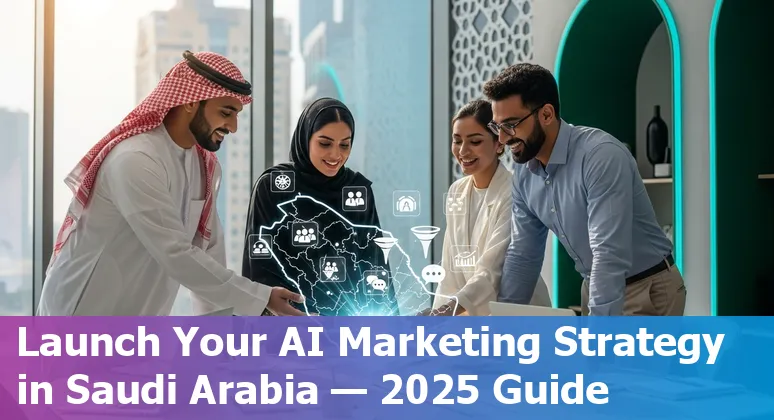
Too Long; Didn't Read:
Saudi marketers should align AI with Vision 2030: localize campaigns (Ramadan, National Day), prioritize Arabic NLP and PDPL-compliant data residency, run 6–8 week pilots and scale. Market outlook: ICT USD 12.1B (2024) → USD 22.84B (2030, 11% CAGR); examples: 30% fewer stockouts, 15% sales uplift, STC ~60% faster resolution.
Saudi marketers planning for 2025 face a unique moment where Vision 2030, rapid AI adoption, and cultural rhythms collide - so this guide focuses on how to localize strategy (think Ramadan and National Day activations), pick the right channels, and test AI pilots that respect local language and customs; see a practical Saudi-focused 2025 marketing strategy for planning tips Saudi 2025 marketing strategy guide.
Real-world Saudi AI deployments - from AI crowd control at Hajj to STC's multilingual support and NEOM's urban planning - show that marketers can borrow proven tactics for personalization, automation, and measurement; a helpful roundup of 15 Saudi AI use cases is available roundup of 15 Saudi AI use cases.
For hands-on upskilling, consider a practical program like the AI Essentials for Work bootcamp to learn prompt-writing, tool workflows, and workplace use cases that turn pilots into repeatable campaigns.
| Bootcamp | Length | Early Bird Cost | Registration |
|---|---|---|---|
| AI Essentials for Work | 15 Weeks | $3,582 | Register for AI Essentials for Work bootcamp |
Table of Contents
- What is the future of AI in marketing 2025 for Saudi Arabia?
- Core AI marketing use cases for professionals in Saudi Arabia
- How is AI used in Saudi Arabia? Local examples and channel tactics
- What is the AI Conference 2025 Saudi Arabia? A marketer's guide
- What is the AI program in Saudi Arabia? Government and industry initiatives
- Decision framework for Saudi Arabia: AI‑only vs Hybrid vs Traditional
- How to implement AI agents step‑by‑step in Saudi Arabia
- Tools, vendors, costs and RFQ tips for Saudi Arabia marketers
- Ethics, privacy, governance and next steps for marketing in Saudi Arabia (Conclusion)
- Frequently Asked Questions
Join a welcoming group of future-ready professionals at Nucamp's Saudi Arabia bootcamp.
What is the future of AI in marketing 2025 for Saudi Arabia?
(Up)The near-term future of AI in Saudi marketing is less about a single app and more about an ecosystem: national strategies and heavy infrastructure spending are turning compute, cloud, and data into marketing fuel - Research & Markets projects the Saudi enterprise ICT market will jump from USD 12.1 billion in 2024 to USD 22.84 billion by 2030, reflecting an 11% CAGR, which means more local cloud capacity, richer datasets, and faster experimentation for marketers (Research & Markets Saudi ICT market outlook 2025 report).
Parallel investments - from PIF's Humain initiative to DataVolt's partnership with NEOM to build net‑zero AI data center capacity - are concrete signals that hyperscale, low‑latency hosting will be available inside the kingdom (including targets like 1.5 GW capacity), lowering friction for real‑time personalization and programmatic scale (Saudi data center market overview 2025–2033 report).
That infrastructure runway, combined with a bold national AI strategy and summits that accelerate partnerships, makes 2025 a year to shift from one-off pilots to repeatable AI workflows - from automated creative scaling across Meta and programmatic channels to localized language models - while still planning for known constraints like a limited talent pool and stricter cybersecurity and data‑localization rules.
For marketers, the practical upshot is clear: invest in partner ecosystems and skills now so campaigns can tap local data centers and cloud services as they come online, and use toolkits that automate creative and testing to convert this infrastructure buildout into measurably higher CTRs and faster learning cycles (see practical tactics for automated creative scaling for Saudi channels Automated ad creative scaling techniques for Saudi marketing professionals).
| Metric | Value |
|---|---|
| Enterprise ICT market (2024) | USD 12.1 billion |
| Enterprise ICT market (2030 forecast) | USD 22.84 billion (CAGR 11%) |
| Data center market (2024) | USD 2.75 billion |
| Data center market (2033 forecast) | USD 6.5 billion (CAGR ~10%) |
| Notable infrastructure investment | NEOM/DataVolt & related AI campus (~USD 5 billion; target 1.5 GW capacity) |
Core AI marketing use cases for professionals in Saudi Arabia
(Up)Core AI marketing use cases in Saudi Arabia center on three practical moves: turning data into timely personalization, automating high-volume creative tests, and using predictive models to plan around cultural peaks like Ramadan and National Day.
AI-driven market research is already streamlining data collection and predictive insights for Saudi brands, letting teams spot demand shifts before competitors do (AI-driven market research in Saudi Arabia); meanwhile KPMG's customer experience findings show personalization, speed, and trust now drive loyalty, so conversational agents and bilingual chatbots that deliver 24/7 Arabic/English support move from novelty to necessity (Saudi CX improvements and AI).
Predictive analytics is another high-impact use case: Saudi retailers use forecasts to stock the right SKUs for Ramadan and reduce stockouts, while supply-chain AI projects promise measurable operational gains (Predictive analytics for Saudi decision‑making).
Add automated ad-creative scaling and programmatic optimization to run far more A/B tests across Meta and programmatic channels, and marketers can convert infrastructure investment into higher CTRs and faster learning - turning pilots into repeatable workflows that respect data-quality, privacy, and local language nuances.
| Use case | Benefit / Example | Stat / Source |
|---|---|---|
| AI-driven market research | Faster, predictive insights for campaign planning | Market research article (Sep 2024) |
| Customer experience & personalization | Bilingual chatbots, tailored journeys that boost loyalty | KPMG report: sector CX improvements (Consultancy‑me, May 2025) |
| Predictive analytics | Optimize inventory and seasonal campaigns (e.g., Ramadan) | Case results: 30% fewer stockouts, 15% sales uplift (AEZ Digital) |
“Customer experience is the new battleground for competitive advantage. As Saudi Arabia continues its rapid transformation, organizations that integrate AI with empathy, integrity, and purpose will lead the way,” said Adib Kilzie, Head of Customer Experience and Alliances at KPMG in Saudi Arabia.
How is AI used in Saudi Arabia? Local examples and channel tactics
(Up)How AI is used across Saudi channels is intensely practical: in Riyadh, AI‑powered search engine marketing automates bid management, discovers Arabic‑friendly keywords, and spins smart ad copy - early adopters report 20–40% improvements in cost‑per‑acquisition within months, making
“set it and monitor”
a lot less risky for busy teams (AI-powered search engine marketing case study in Riyadh).
On the service and CRM side, large operators have moved from novelty to scale - STC's conversational platform handled millions of contacts and cut resolution time by roughly 60%, demonstrating that bilingual chatbots can boost satisfaction while deflecting high contact volumes (Saudi Arabia AI use cases and local case studies).
Retail and e‑commerce are following suit: AI recommendation engines, predictive inventory, and dynamic pricing are driving hyper‑personalization (conversion uplifts reported in sector studies), and local brands from supermarkets to bookstores are shipping tailored promos and chat support that customers actually use (AI personalization and sales in Saudi retail case study).
The so‑what: marrying AI SEM, Arabic‑aware NLP, and retail recommendation layers lets marketers scale relevant creatives and customer journeys across Meta, search, WhatsApp and apps - turning one‑off experiments into repeatable channel playbooks that respect language, seasonality, and local buying habits.
What is the AI Conference 2025 Saudi Arabia? A marketer's guide
(Up)For marketers mapping a conference plan in 2025, pick events that match tactical needs - product showcases and programmatic sessions for creative scaling, executive roundtables for C-suite buy‑in, and infrastructure expos for vendor shortlists - starting with the Smart Data & AI Summit on 27–28 August at the JW Marriott Riyadh for data‑and‑AI practitioners (Smart Data & AI Summit Riyadh 2025), the Intelligent Data, AI & Automation Summit (IDA) on 8–9 October for strategy‑heavy dialogue and executive roundtables tied to Vision 2030 (Intelligent Data, AI & Automation (IDA) Summit Riyadh 2025), and Connected World KSA (18–19 Nov) if the goal is to vet hyperscale cloud, sovereign‑cloud partners and meet hundreds of infrastructure vendors - its exhibition claims 6,000+ attendees, 150+ speakers and 200+ exhibitors, making it the place to walk an aisle of potential partners and leave with a three‑vendor shortlist.
Plan visits around thematic tracks (energy, retail, CX) rather than calendar dates alone, use conference product showcases to validate demos with local Arabic language support, and treat executive roundtables as the fastest route to procurement conversations - imagine exchanging business cards with dozens of decision‑makers on a single exhibition day; that kind of concentrated attention turns conference ROI from “notes in a notebook” into a concrete RFQ shortlist.
| Conference | Date (2025) | Location | Notable stat / focus |
|---|---|---|---|
| Smart Data & AI Summit | 27–28 Aug | JW Marriott Riyadh | Data & AI practitioners |
| Intelligent Data, AI & Automation Summit (IDA) | 8–9 Oct | Riyadh | Executive roundtables; Vision 2030 themes |
| Connected World KSA | 18–19 Nov | Riyadh Front | 6,000+ attendees; 150+ speakers; 200+ exhibitors |
"Instead of exporting oil, we will export data." - Mohammed Al-Jadaan, Minister of Finance, Kingdom of Saudi Arabia
What is the AI program in Saudi Arabia? Government and industry initiatives
(Up)Saudi Arabia's AI program is a coordinated push that turns Vision 2030 ambitions into marketer‑relevant infrastructure and industry action: the Saudi Data & AI Authority (SDAIA) now drives national policy and tools - linking data and AI to 66 of Vision 2030's 96 goals - and publishes practical frameworks from the National Artificial Intelligence Index to Generative AI guidelines that shape public‑sector procurement and safe use (SDAIA and Saudi Vision 2030 strategy).
On the ground, national projects have created a National Data Bank connected to more than 200 government systems and an insights platform, Estishraf, credited with roughly 50 billion SAR in value - concrete plumbing that lets brands tap secure, shared datasets for personalization and measurement via approved partners (Accenture case study on the Saudi National Data Bank and Estishraf).
Complementing public programs are high‑profile industry initiatives - GAIA startup acceleration, Waed Ventures' $100M AI allocations, Aramco's METABRAIN LLM and the $100B “Project Transcendence” investment signal - so marketers should view Saudi's AI program as a full ecosystem: regulation, talent pipelines (45,000+ trained and plans to upskill tens of thousands more), sovereign cloud/HPC build‑out, and startup capital all aimed at turning pilots into scalable, compliant campaigns (WAM: AI as the Engine of Vision 2030).
This mix means procurement, data governance, and Arabic NLP readiness are now as important as creative testing when planning 2025 campaigns.
“SDAIA is continuing to make strides in boosting the Kingdom's transformation to a data-driven economy. We welcome Accenture's partnership to support cutting-edge research and promote digital innovation.” - H.E. Dr. Abdullah AlGhamdi / President of SDAIA
Decision framework for Saudi Arabia: AI‑only vs Hybrid vs Traditional
(Up)Choosing between AI‑only, hybrid, or traditional marketing approaches in Saudi Arabia comes down to three kingdom‑specific tradeoffs: speed versus cultural nuance, scale versus governance, and cost versus control.
For rapid, high‑volume performance work - think hundreds of ad variations, dynamic bidding, or automated product descriptions - AI‑only setups unlock 10x productivity and are ideal for short videos and performance ads, but outputs must be verified for brand tone and local Arabic relevance (Platformance outlines why LLM optimisation and Arabic models matter for visibility and conversion Platformance: Saudi Arabia AI push - LLM optimization & Arabic models for marketers).
Hybrid models pair human strategy with machine speed and are the safest route for multi‑channel Ramadan or National Day programs where consistency, legal compliance and Arabic NLP quality are critical - use specialists to set prompts, guard privacy, and steer measurement.
Traditional, fully human approaches still belong in flagship storytelling and high‑stakes brand moments where nuance and bespoke craft drive long‑term equity.
Budget and timeline expectations map cleanly to these choices: freelancers and boutique firms (entry tier) are fast and affordable, mid‑sized agencies offer balanced hybrid services, and enterprise partners deliver custom integrations and governance.
Test with small pilots, measure ROI not just output speed, and include data‑security checks up front because talent and infrastructure gaps can slow scale - practical decision briefs and RFQ samples help translate a pilot into a three‑vendor shortlist (see an applied decision framework and cost tiers in this implementation guide Entasher: AI Agents in Marketing - decision framework & cost tiers for Egypt, Saudi & UAE).
A vivid rule of thumb: if the campaign must “get language, law and local feeling right,” favour hybrid; if it's volume and speed, AI‑only can win faster.
| Provider Type | Budget Range (per month) | Typical Lead Time |
|---|---|---|
| Freelancers & boutique firms | $800 – $2,000 | 2–4 weeks |
| Mid‑sized agencies | $2,000 – $8,000 | 4–8 weeks |
| Enterprise partners | $10,000 – $50,000+ | 8–16 weeks |
“Today is the worst AI will ever be. It will improve.”
How to implement AI agents step‑by‑step in Saudi Arabia
(Up)Start by treating AI agents as business projects, not experiments: pick one high‑value use case tied to Vision 2030 (e.g., Arabic bilingual customer support, inventory or incident automation), then map success metrics like task automation rate, Arabic language precision and CSAT before touching models; assess data readiness and PDPL/NCA constraints so data residency decisions (Saudi Azure regions, geo‑fencing) and privacy controls are baked into design from day one (see Securiti Saudi Arabia Generative AI Guidelines Securiti Saudi Arabia Generative AI Guidelines).
Choose an architecture that separates model, data and orchestration layers - use LLMs and RAG for reasoning, vector stores for context, and an orchestration engine such as n8n to turn decisions into actions at scale (the NTConsult agentic AI implementation and n8n orchestration guide shows this orchestration layer in practice NTConsult agentic AI implementation and n8n orchestration guide).
Run a fast pilot (6–8 week vendor pilot is a common path) to validate integration, Arabic NLP quality, governance and ROI, then iterate: add human‑in‑the‑loop checkpoints, monitoring/audit trails, and retraining loops; estimate total build timelines if fully in‑house (12–18 months) or lower time‑to‑value if buying a regional solution that includes Arabic tuning and PDPL alignment (Veraqor enterprise AI agents for GCC compliance cites 6–8 week pilots and built‑in compliance) Veraqor enterprise AI agents for GCC compliance.
Scale only after KPIs and security controls are stable - this pragmatic path turns pilots into repeatable agents that can save thousands of hours (one Saudi example reported 2,200 hours/month) while keeping language, law and local trust front and center.
| Phase | Typical Timeline | Key Outputs |
|---|---|---|
| Discovery & use‑case selection | 2–4 weeks | Objectives, KPIs, data & compliance map |
| Pilot (vendor or lean build) | 6–8 weeks | Working agent, Arabic evaluation, ROI signal |
| Production build & governance | 3–6 months | Hardened integration, monitoring, human‑in‑loop |
| Scale (enterprise rollout) | ongoing; 6–18 months | Multi‑unit deployment, continuous retraining, audit trails |
“The enterprises we see succeeding with AI agents aren't cutting jobs, they're shifting effort from low-value execution to high-value impact.”
Tools, vendors, costs and RFQ tips for Saudi Arabia marketers
(Up)Tools and vendors for Saudi marketers in 2025 should be chosen with three local realities in mind: Arabic‑first NLP, PDPL/data‑residency compliance, and infrastructure readiness - so start by mapping needs to categories (creative optimization, programmatic DSPs, personalization/CDP, analytics) and then shortlist vendors that show Arabic tuning and ISO/PDPL hygiene.
Global platforms (Iterable, Smartly.io, HubSpot) and GCC‑aware players (Lucidya for Arabic CX, Excelate DSP, Blueprint for generative creative) both matter; a handy catalog of the top 20 AI marketing tools frames the right categories Top 20 AI marketing tools of 2025, while a Saudi vendor directory helps find regional integrators and dev shops that list hourly rates and case studies Top AI development companies in Saudi Arabia.
Budget accordingly: many Saudi firms quote hourly rates in the $25–$99 range, with outsourced projects running from tens of thousands to several hundred thousand USD for high‑complexity builds; require a 6–8 week paid pilot that delivers Arabic evaluation, security attestations (ISO 27001 / SOC2 where available) and an ROI signal before scaling.
RFQ tips: demand Arabic test sets and PDPL clauses up front, ask for a three‑vendor shortlist with clear milestones and rollback terms, and score proposals not just on price but on Arabic model quality, integration effort and observable pilot KPIs - because the moment a vendor can show a tuned Arabic creative lift, procurement moves from
"maybe" to "approved"
overnight.
| Vendor Type | Typical Hourly Rate | Common Project Budget |
|---|---|---|
| Boutique / Freelancers | $25 – $49 / hr | Up to ~$50k |
| Mid‑sized agencies | $50 – $99 / hr | $50k – $200k |
| Enterprise / Premium integrators | $100 – $300+ / hr | $200k+ |
Ethics, privacy, governance and next steps for marketing in Saudi Arabia (Conclusion)
(Up)Ethics, privacy and governance are no longer optional checkboxes for Saudi marketers - PDPL's Implementing Regulations (effective updates in Sept 2024) mean explicit consent, clear privacy notices, DPIAs for high‑risk processing, a Data Protection Officer (where required), and speedy responses to data subject requests (typically within 30 days) are mandatory parts of any AI campaign; practical guides such as the Saudi PDPL Implementing Regulations guide (compliance primer) and tool-focused compliance writeups that show how localization and subject‑rights tooling help (for example, Countly PDPL compliance playbook (privacy tools)) provide good checklists for teams.
Key operational rules to bake into marketing programs: treat cross‑border flows as a controlled decision (explicit consent or transfer safeguards required), log processing activities and retention (some guidance requires multi‑year records), implement encryption and SIEM/DLP protections, notify SDAIA and affected users within 72 hours for breaches, and design audits and human‑in‑the‑loop checkpoints to respect cultural sensitivities around family and personal privacy - failure to net these controls risks fines (up to SAR 5M) and reputational harm.
Concrete next steps: run a data audit and DPIA on your Arabic NLP and customer datasets, appoint or contract a DPO, add PDPL clauses to vendor RFQs, demand Arabic test sets and local hosting options, and train campaign teams on consent and DSAR workflows; for marketers who need hands‑on skills to operationalize these controls, a practical upskilling path such as the 15‑week AI Essentials for Work bootcamp (15-week practical AI for the workplace) teaches prompt design, tool workflows and workplace governance that help turn compliant pilots into repeatable campaigns.
| Bootcamp | Length | Early Bird Cost | Registration |
|---|---|---|---|
| AI Essentials for Work | 15 Weeks | $3,582 | Register for AI Essentials for Work bootcamp (Nucamp) |
Frequently Asked Questions
(Up)What is the near‑term future of AI for marketing professionals in Saudi Arabia in 2025?
In 2025 AI marketing in Saudi Arabia looks like an ecosystem play rather than a single app: national strategy, cloud/data center build‑out and private/public investments enable real‑time personalization, programmatic scale and repeatable AI workflows. Key market signals include the enterprise ICT market growing from USD 12.1B (2024) to an estimated USD 22.84B by 2030 (≈11% CAGR), a data‑center market projected from USD 2.75B (2024) to ~USD 6.5B by 2033, and major projects (NEOM/DataVolt ~USD 5B targeting ~1.5 GW capacity). Marketers should move from one‑off pilots to partner ecosystems and skill upgrades while planning for PDPL, talent gaps and stricter cybersecurity/data‑localization rules.
What are the core AI marketing use cases in Saudi Arabia and what measurable benefits have been reported?
Core use cases are (1) data‑driven personalization and bilingual CX (Arabic/English chatbots), (2) automated creative scaling and programmatic optimization across Meta/search, and (3) predictive analytics for seasonality (Ramadan, National Day) and inventory. Reported benefits include bilingual support platforms cutting resolution time by ~60% (large telco example), predictive inventory cutting stockouts by ~30% and driving ~15% sales uplift in retail case studies, and early SEM automation showing 20–40% improvements in cost‑per‑acquisition. One deployed agent example saved ~2,200 hours/month.
How do I implement AI agents in a compliant, repeatable way and what timelines should I expect?
Treat an AI agent as a business project: pick a single high‑value use case, define KPIs (e.g., automation rate, Arabic accuracy, CSAT), assess data readiness and PDPL constraints, and choose an architecture that separates model, data and orchestration (LLMs/RAG, vector stores, orchestration engines). Typical phased timeline: Discovery & use‑case selection 2–4 weeks; Pilot (vendor or lean build) 6–8 weeks to validate Arabic quality and ROI; Production build & governance 3–6 months; Enterprise scale ongoing (6–18 months). Include human‑in‑the‑loop checkpoints, monitoring/audit trails, and retraining loops before scaling.
What privacy, ethics and regulatory requirements should marketers include when running AI campaigns in Saudi Arabia?
PDPL compliance is mandatory: perform DPIAs for high‑risk processing, obtain explicit consent where required, provide clear privacy notices, and appoint or contract a DPO when applicable. Data subject access responses are typically required within 30 days and breach notification to authorities/users is expected within 72 hours. Log processing activities and retention, implement encryption and SIEM/DLP controls, and treat cross‑border transfers as controlled decisions (consent or safeguards). Non‑compliance risks fines (reported up to SAR 5M) and reputational harm. Practical steps: add PDPL clauses to RFQs, require Arabic test sets and local hosting options, and run a data audit before pilots.
How should I choose vendors and decide between AI‑only, hybrid or traditional approaches - and what are typical budgets?
Choose based on tradeoffs: AI‑only for high‑volume performance work (fast, 10x productivity but needs verification for Arabic/local tone); hybrid (recommended for Ramadan/National Day or high‑risk campaigns) pairs human strategy with machine speed; traditional is best for flagship storytelling. Typical monthly provider budget bands: freelancers/boutiques $800–$2,000; mid‑sized agencies $2,000–$8,000; enterprise partners $10,000–$50,000+. Hourly rates commonly range $25–$300+. RFQ best practices: require a 6–8 week paid pilot with Arabic evaluation, security attestations (ISO 27001 / SOC2 where available), PDPL clauses, observable pilot KPIs and rollback terms. For upskilling, consider practical programs (example: a 15‑week “AI Essentials for Work” bootcamp) to turn prompt design and tool workflows into repeatable, compliant campaigns.
Reach wider Saudi audiences by applying Bilingual prompts for Arabic and English that preserve tone, nuances, and cultural sensitivity.
Master data-driven decision-making for Saudi marketing teams to stay indispensable in an AI-first world.
Learn how cross-channel attribution tailored to the GCC closes gaps between Meta, TikTok, DSPs and offline conversions for clearer ROI.

Ludo Fourrage
Founder and CEO
Ludovic (Ludo) Fourrage is an education industry veteran, named in 2017 as a Learning Technology Leader by Training Magazine. Before founding Nucamp, Ludo spent 18 years at Microsoft where he led innovation in the learning space. As the Senior Director of Digital Learning at this same company, Ludo led the development of the first of its kind 'YouTube for the Enterprise'. More recently, he delivered one of the most successful Corporate MOOC programs in partnership with top business schools and consulting organizations, i.e. INSEAD, Wharton, London Business School, and Accenture, to name a few. With the belief that the right education for everyone is an achievable goal, Ludo leads the nucamp team in the quest to make quality education accessible