









The Complete Guide to Using AI in the Government Industry in Sandy Springs in 2025
Last Updated: August 27th 2025
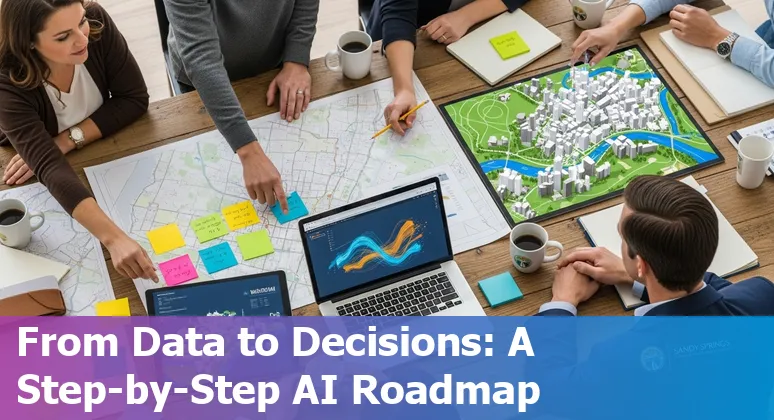
Too Long; Didn't Read:
Sandy Springs' 2025 AI plan prioritizes practical pilots - OCR/image recognition for permitting, a digital Overlook Park sign - plus a centralized data warehouse, staff upskilling, and measurable wins (one-hour weekly reviewer savings). Grant for Georgia Tech pilot denied in July 2025; alternative funding pursued.
As Sandy Springs moves into 2025 with a newly launched Sandy Springs Digital Innovation Initiative, AI is positioned as a practical tool to cut permit wait times, break data silos, and free staff for higher‑value public service - not a flashy experiment but a “slow and steady” transformation rooted in staff upskilling and better data, as covered by the Route Fifty article on mundane digital transformations.
Early projects range from the charmingly concrete (digitizing the Overlook Park bird‑sightings whiteboard) to an AI‑driven permitting pilot proposed with Georgia Tech that would use OCR, image recognition, and drawing‑layer analysis to flag missing information and speed reviews; the grant application was not awarded in July 2025, so the city is exploring other paths forward.
Building a centralized data warehouse and raising citywide data literacy are the practical first steps; municipal teams looking to gain hands‑on AI skills can consider focused training like Nucamp's AI Essentials for Work bootcamp - practical AI skills for the workplace to move from curiosity to capability.
| Bootcamp | Length | Early Bird Cost | Registration |
|---|---|---|---|
| AI Essentials for Work | 15 Weeks | $3,582 | Register for the AI Essentials for Work bootcamp |
“We're interested in how these tools can reduce time‑consuming tasks our team handles daily.” - Mayor Rusty Paul (Route Fifty)
Table of Contents
- Sandy Springs' Current AI Strategy and Digital Transformation
- Permitting Modernization: The First Use Case for AI in Sandy Springs, Georgia
- Data Foundations: Building a Centralized Data Warehouse in Sandy Springs, Georgia
- How to Start with AI in 2025: A Beginner's Roadmap for Sandy Springs, Georgia
- What is the AI Strategy in Georgia? Statewide Policy Context for Sandy Springs, Georgia
- What Will Be the AI Breakthrough in 2025? Implications for Sandy Springs, Georgia
- What is the AI Regulation in the US in 2025? Federal and Georgia Impacts on Sandy Springs, Georgia
- Vendors, Resources, and Training Options for Sandy Springs, Georgia
- Conclusion: Ethical, Staff-Centered AI Adoption Roadmap for Sandy Springs, Georgia
- Frequently Asked Questions
Explore hands-on AI and productivity training with Nucamp's Sandy Springs community.
Sandy Springs' Current AI Strategy and Digital Transformation
(Up)Sandy Springs' AI strategy is deliberately practical and organized: the City's newly formed Sandy Springs Digital Innovation Initiative (city digital innovation program) (est.
2025) bundles technical talent under a steering committee, a technical working group, and an interdepartmental digital development team led by Director of Data Strategy, Analytics, and AI Integration Keith McMellen.
The priority is unglamorous but powerful - break down data silos, stand up a centralized data warehouse, and raise citywide data and AI literacy so models are reliable and useful - while piloting real, service‑focused projects (from an Overlook Park bird‑sightings digital sign to an AI‑assisted permitting idea proposed with Georgia Tech).
The city already taps AI in GIS, Fire, IT, and Communications and is pursuing What Works City certification to formalize governance and metrics; a recent Partnership for Inclusive Innovation grant for permitting automation wasn't awarded in July 2025, so Sandy Springs is exploring alternative funding and incremental builds that keep staff in the loop and work flowing smoothly, not all at once, as described in the Route Fifty article on Sandy Springs digital transformation and AI initiatives (June 2025).
“We are going to just go slow and steady.” - Keith McMellen, Director of Data Strategy, Analytics, and AI Integration
Permitting Modernization: The First Use Case for AI in Sandy Springs, Georgia
(Up)Permitting modernization is the natural first AI use case for Sandy Springs because the city already runs Build Sandy Springs and Plan Sandy Springs to manage applications and fees, and the newly formed Sandy Springs Digital Innovation Initiative has explicitly proposed an AI‑driven permitting pilot with Georgia Tech that would automate document review rather than replace reviewers; the Partnership for Inclusive Innovation proposal (not funded in July 2025) outlined OCR and image recognition to identify and classify drawings, read handwritten annotations, separate drawing layers, and flag inconsistencies or missing information for human review, which would shorten repetitive plan‑review cycles and let staff focus on exceptions and community engagement.
Sandy Springs' recent success digitizing complex rezoning workflows with OpenGov - moving from paper folders and hours of formatting to one‑click letters - shows the payoff of pairing process redesign with automation, and builds a clear, practical path for piloting AI inside existing permitting steps instead of overhauling them overnight.
For municipalities in Georgia, the pragmatic lesson is to match pilot scope to data readiness and use cases that produce visible staff time savings and applicant transparency.
| Proposed AI Capabilities | Relevant Permitting Steps |
|---|---|
| OCR, image recognition, handwritten annotation detection | Step 1: Apply for a Permit; Step 3: Plan Review |
| Drawing‑layer analysis, classification, flagging missing info | Step 3: Plan Review; Step 6: Plan Modifications |
“I used to stay late to get zoning letters out. Now I hit ‘complete' and go home on time.” - Michele McIntosh‑Ross, Planning & Zoning Manager, Sandy Springs, GA
Data Foundations: Building a Centralized Data Warehouse in Sandy Springs, Georgia
(Up)Building Sandy Springs' data foundations starts with a centralized data warehouse and pragmatic governance so AI has clean, trusted inputs rather than patchwork spreadsheets; REI Systems' playbook - central warehouse plus bureau‑specific data marts, a metadata framework, and a maturity roadmap - shows how agencies move from siloed, ad‑hoc practice to managed, auditable data that AI can safely use (REI Systems data management framework for government agencies).
Modern designs favor a cloud‑native platform or lakehouse to host ingestion pipelines (batch and streaming), enable data discovery, and support observability so staff spot quality regressions before models do; StateTech explains why a cloud‑based, scalable data platform frees teams to analyze any dataset and governs access centrally (StateTech article on cloud-based modern data platforms for government).
Practical precedents matter: Boston consolidated 330 GB from 31 departments into a single hub to break silos and accelerate dashboards, a vivid reminder that measurable wins (faster reporting, fewer late nights for reviewers) build political buy‑in.
Vendors such as Databricks surface solution accelerators and governance tooling that Sandy Springs can evaluate as part of a phased gap analysis, roadmap, and staff training plan to move toward higher data‑management maturity and mission‑ready AI (Databricks lakehouse and governance tools for state and local government).
| Foundational Component | Role for Sandy Springs |
|---|---|
| Central data warehouse + data marts | Consolidate departmental datasets while preserving bureau‑specific views for analysts (REI Systems). |
| Cloud‑native platform / lakehouse | Scale storage/compute, enable real‑time and batch pipelines, and simplify governance (StateTech, Databricks). |
| Data observability & QA | Monitor lineage, quality rules, and alerts so AI models rely on accurate inputs (StateTech, REI Systems). |
“A modern data platform is key to enabling enterprise resilience and innovation, and it effectively allows you to work with any data set, regardless of what it is or where it's stored.” - Bill Rowan, Public Sector Vice President at Splunk
Sandy Springs can use these patterns - centralized warehousing, cloud‑native lakehouse architectures, observability, and vendor accelerators - to create measurable wins and build the governance and staff capability needed to deploy AI safely and effectively across city services.
How to Start with AI in 2025: A Beginner's Roadmap for Sandy Springs, Georgia
(Up)Getting started with AI in Sandy Springs in 2025 means thinking small, measurable, and staff‑centered: begin by inventorying high‑value processes and datasets under the City's newly formed Sandy Springs Digital Innovation Initiative, pick a tight pilot (for example, one permit type or the charming Overlook Park bird‑sightings digital sign), and scope the work so it solves a clear pain - faster reviews, fewer manual handoffs, or visible transparency for applicants.
Use research‑backed selection criteria to prioritize pilots that match data readiness and will return tangible time savings, then stand up a small cross‑functional team (planning, IT, communications) to redesign the process before adding automation; this staged approach mirrors the city's move to centralize data and pursue certifications like What Works City while exploring partnerships after the June PIN proposal with Georgia Tech wasn't funded in July 2025.
Seek vendor accelerators and training that pair governance, a data warehouse, and simple OCR/image recognition prototypes, measure staff time saved, and scale only when quality and trust are proven - one successful, low‑risk pilot that saves reviewers an hour a week can become the vivid proof point that wins broader support.
“We are going to just go slow and steady.” - Keith McMellen, Director of Data Strategy, Analytics, and AI Integration
What is the AI Strategy in Georgia? Statewide Policy Context for Sandy Springs, Georgia
(Up)At the state level Georgia is moving toward formalizing how governments use AI: Senate Bill 37, the "AI Accountability Act," would require every state agency and municipality to develop and publish detailed artificial‑intelligence usage plans (with a December 31, 2026 deadline) and would create a Georgia Board for Artificial Intelligence to publish model plans and host adopted plans online - practical guardrails that would make Sandy Springs' Digital Innovation Initiative and centralized data‑warehouse work more auditable and shareable across jurisdictions (Georgia SB 37 AI Accountability Act bill page; Georgia Municipal Association summary of SB 37 AI Accountability Act).
The proposal has already sparked debate over state versus federal roles and the creation of a new oversight board, so timelines and final content remain politically uncertain; for a snapshot of that hearing and the pushback that briefly stalled the bill, see the Georgia Recorder's reporting (Georgia Recorder coverage of SB 37 hearing and pushback).
For Sandy Springs this means planning now: draft a clear, public AI usage plan that documents goals, safety and ethics steps, and data sources so the city can meet any statewide requirements while preserving the “slow and steady” approach already guiding its pilots and staff training.
“I can tell you that I got a call from Congressman Rich McCormick asking us not to do anything on AI, saying that they were going to do it at the federal level.” - Sen. Brandon Beach (Georgia Recorder)
What Will Be the AI Breakthrough in 2025? Implications for Sandy Springs, Georgia
(Up)2025's defining AI breakthrough won't be a single flashy gadget but the moment when more capable models and practical, agentic systems move from lab demos into everyday municipal workflows - a convergence PwC calls “advancements in quality, accuracy, capability and automation” that compound into measurable productivity gains and new operating models; local governments like Sandy Springs can translate that into faster, staff‑centered wins (think routine permit triage, OCR‑assisted plan checks, or an assistant that drafts standard applicant responses) rather than wholesale replacement of reviewers.
The IBM framing of AI agents as the dominant innovation narrative helps explain why cities should plan for human‑led orchestration of digital workers and new oversight roles, while trend reports (Aloa, StartUs, and PwC) underline the same playbook: begin with tight pilots aligned to data readiness, bake in Responsible AI and governance, and treat early gains as proof points to expand.
For Sandy Springs, the practical implication is clear - pair the city's centralized data work with small, measurable agent or model pilots that free staff from repetitive tasks, secure public trust through transparent controls, and create the visible time‑savings that win funding and public buy‑in.
“AI adoption is progressing at a rapid clip... 2025 will bring significant advancements in quality, accuracy, capability and automation that will continue to compound on each other.” - Matt Wood, PwC US and Global Commercial Technology & Innovation Officer
What is the AI Regulation in the US in 2025? Federal and Georgia Impacts on Sandy Springs, Georgia
(Up)With the Senate's July 2025 decision to strip a proposed federal moratorium, the U.S. regulatory landscape has shifted decisively toward a state‑led patchwork - Goodwin notes that 45 states considered nearly 700 AI bills and that “half a dozen” new proposals were arriving nearly every day - so Georgia municipalities like Sandy Springs should treat regulation as a live risk to plan around rather than a distant policy debate (see Goodwin's roundup and Carnegie Endowment's state‑law survey).
Expect transparency, reporting, and targeted, sector‑specific rules (from chatbots to hiring tools and deepfake takedowns) to dominate state action, which means city pilots should prioritize auditable documentation, clear human‑in‑the‑loop designs, and simple incident reporting so a local permitting assistant or OCR prototype doesn't suddenly trip a new disclosure or consumer‑protection rule; think of it as building a small, well‑lit bridge across fast‑moving legislative waters rather than trying to sprint the whole river at once.
Track national updates and state bills, make minimal compliance part of each pilot, and let measurable time‑savings become the visible proof that keeps services humming and lawyers calm.
“The proposed 10‑year moratorium would prevent U.S. states from enforcing ‘any law or regulation limiting, restricting, or otherwise regulating AI models, AI systems, or automated decision systems.”
Vendors, Resources, and Training Options for Sandy Springs, Georgia
(Up)Vendors, resources, and training for municipal AI in Sandy Springs should start with pragmatic, local channels and security‑minded partners: register and monitor bid opportunities through the Georgia Tech supplier portal (Georgia Tech supplier portal and procurement pages) - the portal streamlines vendor communications, accepts attachments, and sends email updates so suppliers stop chasing paper and get clear purchase‑order validation (Georgia Tech supplier portal details) - while Georgia Tech's Office of Information Technology offers a detailed Generative AI Guidance that prohibits submitting PII, flags disallowed tools like DeepSeek, and mandates third‑party security reviews before tool adoption (Georgia Tech Generative AI Guidance).
For turnkey government automation and citizen‑facing workflow modernization, consider experienced vendors such as Conduent, which promotes AI and automation to reduce costs and improve program integrity, and explore local supply‑chain and sourcing help from GaMEP's supplier‑scouting offerings (GaMEP supplier scouting services).
Pair vendor selection with vendor‑friendly training pathways and short, skills‑focused courses (Nucamp AI Essentials for Work bootcamp registration) so staff learn safe, auditable ways to use OCR, agents, and simple automation; the practical goal is one verifiable time‑saving pilot that replaces a repetitive task and becomes the politically persuasive win that funds the next phase.
“We want to use ICE in as many regards as possible to augment our processes, to create a strong customer experience from beginning to end” - ICE success story
Conclusion: Ethical, Staff-Centered AI Adoption Roadmap for Sandy Springs, Georgia
(Up)An ethical, staff‑centered AI roadmap for Sandy Springs in 2025 starts with small, measurable wins: inventory high‑value processes, prioritize pilots that match data readiness, and require clear human‑in‑the‑loop designs and auditable reporting so models assist reviewers rather than replace them - think one permit type or the Overlook Park digital sign and a single pilot that saves reviewers an hour a week as the vivid proof point that wins broader support.
Pair that tactical approach with simple governance and checklist discipline (see the practical MP AI Adoption Checklist for steps to assess readiness and risks), align every pilot to the City's Digital Innovation Initiative so technical work and public accountability stay coordinated, and build staff capability through focused training such as the Nucamp AI Essentials for Work bootcamp to teach prompt design, safe tool use, and job‑based AI skills.
Finally, document assumptions and data sources to stay nimble as Georgia's policy landscape and statewide AI planning expectations evolve - small, transparent wins plus staff upskilling will keep services reliable, legal, and politically sustainable.
| Bootcamp | Length | Early Bird Cost | Registration |
|---|---|---|---|
| AI Essentials for Work | 15 Weeks | $3,582 | AI Essentials for Work bootcamp registration - Nucamp |
Frequently Asked Questions
(Up)What is Sandy Springs' 2025 AI strategy and its main priorities?
Sandy Springs' 2025 AI strategy is pragmatic and staff‑centered. The city formed a Digital Innovation Initiative (est. 2025) with a steering committee, technical working group, and interdepartmental digital development team. Priorities are breaking data silos via a centralized data warehouse, raising citywide data and AI literacy, piloting small service‑focused projects (e.g., a digital Overlook Park bird‑sightings sign and a proposed AI‑assisted permitting pilot), and formalizing governance and metrics (pursuing What Works City certification). The emphasis is on “slow and steady” adoption that frees staff for higher‑value public service.
Which AI use case is Sandy Springs prioritizing first and why?
Permitting modernization is the natural first use case. The city already operates Build Sandy Springs and Plan Sandy Springs, making permit workflows a high‑value target for automation that can produce visible time savings. Proposed capabilities include OCR, image recognition, handwritten annotation detection, and drawing‑layer analysis to flag missing or inconsistent information for human review. The approach focuses on automating repetitive checks (not replacing reviewers), redesigning processes before automation, and piloting narrowly (e.g., one permit type) to match data readiness.
What data foundations does Sandy Springs need before scaling AI?
Sandy Springs should build a centralized data warehouse (with bureau‑specific data marts), adopt a cloud‑native lakehouse or platform to support batch and streaming ingestion, and implement data observability and quality controls. These components enable trustworthy inputs for models, allow data discovery and lineage tracking, and reduce reliance on ad hoc spreadsheets. Vendor accelerators (Databricks, REI Systems playbooks) and phased gap analyses can help create measurable wins and governance needed for safe AI deployment.
How should the city start AI pilots in 2025 and measure success?
Start small and measurable: inventory high‑value processes and datasets, select tight pilots that align with data readiness (for example, one permit type or the Overlook Park digital sign), form a cross‑functional team (planning, IT, communications), redesign the process before adding automation, and use simple OCR/image recognition prototypes. Measure staff time saved, applicant transparency, and quality metrics. Treat one verifiable win (e.g., saving reviewers an hour a week) as the proof point to scale and win funding.
What legal, regulatory, and training considerations should Sandy Springs account for?
Regulatory context in 2025 is dynamic: Georgia is considering laws like the AI Accountability Act (requiring published AI usage plans by Dec 31, 2026) and federal action remains unsettled, creating a state‑led patchwork. Sandy Springs should document AI usage plans, embed human‑in‑the‑loop designs, maintain auditable records, and include incident reporting to reduce legal risk. For training and vendor selection, prioritize secure, government‑aware partners, use local procurement channels (e.g., Georgia Tech supplier portal), and upskill staff with focused courses such as Nucamp's AI Essentials for Work to ensure safe, auditable tool use.
Track progress using KPIs like permit processing time and error rates to prove ROI quickly.
Read about how we mapped at-risk roles using job listings and local department examples to pinpoint exposure.
Explore how HouseCanary market forecasts for surplus land sales can inform pricing and community engagement strategies.

Ludo Fourrage
Founder and CEO
Ludovic (Ludo) Fourrage is an education industry veteran, named in 2017 as a Learning Technology Leader by Training Magazine. Before founding Nucamp, Ludo spent 18 years at Microsoft where he led innovation in the learning space. As the Senior Director of Digital Learning at this same company, Ludo led the development of the first of its kind 'YouTube for the Enterprise'. More recently, he delivered one of the most successful Corporate MOOC programs in partnership with top business schools and consulting organizations, i.e. INSEAD, Wharton, London Business School, and Accenture, to name a few. With the belief that the right education for everyone is an achievable goal, Ludo leads the nucamp team in the quest to make quality education accessible