









The Complete Guide to Using AI in the Education Industry in Modesto in 2025
Last Updated: August 23rd 2025
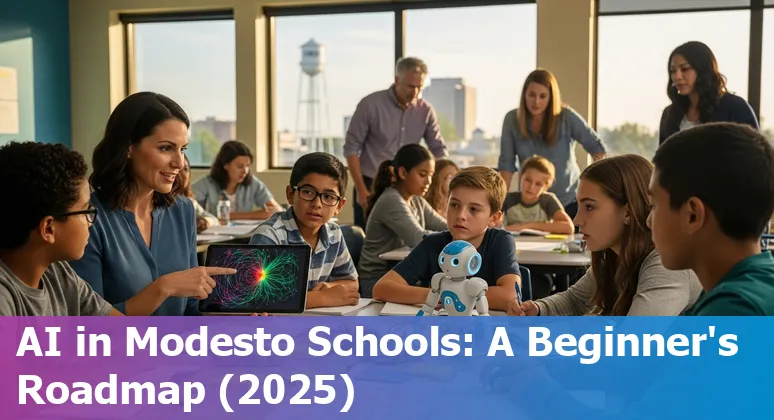
Too Long; Didn't Read:
Modesto City Schools' 2025 AI rollout trains 776 staff (≈1/3 of teachers), enforces AB 1584/COPPA/FERPA-compliant vendor rules, and estimates AI can save teachers ~5.9 hours/week. Approved tools (PowerSchool, MagicSchool, Writable) follow an “80‑20” teacher‑control rule.
Modesto City Schools is accelerating AI adoption in 2025 to relieve teacher workload, protect student data, and align local practice with California law: the district's 20‑member AI committee produced a guidebook and approved new policy language after a report found AI could save teachers an average of 5.9 hours per week - roughly six extra weeks over a school year - while helping personalize learning and reduce burnout; read the district overview in the Modesto Bee on the new guidelines (Modesto City Schools AI guidelines) and explore the district's practical resources and approved tools on the MCS AI hub (MCS AI resource hub).
State actions (SB 1288, AB 2876) and county PD from Stanislaus SCOE make Modesto's move both regulatory and training‑driven; educators seeking structured, career‑focused training can review the Nucamp AI Essentials for Work syllabus to build workplace AI and prompt‑writing skills relevant to schools.
| Bootcamp | Length | Cost (early bird) | Syllabus |
|---|---|---|---|
| AI Essentials for Work | 15 Weeks | $3,582 | Nucamp AI Essentials for Work syllabus |
“The consensus is that AI should be a tool to lighten workloads, not to replace people.” - Fawn Peterson
Table of Contents
- What is the role of AI in education in 2025? A beginner's overview in Modesto, California
- Modesto City Schools' AI governance: policies, committees, and local rules
- Approved AI tools and how Modesto teachers can use them
- Classroom practices and pedagogical guidance in Modesto, California
- Training, resources, and support for Modesto educators and families
- Security, privacy, and approval criteria used by Modesto City Schools
- Regulation and policy: US and California AI rules affecting Modesto in 2025
- Local ecosystem and events: Modesto higher-education and community AI initiatives
- Conclusion: Future steps and practical checklist for Modesto educators and families
- Frequently Asked Questions
Modesto residents: jumpstart your AI journey and workplace relevance with Nucamp's bootcamp.
What is the role of AI in education in 2025? A beginner's overview in Modesto, California
(Up)In Modesto in 2025, AI's role in schools is practical and policy‑driven: districts deploy AI to shave routine work from teachers' plates, personalize instruction, and scaffold student learning while guarding privacy and human judgment - a district report estimates AI could save teachers about 5.9 hours per week (roughly six extra weeks per year) and Modesto has already trained 776 staff (about one‑third of teachers) in AI use; read the district's rollout coverage in the Modesto City Schools AI guidelines coverage by the Modesto Bee (Modesto City Schools AI guidelines coverage - Modesto Bee) and explore approved tools, posters and the guidebook on the Modesto City Schools AI hub with approved tools and guidebook (Modesto City Schools AI hub - approved tools and guidebook).
In classroom practice that beginners can follow: teachers control student access, must avoid entering personally identifiable information, apply the district's “80‑20 rule” (let AI do most drafting but use professional judgment to finalize), and require students to cite and fact‑check AI outputs; approved staff tools include PowerSchool, Microsoft Copilot and Writable, while classroom tools for teacher‑supervised student work include MagicSchool and PowerBuddy AI, which together make AI a classroom assistant rather than a replacement for educators.
| AI Role in Classrooms | Examples Approved at MCS |
|---|---|
| Personalized learning & tutoring | MagicSchool, PowerBuddy AI |
| Teacher efficiency & lesson prep | PowerSchool, Microsoft Copilot, Writable |
| Research, brainstorming, summarizing | Google Gemini, ChatGPT, Claude |
“We think we're ahead, and we're not.” - Abel Maestas
Modesto City Schools' AI governance: policies, committees, and local rules
(Up)Modesto City Schools has codified AI governance around a 20‑member district AI committee (students, staff and parents) that produced the guidebook "Modesto City Schools AI Exploration: Navigating Our Digital Future," bundled posters and classroom guidance, and is - per local coverage - the only district in Stanislaus County with a formal AI committee; full district guidance, approved tools and operational rules are posted on the Modesto City Schools AI hub (Modesto City Schools AI hub: guidelines and approved tools for AI at MCS) and reported in local news (Modesto Bee report on Modesto City Schools AI guidelines and committee).
Governance actions include a school board first reading that adds AI language to Board Policy and Administrative Regulations, ongoing tool reviews that require vendor privacy agreements and accessibility checks, web‑filtering for non‑compliant services, teacher‑controlled student access to specific apps, and explicit local rules: staff must avoid entering personally identifiable information, verify AI outputs for accuracy and bias, and follow adopted practices like the district's “80‑20” professional‑judgment guidance.
The combined goal is pragmatic: protect privacy and equity while using approved tools to save teacher time (a district report estimates about 5.9 hours weekly) and keep humans, not algorithms, in charge of final decisions.
| Governance Element | Detail |
|---|---|
| AI Committee | 20 members (students, staff, parents); district guidebook & posters |
| Board Policy | First reading approved to add AI language to Board Policy/Regs |
| Training | 776 staff trained since 2023 (≈ one‑third of teachers) |
| Controls & Criteria | Web filters, vendor privacy agreements, accessibility/cost/alignment reviews, teacher‑controlled student tools |
“The consensus is that AI should be a tool to lighten workloads, not to replace people.” - Fawn Peterson
Approved AI tools and how Modesto teachers can use them
(Up)Modesto City Schools publishes a short, approved toolkit and clear use rules so teachers can safely apply AI where it helps most: lesson creation (MagicSchool), instant student feedback (Writable), classroom‑integrated support (PowerSchool and PowerBuddy AI inside Schoology/Performance Matters), and research or brainstorming (Google Gemini, Google NotebookLM, Microsoft Copilot, ChatGPT, Claude) - with student access limited to teacher‑controlled modes like PowerBuddy for Learning and MagicSchool.
The district requires free‑version access only, forbids entering personally identifiable information, and asks staff to vet outputs for accuracy, bias and relevance using the district “80‑20” judgment rule; students may use AI only with teacher or guardian permission and must cite and fact‑check AI results.
These practical limits and examples are documented on the district AI hub and in local reporting so teachers can map tools to daily tasks and save time - a district report estimates roughly 5.9 hours saved per teacher each week when AI is used responsibly (Modesto City Schools AI hub – approved tools and guidance, Modesto Bee coverage – MCS adopts AI tools and estimated time savings).
| Tool Category | Approved Examples (MCS) |
|---|---|
| Staff tools | PowerSchool, PowerBuddy AI, MagicSchool, Writable, Google Gemini, NotebookLM, Microsoft Copilot, ChatGPT, Claude |
| Student (teacher‑controlled) | MagicSchool, PowerBuddy for Learning |
“The consensus is that AI should be a tool to lighten workloads, not to replace people.” - Fawn Peterson
Classroom practices and pedagogical guidance in Modesto, California
(Up)Classroom practice in Modesto centers on teacher‑controlled, transparent use of AI: educators must enable student access deliberately (teacher or guardian permission only), never submit personally identifiable information to models, and apply the district's “80‑20” rule - allow AI to draft or scaffold up to 80% of a task but reserve 20% for professional judgment and finalization; teachers are also required to vet outputs for accuracy, bias and relevance, require students to cite and fact‑check AI (Purdue citation guidance is referenced in district materials), and monitor PowerBuddy chat logs for flagged safety concerns so human staff can act when needed - resources, posters and the full guidebook live on the district AI hub (Modesto City Schools AI hub with district AI resources) and the rollout and policy language were reported in local coverage (Modesto Bee coverage of the district AI rollout and policy); teachers looking for practical, classroom‑level tools can follow scaffolded, teacher‑controlled workflows already in use with PowerBuddy and MagicSchool where students receive guided tutoring while teachers retain final authority (PowerBuddy AI program at Modesto City Schools).
The upshot: AI is framed as a time‑saving classroom assistant - when used with clear prompts, oversight and citation rules it can free lesson‑planning time while preserving student learning processes and academic integrity.
| Practice | Guidance |
|---|---|
| Teacher control | Enable student AI only with permission; review outputs; avoid PII |
| Student use | Teacher/guardian permission required; cite and fact‑check AI; no sharing of classmates' data |
| Professional judgment | Apply “80‑20” rule: AI drafts, teacher finalizes |
“The consensus is that AI should be a tool to lighten workloads, not to replace people.” - Fawn Peterson
Training, resources, and support for Modesto educators and families
(Up)Modesto City Schools has moved training and family outreach to the front of its AI rollout: since 2023, 776 staff members - roughly one‑third of the district's teachers - have completed AI trainings, the district schedules family sessions next month and student trainings are expected to launch soon to align home and classroom practices; these trainings accompany the district's guidebook, posters and teacher resources reported by the Modesto Bee (Modesto Bee article: MCS AI trainings and guidelines) and are reinforced by local upskilling options like the Nucamp AI Essentials for Work syllabus with practical prompts and use cases for educators (Nucamp AI Essentials for Work syllabus - practical AI prompts and use cases for educators); the payoff is concrete - district analysis suggests responsibly used AI can free about 5.9 hours per teacher each week, and the MCS Training Academy provides targeted re‑skilling and job‑shadowing for staff affected by district changes so support is both instructional and career‑focused.
| Training Resource | Detail |
|---|---|
| Staff trained | 776 since 2023 (≈ one‑third of teachers) |
| Family trainings | Planned next month (parent support on classroom tools) |
| Student training | Expected to begin soon (teacher‑supervised use) |
| MCS Training Academy | Offers training, job‑shadowing and re‑employment support |
“The consensus is that AI should be a tool to lighten workloads, not to replace people.” - Fawn Peterson
Security, privacy, and approval criteria used by Modesto City Schools
(Up)Modesto City Schools enforces a clear, law‑first approach to AI and edtech: every software request goes through the district's Tech Orders review (most approvals within 5–10 days, but allow up to 30 days if vendors must complete a legal student‑data privacy contract), vendors must demonstrate compliance with California AB 1584 plus federal COPPA and FERPA, and any app that shares or sells student data is disqualified outright - the Technology Advisory Committee recently blocked Quizlet for failing to sign the district's required student data agreement (Quizlet blocked notice and transition guidance).
Approval also checks curriculum alignment, accessibility and site licensing options; approved vendors often show third‑party privacy badges (iKeepSafe, Common Sense, SDPC/CSPA listings) and the district negotiates site licenses when appropriate.
Operational security is enforced districtwide: staff and students use MFA, the Help Desk manages incident reporting and vendor onboarding, and MCS requires secure file transfer for PII (MFT) - plan procurement timelines accordingly and route all tech orders through the district portal to ensure classroom tools meet Modesto's privacy and cybersecurity standards (Modesto City Schools Tech Orders Software, MCS Cybersecurity & Help Desk).
| Approval Element | District Requirement |
|---|---|
| Typical review time | 5–10 days (up to 30 days for legal privacy contract) |
| Legal checks | AB 1584, COPPA, FERPA compliance |
| Non‑approval | Apps that share/sell student data or lack privacy agreement |
| Security controls | MFA, Help Desk reporting, Managed File Transfer for PII |
Regulation and policy: US and California AI rules affecting Modesto in 2025
(Up)Federal policy in 2025 tightened the policy lens that Modesto must follow: Executive Order 14277 (April 23, 2025) creates a White House Task Force on Artificial Intelligence Education, directs public‑private partnerships and teacher‑training priorities, and requires agencies to stand up a Presidential AI Challenge and identify federal resources and grant guidance to expand K‑12 AI literacy (Executive Order 14277 on advancing AI education - White House); the U.S. Department of Education's July 22, 2025 guidance makes clear that federal formula and discretionary funds may be used for AI tools and high‑impact tutoring so long as uses comply with existing statutes, protect privacy, and engage parents and educators (U.S. Department of Education guidance on AI use in schools).
At the same time, the White House's broader “America's AI Action Plan” signals a tilt toward deregulation and warns that federal funding priorities could favor states with “innovation‑friendly” AI rules - an important pressure point for California districts that already layer state privacy and school laws onto local practice (America's AI Action Plan summary and implications for education policy).
The practical takeaway for Modesto: align board policies, vendor privacy agreements, and staff training with federal guidance now to remain eligible for grants, apprenticeships and partnership opportunities that the EO and Department are explicitly encouraging.
“Artificial intelligence has the potential to revolutionize education and support improved outcomes for learners,” said U.S. Secretary of Education Linda McMahon.
Local ecosystem and events: Modesto higher-education and community AI initiatives
(Up)Modesto's local AI ecosystem centers on a hands‑on forum hosted by Modesto Junior College and partners that connects K–14 educators, community colleges, employers and health and manufacturing leaders to practical AI strategies and workforce pipelines: the free Central Valley AI Innovation Forum at MJC East Campus (Forum Building, Room 110) runs 9:00 a.m.–3:00 p.m.
on May 21, 2025, includes a keynote from California Community College Chancellor Dr. Sonya Christian, breakout panels and an employer panel, and even provides lunch and free student parking (closest: Lot 108), making it an efficient one‑day opportunity for teachers to meet regional employers, compare classroom tools, and explore partnership or internship pathways that can translate directly into curricular updates and student job pipelines - see the event page for the full schedule and registration for the Central Valley AI Innovation Forum at Modesto Junior College and local coverage on YCCD forum plans and goals.
| Event | Date | Time | Location | Notes |
|---|---|---|---|---|
| Central Valley AI Innovation Forum | May 21, 2025 | 9:00 a.m. – 3:00 p.m. | MJC East Campus, Forum Bldg., Room 110 | Free; lunch provided; nearest parking Lot 108 |
“This summit represents our collaborative efforts to align educational systems with current and future workforce needs. We aim to streamline the transition from education to earning, ensuring underserved populations across California can access top-notch training and educational programs leading to quality jobs.” - Dr. Sonya Christian
Conclusion: Future steps and practical checklist for Modesto educators and families
(Up)Practical next steps for Modesto educators and families: follow the district's playbook on the MCS AI hub to align classroom practice with state guidance (AB 2876, SB 1288) and federal priorities, join the scheduled family trainings so home and school use the same teacher‑controlled tools, and require every new app to pass the Tech Orders privacy review before classroom use (MCS AI hub guidelines and approved tools).
Start small: pilot teacher‑controlled workflows (MagicSchool, PowerBuddy) using the district “80‑20” rule, add prompt‑writing and citation checks to rubrics, and log time saved to justify scaling - district analysis estimates responsibly used AI can free about 5.9 hours per teacher each week while preserving human judgment.
Insist vendors sign student‑data agreements, block tools that share/sell data, and document classroom prompts and verification steps so audits and grant applications are straightforward; family sessions and planned student training will help maintain consistent expectations across home and school.
For practical upskilling, consider a structured course in workplace AI and prompt engineering like Nucamp's AI Essentials for Work to build prompt skills and policies that transfer directly to K–12 settings (Nucamp AI Essentials for Work syllabus, Modesto school district AI rollout coverage).
These steps protect privacy, preserve jobs, and position the district to win state or federal grants that reward safe, effective AI adoption.
| Program | Length | Early‑bird cost | Links |
|---|---|---|---|
| AI Essentials for Work | 15 Weeks | $3,582 | AI Essentials for Work syllabus | AI Essentials for Work registration |
“The consensus is that AI should be a tool to lighten workloads, not to replace people.” - Fawn Peterson
Frequently Asked Questions
(Up)What role does AI play in Modesto City Schools in 2025?
In Modesto in 2025 AI is deployed to reduce teacher workload, personalize learning, scaffold student learning, and support classroom tasks while preserving human judgment and student privacy. The district estimates AI use can save teachers about 5.9 hours per week. Implementation is governed by a 20‑member AI committee, approved tool lists, teacher‑controlled student access, and explicit rules such as avoiding entry of personally identifiable information (PII) and applying the district's “80‑20” rule (AI drafts up to 80% of a task; teachers finalize).
Which AI tools are approved for staff and student use, and how are they limited?
Modesto City Schools publishes an approved toolkit. Staff‑approved tools include PowerSchool, Microsoft Copilot, Writable, Google Gemini/NotebookLM, ChatGPT and Claude; classroom and teacher‑controlled student tools include MagicSchool and PowerBuddy for Learning. The district requires free‑version access only, forbids submitting PII to models, limits student access to teacher‑controlled modes or guardian permission, and requires staff to verify outputs for accuracy, bias and relevance. Students must cite and fact‑check AI results.
How does Modesto ensure privacy, security and legal compliance when adopting AI?
All software requests go through the district Tech Orders review; typical reviews take 5–10 days (up to 30 days if a vendor legal student‑data contract is needed). Vendors must comply with California AB 1584 and federal COPPA and FERPA; apps that share or sell student data are disqualified. The district enforces MFA, Help Desk incident reporting, Managed File Transfer (MFT) for PII, vendor privacy agreements, accessibility checks, and web‑filtering for non‑compliant services.
What training and support are available for teachers, students and families?
Since 2023, 776 staff (about one‑third of teachers) have completed AI training offered by Modesto City Schools. The district runs staff trainings, schedules family sessions, and plans student trainings. Additional upskilling options include community offerings like Nucamp's AI Essentials for Work (15 weeks, early‑bird cost listed) to build workplace AI and prompt‑writing skills relevant to K‑12 settings. The MCS Training Academy also provides job‑shadowing and re‑employment support for affected staff.
What practical steps should Modesto educators take to pilot and scale AI responsibly?
Start small with teacher‑controlled pilots using approved tools (e.g., MagicSchool, PowerBuddy) and apply the district “80‑20” rule. Add prompt‑writing guidance and citation checks to rubrics, log time saved to justify expansion (district analysis estimates ~5.9 hours saved per teacher weekly), require every new app to pass Tech Orders privacy review, insist vendors sign student‑data agreements, and document classroom prompts and verification steps for audits and grant applications. Align training and family outreach with district guidance and state laws (AB 2876, SB 1288) to remain eligible for grants and partnerships.
Office roles changing fast: Administrative roles facing automation can transition into data analysis and student success case management.
Learn practical strategies for Curriculum gap analysis using NotebookLM to streamline course design and align to standards.
Find out how classroom adaptive platforms and intelligent tutors are boosting engagement in Modesto classrooms.

Ludo Fourrage
Founder and CEO
Ludovic (Ludo) Fourrage is an education industry veteran, named in 2017 as a Learning Technology Leader by Training Magazine. Before founding Nucamp, Ludo spent 18 years at Microsoft where he led innovation in the learning space. As the Senior Director of Digital Learning at this same company, Ludo led the development of the first of its kind 'YouTube for the Enterprise'. More recently, he delivered one of the most successful Corporate MOOC programs in partnership with top business schools and consulting organizations, i.e. INSEAD, Wharton, London Business School, and Accenture, to name a few. With the belief that the right education for everyone is an achievable goal, Ludo leads the nucamp team in the quest to make quality education accessible