









The Complete Guide to Using AI in the Healthcare Industry in Micronesia in 2025
Last Updated: September 8th 2025
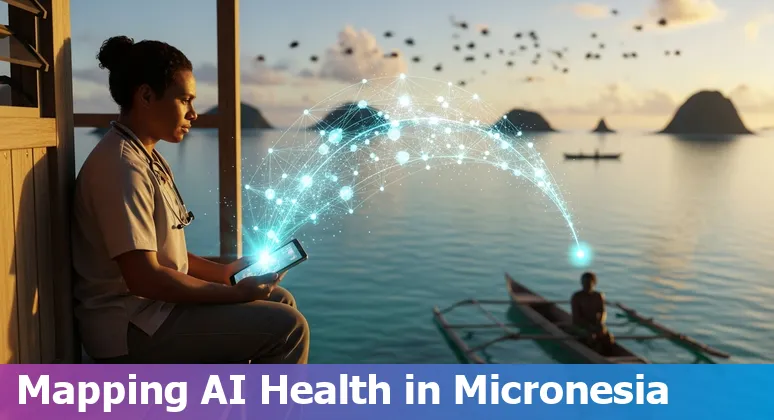
Too Long; Didn't Read:
AI in Micronesia's 2025 healthcare can scale telehealth across 600+ islands (~1,000,000 sq mi, pop. ~101,680), cutting tele‑pathology waits from 2 weeks–3 months to minutes and enabling outbreak detection and supply‑chain forecasting despite ~40% internet penetration.
Micronesia's healthcare landscape - more than 600 islands across roughly 1,000,000 square miles - makes timely specialist care and public-health action a constant logistical challenge, and that's where practical AI and telehealth can make a visible difference.
Local telehealth successes, such as Pohnpei Hospital's tele‑pathology link to the Hokkaido Cancer Center that turned weeks‑or‑months of wait time into near‑instant consults, show how improved broadband and regional leadership support enable smarter workflows; read the FSM telehealth overview.
For clinicians weighing new tools, trusted AI clinical decision support helps balance speed with safety. Start with achievable projects - AI for outbreak detection, supply‑chain forecasting, or decision‑support pilots - and pair them with skills training (see the AI Essentials for Work bootcamp syllabus - practical AI skills for any workplace) so staff can operate tools, check outputs, and keep care culturally and operationally appropriate.
| Attribute | Information |
|---|---|
| Description | Gain practical AI skills for any workplace; learn AI tools, prompt writing, and applied business use. |
| Length | 15 Weeks |
| Cost (early bird / regular) | $3,582 / $3,942 |
| Syllabus / Registration | AI Essentials for Work syllabus - 15-week practical AI skills for business | Register for AI Essentials for Work (15-week bootcamp) |
“I absolutely loved this program. It was just so amazing. I learned so much about artificial intelligence and how to apply it to running and managing a business. I'm thrilled!” - Cal M., AI Student
Table of Contents
- Why AI Matters for Healthcare in Micronesia, FM
- How AI Will Advance Healthcare in Micronesia, FM
- Current Technology & Infrastructure in Micronesia, FM
- Data, Privacy & Legal Considerations for Micronesia, FM
- Choosing AI Tools and Vendors for Micronesia, FM Healthcare
- Building Skills & Finding Healthcare AI Jobs in Micronesia, FM
- Step-by-Step Implementation Roadmap for Clinics in Micronesia, FM
- Sample Projects and Case Ideas for Micronesia, FM
- Conclusion & Next Steps for AI Adoption in Micronesia, FM
- Frequently Asked Questions
Find a supportive learning environment for future-focused professionals at Nucamp's Micronesia bootcamp.
Why AI Matters for Healthcare in Micronesia, FM
(Up)AI matters in Micronesia because it can turn the archipelago's logistical headaches into practical gains: smarter outbreak detection, AI-powered supply‑chain forecasting and remote diagnostics extend scarce clinical expertise across 600+ islands and roughly 1,000,000 square miles, where ships can take five to six days to reach outer atolls.
Regional research highlights AI's ability to tackle climate impacts, geographic isolation, labor shortages and cultural preservation while improving disaster forecasting and health delivery; however, gaps in infrastructure, governance and digital literacy mean projects should start with high‑value, low-risk pilots like telehealth and targeted decision‑support that build local skills and trust.
Real-world telehealth examples - such as Pohnpei's rapid tele‑pathology link with Japanese specialists - show how digitized workflows can cut weeks or months from diagnostic timelines, and coordinated regional guidance can help scale benefits equitably.
For planners, the priority is pragmatic: pair achievable AI use cases with connectivity upgrades and workforce training so every dispensary becomes a node in a resilient, culturally aware health network (see the AI Pacific Islands report and FSM telehealth resources for next steps).
| Attribute | Value |
|---|---|
| Islands / area | 600+ islands; ~1,000,000 sq miles |
| Population (2021) | ~101,680 |
| Health facilities | One hospital per state; 92+ dispensaries |
| Poverty indicator | 41.2% below basic needs line |
“Chuuk State's vision is to build out ‘super-dispensaries' like the one in Satowan for each of our five Chuuk State remote atoll regions.”
How AI Will Advance Healthcare in Micronesia, FM
(Up)AI will advance healthcare in Micronesia by turning telehealth into a force‑multiplier for scarce specialists and strained supply lines: image analysis and AI‑assisted diagnostics can make tele‑pathology consultations truly instant - Pohnpei's program already shortens what used to be a 2‑week to 3‑month wait into minutes - while AI triage and virtual assistants can prioritize cases so clinicians focus where they're most needed (FSM telehealth program overview).
Remote patient monitoring and predictive models will help manage non‑communicable diseases across dispersed communities, and practical tools like AI‑powered supply‑chain forecasting can reduce stockouts on fragile island routes by predicting demand and optimizing limited inventory.
Those advances depend on the steady broadband gains and program support already underway - submarine fiber builds and a recent Digital FSM grant create the plumbing for smarter, lower‑risk pilots.
For planners, the right next step is paired: start with tightly scoped telehealth and diagnostics pilots that embed clinician review and training, then scale proven automation into triage, remote monitoring, and logistics to make specialist expertise and lifesaving diagnostics feel like they're “next door,” even when they're hundreds of miles away.
| Milestone | Detail |
|---|---|
| Tele‑pathology impact | Pohnpei transmits digitized images to Japanese pathologists, cutting 2 weeks–3 months to minutes |
| Broadband timeline | Fiber to Pohnpei (2010); Yap (2018); Chuuk (2019); Kosrae (2021); $30.8M World Bank Digital FSM grant (2020) |
“The future of AI in telemedicine is very promising. AI has the potential to revolutionize telemedicine by making it more accessible, efficient, and effective.” - Mercer
Current Technology & Infrastructure in Micronesia, FM
(Up)Current technology in the Federated States of Micronesia is a fast‑moving mix of new submarine cables, expanding mobile coverage, and satellite fallback that together create the plumbing for practical AI in healthcare: the East Micronesia Cable project will land at Pohnpei and link Kosrae, Nauru and Tarawa by late‑2025, adding vital fiber backhaul for hospitals and clinics (East Micronesia Cable project press release); at the same time LEO satellites like Starlink - with hundreds of community and school/clinic sites deployed and rapid rollouts reported across FSM - are smoothing last‑mile gaps and giving remote dispensaries near‑fiber speeds without new undersea works (Starlink deployments in Micronesia improving connectivity).
Major population centers now have 4G/4G+ coverage (FSM reported nationwide 4G since ~2022), average download speeds in the low tens of Mbps, and about 40% internet penetration nationally, but affordability and outer‑atoll last‑mile access remain the stubborn constraints.
For clinic planners that means prioritizing hybrid designs - fiber‑connected hubs where possible, satellite‑backed remote sites, and lightweight caching and offline workflows - so AI tools and telehealth are resilient even when a ship takes days to reach the outer atolls and a clinic's power or link blinks.
| Attribute | Detail |
|---|---|
| EMC landing / timeline | Pohnpei hub to Kosrae, Nauru, Tarawa - on track for late‑2025 |
| Starlink / LEO | Widespread deployments and community gateways; Starlink available and expanding in FSM |
| Internet users (FSM) | ~40% of population online |
| Mobile coverage | 4G nationwide since ~2022; outer atolls rely more on satellite |
| Average speed | FSM download ~12.6 Mbps (2023) |
“Right now, our internet is really slow it interferes with what we're trying to do; getting our degrees.” - Mathew Alvien
Data, Privacy & Legal Considerations for Micronesia, FM
(Up)Data, privacy and legal risk in Micronesia currently live in a practical grey zone: there is no comprehensive national data‑protection statute or authority outside the telecommunications rules, so health projects must rely on the FSM Code's telecom confidentiality provisions (21 F.S.M.C. §§349–350) plus strong technical and contractual safeguards; see the DLA Piper country summary for details.
That means clinicians and planners should treat consent, minimization, encryption, and clear cross‑border contracts as the primary protections for patient records and AI training data, especially when remote clinics send images or monitoring feeds over satellite links.
For cross‑border sharing and analytics, follow proven approaches - assess which data must stay local, use residency and transfer safeguards, and document lawful bases for processing as recommended in global guides to cross‑border health transfers.
Practical vendors and architectures can help: choose providers that support regional data residency and strong audit trails, and design workflows so sensitive data is tokenized or stored locally while models run on de‑identified inputs.
In short, until FSM adopts broader privacy law, operational controls, explicit consent practices, and sovereignty‑aware contracts will determine whether AI in healthcare is both useful and trustworthy (see cross‑border rules and data‑sovereignty guidance for concrete checklists).
| Issue | Situation in FSM |
|---|---|
| Comprehensive data protection law | None outside telecommunications (per DLA Piper) |
| Relevant statutory text | 21 F.S.M.C. §§349–350 (telecom confidentiality/consent) |
| National DPA / DPO requirement | None listed |
| Recommended safeguards | Consent, minimization, encryption, data residency, vendor contracts, audit trails |
“the data subject shall have the right to withdraw his or her consent at any time,”
Choosing AI Tools and Vendors for Micronesia, FM Healthcare
(Up)Choosing AI tools and vendors for Micronesia's health clinics means matching technology to islands: favor vendors who support a hybrid approach - cloud training and centralized analytics plus lightweight, privacy‑minded edge inference - so diagnostics and triage still work when a satellite link blinks or a supply ship is days away; see the practical Edge vs.
Cloud primer on Coursera for the core tradeoffs. Prioritize partners that can deliver low‑power edge appliances or optimized on‑device models (for low latency, better privacy, and reduced bandwidth bills), offer over‑the‑air updates and model compression, and run a short PoC to prove integration with local EHRs and workflows rather than selling a perfect‑on‑day‑one system; Datacenters.com's lifecycle guidance explains why training should usually live in the cloud while inference runs at the edge.
Budget pragmatically - simple AI features can start in the tens of thousands of dollars while full custom systems climb higher - so pick vendors who provide clear cost estimates, integration services, and documented data‑residency and audit capabilities (see implementation cost benchmarks).
The goal: a vendor ecosystem that makes specialist expertise feel
next door
to an outer‑atoll dispensary by combining resilient edge operations, secure cloud learning, and measurable pilots that build local skills and trust.
| Decision factor | Practical recommendation for Micronesia |
|---|---|
| Latency / offline needs | Edge inference on‑site for real‑time triage and monitoring |
| Model training / heavy compute | Cloud training with periodic sync from edge devices |
| Cost & rollout | Start with PoC; expect simple projects from ~$40,000 and scale selectively |
| Privacy & compliance | Prefer vendors offering local processing, data residency, and audit trails |
Building Skills & Finding Healthcare AI Jobs in Micronesia, FM
(Up)Upskilling and job-hunting for healthcare AI in Micronesia means combining clinical credibility with practical tech skills and a willingness to work remotely: local clinicians can translate patient-care knowledge into roles like AI Trainer, clinical data architect, or remote radiologist while technologists can step into DevOps/MLOps support for telehealth platforms.
Scan dedicated listings - Himalayas' Micronesia healthcare board highlights openings from AI Client Success Manager to IT Health Sciences Specialist and Clinical Data Architect, including AI Trainer roles that list wide salary bands (e.g., $17k–$135k USD for some Invisible Technologies postings) - and use remote-engineering boards like JobGether for DevOps and MLOps positions that keep cloud/edge systems running for clinics.
For imaging or informatics tracks, employer pages such as DeepHealth's careers explain how radiology‑focused AI teams hire for workflow and model‑ops roles. Practical next steps: build a portfolio of small projects (telehealth triage prompts, EHR data pipes, or an annotated image set), practice AI‑tool operation and error‑checking to show clinical oversight, and target short, role‑specific training so one strong remote job listing can connect islands-wide care - one vacancy can recruit skills that make a specialist's expertise available to a dispensary hundreds of miles away via telehealth and AI-assisted workflows.
| Resource | Examples from listings |
|---|---|
| Himalayas Micronesia healthcare jobs board - AI and clinical roles | AI Client Success Manager; IT Health Sciences Specialist – AI Trainer; Clinical Data Architect; Remote Radiologist (varied salaries) |
| JobGether remote DevOps and MLOps jobs for Micronesia | Senior DevOps Engineer; MLOps/DevOps roles; GCP DevOps listings for remote infrastructure work |
| DeepHealth AI imaging and radiology careers | Roles in radiology informatics and AI-powered imaging workflows; team growth and cloud-native platform opportunities |
Step-by-Step Implementation Roadmap for Clinics in Micronesia, FM
(Up)A practical, step‑by‑step implementation roadmap for clinics in the Federated States of Micronesia starts with governance and priorities - bring national and state health directors, maternal & child health coordinators, and community leaders together to map urgent gaps and low‑risk, high‑value pilots (telehealth consultations, diagnostics, and supply‑chain forecasting); see the FSM MCH program overview for how state and national roles can align.
Next, secure resilient connectivity and hub sites: pick a fiber‑connected clinic as a regional node and equip remote dispensaries with satellite fallback and battery‑friendly edge devices so services survive typhoons and power blips (typhoon season runs July–December and medevac capacity is limited, so offline workflows matter - see FSM travel & health guidance).
Launch a tight pilot - tele‑pathology or a supply‑chain forecasting PoC that uses lightweight edge inference and cloud training - measure time‑to‑diagnosis, stockout frequency, and clinician trust, then iterate; practical AI use cases and a supply‑chain forecasting primer help scope pilots.
Protect patients and providers by documenting consent, minimizing data transfers, and using contractual residency/audit guarantees before any cross‑border sharing.
Finally, invest in local training and partnerships with the MCH network, quantify outcomes, and scale only after clinician review and measured improvements so specialist expertise truly feels “next door” to outer‑atoll dispensaries.
| Step | Action |
|---|---|
| 1. Governance & priorities | Engage national/state DOH and MCH coordinators to choose pilots (FSM Maternal and Child Health program overview) |
| 2. Connectivity & resilience | Design hub-and-spoke with fiber hubs + satellite edge for remote dispensaries; plan offline workflows (account for typhoon season and limited medevac) |
| 3. Pilot & measure | Run telehealth/diagnostics and AI supply‑chain pilots, track clinical impact and stockouts (AI supply-chain forecasting primer for Micronesia healthcare) |
| 4. Data & consent | Document consent, minimize transfers, use contracts and audit trails before cross‑border processing |
| 5. Train & scale | Use MCH networks for workforce development, repeat measurement, then expand proven pilots |
Sample Projects and Case Ideas for Micronesia, FM
(Up)Sample projects that make sense in Micronesia start small, practical, and locally tuned: deploy an AI chatbot for appointment scheduling, automated reminders, and 24/7 front‑desk handling so nurses spend less time on calls and more on patients (examples and feature ideas are well summarized in Emitrr's healthcare chatbot overview); build a multilingual voice/chat agent for triage and symptom‑checking that works over SMS, WhatsApp or IVR for low‑literacy or older patients and hands off urgent cases to clinicians; pilot chronic‑care check‑ins and medication‑adherence reminders that flag concerning trends to clinicians before a medevac is needed; integrate pre‑visit intake and lab‑result notifications to shorten telehealth consults and make specialist reviews faster; run a small tele‑pathology + conversational‑AI workflow so images and structured notes are pre‑filtered for remote pathologists; and pair every clinical pilot with an operational PoC for AI‑powered supply‑chain forecasting to prevent stockouts on fragile island routes (see the Nucamp primer on AI supply‑chain forecasting).
Start each project as a tight PoC - multichannel (chat/voice/SMS), EHR‑integrated, HIPAA‑minded, and edge‑aware - so the tool still helps when a satellite link blinks; Riseapps' case studies show how conversational pilots can screen huge volumes quickly, proving the model before scale.
Conclusion & Next Steps for AI Adoption in Micronesia, FM
(Up)Conclusion: momentum in Micronesia's health system now needs steady, practical steps - start with tight, measurable pilots (tele‑pathology, outbreak detection, AI supply‑chain forecasting) that embed clinician review, documented consent, and offline‑first edge designs so services keep working when a ship takes five to six days to an outer atoll; pair those pilots with clear ethical guardrails around privacy, bias and human oversight (see the short primer on ethical issues in AI and healthcare) and a data strategy that prioritizes minimization and local residency for sensitive records.
Invest in workforce readiness so clinicians and technicians can operate, validate and iterate on models - role‑focused training like the AI Essentials for Work bootcamp builds prompt, tool‑use and governance skills that turn pilots into sustainable services - and scope vendor contracts for audit trails, residency and predictable costs before cross‑border processing begins.
With measured pilots, documented outcomes, and local capacity-building tied to concrete use cases (for example, AI forecasting to prevent stockouts), AI can make specialist care feel
next door
across hundreds of islands while keeping patients safe and systems accountable.
| Attribute | Information |
|---|---|
| Description | Gain practical AI skills for any workplace; learn AI tools, prompt writing, and applied business use. |
| Length | 15 Weeks |
| Courses included | AI at Work: Foundations; Writing AI Prompts; Job Based Practical AI Skills |
| Cost (early bird / regular) | $3,582 / $3,942 |
| Syllabus / Registration | AI Essentials for Work syllabus | Register for AI Essentials for Work bootcamp |
Frequently Asked Questions
(Up)What practical AI use cases should Micronesian clinics start with in 2025?
Start with high‑value, low‑risk pilots that embed clinician review: tele‑pathology (already cutting 2 weeks–3 months to minutes in Pohnpei), outbreak detection and surveillance, AI‑powered supply‑chain forecasting to reduce stockouts, AI triage/virtual assistants to prioritize cases, and remote patient monitoring for NCD management. Pair each pilot with workforce training, clear success metrics (time‑to‑diagnosis, stockout frequency, clinician trust), and offline‑first designs so services survive connectivity interruptions.
What is the current technology and connectivity situation in the Federated States of Micronesia, and how should projects be designed?
Micronesia covers 600+ islands across roughly 1,000,000 sq miles. Major population centers have 4G (nationwide since ~2022), ~40% internet penetration, and average download speeds around 12.6 Mbps (2023). Submarine fiber (East Micronesia Cable) will land at Pohnpei and link Kosrae, Nauru and Tarawa on track for late‑2025; LEO/satellite (e.g., Starlink) is expanding for last‑mile fallback. Design hub‑and‑spoke networks with fiber‑connected hubs, satellite‑backed remote dispensaries, battery‑friendly edge devices, lightweight caching and offline workflows so AI inference continues when links or power fail.
What data‑privacy and legal safeguards are required when using AI in Micronesian healthcare?
FSM currently lacks a comprehensive national data‑protection law outside telecommunications, so health projects should rely on telecom confidentiality (21 F.S.M.C. §§349–350) plus strong technical/contractual safeguards. Recommended controls: explicit consent and documented withdrawal options, data minimization, encryption in transit and at rest, data residency or tokenization, vendor contracts with audit trails, and de‑identification before cross‑border processing. Treat consent, residency and vendor guarantees as primary protections until broader privacy law is adopted.
How should clinics choose AI vendors and budget for pilots?
Prefer vendors that support a hybrid cloud/edge architecture: cloud training for heavy compute and centralized analytics, with lightweight edge inference for low latency and offline resilience. Require over‑the‑air updates, model compression, documented data residency and audit logs, and an integration PoC with local EHRs. Budget pragmatically: simple AI features can start in the tens of thousands of dollars; expect typical PoCs from around $40,000, with larger custom systems costing more. Start small, measure impact, then scale selectively.
What step‑by‑step roadmap and workforce steps will help scale safe, effective AI in Micronesia?
Follow a five‑step roadmap: 1) Governance & priorities - align national/state DOH, MCH coordinators and community leaders to choose pilots; 2) Connectivity & resilience - designate fiber hubs, equip remote dispensaries with satellite fallback and edge devices, plan offline workflows (account for typhoon season and limited medevac); 3) Pilot & measure - run tight telehealth/diagnostic and supply‑chain PoCs and track clinical and operational metrics; 4) Data & consent - document consent, minimize transfers, and secure contractual residency/audit guarantees; 5) Train & scale - invest in role‑specific training so clinicians can validate outputs and operate tools. Example training: a practical AI Essentials program is 15 weeks with early‑bird tuition $3,582 and regular $3,942, useful for building prompt, tool‑use and governance skills.
Expand local research capacity by automating clinical trials and data workflows to speed recruitment and data cleaning.
Mastering AI-tool operation and error-checking is a concrete way for technicians to add value beyond automated readings.
See why Multilingual Patient Engagement Materials improve consent, adherence, and health literacy through validated local translations and audio options.

Ludo Fourrage
Founder and CEO
Ludovic (Ludo) Fourrage is an education industry veteran, named in 2017 as a Learning Technology Leader by Training Magazine. Before founding Nucamp, Ludo spent 18 years at Microsoft where he led innovation in the learning space. As the Senior Director of Digital Learning at this same company, Ludo led the development of the first of its kind 'YouTube for the Enterprise'. More recently, he delivered one of the most successful Corporate MOOC programs in partnership with top business schools and consulting organizations, i.e. INSEAD, Wharton, London Business School, and Accenture, to name a few. With the belief that the right education for everyone is an achievable goal, Ludo leads the nucamp team in the quest to make quality education accessible