









Top 5 Jobs in Retail That Are Most at Risk from AI in Mesa - And How to Adapt
Last Updated: August 23rd 2025
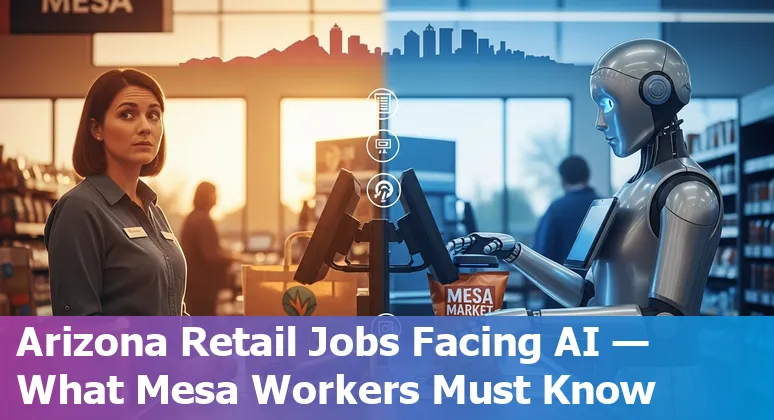
Too Long; Didn't Read:
Mesa retail jobs with highest AI risk: cashiers, basic customer service, entry‑level sales, warehouse pickers, and proofreaders. With 69% of retailers reporting revenue gains from AI, workers should reskill in AI oversight, promptcraft, kiosk/robot troubleshooting, and hybrid tech roles.
Mesa retail workers should pay attention because AI is already reshaping U.S. stores: retailers use generative AI, chatbots, smart shelves, and cashier‑less systems to boost efficiency, reduce costs, and personalize shopping (see a practical industry overview in Forbes), while market research shows widespread adoption and measurable gains - Neontri reports 69% of retailers saw increased revenue after adopting AI. These shifts put routine roles such as cashiers, entry-level sales, and basic support at higher risk of automation but also create openings for staff who learn to operate, oversee, or prompt AI tools; local workers who reskill can move into higher‑value tasks or AI‑assisted roles.
For Mesa employees seeking practical, work-focused AI skills, consider Nucamp's AI Essentials for Work bootcamp to learn prompting and on‑the‑job AI applications.
Forbes overview of AI in retail and industry insights, Neontri retail AI trends and statistics, Nucamp AI Essentials for Work bootcamp - practical AI skills for the workplace.
| Bootcamp | Length | Early bird cost | Key courses |
|---|---|---|---|
| AI Essentials for Work bootcamp syllabus | 15 Weeks | $3,582 | AI at Work: Foundations; Writing AI Prompts; Job Based Practical AI Skills |
"We are at a tech inflection point like no other, and it's an exciting time to be part of this journey."
Table of Contents
- Methodology: How we chose the top 5 retail jobs at risk in Mesa
- Retail Cashiers: Risk factors and how to adapt (cashiers)
- Customer Service Representatives (basic support): Risk factors and adaptation
- Sales Associates / Entry-level Sales: Risk factors and adaptation
- Warehouse & Stockroom Workers: Risk factors and adaptation
- Proofreaders / Copy Editors and Entry-Level Content Roles: Risk factors and adaptation
- Conclusion: Key takeaways and next steps for Mesa retail workers
- Frequently Asked Questions
Before you deploy any system, review the Mesa-specific AI compliance checklist to avoid privacy pitfalls and tax surprises in Arizona.
Methodology: How we chose the top 5 retail jobs at risk in Mesa
(Up)Selection combined macro projections from the World Economic Forum's Future of Jobs Report, Microsoft Research's AI‑applicability ranking of occupations, and local Mesa deployment signals (practical chatbots and shelf‑monitoring use cases highlighted by Nucamp) to identify retail roles where task overlap makes automation or augmentation most likely; positions that rank high on Microsoft's exposure list and align with WEF's displacement signals - while matching AI projects already being used in Mesa stores - were prioritized, producing a shortlist focused on routine, transaction‑heavy, and communication‑intensive jobs (cashiers, customer service reps, entry‑level sales associates, warehouse/stockroom workers, and proofreaders).
The methodology emphasizes actionable skill gaps WEF calls out (AI literacy, data skills, creative problem solving) so Mesa workers can target reskilling toward AI oversight, promptcraft, and retail‑tech operation rather than trying to outcompete automation at scale.
See the WEF framework and Microsoft exposure list for the underlying indicators and Nucamp's Mesa use cases for local examples.
| Criterion | Source / Use |
|---|---|
| Global displacement & skills signals | World Economic Forum Future of Jobs Report 2025 - jobs and skills analysis |
| AI applicability by occupation | Microsoft Research generative AI occupational impact (Fortune summary) |
| Local Mesa AI deployments | Nucamp AI Essentials for Work syllabus - Mesa retail AI use cases and examples |
“You're not going to lose your job to an AI, but you're going to lose your job to someone who uses AI.”
Retail Cashiers: Risk factors and how to adapt (cashiers)
(Up)Retail cashiers in Mesa should expect self‑checkout to change what the job looks like: kiosks are now mainstream in U.S. grocery and retail, and stores deploy them to cut labor costs and speed transactions, which shifts routine scanning and payment tasks away from humans and toward oversight roles; reporting shows attendants stretched thin policing multiple machines and customers (see the Prism report on self‑checkout headaches for cashiers).
That shift creates two measurable risks - role displacement and higher shrink - and one clear path to adapt: move from one‑task cashiering to technology oversight.
Research finds shrink at self‑checkout is substantially higher (roughly 3.5–4% vs. under 1% for staffed lanes), so cashiers who train in kiosk troubleshooting, customer assistance, basic loss‑prevention techniques, and retail AI tools (computer‑vision shelf monitoring or kiosk support) become indispensable as hybrid floor technicians rather than replaceable checkout operators.
Employers reward those who can reduce shrink, fix simple hardware/software issues, and coach customers through scan‑and‑go; for Mesa workers, short, practical upskilling on in‑store AI use cases is the most direct way to protect earnings and pivot into higher‑value roles (Prism report on self‑checkout headaches for cashiers: Prism report on self‑checkout system headaches for cashiers, Wharton analysis of self‑checkout shrink and trade‑offs: Wharton analysis of self‑checkout shrink and trade‑offs, Nucamp AI Essentials for Work syllabus with retail AI prompts and use cases: Nucamp AI Essentials for Work syllabus - retail AI prompts and use cases).
“It's facilitating errors and, in some cases, the steal.” - Santiago Gallino
Customer Service Representatives (basic support): Risk factors and adaptation
(Up)Basic customer service roles in Mesa face clear automation risk because AI now handles routine, high‑volume tasks - 24/7 chatbots, automated ticket creation and smart routing reduce the need for human reps to answer FAQs and track orders (Devoteam notes Gartner expects 80% of CS orgs to adopt generative AI by 2025).
Local Mesa retailers already deploy AI chatbots to cut labor costs and speed responses, so reps who only field predictable inquiries are most exposed; industry examples show AI can automate large shares of queries and deliver faster, personalized service while cutting costs (see real deployments and outcomes in Sobot's case studies).
The practical adaptation is to pivot from sole issue‑resolver to AI overseer: learn AI‑assisted note‑taking, knowledge‑base maintenance, prompt design for chatbots, and seamless AI→human handoffs so emotional or complex cases stay with people.
Employers reward staff who reduce escalations and manage data/privacy in AI workflows; becoming the store's AI liaison is a concrete way to keep hours and move into higher‑value support work.
Devoteam report on the impact of AI on customer service, Sobot case studies on replacing customer service with AI, Nucamp AI Essentials for Work bootcamp - practical AI skills for the workplace.
| AI Use Case | Primary Benefit |
|---|---|
| Chatbots & virtual assistants | 24/7 self‑service, faster responses |
| Agent assist (real‑time prompts, summarisation) | Frees agents for complex/empathic work |
| Automated ticketing & routing | Prioritises urgent cases, reduces handling time |
Sales Associates / Entry-level Sales: Risk factors and adaptation
(Up)Entry‑level sales associates in Mesa confront a clear shift: generative AI and recommendation engines now surface targeted upsells, virtual try‑ons, and contextual bundles that often convert - researchers note examples where recommendations drove a large share of purchases (Amazon cited ~35% in one case) and personalization can boost purchase rates and average order value (Monetate: up to 70% and 33% respectively) - so routine pitch-and-shelve work risks shrinking.
The practical adaptation is to trade repeatable pitches for high‑value human skills: interpret and validate AI suggestions, fix mismatches, craft localized bundles (seasonal Mesa gear, event‑specific kits), handle complex sizing/returns, and own AI promptcraft and curation so recommendations reflect local tastes.
Learn to operate hybrid stacks that pair GenAI with recommendation services (e.g., Amazon Personalize) and become the store expert who audits AI output, designs custom offers, and closes the deals AI surfaces; that single capability - turning a generic suggestion into a Mesa‑ready upsell - directly preserves commissions and makes an associate indispensable.
See research on generative AI product recommendations, conversational shopping assistants, and hybrid recommendation architectures for practical examples and implementation patterns: generative AI personalized product recommendations research and examples, conversational shopping assistants and context-aware personalization use cases, building GenAI recommendation systems with Amazon Personalize implementation guide.
“If the primary LLM generates a product description that is too generic or fails to highlight key features unique to a specific customer, the evaluator LLM will flag the issue.” - Mihir Bhanot, Director of Personalization, Amazon
Warehouse & Stockroom Workers: Risk factors and adaptation
(Up)Warehouse and stockroom work in Mesa is shifting from heavy lifting and repetitive picking to supervising sensors, fleets of AMRs/cobots, and AI-driven inventory systems - so routine pick‑and‑pack roles are among those most exposed to automation (WINSS lists “Warehouse and Logistics Workers” among jobs at risk), but this transition also creates a clear pathway: learn to run, troubleshoot, and interpret warehouse tech rather than just move boxes.
Large operators are already adopting robotics at scale - nearly 50% of large warehouses are expected to deploy robots by the end of 2025 - and facilities report 25–30% efficiency gains in early automation stages, meaning stores that upskill staff can cut shrink and speed fulfillment (see robotics adoption and trend analysis).
Practical adaptation for Mesa workers: train on AMR/cobot coordination, inventory‑tracking tools (RFID/real‑time systems), basic robotics maintenance, and VR/ wearable training so the worker becomes a hybrid technician or supervisor instead of a replaceable picker; employers reward that mix with steadier hours and higher pay.
For local resources and trend evidence, see the Raymond Handling overview on warehouse robotics, Kardex's 2025 warehouse automation trends, and VKTR's upskilling recommendations for warehouse workers.
| Metric | Value / Trend |
|---|---|
| Large‑warehouse robotics adoption | Nearly 50% by end of 2025 (Raymond Handling) |
| Reported efficiency gains | ~25–30% operational improvement in first year (Kardex) |
| Suggested adaptation paths | Robotics technician, AMR supervisor, inventory analyst (VKTR) |
“AI is driving a huge shift towards flexible automation in warehouses...”
Proofreaders / Copy Editors and Entry-Level Content Roles: Risk factors and adaptation
(Up)Proofreaders, copy editors and entry‑level content creators serving Mesa retailers face clear exposure as AI tools take over routine fixes - grammar, formatting, short product descriptions and rapid social posts - but the research shows a practical path to staying valuable: shift from error‑checking to higher‑order editorial judgment, AI oversight, and ethical verification.
Studies and industry voices report that AI already speeds language editing and formatting yet remains fallible and best at “good enough” drafts, so editors who learn promptcraft, vet citations, catch AI hallucinations, and offer developmental edits that machines can't will keep demand (see CIEP editor perspectives on how AI changes editorial work and the need to learn AI tools).
Medical‑writing research echoes the same tradeoffs - AI can draft abstracts and tidy manuscripts but requires human accountability, disclosure, and strict fact‑checking (see the Journal of Family Medicine & Primary Care recommendation on transparency and limits for AI authorship).
Positioning services around what AI cannot reliably do - nuanced voice, structural revisions, ethical checks and client coaching - plus documenting AI use on invoices or web pages turns a threat into a differentiator; employers and local Mesa stores will pay a premium for staff who can safely run AI‑assisted workflows and protect brand trust (see the New York Book Forum analysis of the potential impact of AI on editing and proofreading).
"Most of all I believe that, when it comes to the quintessentially human activity of communication, ultimately humans will always prefer to work with other humans."
Conclusion: Key takeaways and next steps for Mesa retail workers
(Up)Bottom line for Mesa retail workers: routine tasks are the most exposed, but learning to operate and oversee the same AI systems that threaten jobs - like computer-vision shelf monitoring use cases in retail and AI chatbot customer service applications for retail - turns vulnerability into a concrete advantage; employers look for staff who can reduce shrink, troubleshoot kiosks/sensors, and craft prompts that keep customers satisfied.
A practical next step is focused, short‑term training: Nucamp's 15‑week AI Essentials for Work (early bird $3,582) teaches prompt writing, real‑world AI tool use, and job‑based skills that help shift a cashier, CSR, or stock worker into an AI‑oversight role - one clear “so what”: being the person who runs the chatbot or fixes a shelf‑monitor alert makes a worker far more likely to retain hours and higher pay than someone who only does routine scanning or basic ticketing.
Learn the use cases, then train to own them.
| Bootcamp | Length | Early bird cost | Register |
|---|---|---|---|
| AI Essentials for Work | 15 Weeks | $3,582 | Register for Nucamp AI Essentials for Work (15-week) |
Frequently Asked Questions
(Up)Which retail jobs in Mesa are most at risk from AI right now?
The article identifies five roles most exposed in Mesa: retail cashiers, basic customer service representatives, entry‑level sales associates, warehouse/stockroom workers, and proofreaders/copy editors. These positions involve routine, transaction‑heavy, or high‑volume tasks that AI (self‑checkout, chatbots, recommendation engines, robotics, and automated editing tools) can automate or augment.
What concrete risks do cashiers and customer service reps face, and how can they adapt?
Cashiers face displacement from self‑checkout and higher shrink rates (self‑checkout shrink ~3.5–4% vs staffed lanes under 1%), shifting the role toward kiosk oversight. Customer service reps face automation of routine inquiries via 24/7 chatbots and automated ticketing. Practical adaptations include training in kiosk troubleshooting and loss‑prevention for cashiers, and learning AI‑assisted note taking, prompt design, knowledge‑base maintenance, and managing AI→human handoffs for reps - becoming an AI overseer or liaison rather than only answering routine tasks.
How can entry‑level sales associates and warehouse workers make themselves more valuable as AI is adopted?
Sales associates should move from repeatable pitches to high‑value tasks: auditing and curating AI recommendations, creating localized bundles, handling complex customer needs, and designing prompts for conversational shopping tools. Warehouse and stockroom workers should upskill in AMR/cobot coordination, RFID/real‑time inventory systems, basic robotics maintenance, and supervisory/technical roles. These changes turn routine jobs into hybrid tech‑oversight positions with steadier pay.
Are content roles like proofreaders doomed by AI, and what should editors do?
Routine editing (grammar, formatting, short product descriptions) is highly automatable, but proofreaders and entry‑level content creators remain valuable if they shift to higher‑order editorial judgment. Key adaptations: learn promptcraft, fact‑check and catch AI hallucinations, provide structural/developmental edits, verify citations, and document AI use. Positioning services around nuance, ethics, and brand voice preserves demand and can command a premium.
What short‑term training or next steps are recommended for Mesa retail workers who want to adapt?
Focus on short, practical reskilling in AI oversight and job‑based AI skills: prompt writing, real‑world AI tool workflows, kiosk and sensor troubleshooting, chatbot prompt design, inventory tech basics, and robotics supervision. The article highlights Nucamp's 15‑week AI Essentials for Work bootcamp (early bird cost listed) as an example program teaching these applied skills to help workers transition into AI‑assisted or oversight roles.
Learn why demand forecasting tuned to Arizona weather prevents stockouts and excess inventory.
Empower floor teams with sales associate copilot prompts to speed customer service and increase average sale per associate.

Ludo Fourrage
Founder and CEO
Ludovic (Ludo) Fourrage is an education industry veteran, named in 2017 as a Learning Technology Leader by Training Magazine. Before founding Nucamp, Ludo spent 18 years at Microsoft where he led innovation in the learning space. As the Senior Director of Digital Learning at this same company, Ludo led the development of the first of its kind 'YouTube for the Enterprise'. More recently, he delivered one of the most successful Corporate MOOC programs in partnership with top business schools and consulting organizations, i.e. INSEAD, Wharton, London Business School, and Accenture, to name a few. With the belief that the right education for everyone is an achievable goal, Ludo leads the nucamp team in the quest to make quality education accessible