









Top 10 AI Prompts and Use Cases and in the Hospitality Industry in McKinney
Last Updated: August 23rd 2025
Too Long; Didn't Read:
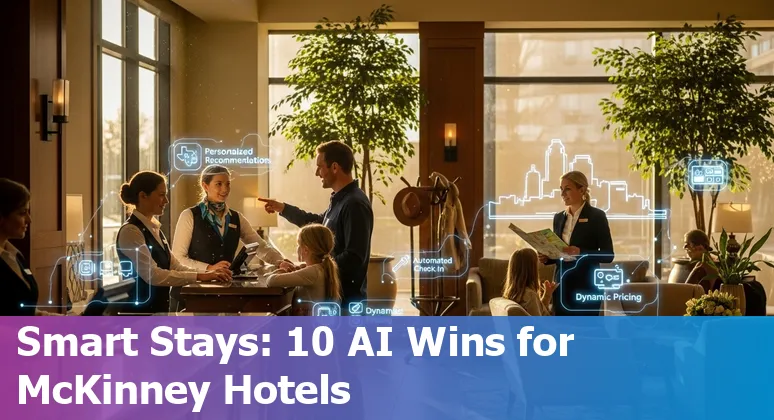
McKinney hotels can boost occupancy and guest satisfaction by piloting AI prompts - 24/7 chatbots, voice bookings, sentiment triage, dynamic pricing - after Collin County generative AI rose from 20% to 36% (Apr 2024–May 2025). Expect 10–30% higher ancillary revenue and faster peak throughput.
McKinney hospitality operators are uniquely positioned to benefit from rapid local AI adoption: Collin County's tech boom coincides with a jump in generative AI use from 20% to 36% between April 2024 and May 2025, making practical tools - 24/7 chatbots, virtual concierges, automated check‑ins and AI revenue engines - core to keeping occupancy and guest satisfaction competitive; see the Collin County growth report and NetSuite's roundup of AI use cases for concrete examples.
For McKinney hotels that pilot focused prompts (booking flows, sentiment triage, dynamic pricing), the payoff is measurable - faster throughput at peak events and freed front‑desk time for higher‑value service.
Upskilling staff on prompt engineering and operational AI via Nucamp's AI Essentials for Work syllabus can convert these tools into local revenue and service gains.
| Bootcamp | Length | Early-bird Cost | Syllabus |
|---|---|---|---|
| AI Essentials for Work | 15 Weeks | $3,582 | AI Essentials for Work syllabus - Nucamp Bootcamp |
“Hospitality professionals now have a valuable resource to help them make key decisions about AI technology,” said SJ Sawhney.
Table of Contents
- Methodology: How we selected the Top 10 AI Prompts and Use Cases
- Reservation Handling - LouLou AI voice-first booking flows
- Caller Intent & Escalation Detection - Real-time tone analysis
- Multi-step Booking Flows - OpenTable and Resy orchestration
- PMS Integration - Boulevard guest preference capture
- FAQ & Service Responder - ChatGPT and Microsoft Copilot pilots
- Post-stay Follow-up & Review Solicitation - University of South Carolina Copilot example
- Emergency & Safety Triage - Human-in-loop escalation
- Accessibility & Inclusive Service Handling - ADA-focused prompts
- Local Recommendations & Concierge Bookings - LouLou AI + local concierge integrations
- Upsell / Cross-sell Engine - CRM-driven personalized offers
- Conclusion: Roadmap for McKinney Operators - Start small, measure, govern
- Frequently Asked Questions
Find out how AI-driven housekeeping and staffing tools can optimize labor in McKinney's competitive market.
Methodology: How we selected the Top 10 AI Prompts and Use Cases
(Up)Selection began with business-first filters drawn from hospitality playbooks: prioritize measurable operator goals (revenue, NPS, peak-event throughput), map concrete operational pain points (check‑in queues, staffing churn, fragmented PMS/POS data), and score candidate prompts by value versus implementation complexity using MobiDev's 5‑step roadmap and governance checklist to capture data readiness and compliance needs - regulators are tightening scrutiny as hospitality systems process IDs, payment tokens, and health data, so privacy and auditability were treated as pass/fail gates.
Shortlisted prompts and use cases were stress‑tested for McKinney by simulating event-day loads and PMS integration touchpoints, favoring those that unlock outsized human benefits (reduce repetitive tasks so staff can upsell and solve high‑touch issues) and that fit a staged pilot path: prototype, single‑property pilot, metric tracking, and governed scale.
Final selection favored conversational booking flows, sentiment triage, dynamic pricing hooks, and kiosk/mobile check‑in automations - each justified by feasibility, vendor interoperability, and a clear ROI measurement plan; see the MobiDev integration playbook and local examples of automated check‑in kiosks reducing labor costs for concrete reference.
| Step | Focus |
|---|---|
| 1. Identify Priorities | Revenue/NPS/operational targets |
| 2. Map Challenges | Queues, staffing, data gaps |
| 3. Evaluate Readiness | APIs, data quality, compliance |
| 4. Match Use Cases | Value vs. complexity |
| 5. Pilot & Measure | Single property → governed scale |
“The hospitality sector globally is indeed at the cusp of AI-driven transformation. Through enhanced personalization, AI can help enrich guest experiences while preserving the human touch, thus redefining luxury hospitality.” - Puneet Chhatwal
Reservation Handling - LouLou AI voice-first booking flows
(Up)LouLou AI voice-first booking flows are presented here as a practical reservation pattern for McKinney hotels: a phone‑first assistant answers after‑hours and overflow calls, handles multilingual queries, checks availability against the PMS, and routes complex cases to a human agent - tactics shown to cut missed calls (about 40% of hotel calls go unanswered) and to be deployed rapidly in many solutions (Dialzara roundup of AI voice assistants for hotel reservations).
Start with an after‑hours and peak‑period pilot to capture high‑intent callers during Collin County events, then expand to full booking flows once integrations and prompts prove reliable; industry spotlights recommend this staged approach and cite measurable uplifts in voice conversion and revenue when teams combine training, real‑time routing, and branded voice prompts (Hotel Technology News analysis of AI voice tools for hotel reservations and guest communication).
Build the voice script with Voiceflow‑style conversational blocks so the assistant can confirm dates, upsell a parking or breakfast add‑on, and hand off to staff for special requests - this preserves the human touch while freeing front‑desk time for VIPs and on‑site problem solving (Voiceflow guide to building hotel booking chatbots with conversational blocks).
The so‑what: a quick, governed voice pilot can turn missed phone leads into direct bookings and measurable revenue without adding overnight staff, while keeping handoffs seamless for guests who prefer human contact.
| Metric | Source / Value |
|---|---|
| Unanswered calls | ~40% of hotel calls (Dialzara) |
| Typical rapid setup | Under 10 minutes for some agents (Dialzara) |
| Average booking value via voice | $1,570 (Revinate) |
“Reservation agents aren't just order takers - they're relationship builders.”
Caller Intent & Escalation Detection - Real-time tone analysis
(Up)Real-time caller intent and escalation detection turn every McKinney hotel phone interaction into actionable context: AI unifies voice, chat, and review signals into a single timeline so the front desk sees recent messages, past complaints, and current tone before answering, and can flag “frustration” or “loyalty” signals in real time for immediate routing (Real-time unified customer interactions for hotels - HospitalityTech).
Natural language models and sentiment analytics spot emotional cues and trigger playbooks - escalate to a manager, open a human-handled line, or push a targeted recovery offer - so issues are addressed before they snowball into negative reviews or chargebacks, a capability shown to enable proactive service recovery and faster problem resolution (AI-driven real-time guest feedback analysis - Surveypal).
The so‑what for McKinney operators: a two‑minute tone flag on a call can convert a frustrated caller into a satisfied guest and protect the property's local reputation during busy Collin County events.
Multi-step Booking Flows - OpenTable and Resy orchestration
(Up)Multi-step booking flows let McKinney restaurants and hotel dining outlets orchestrate OpenTable, Resy, and direct channels into a predictable service rhythm so kitchen and floor teams aren't surprised on high‑demand nights; implement OpenTable's flow controls to cap covers or parties in each 15‑minute slot (cover and party pacing limits) and attach floor plans to shifts for precise seating coordination (OpenTable flow controls documentation).
Consolidating online bookings into a single reservation view also makes shift planning and guest personalization practical - OpenTable's reservation management surfaces guest profiles, smart table management, deposit/credit‑card policies to cut no‑shows, and integrations for experiences and events that local operators can sell alongside a table (OpenTable reservation management features and integrations).
For operators choosing a vendor mix, side‑by‑side comparisons help decide where to centralize orchestration and when to use niche features from Resy or alternatives (comparison of OpenTable and Resy reservation platforms).
The so‑what: pairing 15‑minute pacing limits with deposit policies turns volatile Collin County event nights into manageable, sellable seatings so staff can focus on service and upsells instead of firefighting.
PMS Integration - Boulevard guest preference capture
(Up)Boulevard's Admin API and Webhooks make PMS integration practical for McKinney operators by streaming booking and client events (e.g., APPOINTMENT_CREATED, CLIENT_CREATED) into downstream systems so guest profile fields - firstName, mobilePhone, tags and appointment details - are captured the moment a reservation is made; see the Boulevard Admin API Webhooks guide (createWebhook example and verification headers) for implementation details (Boulevard Admin API Webhooks guide - createWebhook example & verification headers).
Capture at-booking preferences via a webhook, persist them to the property's PMS or OPERA connector (Boulevard's integrations support room-charge and real‑time transaction sync), and trigger targeted pre‑arrival marketing or post‑stay flows in tools like Klaviyo using Boulevard's appointment metrics - turning a booking into an automated personalization pipeline without manual data entry (Boulevard integrations documentation - PMS & connector setup, Klaviyo and Boulevard integration guide - setup for targeted email flows).
Build receivers to acknowledge webhooks quickly, apply idempotency checks and background processing (Boulevard best practices) so McKinney front desks see pre-filled check‑in fields and relevant upsell offers before a guest arrives - a single webhook can eliminate a paper intake step and let staff focus on service during busy Collin County events.
| Webhook Event | Local Use |
|---|---|
| CLIENT_CREATED | Populate guest profile (name, mobile, tags) |
| APPOINTMENT_CREATED | Capture booking details and preferences for PMS/OPERA |
| APPOINTMENT_COMPLETED | Trigger Klaviyo/Widewail post‑stay flows and review requests |
FAQ & Service Responder - ChatGPT and Microsoft Copilot pilots
(Up)FAQ and service‑responder pilots in McKinney should pair a ChatGPT‑backed FAQ agent for natural multi‑turn answers with an enterprise Copilot‑style responder that hands off to humans via Microsoft Teams when needed: lightweight ChatGPT integrations (for example, Aiello's ChatGPT usage in voice/chat stacks) speed resolution of complex phrasing, while Teams‑connected workflows preserve escalation and PMS data sync for auditability (Dialzara roundup of AI voice assistants for hotel reservations and ChatGPT usage, Goodcall AI answering service for hospitality with Microsoft Teams integration).
Pilots should measure hard operator KPIs: AI can resolve up to 70% of routine inquiries and cut response times to seconds, with field results showing double‑digit lifts in direct bookings - so the practical upside for McKinney properties is clear: free up front‑desk capacity during Collin County events, convert late‑hour leads into confirmed stays, and preserve a branded human escalation path for VIPs and safety issues (Hotelogix analysis of AI messaging impact on hotel bookings).
Post-stay Follow-up & Review Solicitation - University of South Carolina Copilot example
(Up)For McKinney properties, a Copilot‑style post‑stay follow‑up turns checkout into a measurable reputation and revenue channel: trigger a thank‑you and review request 24–48 hours after checkout, include a direct link to Google or TripAdvisor, and send one targeted follow‑up three days later if there's no response - this timing and sequence is a proven operator pattern for lifting engagement and converting feedback into repeat bookings or loyalty signups (VBOUT post‑stay follow‑up, Asksuite guest messaging workflows).
Route verified responses automatically to the right platform and language to protect local SEO and OTA placement, and connect the flow to your PMS/CRM via Zapier or workflow tools so reviewers become segmented marketing contacts for Texas‑specific offers; automated routing and verified‑guest filters keep requests authentic and high‑value (Hotelinking automated guest reviews).
The so‑what: a single governed automation - timed follow‑up, platform routing, and CRM sync - turns a busy Collin County event weekend into fresh, local search‑visibility and repeat‑booking opportunities without extra staff time.
Note: The condition specified in the trigger here is “Last Engagement Date,” but in this case it should be “Checkout Date”; you can adjust it based on your preferences.
Emergency & Safety Triage - Human-in-loop escalation
(Up)Emergency and safety triage for McKinney properties should pair fast AI prioritization with clear human escalation: AI classifies incoming signals (calls, SMS, sensor alerts, guest reports) and triages them so staff see a single, color‑coded queue that elevates life‑threatening or high‑frustration events to a manager or 911, while routine issues flow to front‑desk follow‑up - an approach that treats incidents “like a hospital, not a hotel” and preserves guest trust during busy Collin County weekends (Micrometrics article: Triage like a hospital, not a hotel).
Equip staff with certified first‑aid and scenario training so human responders make confident, time‑critical choices when AI flags a case (Lingio guide: first‑aid training for hotel staff), and deploy discreet one‑touch panic devices and zoneable mass‑notification tools so a housekeeper's Wi‑Fi panic button immediately conveys location to security and first responders - closing the loop between detection, AI prioritization, and on‑site human action (Alertus guide: panic buttons and mass notification for hospitality staff).
“Just because emergencies are unpredictable doesn't mean you shouldn't plan for them.”
The so‑what: governed AI triage plus practiced human roles turns ambiguous guest reports into rapid, documented responses that protect guest safety and the property's local reputation without replacing the judgment only trained staff can provide.
Accessibility & Inclusive Service Handling - ADA-focused prompts
(Up)McKinney operators should bake ADA‑focused prompts into booking, check‑in, and messaging flows so accessibility becomes operational, not optional: require reservation systems to list and hold accessible room features (ADA guidance mandates accessible rooms be described and held back until all other rooms of that type are rented) and ensure guests can reserve them by phone, web, or agent equally (ADA Accessible Lodging factsheet).
At arrival and front desk, prompts should offer alternate formats (Braille, large print, audio) and staff scripts for guiding guests with low vision - many legally blind guests read 18–20 point sans‑serif type - so check‑in becomes fast and dignified rather than a bottleneck.
Also build web and booking flows to follow DOJ web‑accessibility practices so online reservations aren't a barrier for Texans who rely on screen readers. The practical payoff: fewer lost bookings and complaints during Collin County events, measurable service consistency, and access to federal tax incentives (Section 44 credit and Section 190 deduction) that defray retrofit costs (ADA Guide for Places of Lodging).
The Americans with Disabilities Act authorizes the Department of Justice to provide technical assistance. This document provides informal guidance and is not a final agency action. Guidance documents do not establish legally enforceable responsibilities beyond the applicable statutes, regulations, or binding judicial precedent.
Local Recommendations & Concierge Bookings - LouLou AI + local concierge integrations
(Up)In McKinney, a LouLou AI–style concierge that pairs local recommendation FAQs with direct Resy, OpenTable and Boulevard integrations turns common guest queries into instant, bookable actions without waking the overnight staff, giving guests 24/7 service and operators a predictable way to convert local interest into confirmed experiences;
“best steakhouse near the historic downtown,” “family‑friendly weekend tours,” or a last‑minute dinner request
see how LouLou AI extends beyond reservations into concierge bookings (LouLou AI concierge integrations and booking automation) and why AI concierges are effective at recommending attractions, dining, and activities based on guest preferences (AI concierge travel and hospitality guide).
The so‑what: automated, governed booking flows free front‑desk time during Collin County event peaks while capturing upsells and verified guest preferences that feed PMS and loyalty workflows already used by McKinney hotels (see local automation examples at Nucamp AI Essentials for Work syllabus and McKinney automation examples).
| Integration | Concierge Function |
|---|---|
| Resy | Complete restaurant bookings and confirmations |
| OpenTable | Multi‑step reservations and pacing controls |
| Boulevard | Guest preference capture and upsell fulfillment |
Upsell / Cross-sell Engine - CRM-driven personalized offers
(Up)A CRM-driven upsell and cross‑sell engine turns guest data into timely, personalized offers that matter in McKinney - think pre‑arrival room‑upgrade nudges for Collin County festival weekends, targeted dining packages for downtown visitors, or in‑stay spa and late‑checkout prompts delivered by SMS, app, or trained staff.
By tying loyalty history, booking channel and on‑property behavior into one‑to‑one communications, operators can present higher‑value choices when guests are most likely to say yes; industry guides show front‑desk teams can drive 10–30% more ancillary revenue with well‑timed offers (Guestara front desk upselling tactics guide), while CRM segmentation and one‑to‑one messaging can multiply conversion compared with broad blasts (Revinate one‑to‑one guest communication case study) and modern hotel CRMs make personalization at scale practical for loyalty and repeat business (Event Temple personalization at scale for hotel CRMs).
The so‑what: implement a small pilot (pre‑arrival email + a staffed front‑desk script) and expect measurable uplifts in ancillary spend without adding headcount - turning data already in the PMS/CRM into repeatable Texas revenue.
| Metric | Typical Improvement | Source |
|---|---|---|
| Ancillary revenue (front desk upsell) | +10–30% | Guestara front desk upselling tactics guide |
| Conversion uplift from personalization | ~20%+ | Event Temple personalization at scale for hotel CRMs |
| Segmented email conversion vs. large lists | 4.2× | Revinate one‑to‑one guest communication case study |
Conclusion: Roadmap for McKinney Operators - Start small, measure, govern
(Up)McKinney operators should treat AI like a staged investment: pick one high‑value pilot (after‑hours voice bookings, FAQ responder, or a paced restaurant flow) for a single property during a Collin County event, instrument it with clear KPIs (booking conversion, unanswered‑call reduction, NPS/RevPAR deltas) and run a 30‑ to 90‑day pilot, then apply MobiDev's 5‑step AI roadmap to assess data readiness, compliance, and integration complexity before scaling; see MobiDev's 5‑step AI roadmap for hospitality pilots, KPIs, and governance for the playbook on pilots, KPIs, and governance.
Start small so staff adapt (human‑in‑loop for safety and escalations), measure weekly to catch model drift or UX gaps, and codify privacy, webhook, and PMS rules into an audit trail - training front‑desk teams on prompt design and workflows is essential, and local upskilling via the Nucamp AI Essentials for Work syllabus: AI at Work, Writing AI Prompts, Job-Based Practical AI Skills converts pilots into repeatable revenue engines.
The so‑what: even reclaiming a fraction of the ~40% of missed hotel calls can turn lost leads into direct bookings when pilots are governed, measured, and staffed for real-world service.
| Bootcamp | Length | Early-bird Cost | Syllabus |
|---|---|---|---|
| AI Essentials for Work | 15 Weeks | $3,582 | AI Essentials for Work syllabus - Nucamp AI Essentials for Work (15 weeks) |
“AI won't beat you. A person using AI will.”
Frequently Asked Questions
(Up)What are the top AI use cases McKinney hospitality operators should pilot first?
Start with one high‑value, low‑complexity pilot: after‑hours voice booking flows (LouLou AI), an FAQ/service responder (ChatGPT + Copilot) or a paced multi‑step booking flow for restaurants. These pilots directly impact measurable KPIs - booking conversion, unanswered‑call reduction, NPS/RevPAR - and fit the staged path recommended in the MobiDev 5‑step roadmap (prototype → single‑property pilot → metric tracking → governed scale).
How were the Top 10 prompts and use cases selected and validated for McKinney?
Selection used business‑first filters: prioritize measurable operator goals (revenue, NPS, throughput), map concrete pain points (check‑in queues, staffing churn, fragmented PMS/POS data), and score prompts by value versus implementation complexity. Candidates passed privacy/compliance gates, were stress‑tested for event‑day loads and PMS integration, and favored use cases with clear ROI measurement plans (conversational booking flows, sentiment triage, dynamic pricing hooks, kiosk/mobile check‑ins).
What measurable benefits can McKinney properties expect from pilots like voice bookings and FAQ responders?
Examples include converting missed phone leads into bookings (addressing ~40% of unanswered hotel calls), faster handling during peaks, freed front‑desk time for high‑value service, AI resolving up to ~70% of routine inquiries, double‑digit lifts in direct bookings, and 10–30% increases in ancillary revenue from targeted upsells when combined with CRM segmentation and timely offers.
What technical and governance considerations should hotels in Collin County address before scaling AI?
Assess API readiness, data quality, compliance (IDs, payment tokens, health data) and implement audit trails. Follow the 5‑step roadmap: identify priorities, map challenges, evaluate readiness (APIs/webhooks), match use cases to value/complexity, then pilot and measure. Include human‑in‑loop escalation for safety, idempotent webhook receivers, prompt engineering training, and weekly KPI tracking to catch model drift.
How can McKinney operators upskill staff to get value from AI tools?
Train staff in prompt engineering, human‑in‑loop workflows, privacy/audit practices, and vendor integrations. Consider structured upskilling like Nucamp's AI Essentials for Work (15 weeks, early‑bird cost example $3,582) to convert pilots into revenue and service gains. Start small with single‑property pilots, codify escalation playbooks, and practice emergency/safety scenarios so staff retain decision authority while AI handles prioritization.
Learn about the HR tasks that AI is already automating in hospitality and how to upskill.
Discover how AI-driven personalized guest experiences in McKinney are boosting repeat bookings and guest satisfaction across local hotels.

Ludo Fourrage
Founder and CEO
Ludovic (Ludo) Fourrage is an education industry veteran, named in 2017 as a Learning Technology Leader by Training Magazine. Before founding Nucamp, Ludo spent 18 years at Microsoft where he led innovation in the learning space. As the Senior Director of Digital Learning at this same company, Ludo led the development of the first of its kind 'YouTube for the Enterprise'. More recently, he delivered one of the most successful Corporate MOOC programs in partnership with top business schools and consulting organizations, i.e. INSEAD, Wharton, London Business School, and Accenture, to name a few. With the belief that the right education for everyone is an achievable goal, Ludo leads the nucamp team in the quest to make quality education accessible