









The Complete Guide to Using AI in the Education Industry in Madison in 2025
Last Updated: August 21st 2025
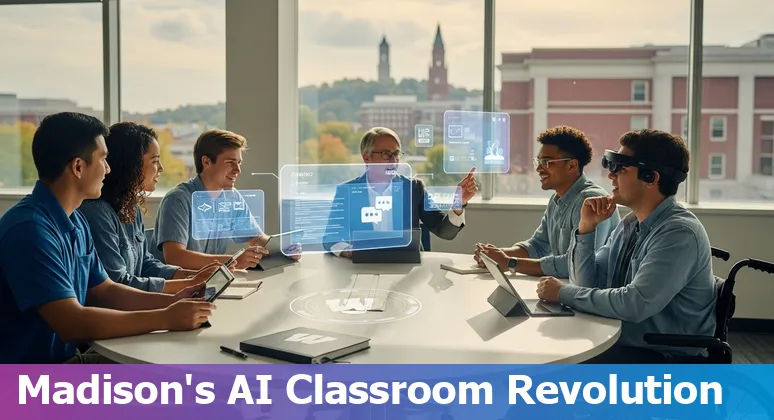
Too Long; Didn't Read:
Madison's 2025 AI guide shows districts how to pilot generative tools with human‑in‑the‑loop review, DPI‑aligned policies, enterprise NetID protections (Copilot/Gemini), and staff upskilling (15‑week AI Essentials). Wisconsin context: 818,100 students and 22‑page WDPI AI guidance to follow.
Madison stands at the center of a practical, urgent conversation about AI in classrooms: the UW–Madison “AI and Society” workshop (June 27–28, 2025) convened educators, learning‑science researchers, and practitioners to tackle classroom uses, bias, and privacy while giving attendees concrete resources like a free copy of Atlas of AI - a direct, usable starting point for district pilots (UW–Madison AI and Society workshop details).
Local leaders must shape adoption, not vendors; for teachers and staff wanting hands‑on upskilling, the 15‑week AI Essentials for Work curriculum offers practical prompt writing and workplace AI skills to help Madison districts move from debate to classroom-ready practice (Nucamp AI Essentials for Work syllabus - 15-week curriculum).
| Attribute | Information |
|---|---|
| Description | Practical AI skills for any workplace; prompts, tools, and applied workflows |
| Length | 15 Weeks |
| Courses included | AI at Work: Foundations; Writing AI Prompts; Job Based Practical AI Skills |
| Cost | $3,582 early bird; $3,942 afterwards (18 monthly payments) |
| Syllabus | AI Essentials for Work syllabus (Nucamp) |
| Registration | Register for Nucamp AI Essentials for Work |
Table of Contents
- What is the role of AI in education in 2025?
- Key AI events and workshops in Madison, Wisconsin (2025)
- UW–Madison and local higher-ed AI initiatives
- Blackhawk Technical College and vocational AI adoption in Wisconsin
- K–12 vendors and classroom tools: Renaissance and others in Madison, Wisconsin
- Practical classroom practices and AI policies for Madison educators
- AI tools and case studies with measurable outcomes in Wisconsin healthcare and education
- AI regulation, ethics, and policy landscape in the US and implications for Madison, Wisconsin in 2025
- Conclusion: Next steps for Madison educators in Wisconsin (2025)
- Frequently Asked Questions
Build a solid foundation in workplace AI and digital productivity with Nucamp's Madison courses.
What is the role of AI in education in 2025?
(Up)In 2025 AI in Wisconsin classrooms functions as a tool for amplification, not replacement: districts can use generative models and administrative Copilot workflows to automate routine tasks and free teacher time, while adopting assessment analytics cautiously because, as UW–Madison learning‑scientist Mitchell Nathan warns, many systems are “disembodied” and can misread embodied student signals - leading to poor decisions about learning supports; local guidance therefore emphasizes human‑in‑the‑loop review and revised assignment design so tasks require personal, higher‑order responses that resist easy AI shortcuts.
Practical steps recommended by UW–Madison's instructional design team include transparent, classroom‑level policies, choosing tools with acceptable privacy profiles (for example Microsoft Copilot for NetID users), and redesigning assessments and rubrics to surface student thinking rather than canned outputs (UW–Madison on limitations of disembodied AI; UW–Madison considerations for using AI in the classroom).
Policy context matters: the Wisconsin DPI's 22‑page AI guidance and statewide training pillars give districts a practical framework to coach teachers, protect student data, and pilot augmented‑intelligence models that keep educators central to high‑stakes decisions (Wisconsin AI education policy landscape).
So what: schools that pair clear DPI‑aligned policies with human oversight can harness AI efficiency without sacrificing accurate judgments about who needs help and why.
| Attribute | Value |
|---|---|
| Wisconsin student population (context) | 818,100 |
| WDPI resource | 22‑page "AI Guidance for Enhancing K‑12 and Library Education" (5 Training Pillars) |
| UW–Madison classroom guidance | Recommendations to combine AI with human review; tool privacy guidance (e.g., Microsoft Copilot for NetID) |
“This needs to change before educational practices become too dependent on dAI systems without proper considerations of ways to address these limitations.”
Key AI events and workshops in Madison, Wisconsin (2025)
(Up)Madison's 2025 calendar delivered multiple, tightly focused opportunities for educators to see AI applied and debated: the Wisconsin School of Business' AI Day (Feb 7, 2025) packed Grainger Hall with cross‑industry talks on healthcare AI, sustainability for Google data centers, GenAI supply‑chain use cases, and startup demos from EnsoData and Olli Health, giving attendees practical contacts for pilot projects (Wisconsin School of Business AI Day 2025 event details); the student‑run TEDxUW‑Madison (Apr 4) convened national business leaders to probe generative AI's promise and limits in medicine and society; and the statewide Wisconsin AI Summit offered commercialization guidance, federal‑agency briefings, and one‑on‑one consultations with partners while Day 1 in‑person spots filled and virtual registration remained available (Wisconsin AI Summit registration and details).
So what: AI Day alone drew roughly 175 MBA/master's students plus 50 faculty and staff, demonstrating local demand for concrete classroom pilots and industry partnerships that districts can tap for real‑world learning and internships.
| Event | Date | Location / Note |
|---|---|---|
| AI Day (WSB) | Feb 7, 2025 | Grainger Hall - cross‑industry talks, healthcare & sustainability |
| TEDxUW‑Madison | Apr 4, 2025 | Memorial Union Grand Hall - 14 speakers on AI in medicine, business, society |
| Wisconsin AI Summit | 2025 (registration open) | Center for Technology Commercialization - in‑person filled; virtual option |
| Scrum Day Madison (AI & Agile) | Oct 16, 2025 | Madison Marriott West - panel on AI tools for agile teams |
“AI Day gave our students the opportunity to explore a wide range of AI applications, from innovative local startups like EnsoData and Olli Health in health care to industry leaders like Salesforce and Google… Our WSB community found the presentations and discussions insightful and thought‑provoking.”
UW–Madison and local higher-ed AI initiatives
(Up)UW–Madison has built an integrated, campus‑wide AI ecosystem that pairs secure, enterprise tools with practical teaching and policy supports so instructors and districts can pilot classroom uses without exposing student data: the university provides free, NetID‑authenticated access to vetted services like Microsoft 365 Copilot Chat, Google Gemini and NotebookLM (enterprise protections mean Copilot and Gemini will not use NetID prompts to train their models), plus meeting assistants in Webex and Zoom for secure transcription and summaries (UW–Madison generative AI services and access); instructional teams at CTLM offer workshops, an AI Prompt Cookbook, and a semester of events to help faculty redesign assignments and set syllabus language (CTLM generative AI in teaching resources), while Libraries and career services publish hands‑on guides - from research guides and citation advice to the AI Career Toolkit that outlines safe student uses, mock interview AI feedback, and clear privacy advice about never entering sensitive identifiers (University of Wisconsin AI Career Toolkit for students).
So what: by combining zero‑cost, enterprise‑grade tools with staged pedagogical support and explicit data policies, UW–Madison creates a low‑friction, lower‑risk environment where districts and higher‑ed partners can test AI workflows, redesign assessments, and train staff in prompt literacy without sacrificing privacy or academic integrity.
| Resource | What it offers |
|---|---|
| UW–Madison enterprise AI tools | Free NetID access to Copilot, Gemini, NotebookLM, Webex/Zoom AI with enterprise data protections |
| CTLM (Center for Teaching, Learning & Mentoring) | Workshops, events, AI Prompt Cookbook, syllabus language and course planning support |
| Libraries & Career Services | Generative AI research guides, citation guidance, and an AI Career Toolkit for safe student use |
Blackhawk Technical College and vocational AI adoption in Wisconsin
(Up)Blackhawk Technical College has moved rapidly from policy conversations to classroom practice, building faculty-led safeguards (authentic assessments, explicit AI-use policies, and modeled workflows) while also creating new learning pathways so vocational students graduate with employer-ready AI skills.
Faculty across communications, manufacturing, and electro‑mechanical programs now require students to reflect on AI use - students submit ChatGPT interaction screenshots in composition courses and technicians use AI for quick troubleshooting - backed by a formal partnership with the AAC&U Institute on Artificial Intelligence and a planned AI Literacy general education course launching in Fall 2025.
This effort dovetails with Blackhawk's workforce focus and high placement outcomes (97% of graduates employed within six months) and leverages campus supports like library research help and tutoring to make AI adoption accessible and equitable.
Read more: Blackhawk Technical College - Embracing the Future With AI, Blackhawk Technical College Programs & Courses - Industry-Aligned Certificates and Degrees, Blackhawk Technical College Catalog - General Studies (890) AI Literacy Listing.
| Attribute | Information |
|---|---|
| New course | AI Literacy (General Studies 890) - launch: Fall 2025 |
| Institutional partnership | American Association of Colleges and Universities (AAC&U) Institute on Artificial Intelligence |
| Graduate outcome | 97% of Blackhawk graduates employed within six months of graduation |
“AI is here to stay,” - Antonio Tang, Communications instructor.
K–12 vendors and classroom tools: Renaissance and others in Madison, Wisconsin
(Up)K–12 vendors have moved from pilot tools to classroom-ready packages Madison districts can use this year: Renaissance's Nearpod now bundles ready-to-teach AI literacy lessons (the 21st Century Readiness Program) that cover what AI is, how it works, and digital citizenship while aligning to state/district initiatives and even qualifying for Federal Title I–II–IV funds; its announced AI Lesson Generator (Back‑to‑School 2025) plus Nearpod's AI Create lesson and question generators let teachers produce standards‑aligned, interactive lessons and quick formative questions with human review built in, and Nearpod states AI Create runs on OpenAI's GPT‑4.o mini with developer safety guards and no user data used to train models - features that help districts meet DPI guidance on privacy and teacher oversight (Renaissance Nearpod AI literacy resources announcement (May 29, 2025); Nearpod AI Create lesson and question generator details).
So what: districts can adopt turnkey, standards‑aligned AI lessons while keeping teachers in the loop and retaining control over student exposure to generative outputs.
| Vendor / Tool | Key features |
|---|---|
| Renaissance / Nearpod (21st Century Readiness) | Ready-to-teach AI literacy lessons, aligned to standards, Title I–II–IV funding eligibility |
| Nearpod AI Create | Lesson & Question Generators; GPT‑4.o mini; teacher review/human‑in‑the‑loop; no user data used to train models |
“AI is already transforming classroom education and shaping students' future success.” - Chris Bauleke, Chief Executive Officer at Renaissance.
Practical classroom practices and AI policies for Madison educators
(Up)Madison classrooms should pair clear, district‑aligned policies with small, classroom‑level practices that make AI use transparent, teachable, and reversible: co‑create expectations with students, add explicit AI language to syllabi, and redesign or scaffold assignments so prompts demand local, reflective, higher‑order responses rather than generic outputs; require documentation of process (for example, screenshots or brief reflection on prompts and tool choices) when students use generative tools so assessment targets thinking, not polished text (a practice already used in vocational courses); always provide alternatives for students who won't share personal data and pilot only tools with acceptable privacy profiles while tracking outcomes through short teacher reflections.
Support these steps with ongoing professional development and family communication so classroom norms match district safeguards - use the Wisconsin DPI's AI Guidance for K‑12 and libraries for policy anchors, follow UW–Madison's classroom considerations for concrete assignment and tool‑selection strategies, and connect to MMSD Instructional Technology resources for local digital‑literacy supports and 1:1 device integration (Wisconsin DPI AI guidance for K-12 schools and libraries; UW–Madison IDC considerations for using AI in the classroom; MMSD Instructional Technology and 1:1 device integration resources).
So what: a short cycle of co‑created rules, assignment redesign, documented AI process, and focused PD turns anxiety about generative tools into measurable classroom improvements in integrity and learning.
| Practice | Why it matters / Source |
|---|---|
| Co‑create class AI expectations | Builds student buy‑in and clarity - UW–Madison IDC |
| Require AI process documentation (screenshots/reflection) | Centers assessment on thinking, not polished output - Blackhawk/UW examples |
| Provide alternatives to non‑NetID tools | Protects student data and equity - UW & DPI guidance |
| Ongoing PD and family communication | Aligns classroom practice with district policy - Wisconsin DPI & MMSD resources |
“Students are excited about AI, and we want to empower educators to embrace the opportunity to teach students how to use AI responsibly,” - Wisconsin State Superintendent Dr. Jill Underly.
AI tools and case studies with measurable outcomes in Wisconsin healthcare and education
(Up)Madison's AI story is already measurable: health systems showcased at Epic's XGM and UGM pilots that freed clinician time and cut administrative load - Stanford nurses logged over 4,500 AI charting sessions, Advocate Health reported 1.4 million ambient documentation encounters with 88% of physicians saying it saved time and 79% saying patient experience improved, and Mercy trimmed 25 seconds per patient message with an In Basket AI - while university and district pilots emphasize human‑in‑the‑loop governance so gains don't come at the cost of safety or privacy; these lessons translate to education where Blackhawk Technical College pairs authentic assessments and AI literacy with workforce outcomes (97% employment within six months) to show how measured rollout plus clear policies yields real results.
Read the detailed health IT case summaries at Epic's XGM reporting, UW Health's roundtable recommendations for safe rollout, and Blackhawk's AI adoption notes for vocational practice and measurable student outcomes.
| Metric / Case | Reported Outcome |
|---|---|
| Stanford AI Charting (nursing) | 4,500+ AI charting sessions (time reclaimed for bedside care) |
| Advocate Health ambient documentation | 1.4M encounters; 88% clinicians saved time; 79% improved patient experience |
| Mercy In Basket AI | Reduced 25 seconds per message (faster clinician responses) |
| Mayo Clinic In Basket routing | 64% drop in nurse overtime in one department |
| UMMC ASAP Level Up (ED charging) | Revenue adjudication reduced >85%; contract coders from 8 to 1 |
| Blackhawk Technical College | AI literacy + authentic assessments; 97% employment within six months |
“Through augmenting clinical care and automating some administrative tasks, AI has the potential to improve access to care and enhance the patient and provider experience, supporting the health care workforce, not replacing it.”
AI regulation, ethics, and policy landscape in the US and implications for Madison, Wisconsin in 2025
(Up)The U.S. regulatory picture for AI in 2025 combines a federal push toward growth with a fast‑moving state patchwork that matters for Madison schools: the federal “America's AI Action Plan” (July 23, 2025) emphasizes deregulation, infrastructure investment, open‑source preference and workforce incentives - policies that analysts warn
“will likely favor states with fewer AI restrictions”
and may tie funding to looser state rules (America's AI Action Plan federal policy summary); at the same time the National Conference of State Legislatures documents extraordinary state activity in 2025 - every state filed bills, and 38 states adopted or enacted roughly 100 measures this year - creating obligations that range from disclosure and provenance rules to sectoral limits (NCSL 2025 state AI legislation summary and analysis).
Practical next steps for Madison: treat procurement and vendor contracts as living compliance documents (require training‑data provenance, privacy attestations, and human‑in‑the‑loop clauses), watch the IAPP state tracker for emerging private‑sector mandates, and prioritize district policies that preserve access to federal workforce/infrastructure incentives while protecting student privacy and classroom integrity (IAPP US state AI governance legislation tracker for compliance).
So what: with ~100 new state measures this year, Madison's legal, IT, and curriculum teams must coordinate now to keep pilots eligible for funding and avoid downstream compliance surprises.
| Source / Trend | Implication for Madison, WI (2025) |
|---|---|
| America's AI Action Plan (federal) | Incentives + deregulation focus - monitor grant terms; align procurement to preserve funding eligibility |
| NCSL 2025 state legislation summary | 38 states enacted ~100 measures - expect disclosure, provenance, or sectoral rules that affect vendors and tools |
| IAPP State Tracker | State‑by‑state compliance differences - use tracker for vendor risk assessments and contract clauses |
Conclusion: Next steps for Madison educators in Wisconsin (2025)
(Up)Next steps for Madison educators: move from policy to short, measurable pilots that keep humans central, protect student data, and preserve eligibility for federal and state incentives - start by sending instructional leaders to regional convenings such as UW–Stevens Point AI Innovations at Work conference (Feb 27, 2025) to learn practical frameworks like the Midpoint 10‑Step Method and workforce strategies; pair those lessons with UW–Madison guidance on the limits of disembodied AI and human-in-the-loop review by requiring human‑in‑the‑loop review and revised assessment design so systems never substitute for teacher judgment; and invest in prompt literacy and applied skills for staff - one concrete option is a 15‑week cohort course: Nucamp AI Essentials for Work 15-week syllabus to give teachers and instructional coaches hands‑on practice with prompts, workflows, and classroom use cases before scaling districtwide.
So what: a short-cycle plan - attend, pilot with enterprise‑grade safeguards, train a 15‑week cohort, and bake provenance/human‑review clauses into vendor contracts - turns anxiety into measurable classroom improvements while protecting privacy and funding eligibility.
| Next step | Action | Source |
|---|---|---|
| Learn frameworks | Attend UW‑Stevens Point AI Innovations at Work (Feb 27, 2025) | UW–Stevens Point AI Innovations at Work conference |
| Protect assessment integrity | Require human‑in‑the‑loop review and redesign rubrics | UW–Madison guidance on limits of disembodied AI |
| Build staff capacity | Run a 15‑week prompt‑literacy cohort (AI Essentials for Work) | Nucamp AI Essentials for Work 15-week syllabus |
“This needs to change before educational practices become too dependent on dAI systems without proper considerations of ways to address these limitations.”
Frequently Asked Questions
(Up)What is the appropriate role of AI in Madison classrooms in 2025?
In 2025 AI is treated as an amplification tool, not a replacement for teachers. Districts use generative models and Copilot workflows to automate routine tasks and free teacher time while keeping high‑stakes judgments human‑in‑the‑loop. Guidance emphasizes redesigned assessments that surface student thinking, transparent classroom policies, and choosing tools with acceptable privacy profiles (for example UW–Madison enterprise access to Microsoft Copilot for NetID users).
What practical steps can Madison schools take to pilot AI safely and effectively?
Start with short, measurable pilots that pair DPI‑aligned district policies with human oversight. Co‑create classroom AI expectations, add explicit AI language to syllabi, redesign assessments to require higher‑order, local responses, and require documentation of students' AI process (screenshots or brief reflections). Pilot only tools with acceptable privacy profiles, track outcomes through teacher reflections, and support implementation with ongoing professional development and family communication.
What training and resources are available for educators and staff in Madison?
UW–Madison provides enterprise, NetID‑authenticated tools (Microsoft 365 Copilot Chat, Google Gemini, NotebookLM) plus CTLM workshops, an AI Prompt Cookbook, and syllabus/course planning support. Local options include conferences and workshops (e.g., UW–Madison “AI and Society” workshop, AI Day, Wisconsin AI Summit) and a practical 15‑week 'AI Essentials for Work' cohort that teaches prompt writing, applied workflows, and workplace AI skills (15 weeks; costs vary by payment plan).
How should Madison districts handle vendor selection, privacy, and compliance?
Treat procurement and vendor contracts as living compliance documents: require training‑data provenance, privacy attestations, and human‑in‑the‑loop clauses. Prefer enterprise or vetted tools that do not use NetID prompts to train models, follow Wisconsin DPI's 22‑page AI guidance (5 training pillars), and monitor federal/state policy trends (e.g., America's AI Action Plan and state legislation) to preserve funding eligibility and meet disclosure or provenance requirements.
Are there measurable outcomes or case studies showing AI benefits in education or related sectors?
Yes - healthcare pilots show time savings and improved workflows (e.g., Advocate Health: 1.4M ambient documentation encounters; 88% clinicians saved time). In education, Blackhawk Technical College pairs authentic assessments and AI literacy with workforce outcomes (97% employment within six months), demonstrating that measured rollouts with clear policies and human oversight can produce real results.
Discover the best local partnerships for retraining in Madison that can help educators pivot careers with practical programs.
Learn how predictive enrollment forecasting for Wisconsin programs fills more seats and trims staffing costs.
Understand how tailored copyright case briefs can explain Zarya of the Dawn and Rose Enigma implications for student-created art.

Ludo Fourrage
Founder and CEO
Ludovic (Ludo) Fourrage is an education industry veteran, named in 2017 as a Learning Technology Leader by Training Magazine. Before founding Nucamp, Ludo spent 18 years at Microsoft where he led innovation in the learning space. As the Senior Director of Digital Learning at this same company, Ludo led the development of the first of its kind 'YouTube for the Enterprise'. More recently, he delivered one of the most successful Corporate MOOC programs in partnership with top business schools and consulting organizations, i.e. INSEAD, Wharton, London Business School, and Accenture, to name a few. With the belief that the right education for everyone is an achievable goal, Ludo leads the nucamp team in the quest to make quality education accessible