









How to Pay for Tech Training in Lafayette, LA in 2026: Scholarships, Grants & Government Programs
By Irene Holden
Last Updated: March 11th 2026
Key Takeaways
To pay for tech training in Lafayette, LA in 2026, leverage a personalized mix of government grants, scholarships, and employer assistance, starting with federal programs like Pell Grants offering up to $7,395 and Louisiana's M.J. Foster Promise providing up to $3,200 per year. Combine these with local initiatives and support from Acadiana's energy and healthcare employers to build a funding stack that capitalizes on the region's lower cost of living and growing tech ecosystem.
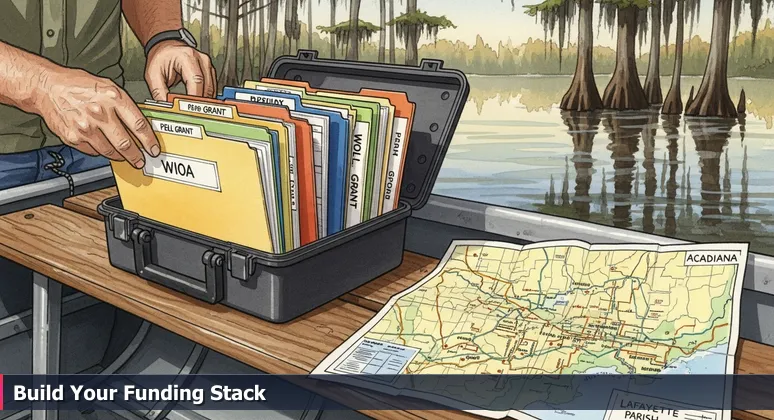
Every seasoned angler in the Atchafalaya knows you don’t catch specks with a single lure. You assemble a tackle box - a precise kit for the specific waters you’re fishing. In 2026, funding a tech career in Lafayette, LA, works the same way. The barrier isn't a lack of opportunity, but navigating the complex ecosystem of federal, state, and local resources to build your personalized financial strategy.
The local advantage is significant. With a lower cost of living than coastal hubs and powerhouse employers in energy, healthcare, and a burgeoning AI startup scene, Lafayette is an ideal launchpad. The region is actively supported by major investments, such as the $5 million federal investment establishing the Silicon Bayou Semiconductor Training Center at UL Lafayette, creating a direct pipeline from training to high-tech jobs.
This guide is your map and tackle box. We'll break down every source, from federal Pell Grants (up to $7,395) administered through the FAFSA to state programs like the M.J. Foster Promise Program. You'll learn how to work with local boards like Acadiana Workforce Solutions for WIOA funding and tap into the deep well of employer support from regional giants.
The most successful candidates build a "funding stack" - combining multiple tools like grants, scholarships, and employer benefits. With nearly $25 million in new federal support advancing research and workforce development in the region, the resources for your tech future are here, waiting to be assembled.
In This Guide
- Your Guide to Tech Career Funding in Lafayette
- Master Federal Grant Programs for Free Money
- Leverage Louisiana State Grant Opportunities
- Explore Lafayette-Specific Funding Initiatives
- Secure Private and Diversity Scholarships
- Tap into Employer Tuition Assistance Programs
- Utilize Veteran and Military Education Benefits
- Understand Income Share Agreements
- Navigate Flexible Payment Plans and Loans
- Build Your Personalized Funding Strategy
- Plan Your 2026 Application Timeline
- Conclusion: Seize Lafayette's Tech Career Opportunities
- Frequently Asked Questions
Learn how to begin an AI career in Acadiana in 2026 with this complete resource.
Master Federal Grant Programs for Free Money
Think of federal programs as your heavy-duty tackle - foundational tools designed to handle significant financial need without requiring repayment. For Lafayette residents, these grants are administered through local agencies, making them accessible parts of your funding stack.
| Program | Key Details & Local Admin | Best For |
|---|---|---|
| Workforce Innovation and Opportunity Act (WIOA) | Administered locally by Acadiana Workforce Solutions. Can cover 100% of tuition for approved short-term training in IT and cybersecurity. Eligibility targets unemployed/underemployed individuals meeting specific criteria. | Career changers, those laid off, or workers in low-wage jobs seeking rapid re-skilling. |
| Federal Pell Grant | For the 2026-27 award year, up to $7,395. Not a loan. Eligibility determined by financial need via the FAFSA. Available for many eligible certificate programs at accredited institutions. | Individuals with demonstrated financial need, including those pursuing technical certificates at community colleges. |
| Trade Adjustment Assistance (TAA) | For workers who lost jobs due to foreign trade. Can cover 100% of training costs, plus allowances. Process is handled through the Louisiana Workforce Commission. | Workers formally certified as displaced due to international competition or outsourcing. |
This federal support is actively transforming the local landscape. As Dr. Ramesh Kolluru, UL Lafayette’s Interim President, stated regarding recent federal investments, such support is "transformative" and enables the expansion of targeted initiatives that strengthen Louisiana's economy and workforce.
Your first step is to contact Acadiana Workforce Solutions for WIOA counseling and file your FAFSA to unlock Pell Grant eligibility. These programs provide the substantial, no-strings-attached capital that forms the bedrock of a successful funding strategy.
Leverage Louisiana State Grant Opportunities
Louisiana's state-specific programs act as precision tools, finely tuned to the local economic waters and the needs of adult learners. These resources complement federal aid and are designed to keep talent within the state, directly supporting high-demand fields critical to regions like Acadiana.
| Program | Award & Key Details | Eligibility & Process |
|---|---|---|
| M.J. Foster Promise Program | A "last-dollar" grant covering remaining tuition after other aid. Provides up to $3,200 per academic year, with a lifetime maximum of $6,400 for fields like Information Technology. | For Louisiana residents 21 years or older. Apply via the Louisiana Office of Student Financial Assistance (LOSFA) after filing your FAFSA. |
| Louisiana GO Grant | Need-based aid that acts as a booster for Pell Grant recipients. Awards up to $3,000 per year. | Must be a LA resident, receive a Federal Pell Grant, and have remaining financial need. Details are available on the official GO Grant page. |
| Tech Ready Louisiana | Provides free access to thousands of online tech courses and professional certificates from Coursera, including data analytics and IT support. | All Louisiana residents 18+. A perfect, zero-cost way to build foundational skills. Part of the Louisiana Workforce Commission's initiative to build a tech-ready workforce. |
These programs are interconnected. The strategic approach is to file your FAFSA first to determine Pell Grant eligibility, which then opens the door for the M.J. Foster Promise Program and potentially the GO Grant. Meanwhile, you can immediately enroll in Tech Ready Louisiana to begin building credentials and demonstrating commitment.
This layered state support system is a direct investment in your future and reflects a broader commitment, like the $1.5 million NSF grant funding the SUCCESS Scholars Program at Louisiana Tech, which provides four-year scholarships and career support to meet STEM workforce needs.
Explore Lafayette-Specific Funding Initiatives
The true strength of building your tech career in Acadiana lies in hyper-local initiatives that understand the regional job market. These programs, often funded by federal dollars flowing into local institutions, create direct pipelines from the classroom to employers in our energy and healthcare sectors.
Start with scholarships designed for the parish. The LPACTE Scholarship, offered by the Lafayette Parish Association of Career and Technical Education, targets high school seniors planning to attend local technical colleges, with a typical deadline at the end of March. Furthermore, Acadiana Workforce Solutions administers localized WIOA-funded career scholarships, providing personalized guidance aligned with Lafayette's specific employer demands.
The most powerful local advantage is seen in major federal investments targeting our economic drivers. A prime example is the $5 million federal investment establishing the new Silicon Bayou Semiconductor Training Center at UL Lafayette. As Dr. Ramesh Kolluru, UL Lafayette's Interim President, noted, this support for applied research and workforce development is "transformative" for the future workforce, creating high-tech local jobs in emerging fields.
These initiatives are part of a larger ecosystem. The Career and Technical Education division of the Lafayette Parish School System also facilitates programs like Jump Start, which can include STEM-focused pathway awards, further strengthening the local talent pipeline from high school onward.
Secure Private and Diversity Scholarships
Beyond government programs, competitive private and diversity scholarships act as specialized prize lures in your tackle box. These awards require more targeted effort but offer substantial value and can be stacked with other funding sources to minimize out-of-pocket costs.
In the Acadiana region, several key opportunities stand out. The Metallica Scholars initiative, administered through the community college system, provides scholarships for high-demand technical fields. Locally, you should check with South Louisiana Community College (SoLAcc) for availability in tech-adjacent programs. For broader skills training, the Community Foundation of Acadiana offers various workforce scholarships that are available year-round.
Given Lafayette's strong healthcare employer base, targeted scholarships for supporting roles are also available. For example, KATC reported on scholarships offered for first responder students in early 2026, which can include IT and data roles supporting emergency medical services and hospitals.
To successfully secure these funds, treat the search like a targeted job hunt. Regularly check the financial aid pages of local institutions like SoLAcc and UL Lafayette, and set up alerts for workforce development news in Acadiana. A compelling application often ties your tech career goals directly to strengthening local industries like energy, healthcare, or public safety, demonstrating a commitment to the community's economic future.
Tap into Employer Tuition Assistance Programs
One of Acadiana's most powerful secret weapons is the robust tuition assistance offered by its major employers. These organizations, deeply invested in building technical talent from within, often have substantial professional development budgets designed to upskill their existing workforce into tech roles.
The region's economic pillars are your allies. As a major research institution driving AI and cyber-physical systems, the University of Louisiana at Lafayette offers tuition benefits for employees. Healthcare giants like Ochsner Lafayette General and Acadian Ambulance urgently need IT, data analysis, and cybersecurity professionals. Similarly, energy sector leaders such as Schlumberger, Baker Hughes, and Halliburton have long histories of investing in technical training.
Accessing these benefits requires initiative. Speak directly with your HR department about Professional Development or Tuition Reimbursement policies. As George Sfier, CEO of a local industrial firm, emphasized, having qualified personnel is critical for business success, making employers more likely to invest. This aligns with statewide programs like the Incumbent Worker Training Program (IWTP), which partners with employers to fund customized training and prevent job loss due to technological change.
This employer support is a strategic component of the local ecosystem. The Lafayette Economic Development Authority (LEDA) actively connects businesses with workforce training resources. Combining employer assistance with state grants like the M.J. Foster Promise Program can create a nearly zero-cost path to a tech certification, firmly rooting your new career in Lafayette's thriving economic landscape.
Utilize Veteran and Military Education Benefits
For veterans and active military members in Acadiana, your service has earned you a distinct set of powerful tools for funding a tech education. These benefits are designed to be stacked with other forms of aid, creating one of the most comprehensive funding packages available for your career transition.
The cornerstone is the GI Bill®, which can cover full or partial tuition at approved institutions. This includes not only traditional degrees but also approved intensive bootcamps focused on coding, cybersecurity, and data science. Institutions like South Louisiana Community College (SoLAcc) and UL Lafayette are approved to accept these benefits. Additionally, the VET TEC program traditionally covers tuition for high-tech training bootcamps, though applicants should verify its current funding status annually.
For those serving locally, the Louisiana National Guard Tuition Exemption offers a significant advantage, providing eligible members with full tuition exemptions for state-funded programs. This can be a game-changer when paired with a state grant like the M.J. Foster Promise Program for remaining fees.
The key to maximizing these benefits is verification and stacking. First, confirm your specific benefit eligibility with the VA. Then, ensure your chosen tech training provider - whether a community college, university, or approved bootcamp - is certified for VA benefits. Finally, build your stack: use the GI Bill or VET TEC as your primary funding source, then layer on any state grants for which you qualify to cover additional costs, creating a robust financial plan for your new career in Lafayette's tech ecosystem.
Understand Income Share Agreements
When grants and scholarships don't cover the full cost, Income Share Agreements (ISAs) serve as a strategic safety line. Offered by some tech bootcamps, an ISA allows you to defer tuition payments until after you graduate and secure a qualifying tech job, typically agreeing to pay a fixed percentage of your income for a set period once you exceed a minimum salary threshold.
The primary advantage is alignment of risk: the training provider succeeds only when you do. If you don't land a qualifying job, you owe nothing, making it a powerful option for career changers with upfront cost concerns. This model can be particularly appealing in a market like Lafayette, where entry-level tech roles in supporting the energy and healthcare sectors provide solid earning potential.
However, careful evaluation is crucial. While there's no traditional debt, the total amount repaid can be higher than the sticker tuition if you land a high-paying position quickly. Always read the contract terms meticulously, paying close attention to the payment cap, salary threshold, payment duration, and any stipulations about job type or location. It's one tool in your box, best used strategically after exhausting "free money" options like grants.
Before committing, research the bootcamp's outcomes and reputation. As with any financial agreement, understanding the details is paramount. For more traditional financing options, including payment plans, you can explore resources available through local institutions like South Louisiana Community College.
Navigate Flexible Payment Plans and Loans
When your funding stack needs final reinforcement, flexible payment plans and private loans can bridge the gap. These are your pragmatic tools for managing cash flow, but they require careful consideration to avoid unnecessary debt.
The first and often most manageable option is an interest-free payment plan directly through your training provider. Many bootcamps and community colleges allow you to break the total cost into monthly installments over the course of the program, significantly reducing the upfront financial burden without accruing interest.
For larger gaps, private education loans are a last resort. Options exist, such as the Sallie Mae Career Training Smart Option Loan, designed specifically for students at non-degree granting career schools. Locally, institutions like the University of Louisiana Federal Credit Union may offer education loans with competitive rates for members, providing a community-focused alternative.
Always exhaust all grant, scholarship, and employer assistance options before turning to loans. If you must borrow, compare all terms - interest rates, fees, and repayment schedules - meticulously. The goal is to launch your career without being anchored by excessive debt, especially in a market like Lafayette where the lower cost of living is a key advantage.
Build Your Personalized Funding Strategy
Assembling your personalized funding stack is a strategic process, not a passive search. The most successful candidates combine multiple resources, and your starting point depends on your current situation. Follow this decision tree to identify your primary funding targets and build a complementary strategy.
- Are you currently employed, especially at a large regional employer (healthcare, energy, UL)? If YES, investigate Employer Tuition Assistance first. Then, supplement with the M.J. Foster Promise Program and a Payment Plan.
- Are you unemployed, underemployed, or displaced due to trade? If YES, your primary target is WIOA funding via Acadiana Workforce Solutions. Also, file your FAFSA for Pell Grant eligibility. If laid off due to foreign competition, investigate TAA.
- Are you a Louisiana resident over 21? If YES, the M.J. Foster Promise Program is your cornerstone. Pair it with Pell (via FAFSA) and Louisiana GO Grant potential. If NO, look to Private Scholarships, Payment Plans/ISAs, and explore Tech Ready Louisiana for free initial credentials.
This methodical approach ensures you're not leaving money on the table. As Dr. Ramesh Kolluru noted, federal and state support creates a "transformative" environment for workforce development, but it requires active navigation. Your stack might combine a WIOA grant for 80% of tuition, a private scholarship for books, and a no-interest payment plan for the remainder.
Remember, Lafayette's unique ecosystem - with its employer partnerships and state programs - is designed to support this very process. By building your customized funding portfolio, you turn the complex landscape of financial aid into a clear, actionable path toward your tech career.
Plan Your 2026 Application Timeline
Strategic timing is as crucial as knowing which programs to target. To maximize your funding opportunities in Lafayette's 2026 cycle, follow this actionable calendar and prepare your documentation in advance.
- January - Ongoing: File your FAFSA for the upcoming academic year. This is your universal key. Simultaneously, enroll in Tech Ready Louisiana courses anytime to build foundational skills at zero cost.
- February - April: Research and apply for local scholarships like the LPACTE Scholarship (typically a March deadline). This is also the ideal window to contact Acadiana Workforce Solutions to begin WIOA counseling, as processing can take time.
- Spring 2026: Apply for the M.J. Foster Promise Program. Applications typically open in spring for the following academic year through the Louisiana Office of Student Financial Assistance (LOSFA).
- 90 Days Before Training Starts: Finalize your funding stack. Confirm employer benefits, receive your WIOA determination, and secure any necessary ISA or payment plan agreements with your chosen provider.
To streamline every application, gather these documents early: Social Security Number, Driver’s License/State ID, most recent tax returns, proof of Louisiana residency (like a utility bill or lease), your high school diploma/GED or college transcripts, and an updated résumé. For WIOA or TAA, also have proof of unemployment, a layoff notice, or recent pay stubs proving low income.
This proactive approach transforms a daunting process into a manageable checklist, ensuring you meet critical deadlines and assemble the strongest possible financial foundation for your tech training.
Conclusion: Seize Lafayette's Tech Career Opportunities
The path to a tech career in Lafayette in 2026 is not blocked by cost - it’s paved with strategic funding opportunities unique to our region. You now have the map and the tackle box, filled with tools from federal WIOA grants and the M.J. Foster Promise Program to employer assistance and flexible ISAs. Your task is not to find one perfect solution but to assemble the right combination for your specific journey.
This strategic assembly is where a provider like Nucamp becomes a powerful tool in your kit. Offering some of the most affordable bootcamp options in the market - with programs like their 25-week AI Tech Entrepreneur bootcamp at $3,980 - Nucamp’s model aligns perfectly with the funding stack strategy. Their flexible payment plans and community-based learning support the financial and logistical realities of career changers in Acadiana, making advanced AI and coding education accessible.
From the federal dollars fueling the Silicon Bayou Semiconductor Training Center to the deep well of employer support in our energy and healthcare sectors, the resources are here. With a lower cost of living than coastal hubs and a growing energy-tech and AI startup ecosystem, Lafayette offers a compelling environment to launch and grow. Build your personalized funding stack, leverage accessible education pathways, and cast your line into Acadiana’s thriving tech waters. Your future in this dynamic ecosystem is waiting to be landed.
Frequently Asked Questions
How can I afford tech training in Lafayette, LA in 2026?
You can build a funding stack using multiple sources, starting with government grants like the Workforce Innovation and Opportunity Act (WIOA) through Acadiana Workforce Solutions, which can cover 100% of tuition for eligible programs. Pair this with state programs such as the M.J. Foster Promise Program and federal Pell Grants up to $7,395 to reduce costs significantly.
Are there any grants I don't have to repay for tech training in Lafayette?
Yes, several grants require no repayment. For example, Federal Pell Grants provide up to $7,395 based on financial need, and Louisiana's M.J. Foster Promise Program offers up to $3,200 per year for adult learners in high-demand fields like IT, making them ideal for funding your training in Acadiana.
What local scholarships are available for tech students in the Acadiana area?
Local scholarships include the LPACTE Scholarship for technical education and awards from the Community Foundation of Acadiana. Additionally, employers like Ochsner Lafayette General and energy companies such as Schlumberger often provide tuition assistance, leveraging Lafayette's strong healthcare and energy sectors for tech roles.
How does Lafayette's lower cost of living help with funding tech training?
With a lower cost of living compared to major coastal tech hubs, your funding goes further in Lafayette, reducing living expenses while you train. This advantage allows you to focus on grants and employer assistance, making it easier to afford programs and launch a tech career in the growing local ecosystem.
What are the first steps to secure funding for tech training in 2026?
Start by filing your FAFSA to access federal and state aid like Pell Grants, then contact Acadiana Workforce Solutions for WIOA counseling. Also, check if your employer offers tuition reimbursement, common in Lafayette's energy and healthcare sectors, to build a personalized funding strategy early.
Learn which AI tech bootcamps top the charts in Lafayette for 2026.
Explore the detailed analysis of cost of living vs tech salaries in Lafayette, LA in 2026 to see if you can afford it.
Explore high-paying cybersecurity roles in Acadiana's energy and healthcare sectors for the upcoming year.
Read about the top 10 AI startups to watch in Lafayette, LA for insights into 2026's tech trends.
Learn about where to find top AI engineer positions in Acadiana in 2026 from this insightful article.

Irene Holden
Operations Manager
Former Microsoft Education and Learning Futures Group team member, Irene now oversees instructors at Nucamp while writing about everything tech - from careers to coding bootcamps.