









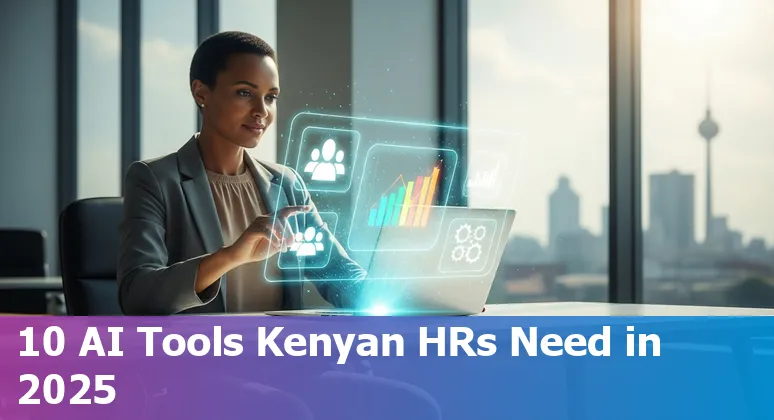
Top 10 AI Tools Every HR Professional in Kenya Should Know in 2025
Last Updated: September 9th 2025
Too Long; Didn't Read:
Kenyan HR leaders should adopt AI for hiring, learning and planning: 43% of organizations use AI in HR and 51% in recruiting (SHRM 2025), yet two‑thirds lack upskilling. Key tools: conversational hiring, SMS‑first frontline assistants, talent intelligence and internal mobility platforms.
Kenyan HR leaders in 2025 face the same tight budgets and high expectations seen globally: Mercer points to a push for human‑centric productivity and a digital‑first culture, while Deloitte urges a new worker‑value proposition as AI reshapes roles; together these trends make AI less optional and more strategic for hiring, learning and planning.
SHRM's 2025 data shows AI adoption jumping (43% of organizations use AI in HR, and 51% use it in recruiting), but also flags a major upskilling gap - two out of three employers say they haven't prepared people to work with AI - so Kenyan teams should pair tools with training.
Practical steps - automating resume screening, personalizing L&D, and keeping humans in the loop - can turn weeks of admin into minutes of insight. For HR pros ready to build those skills, Nucamp's AI Essentials for Work course offers a hands‑on path to prompt writing and workplace AI applications tailored to nontechnical learners.
| Attribute | Information |
|---|---|
| Description | Gain practical AI skills for any workplace; learn tools, prompts, and apply AI across business functions. |
| Length | 15 Weeks |
| Courses included | AI at Work: Foundations; Writing AI Prompts; Job Based Practical AI Skills |
| Cost (early bird) | $3,582 |
| Syllabus | AI Essentials for Work syllabus |
| Registration | Register for AI Essentials for Work |
HR is tasked with cultivating continued innovation while maintaining a healthy work culture in a climate where opportunities are high, yet budgets are tight. - Kate Bravery, Senior Partner, Mercer
Table of Contents
- Methodology: How we chose the Top 10 AI Tools
- Paradox (Olivia): Conversational AI for High‑Volume Hiring
- TeamSense Employee Assistant: SMS-First Staff Support
- Eightfold AI: Talent Intelligence & Internal Mobility
- SeekOut: Advanced Sourcing & Talent Mapping
- Gloat: AI Internal Talent Marketplace
- Lattice: Performance, Engagement & People Analytics
- Leapsome: Unified Reviews, Engagement & Learning
- ChartHop: Live Org Mapping, Planning & Compensation
- Coworker.ai: People Ops Unification & Organizational Memory
- HireVue: AI Video Interviews & Assessments
- Conclusion: Choosing and Implementing AI Tools in Kenyan HR
- Frequently Asked Questions
Explore how performance analytics with AI uncovers actionable insights to boost productivity in Kenyan workplaces.
Methodology: How we chose the Top 10 AI Tools
(Up)Selection for the Top 10 list leaned on three pragmatic principles tuned to Kenya's realities: choose tools that report risk‑aligned, measurable outputs (not vendor‑friendly vanity metrics), prove usability across Nairobi and satellite offices, and support human‑in‑the‑loop governance.
To avoid the “dashboard overload” problem - where a single vendor view with 35 metrics becomes noise rather than insight - priority went to vendors that expose meaningful controls and allow independent measurement, a lesson drawn from an analysis of selection bias in cybersecurity metrics (analysis of selection bias in cybersecurity metrics - Huntsman Security blog).
Each product was also evaluated through practical UX checks: remote and in‑person moderated tasks, first‑click and session‑replay tests to surface real friction, and lightweight guerrilla tests where budgets demanded fast feedback (usability testing methods guide - Contentsquare).
Finally, responsibility and local fit were nonnegotiable - tools had to enable bias testing, human oversight, and Kenyan policy alignment as recommended in Nucamp's guidance on Nucamp AI Essentials for Work syllabus - responsible AI deployment in HR - so HR teams get decisions they can trust and act on.
Paradox (Olivia): Conversational AI for High‑Volume Hiring
(Up)For Kenyan HR teams racing to staff retail, hospitality, logistics and frontline roles, Paradox's Olivia shows how conversational AI turns frantic hiring queues into a steady, mobile-first pipeline: candidates can apply by answering a few quick questions over text or chat - no logins, no long forms - and Olivia handles instant screening, interview scheduling via SMS or WhatsApp, reminders and onboarding, freeing recruiters to focus on quality rather than chasing paperwork.
Built for scale, Paradox pairs a conversational ATS and CRM with automated event workflows and analytics, and reports dramatic ROI in other markets (faster scheduling, huge hours saved and lower cost‑per‑hire); Nairobi operations with many locations will find the conversational scheduling features especially useful for panel and multi‑site interviews.
Learn more about Paradox's product suite and how it frames high‑volume hiring in the High‑Volume Hiring Guide or explore Conversational Scheduling for calendar‑sync and reschedule automation to cut no‑shows and shrink time‑to‑hire.
| Feature | Benefit |
|---|---|
| Conversational Apply | Quick text/chat screening to reduce drop‑off |
| Conversational Scheduling | Automated SMS/WhatsApp scheduling, reminders, panel coordination |
| Multilingual & Fair AI | 100+ language support, accessibility and compliance features |
“Paradox is the first solution that really knew how to do high volume recruitment; it's been a game changer for us.”
TeamSense Employee Assistant: SMS-First Staff Support
(Up)For Kenyan HR teams supporting large, shift-based workforces - think retail, hospitality, logistics and frontline sites - TeamSense's Employee Assistant offers a pragmatic, SMS-first lifeline that gets answers into palms without portals or passwords: employees text a question and receive instant, policy‑grounded replies pulled from the company's approved documents, with built‑in translation into 25+ languages and smart escalation to HR when needed.
That means routine disruptions - questions like “Where do I park on my first day?” or “I missed a punch, what do I do?” - get solved in seconds instead of interrupting supervisors or closing the shop floor, and anonymized trend data surfaces recurring policy gaps so HR can fix root causes.
For Kenyan organisations wanting a low-friction, compliance-safe frontline assistant, see the TeamSense launch note on the Employee Assistant and their wider roundup of HR AI tools for practical context and deployment ideas.
| Feature | Benefit |
|---|---|
| Instant Answers from Approved Documents | Company‑specific, compliance‑safe responses |
| Multilingual Support (25+) | Reduces language barriers across deskless teams |
| SMS‑First, No Login | Friction‑free access for frontline staff |
| Smart Escalation | Routes complex queries to HR to avoid unresolved issues |
| Operational Insights | Identifies recurring questions so policies can be improved |
“HR doesn't work 24/7, but TeamSense does.” - Valentine Chavez‑Gonzalez, Director of HR at UBM
Eightfold AI: Talent Intelligence & Internal Mobility
(Up)Eightfold AI packages deep‑learning, agentic AI and the world's largest talent dataset into a talent‑intelligence hub that Kenyan HR teams can use to spot skills, match people to work, and move employees into roles faster - think of it as a live skills map for an organisation that helps avoid unnecessary external hires.
The platform combines enterprise data, market trends and real‑time work signals to power skills‑based matching, internal mobility, a talent marketplace and a workforce exchange, and it surfaces candidate and employee insights (Eightfold cites 1+ billion career trajectories and 1+ million skills) so decisions are more predictive than reactive.
Features that matter for Kenya - multi‑channel candidate engagement (email, SMS and WhatsApp), configurable interview scheduling and integrations with HR systems - make it practical for distributed teams and busy hiring calendars.
For HR leaders aiming to turn internal talent into a competitive advantage, explore the Eightfold Talent Intelligence platform and the product overview to see how agentic AI and skills‑first workflows could shrink vacancies and lift retention without losing human oversight.
| Feature | Benefit |
|---|---|
| Skills‑based Matching | Find candidates and internal employees by potential and skills, not just résumés |
| Internal Mobility / Talent Marketplace | Promote and redeploy talent to close skill gaps and reduce external hiring |
| Candidate Engagement (Email, SMS, WhatsApp) | Reach Kenyan candidates on the channels they use most |
| Agentic AI & Large Talent Dataset | Predictive insights powered by 1B+ career trajectories and 1M+ skills |
| Integrations & Scheduling | Works with calendars, video tools and HR systems for smoother hiring workflows |
SeekOut: Advanced Sourcing & Talent Mapping
(Up)SeekOut is a go‑to for Kenyan HR teams who need to go beyond job boards and uncover talent that doesn't show up in a standard LinkedIn search: its AI Talent Search and GitHub integration surface technical contributors and passive candidates by skills and activity, not just titles, which helps Nairobi tech hubs and distributed teams find engineers and data talent whose work speaks louder than a CV (see the iMocha SeekOut overview).
Built‑in diversity filters and workforce analytics make it practical for skills‑first hiring and talent‑mapping projects that feed strategic workforce maps and succession plans, while talent insights help recruiters prioritise outreach and plan for future gaps; the Workday AI sourcing guide explains why those capabilities matter for scale and quality.
The tradeoffs are real - pricing is not public and occasional data freshness issues have been reported - but for organisations that need deeper sourcing, internal mobility and strategic talent maps, SeekOut turns a scattershot search into a targeted, evidence‑backed pipeline and can surface candidates who never applied in the first place.
| Feature | Benefit |
|---|---|
| AI Talent Search | Finds candidates beyond LinkedIn; skill‑focused matching |
| GitHub Integration | Identifies technical contributors by activity and projects |
| Diversity Hiring Tools | Filters for underrepresented talent pools |
| Workforce Insights & Talent Mapping | Supports strategic hiring and internal mobility |
| Pricing & Rating | Pricing hidden; G2 rating ~4.5/5 (per iMocha) |
Gloat: AI Internal Talent Marketplace
(Up)Gloat's AI-powered internal talent marketplace turns hidden skills into visible options - especially useful for Kenyan organisations juggling distributed teams, tight hiring budgets and urgent upskilling needs - by matching employees to roles, gigs, mentorships and projects based on skills, interests and career goals, not paperwork; employers from Schneider Electric to Seagate and Mastercard report faster redeployments, measurable savings and higher retention, and Gloat even supported a single‑day rollout that opened the platform to 300,000 employees, a vivid reminder that scale is possible when change management is paired with technology (Gloat talent marketplace explained - features and use cases).
For Nairobi HR leaders, the platform's skills‑foundation, career pathing, project marketplace and analytics mean fewer external hires and more on‑the‑job learning, while built‑in accessibility and integrations ease adoption across functions and devices; independent coverage notes Gloat's workforce‑agility focus and AI workforce graph as key differentiators for enterprises aiming to redeploy talent quickly (Brandon Hall analysis of Gloat and workforce agility), making it a practical option for organisations that want to democratise career mobility without adding recruitment headcount.
| Feature | Benefit for Kenyan HR |
|---|---|
| AI‑driven matching & skills graph | Surface internal candidates fast; reduce external hiring costs |
| Project/gig marketplace & career pathing | Turn training into hands‑on experience and retain talent |
| Talent market intelligence & analytics | Inform workforce planning and spot skill gaps |
| Accessibility & integrations | Broader employee participation and smoother adoption |
Lattice: Performance, Engagement & People Analytics
(Up)Lattice sits squarely in the conversation Kenyan HR leaders are having about turning performance, engagement and people analytics into practical action: platforms like this can operationalize the AI‑driven performance evaluation that research shows improves decision‑making and workforce productivity while enabling near‑real‑time coaching instead of a once‑a‑year paperwork scramble (see the systematic review on AI‑driven performance evaluation in Kenya).
Mercer's guidance on reimagining performance management highlights a clear opportunity - organisations are already considering AI‑enabled continuous feedback to make performance a living conversation rather than a quarterly ritual - and tools that combine engagement signals with people analytics can surface turnover risks or learning gaps days or weeks earlier, not after a resignation email lands.
That upside comes with caveats documented in Kenyan studies: high costs, limited IT infrastructure and data‑privacy concerns mean deployment must be strategic, phased and paired with upskilling, human‑in‑the‑loop reviews and bias testing.
For safe, effective rollouts, pair any Lattice deployment with clear governance and training (see Nucamp's guidance on responsible AI deployment in HR) so insights become trusted levers for managers and not mysterious scores - imagine spotting a hidden skills cluster and opening an internal gig before the business even posts a vacancy.
| Opportunity | Research-backed note |
|---|---|
| AI‑driven evaluation | Improves decision‑making and productivity (systematic review on Kenyan organisations) |
| Continuous feedback | Growing interest to replace static reviews with ongoing coaching (Mercer) |
| Deployment barriers | Cost, IT infrastructure and data privacy risks require phased rollout and training (Kenya studies) |
Leapsome: Unified Reviews, Engagement & Learning
(Up)Leapsome bundles reviews, engagement surveys and learning into a single people‑enablement platform that Kenyan HR teams can use to turn the annual review scramble into an ongoing coaching rhythm - ideal for Nairobi startups and distributed teams that need lightweight, practical tools rather than a heavy on‑prem install.
With entry pricing reported from $8/user/month and modular buying (Reviews, Goals, Surveys, Learning, Instant Feedback and more), Leapsome makes it easy to pilot one or two modules and scale as managers see ROI, while its AI features - Leapsome AI and recent AI Copilot context‑recognition updates - help generate constructive comments, surface trends and speed manager prep for 1:1s.
Integrations with Slack, Microsoft Teams and common HRIS systems smooth adoption, and the learning‑path and survey exports now support multi‑language and reporting needs that matter for regional workforces; read a hands‑on Leapsome review for feature details and consider pairing any rollout with Nucamp's AI Essentials for Work syllabus on responsible human-in-the-loop AI deployment in HR to keep decisions transparent and trustworthy.
| Feature | Detail |
|---|---|
| Price | $8 per user / month (entry pricing) |
| Key modules | Reviews, Goals, Surveys, Learning, Instant Feedback, Meetings, Competency Framework |
| Notable AI | Leapsome AI for feedback drafting; AI Copilot with context recognition for personalized prompts |
ChartHop: Live Org Mapping, Planning & Compensation
(Up)ChartHop turns the spreadsheet scramble into a visual command centre that Kenyan HR teams will recognise the moment they map Nairobi offices, regional hubs and remote field teams: interactive org charts, a map view for location planning, and sandbox headcount scenarios make it easy to model hires, redeployments and budget impact in real time, while AI‑powered dashboards surface retention and comp risks before they become crises.
The platform's compensation module bundles visual offer letters, cycle configuration and secure approval workflows so managers can make equitable pay decisions without late‑night spreadsheets, and headcount planning can push approved roles straight to ATS partners - useful for HR teams juggling limited budgets and fast hiring in retail, tech and logistics.
For a closer look at scenario planning and pricing tiers, see the ChartHop Headcount Planning module for workforce scenario planning and the ChartHop pricing page with PEPM and module pricing details to compare ChartHop Basic ($2 PEPM) with core modules starting at $8 PEPM (minimum contract details apply); expect a short implementation phase to get live data flowing and governance set up.
| Feature | Why it matters for Kenyan HR |
|---|---|
| Interactive Org Chart & Map | Visualise reporting lines and regional distribution across Nairobi and field sites |
| Headcount Scenario Planning | Model hires, budgets and approvals to avoid last‑minute cost surprises |
| Compensation Management | Configure cycles, visual letters and secure collaboration to drive equitable pay |
| AI‑Powered Dashboards | Expose trends (turnover, budget variance) so leaders act earlier |
| Pricing | Basic $2 PEPM; core modules $8 PEPM first module, $4 for each additional (min $9K/yr) |
Org planning in ChartHop has brought us out of the dark. Because we're in a shared environment, Finance and Operations can constantly see what's going on and what scenarios managers are working on. - Dan Beksha, Head of Strategic Planning, Plaid
Coworker.ai: People Ops Unification & Organizational Memory
(Up)Coworker.ai's enterprise onboarding playbook shines where Kenyan people ops need it most: turning fragmented policies, legacy SOPs and ad‑hoc training into a single, staged onboarding strategy that actually lands with busy managers and frontline teams.
The checklist - from defining a clear AI vision and mapping short‑ and long‑term goals to assessing team readiness, picking high‑impact use cases, offering role‑based training and embedding AI into everyday systems - mirrors the pragmatic steps Kenyan HR leaders can use to unify people ops and create dependable organizational memory (only 35% of firms start with a formal AI strategy, and 74% with structured plans report tangible ROI).
When combined with agentic assistants that provision access, answer FAQs and push personalized learning, that checklist helps Nairobi HR teams cut first‑day friction and make knowledge reusable across branches; read Coworker.ai's Coworker.ai Enterprise AI Onboarding Checklist for HR and the Moveworks guide on Moveworks Guide to AI Agents for Onboarding for practical integration patterns and measurement tips that keep humans in control while turning onboarding into institutional memory rather than a one‑off scramble.
HireVue: AI Video Interviews & Assessments
(Up)HireVue sits at the enterprise end of the video‑interview spectrum: its AI assessments, enterprise security (SOC 2 Type II, GDPR), and global scale (60+ languages, transcription/translation) make it a powerful choice for large employers and regulated industries that need to evaluate thousands of applicants reliably - vendors point to dramatic wins (Emirates cut a hiring cycle from 60 days to 7; Holcim reported an 89% boost in hiring speed).
That power comes with a steep price and complexity: base fees are reported around $35k–$75k/year plus per‑assessment and implementation costs, and deployments commonly take 3–6 months, so smaller Kenyan teams may find the platform over‑engineered.
Critics also flag the risks of algorithmic interpretation of video signals and candidate experience tradeoffs; for a balanced breakdown of features, pricing and alternatives see the 2025 HireVue review, and for a critical view on video AI interviews consult the Ask The Headhunter analysis on automated screening.
In short: HireVue can transform high‑volume, compliance‑sensitive hiring - but expect a heavy lift in cost, implementation and candidate‑experience governance.
| Feature | Research note |
|---|---|
| Enterprise security & compliance | SOC 2 Type II, GDPR, end‑to‑end encryption, data residency options |
| Global scale & language support | 60+ languages with transcription/translation |
| Pricing & costs | Base ~$35k–$75k/yr; per‑user $150–$300/yr; AI assessments $25–$50 each; implementation $10k–$50k |
| Implementation | Complex; typical 3–6 month rollout with professional services |
| Best fit | Large enterprises with high volume or regulated hiring; may be impractical for SMBs |
“The face is not a window into the mind.” - independent psychologist quoted in Ask The Headhunter on AI video interviews
Conclusion: Choosing and Implementing AI Tools in Kenyan HR
(Up)Choosing and implementing AI in Kenyan HR is less about chasing the newest feature and more about sequencing: start with compliance and frontline workflows, prove measurable wins, then scale with human‑in‑the‑loop governance and bias testing.
Homegrown compliance platforms demonstrate the point - AI can deliver
policy updates in real time
, run document audits and power compliance chatbots so one regulatory slip doesn't turn into fines or bad press (FaidiHR: AI tools for HR compliance in Africa); meanwhile, low‑friction tools for deskless teams cut hours of supervisor interruptions and show quick ROI. Pilot a single use case, tie progress to clear metrics (time‑to‑hire, error rates, query resolution), and require periodic audits so models stay fair and local‑law ready.
Training is the keystone: embed upskilling and prompt literacy into rollouts so managers can interpret AI outputs - Nucamp AI Essentials for Work syllabus (15-week workplace AI course).
When compliance, usability and people development lead the roadmap, AI becomes an enabler for Kenyan HR - reducing risk, speeding service and keeping humans firmly in control.
| Priority | Why it matters | Example / Resource |
|---|---|---|
| Compliance first | Avoid fines and legal risk with real‑time policy tracking | FaidiHR AI HR compliance tools in Africa |
| Frontline pilots | Quick wins, lower supervisor load, better employee access | TeamSense AI SMS-first HR assistant |
| Upskill staff | Promote prompt literacy and human‑in‑the‑loop oversight | Nucamp AI Essentials for Work syllabus (15 weeks) |
Frequently Asked Questions
(Up)Which AI tools are highlighted as the top 10 for HR professionals in Kenya in 2025?
The article highlights ten practical HR AI tools: Paradox (Olivia) for conversational high‑volume hiring; TeamSense Employee Assistant for SMS‑first frontline support; Eightfold AI for talent intelligence and internal mobility; SeekOut for advanced sourcing and talent mapping; Gloat for an internal talent marketplace; Lattice for performance, engagement and people analytics; Leapsome for unified reviews, engagement and learning; ChartHop for live org mapping, planning and compensation; Coworker.ai for onboarding/playbook and organizational memory; and HireVue for enterprise AI video interviews and assessments.
How should Kenyan HR teams choose and evaluate AI tools?
Choose tools using pragmatic, local criteria: require risk‑aligned, measurable outputs (avoid vendor vanity metrics); confirm usability across Nairobi offices and satellite sites via UX checks (remote moderated tasks, first‑click/session replay); insist on human‑in‑the‑loop governance and bias testing; and prioritise vendors that expose meaningful controls and independent measurement. Measure pilots against clear metrics such as time‑to‑hire, error rates, query resolution time and supervisor hours saved.
What practical benefits can Kenyan HR expect from these AI tools?
Practical wins include automating resume screening and scheduling to cut time‑to‑hire from weeks to minutes, SMS/WhatsApp‑first candidate and employee engagement that reduces drop‑off and supervisor interruptions, personalized L&D and internal mobility that lowers external hiring, better sourcing of passive or technical talent, visual org planning and comp insights to avoid budget surprises, and operational analytics that surface recurring policy gaps for corrective action.
What are the main risks, costs and deployment considerations Kenyan HR leaders must plan for?
Key risks and tradeoffs are data privacy and residency, algorithmic bias, candidate experience concerns (especially with video AI), infrastructure and cost. Some platforms (e.g., HireVue) target large enterprises with base fees often reported around $35k–$75k/yr plus per‑assessment and implementation costs, while smaller tools may charge per user or PEPM (Leapsome entry pricing ≈ $8/user/month; ChartHop basic ≈ $2 PEPM). Mitigate risk with phased rollouts, human‑in‑the‑loop reviews, governance, periodic audits, and local‑law compliance checks.
How can HR teams in Kenya close the AI upskilling gap and prepare staff to work with these tools?
SHRM data shows AI adoption rising (about 43% of organizations use AI in HR, 51% in recruiting) but two‑thirds of employers haven't prepared people to work with AI. Recommended actions: embed prompt literacy and human‑in‑the‑loop training into rollouts, pilot a single high‑impact use case tied to clear metrics, and scale with role‑based training. For structured training, Nucamp's AI Essentials for Work course is a hands‑on option: a 15‑week program (courses include AI at Work: Foundations; Writing AI Prompts; Job‑Based Practical AI Skills) with an early‑bird cost listed at $3,582.
See which new HR roles that will grow - from AI oversight to wellbeing specialists tailored to Kenya's workforce.
Link engagement scores to retention and performance with the Employee engagement correlation prompt and get a department-level 90-day action plan.

Ludo Fourrage
Founder and CEO
Ludovic (Ludo) Fourrage is an education industry veteran, named in 2017 as a Learning Technology Leader by Training Magazine. Before founding Nucamp, Ludo spent 18 years at Microsoft where he led innovation in the learning space. As the Senior Director of Digital Learning at this same company, Ludo led the development of the first of its kind 'YouTube for the Enterprise'. More recently, he delivered one of the most successful Corporate MOOC programs in partnership with top business schools and consulting organizations, i.e. INSEAD, Wharton, London Business School, and Accenture, to name a few. With the belief that the right education for everyone is an achievable goal, Ludo leads the nucamp team in the quest to make quality education accessible