









The Complete Guide to Using AI in the Hospitality Industry in Jacksonville in 2025
Last Updated: August 20th 2025
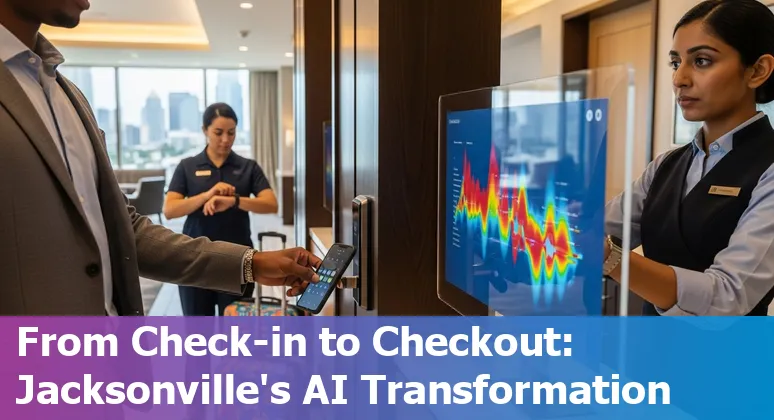
Too Long; Didn't Read:
Jacksonville hospitality in 2025 moves from pilot to production: AI boosts RevPAR via event‑driven pricing for Jaguars games/festivals, personalization lifts revenue 10–30%, smart energy cuts ~20% costs, and a 15‑week AI Essentials course ($3,582) speeds staff upskilling and ROI.
Jacksonville's hospitality sector in 2025 is shifting from experiment to execution: waterfront venues and meeting planners now use AI-powered event planning to personalize itineraries, streamline logistics, and match attendees for higher-value networking (AI-powered event planning for Jacksonville venues and meeting organizers); practical adoption strategies emphasize starting with guest personalization and predictive analytics to optimize staffing, reduce waste, and seize local demand signals like Jaguars games and festivals that can lift RevPAR on peak weekends (practical AI adoption strategies for hoteliers in 2025).
For managers who need actionable skills fast, a focused program - AI Essentials for Work (15 weeks, $3,582 early-bird) - teaches prompt-writing, AI tools, and job-based projects to turn these trends into measurable revenue and efficiency gains (AI Essentials for Work bootcamp syllabus (15-week professional program)).
Table of Contents
- What Is AI and How Hospitality Uses It in Jacksonville, Florida
- AI Trends in Hospitality Technology 2025: What Jacksonville Hoteliers Should Watch
- Practical AI Use Cases in Jacksonville Hotels and Venues
- Will Hospitality Jobs Be Replaced by AI in Jacksonville?
- Building an AI-Ready Team in Jacksonville: Training and Partnerships
- Regulation, Ethics, and Guest Privacy in Jacksonville's AI Deployments
- Measuring ROI: KPIs for AI Projects in Jacksonville Hotels
- The Global Picture: Impact of AI on the Hospitality Industry by 2030 and What Jacksonville Can Learn
- Conclusion: A Practical Roadmap for Jacksonville Hospitality Leaders in 2025
- Frequently Asked Questions
Experience a new way of learning AI, tools like ChatGPT, and productivity skills at Nucamp's Jacksonville bootcamp.
What Is AI and How Hospitality Uses It in Jacksonville, Florida
(Up)Artificial Intelligence - built from machine learning models that learn from historical data, natural language processing for guest dialogs, and computer vision for touchless check‑ins - turns scattered hotel data into actionable decisions for Jacksonville operators, not just flashy robots; AI powers dynamic pricing, 24/7 chatbots, inventory and housekeeping optimization, and back‑of‑house forecasting so venues can match staffing to real demand.
For a concrete local example, the Hyatt Regency Riverfront in Jacksonville uses AI to generate staffing schedules and forecast food‑and‑beverage needs, illustrating how predictive models move efficiency from theory into daily hotel operations (Hyatt Regency Riverfront AI staffing and F&B forecasting case study).
Basic tech to adopt first includes ML for revenue management, NLP for automated guest messaging, and computer vision for streamlined check‑ins - each supported by practical guides and adoption roadmaps for AI in hospitality (AI technologies and applications overview for hospitality operators).
Connecting those systems to local demand signals - Jacksonville Jaguars schedules, festival calendars, and convention bookings - lets properties price rooms and allocate staff in near real time, turning event spikes into measurable RevPAR opportunities with event-driven pricing strategies (Dynamic pricing strategies for Jacksonville Jaguars games, festivals, and conventions).
| AI Technology | Jacksonville Hospitality Use / Example |
|---|---|
| Machine Learning | Revenue management, demand forecasting, staffing & F&B forecasts (Hyatt Regency Riverfront) |
| Natural Language Processing | Chatbots and automated guest communications |
| Computer Vision | Touchless check‑in, security, identity verification |
| Dynamic Pricing | Event-driven pricing for Jacksonville Jaguars games, festivals, and conventions |
AI Trends in Hospitality Technology 2025: What Jacksonville Hoteliers Should Watch
(Up)Jacksonville hoteliers should watch a cluster of practical AI trends in 2025 that move beyond novelty and directly affect RevPAR and guest satisfaction: hyper-personalisation powered by CRM + ML that tailors offers and in‑stay settings, dynamic event‑driven pricing tied to Jaguars games and festivals, and predictive analytics that forecast occupancy so staffing and F&B orders scale automatically; these approaches are already driving measurable outcomes - hotels using personalization tools report revenue uplifts of 10–30% - while AI-generated content and SEO tools boost online visibility and direct bookings.
24/7 conversational AI (chatbots and virtual concierges) and sentiment analysis now handle routine questions and reputation management, freeing staff for higher‑value service, and energy/IoT integrations cut costs by adjusting climate and lighting around actual occupancy.
Successful rollouts follow Alliants' advice to start with guest personalization and phased integration into existing PMS/APIs, prioritize data governance, and train teams so AI augments - not replaces - the guest experience (Hotelbeds report on hyper-personalisation and AI in hotels, HospitalityNet analysis of predictive pricing and generative content for hotels, Alliants practical AI adoption strategies for hoteliers in 2025).
“The days of the one-size-fits-all experience in hospitality are really antiquated.”
Practical AI Use Cases in Jacksonville Hotels and Venues
(Up)Practical AI deployments in Jacksonville hotels start with high-impact, low-friction tools: AI concierges and intelligent guest messaging to handle routine requests 24/7 and free staff for high‑touch service, predictive analytics that schedule housekeeping and maintenance before failures occur, smart energy control that trims utilities by up to 20%, and dynamic pricing that responds to Jaguars games and local festivals to capture peak-weekend RevPAR gains.
For concrete blueprints, vendors and case studies outline an adoption path - from handling up to 80% of guest inquiries and driving large upsell lifts to routing requests in multiple languages and integrating with PMS/CRM - so properties can pilot a messaging/concierge stack, add demand forecasting for staffing and F&B, then layer revenue optimization and predictive maintenance (Conduit AI hotel use cases and phased implementation (2025), Telnyx AI concierge systems and real-time routing).
Local operators should prioritize pilots that link event calendars to pricing engines - tying rates to Jaguars schedules and festivals - to turn predictable local demand into measurable revenue uplift (Event-driven dynamic pricing strategies for Jacksonville venues); Hyatt and other brands show these tools scale quickly and cut costs while improving guest satisfaction.
| Use Case | Jacksonville Impact / Source |
|---|---|
| AI Concierge & Intelligent Messaging | 24/7 multilingual requests, upsells, routing to staff (Telnyx; Conduit) |
| Dynamic, Event‑Driven Pricing | Tie rates to Jaguars games & festivals to lift RevPAR (Nucamp placeholder; Conduit) |
| Predictive Maintenance & Scheduling | Reduce downtime, optimize housekeeping/maintenance (Conduit) |
| Smart Energy Management | Adjust HVAC/lighting by occupancy to cut energy ~20% (Transforming Hospitality) |
| Personalization & Recommendation Engines | Tailored offers, higher spend and loyalty via guest-data ML (Conduit; Transforming Hospitality) |
Will Hospitality Jobs Be Replaced by AI in Jacksonville?
(Up)AI will reassign many tasks in Jacksonville hotels but is unlikely to erase frontline hospitality jobs: tourism already supports 59,600 local positions and hotels report chronic understaffing (67%), so operators are using AI to speed hiring, automate repetitive back‑office work, and free people for guest‑facing service rather than cut occupancy‑floor roles; for example, an ATS automation case cut time‑to‑hire from 14 days to under 24 hours, showing the “so what” - faster hiring and better staff allocation during Jaguars weekends and festivals means fewer canceled shifts and higher guest satisfaction (2025 hospitality hiring trends report).
Hospitality's human touch remains a durable advantage - experts note AI will hit accounting and HR first while service roles persist (Analysis: why hospitality is AI‑resistant) - but legal and compliance risks around AI at work are rising, so Jacksonville leaders should pair automation pilots with upskilling, education perks that can cut turnover 20–40%, and counsel from HR/legal forums to manage risk (Jacksonville employment law and AI workplace discussion).
| Metric | Value |
|---|---|
| Visitors (2024) | 8.2 million |
| Jobs supported by tourism | 59,600 |
| Hotels reporting understaffing | 67% |
| Sample time‑to‑hire improvement | 14 days → under 24 hours (ATS case) |
| Turnover reduction with education perks | 20–40% |
“There's no such thing as virtual hospitality.”
Building an AI-Ready Team in Jacksonville: Training and Partnerships
(Up)Building an AI‑ready team in Jacksonville means wiring local talent pipelines to on‑ramp hospitality staff into practical AI roles - short, job‑focused training, industry apprenticeships, and vendor partnerships so front‑line staff learn prompt engineering, ethics, and tool‑integration alongside traditional IT skills.
Florida State College at Jacksonville has embedded Intel® Digital Readiness content into academic and workforce programs (CAI‑1001, IDC‑4022C) and runs public workshops and half‑day events that bring Intel trainers and employers together, making it easier for hotels to source workers already versed in AI for operations and security (FSCJ–Intel AI training partnership).
University offerings and microcredentials broaden the pool: UNF's digital badges and professional certificates cover prompt engineering, generative AI for business, and manager‑level AI skills so supervisors can deploy and govern tools responsibly (UNF digital badges and AI courses).
Statewide collaboration fuels scale - Florida colleges, universities, and industry partners are aligning curricula and apprenticeships to meet hospitality demand and accelerate deployment (Florida higher‑education AI partnerships and workforce alignment) - so the “so what” is clear: hotels that recruit from these programs can convert pilots into staffed, monitored production systems faster and with fewer compliance and privacy gaps.
| Provider | Key Offerings | Partners / Notes |
|---|---|---|
| Florida State College at Jacksonville (FSCJ) | CAI‑1001 Intro to AI; IDC‑4022C Machine Learning for FinTech; AI & Cybersecurity workshops; continuing workforce courses (Prompt Engineering, Ethics) | Intel Digital Readiness Program; public workshops with Intel trainers |
| University of North Florida (UNF) | Digital badges (Intro to AI, Prompt Engineering); professional certificates (AI for Professionals, GenAIBIZ) | LinkedIn Learning, Microsoft learning paths, AI support/tutorials |
| Edward Waters University & NLP Logix | Internships, data science boot camps, community tech training | Local industry internships and vocational outreach |
| AACC / Intel / Dell initiative | AI for Workforce program, community college incubators and curriculum | National expansion model to scale AI training across colleges |
“We're thrilled to welcome Kevin Rush and our community partners for a day of exploration and collaboration,” - Sha'Kia Riggins, FSCJ Dean of Information Technology
Regulation, Ethics, and Guest Privacy in Jacksonville's AI Deployments
(Up)Jacksonville hotels adopting AI must treat regulation, ethics, and guest privacy as operational priorities: Florida's Florida Information Protection Act (FIPA) requires “reasonable” security measures, encryption for sensitive data, prompt breach notification to affected individuals (generally within 30 days) and reporting to state authorities when thresholds are met, and non‑compliance can trigger penalties and litigation, so AI pilots need incident response playbooks and vendor contracts that enforce encryption and data‑handling rules (Florida employee, consumer & financial data privacy policies); statewide cybersecurity laws like House Bill 7055 layer a government‑level cyber framework and ban ransom payments by counties/municipalities while imposing deadlines for local plans, meaning hotels that contract with public venues or event partners should verify partners' cyber posture (Florida local government cyber & data privacy overview).
Practically, the “so what” is immediate: a documented incident response, staff training on data handling, clear guest privacy notices and opt‑in consent for profiling, plus strong vendor SLAs, turn AI projects from legal risk into scalable trust - avoiding fines and preserving bookings driven by reputation.
For lodging‑specific compliance and inspections, follow DBPR Division of Hotels & Restaurants guidance on licensing and public‑lodging requirements (DBPR Division of Hotels & Restaurants).
| Regulation | Key Requirement | Why it matters to Jacksonville hotels |
|---|---|---|
| Florida Information Protection Act (FIPA) | Reasonable security, encryption, breach notice to individuals (≈30 days), report to state for large incidents | Applies to guest data - noncompliance → penalties & litigation |
| House Bill 7055 (2022) | Cybersecurity framework for state/local gov't, incident response, deadlines for local plans; prohibits ransomware payments by public entities | Public venues and municipal partners must meet standards; hotels should vet partners |
| DBPR Division of Hotels & Restaurants (Chapter 509, F.S.) | Licensing, inspections, health & safety regulation for lodging and food service | Regulatory compliance affects operations, inspections, and consumer complaints |
Measuring ROI: KPIs for AI Projects in Jacksonville Hotels
(Up)Measuring ROI for AI projects in Jacksonville hotels means tracking a short list of hard KPIs that connect technology to dollars and guest outcomes: RevPAR and occupancy (with event‑driven lifts tied to Jaguars games and festivals), direct‑booking conversion and channel mix, ancillary revenue per occupied room, labor‑cost reductions and staff hours saved, time‑to‑productivity for new hires, and operational metrics like predictive‑maintenance downtime and energy savings; consolidated, cross‑system analytics are essential to see these signals rather than siloed reports (Hotel analytics: unify PMS/CRM/CRS for actionable insight).
Use both “hard” financial KPIs (IBM's guidance on cost savings and profit gains) and people/quality KPIs (retention, manager satisfaction) to avoid vanity metrics (IBM on AI ROI KPIs).
For a concrete benchmark, Disco's onboarding ROI framework shows how a ~$25K AI program plus measurable HR/time savings can produce rapid payback (their worked example returned ~240% ROI), so set targets (e.g., payback within 12 months, X% RevPAR lift on event weekends) and track them with dashboards, prompt‑based surveys, and time‑tracking automation to prove value and scale successful pilots (Disco: ROI formula and KPIs for AI onboarding).
| KPI | Why it matters |
|---|---|
| RevPAR (event vs. baseline) | Shows direct revenue impact of dynamic pricing on Jaguars/festival weekends |
| Occupancy & ADR | Core demand signals for revenue management |
| Direct booking conversion rate | Measures effectiveness of personalization and CRM-driven offers |
| Ancillary revenue per occupied room | Captures upsell and in‑stay monetization |
| Labor cost reduction / staff hours saved | Quantifies operational efficiency from automation |
| Time‑to‑productivity & cost per hire | Links AI training/onboarding to faster workforce contribution |
| Downtime avoided (predictive maintenance) | Translates reliability into guest satisfaction and cost avoidance |
| Energy savings | Operational cost reductions from IoT/AI HVAC control |
The Global Picture: Impact of AI on the Hospitality Industry by 2030 and What Jacksonville Can Learn
(Up)Global forecasts make one thing clear for Jacksonville leaders: AI in travel and hospitality is no longer niche - its market is expected to expand from single‑digit billions today into the low‑to‑double‑digit billions by 2030, meaning scaled, revenue‑focused pilots will win share; for example, IndustryARC projects the travel & hospitality AI market to reach $8,347.0 million by 2030 (15.2% CAGR, 2024–2030) while Grand View Research estimates AI in tourism growing from about $3.37 billion in 2024 to roughly $13.87 billion by 2030, underscoring wide but unmistakable upside across personalization, pricing, and operations.
Jacksonville hotels should treat that growth as a playbook: prioritize dynamic pricing, 24/7 guest messaging, and predictive maintenance so event‑driven demand (Jaguars games, festivals, conventions) converts into measurable RevPAR lifts and fewer last‑minute staffing gaps; the practical “so what” is simple - when global investment multiplies, properties that link local calendars to AI pricing and messaging capture outsized weekend revenue while smaller independents use affordable AI stacks to close the technology gap with chains.
Learn more about the market outlook and sector use cases at IndustryARC market research and Grand View Research industry analysis.
| Source | 2024 (USD) | 2030 Forecast (USD) | CAGR (where reported) |
|---|---|---|---|
| Grand View Research (AI in Tourism) | $3,373.0M | $13,868.8M | - |
| IndustryARC (Travel & Hospitality AI) | - | $8,347.0M | 15.2% (2024–2030) |
| GlobeNewswire / ResearchAndMarkets (market outlook) | $3.37B | $13.86B | 26.7% (2024–2030) |
"Smart Hospitality" projected to rise >25% by 2021
Conclusion: A Practical Roadmap for Jacksonville Hospitality Leaders in 2025
(Up)Practical roadmap: start small, measure fast, scale only what proves value - pilot a narrow use case (guest messaging or event‑driven pricing tied to Jaguars games and festival calendars), staff the pilot with people trained in prompt engineering and tool‑integration, and set a clear payback target (for example, aim for measurable RevPAR or labor‑hours gains within 12 months).
Use Alliants' phased adoption playbook to prioritize guest personalization, predictive analytics, and seamless PMS integration (Alliants practical AI adoption strategies for hotels), enroll operations and revenue teams in short technical-upskill programs (Nucamp's AI Essentials for Work is a 15‑week, practitioner course with a focused curriculum and an early‑bird price of $3,582 to teach prompt writing and workplace AI skills - see the Nucamp AI Essentials for Work syllabus), and connect pilots to local industry training like FIU's 10‑week “Advanced Hospitality Technology” cohort (online, $500; next cohort starts September 22, 2025) to create an on‑ramp for staff who will operate and govern models (FIU Integrating AI & ML for Hospitality course details).
Track hard KPIs (event vs. baseline RevPAR, labor hours saved, direct‑booking conversion) and lock vendor SLAs and incident‑response playbooks up front to meet Florida privacy and security expectations; the result: convert a single successful pilot into a repeatable playbook that captures weekend demand spikes, shortens time‑to‑hire for AI‑augmented roles, and protects guest trust.
| Resource | What it Provides | Key Detail |
|---|---|---|
| Nucamp - AI Essentials for Work | 15‑week practical AI training for workplace skills | Early‑bird $3,582; syllabus: Nucamp AI Essentials for Work syllabus |
| FIU - Integrating AI & ML (Hospitality) | 10‑week online course for AI/ML hospitality applications | $500; cohort starts Sept 22, 2025; course details: FIU Integrating AI & ML course |
| Alliants guidance | Phased adoption framework for hotels | Prioritize personalization, predictive analytics, PMS integration - see Alliants practical AI adoption strategies |
Frequently Asked Questions
(Up)How is AI being used in Jacksonville's hospitality industry in 2025?
Hotels and venues in Jacksonville use AI for guest personalization, dynamic event‑driven pricing tied to Jaguars games and festivals, 24/7 chatbots and virtual concierges (NLP), machine‑learning revenue management and demand forecasting, computer‑vision touchless check‑in, predictive maintenance and housekeeping scheduling, and smart energy management to reduce utility costs. Local examples include Hyatt Regency Riverfront using predictive staffing and F&B forecasting.
What practical ROI and KPIs should Jacksonville hoteliers track for AI projects?
Track hard financial KPIs like RevPAR (event vs. baseline), occupancy & ADR, direct‑booking conversion, and ancillary revenue per occupied room. Operational KPIs include labor‑cost reduction/staff hours saved, time‑to‑productivity and cost per hire, downtime avoided from predictive maintenance, and energy savings. Set payback targets (e.g., payback within 12 months) and use consolidated dashboards to tie AI activity to revenue and cost outcomes.
Will AI replace hospitality jobs in Jacksonville?
AI is likely to reassign many repetitive back‑office and administrative tasks (accounting, HR automation) but not eliminate frontline guest‑facing roles. Jacksonville's tourism already supports ~59,600 jobs and many hotels report understaffing; operators use AI to speed hiring (sample ATS case reduced time‑to‑hire from 14 days to under 24 hours), automate routine work, and free staff for higher‑value service. Successful adoption pairs automation with upskilling and education perks to reduce turnover.
How should Jacksonville hotels start implementing AI safely and compliantly?
Begin with low‑friction pilots (guest messaging, event‑driven pricing) integrated into PMS/APIs, prioritize data governance, vendor SLAs, incident‑response playbooks, and staff training on data handling and ethics. Comply with Florida regulations like the Florida Information Protection Act (reasonable security, encryption, breach notices) and consider House Bill 7055 implications when working with public venues. Use opt‑in consent for profiling and document privacy notices.
What training and partnerships can help Jacksonville properties build AI‑ready teams?
Use short, job‑focused programs and local partnerships: examples include Nucamp's AI Essentials for Work (15 weeks), Florida State College at Jacksonville courses and Intel Digital Readiness workshops, UNF digital badges and professional certificates, and local internships/bootcamps. Combine vendor partnerships and apprenticeships so front‑line staff learn prompt engineering, tool integration, ethics, and operational governance to operate and scale AI pilots.
As technology reshapes guest services, the AI disruption in Jacksonville hospitality is creating both risks and new career pathways.
Capture more revenue during festivals and games with dynamic pricing engines optimizing RevPAR for local events.
Discover how event-driven dynamic pricing signals like Jaguars schedules and festivals increase RevPAR during peak weekends.

Ludo Fourrage
Founder and CEO
Ludovic (Ludo) Fourrage is an education industry veteran, named in 2017 as a Learning Technology Leader by Training Magazine. Before founding Nucamp, Ludo spent 18 years at Microsoft where he led innovation in the learning space. As the Senior Director of Digital Learning at this same company, Ludo led the development of the first of its kind 'YouTube for the Enterprise'. More recently, he delivered one of the most successful Corporate MOOC programs in partnership with top business schools and consulting organizations, i.e. INSEAD, Wharton, London Business School, and Accenture, to name a few. With the belief that the right education for everyone is an achievable goal, Ludo leads the nucamp team in the quest to make quality education accessible