









Top 10 AI Startups to Watch in Ireland in 2026
By Irene Holden
Last Updated: April 15th 2026
Too Long; Didn't Read
Tines and Deciphex lead the top AI startups to watch in Ireland in 2026, with Tines achieving unicorn status through its no-code automation platform and Deciphex revolutionizing healthcare by speeding up pathology diagnoses by 40%. Their success is amplified by Ireland's favourable 12.5% corporate tax environment and over €159 million in state support, positioning Dublin as a key hub for AI innovation alongside major tech employers like Google and Meta.
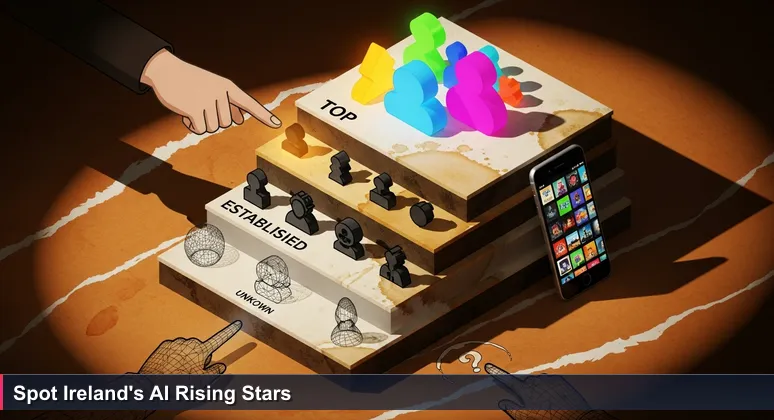
That moment of choice at the festival poster mirrors the energy in Ireland's tech scene, where global giants and homegrown innovators share the stage. The country has solidified its position, ranking 4th worldwide in AI adoption, creating a magnetic environment for cutting-edge ventures.
This success is underpinned by a powerful trifecta. Ireland's 12.5% corporate tax rate provides a stable financial runway for deep R&D, while universities like Trinity College Dublin and UCD act as prolific talent incubators, spinning out companies directly from their labs. Furthermore, state commitment is clear, with over €159 million awarded under the Disruptive Technologies Innovation Fund to propel high-potential projects.
The ecosystem's strength is reflected in global benchmarks. A report highlighted by The Irish Times ranked Ireland first globally for workforce readiness in the AI-driven work revolution. Simultaneously, Enterprise Ireland has become a dominant force, noted as the #7 most active VC globally in enterprise software by deal count, according to industry analysis. This unique confluence of policy, talent, and capital is why global leaders scale here and why the next wave of Irish AI startups commands the world's attention.
Table of Contents
- Ireland's AI Startup Landscape 2026
- MESO
- Toyo
- Vaultree
- Manna Drone Delivery
- Equal1
- Inspeq AI
- Protex AI
- Nory
- Deciphex
- Tines
- Frequently Asked Questions
Find out the in-demand AI skills for Ireland in 2026 with this guide.
MESO
Addressing the critical challenge of teacher workload, MESO emerges from Trinity College Dublin's research ecosystem as a specialized AI tool. Unlike generic chatbots, its pedagogical AI is fine-tuned for Ireland's national curriculum, generating differentiated lesson plans and administrative materials that adhere to educational standards, thereby freeing educators to focus on student engagement.
As a direct product of the academic pipeline, MESO exemplifies the commercial potential of university research. The startup, an AI-powered Ed-Tech spin-out backed by Enterprise Ireland, is currently validating its model in over 20 Irish schools. This pilot phase is a crucial step towards a planned national rollout, targeting a pervasive public sector challenge.
The future trajectory hinges on scalable impact within the Irish system. Success could lead to a transformative public-private partnership with the Department of Education, positioning MESO as a foundational platform in Irish schools. This path highlights the essential role of university hubs like Trinity Innovation in converting cutting-edge research into societal and economic value, offering a replicable model for educational technology export.
Toyo
Moving beyond AI assistants that require constant prompting, Dublin's Toyo is betting on autonomous agents. Founded by ex-Pusher founder Damien Tanner, the startup builds AI that executes complete business functions - like procurement or customer onboarding - from trigger to completion with minimal human oversight, representing the shift toward agentic systems.
Emerging from stealth in early 2026, Toyo immediately signaled its potential with a €3.6 million Seed round. As reported by the Business Post, the raise was led by Frontline Ventures with angels from Cloudflare and Amazon, attracting a waitlist of high-growth tech firms eager to move past simple AI pilots.
The critical test for Toyo's ambitious vision will be securing anchor clients in the cautious enterprise software market. Its success depends on proving that its agents offer a tangible "agentic advantage" in reliability and efficiency over existing tools. As noted by industry trackers, this aligns with a broader enterprise trend where organisations are moving beyond pilots to explore how autonomous AI reshapes operations.
Vaultree
Tackling a fundamental barrier to AI adoption in regulated industries, Cork-based Vaultree specializes in Privacy-Enhancing Technology (PET). Its breakthrough enables Fully Functional Data-In-Use Encryption (FFDUE), allowing AI models to be trained on sensitive data - like financial or healthcare records - while the information remains encrypted throughout the entire process, eliminating a major compliance and security risk.
The startup has gained significant validation through strategic alliances and capital. With a €16 million Series A from firms like Ten Eleven Ventures, Vaultree has secured crucial partnerships with giants such as Google Cloud and Iron Mountain for distribution. This positions it as a notable player among Ireland's cybersecurity startups targeting enterprise-grade solutions.
The next major signal will be adoption by a flagship client in Ireland's dense ecosystem of regulated firms. A successful case study with a top-tier Irish bank or pharmaceutical company, as tracked by platforms like Tracxn, would serve as a powerful reference for global expansion, simultaneously bolstering Cork's reputation as a hub for security and data innovation.
Manna Drone Delivery
Confronting the congestion and carbon cost of last-mile logistics, Manna makes suburban drone delivery a commercial reality. Its AI-driven autonomous systems manage high-altitude flight, dynamic obstacle avoidance, and precision landing, integrating directly with local retail platforms to enable 3-minute delivery windows.
This is not a future concept but a live service. Manna operates commercially in Dublin suburbs like Blanchardstown and has completed pilots in the US, executing thousands of autonomous flights weekly. Its significant operational scale is supported by over €30 million in backing from investors like Molten Ventures and Atlantic Bridge, marking it as a standout hardware-and-software AI venture.
The critical path to scaling is regulatory. Manna's success in navigating the Irish Aviation Authority sets a precedent. The next major milestone will be approvals and launches in new EU capitals, a move that would transform it from an innovative Irish service into a pan-European logistics contender, showcasing how deep-tech startups from Ireland can redefine entire industries.
Equal1
Addressing the exotic cost and scalability challenges of quantum computing, Dublin's Equal1 is pioneering a practical path forward. This University College Dublin spinout is building quantum processors, dubbed "Bell-1," using standard, cost-effective silicon technology. The goal is to run complex AI models with a fraction of the power consumption of traditional data centers, making quantum capabilities accessible.
Representing Ireland's ambitious stake in the global quantum race, Equal1 has secured substantial backing of approximately €60 million from investors including Atlantic Bridge and the European Innovation Council. Its strategic partnership with quantum control firm Q-Ctrl for 2026 data centre deployments marks a concrete step from research toward commercial application, highlighting how tech giants are betting big on AI research in the Irish ecosystem.
The pivotal moment will be the first benchmark results from a Bell-1 processor in a live setting. Demonstrating a clear, quantifiable advantage in speed or efficiency for specific AI workloads would attract intense strategic interest from the cloud giants headquartered in its Dublin backyard, validating Ireland's capacity to produce world-class deep-tech hardware innovation.
Inspeq AI
As enterprises rush to deploy Large Language Models, they face paralysis from risks like hallucination, bias, and data leakage. Dublin's Inspeq AI provides the essential solution: a comprehensive "trust layer" for GenAI. Its MLOps platform evaluates AI applications in real-time for safety, security, and accuracy, enabling companies to deploy with confidence.
The startup has gained early recognition through prestigious programs, being selected for accelerators like Hub71 in Abu Dhabi and Dublin’s own NovaUCD. It has secured approximately €1.1 million in Seed funding, followed by a larger 2025 bridge round led by Sure Valley Ventures and Enterprise Ireland, fueling its focus on stringent compliance sectors. This positions it among the top developers in the critical AI Ops space in Ireland.
Inspeq's immediate trajectory is focused on the regulated finance and legal sectors, with active pilots already underway at Irish financial institutions. A landmark deal with a pillar Irish bank would serve as the perfect beachhead, transforming the startup into a de facto standard for trusted AI deployment. Success in this domain, a cornerstone of the national economy, would provide a powerful launchpad for global expansion in all compliance-driven industries.
Protex AI
In industrial and logistics settings, preventing devastating workplace accidents has traditionally been reactive, relying on after-the-fact reports. Limerick's Protex AI offers a proactive solution by transforming existing CCTV cameras into intelligent safety sensors. Its computer vision AI analyses footage in real-time to identify "near-misses" and unsafe behaviours - like a missing safety helmet near machinery - without costly new hardware installations.
The startup has demonstrated impressive commercial traction, moving beyond pilots to secure global partnerships with major players like Marks & Spencer and Logistics UK. Its growth is underscored by a substantial ~€50 million Series B in 2025, led by Notion Capital, and significant recognition, being ranked #21 on the Sifted 2026 leaderboard of top European startups.
The next evolution for Protex AI lies in deeper system integration. The true strategic value will be unlocked when its real-time safety data feeds automatically into enterprise resource planning (ERP) and workforce management systems. This creates a closed-loop where safety insights directly inform staff scheduling, targeted training, and operational planning, embedding preventative safety into the core workflow of global logistics clients.
Nory
Running a restaurant involves a constant battle against food waste, labour overruns, and unpredictable demand. Dublin's Nory tackles this by acting as the AI-powered "operating system" for hospitality. It uses predictive analytics to forecast hourly customer flow, automatically optimizing staff schedules and inventory orders in real-time.
What sets Nory apart is its deeply vertical AI, built by founder Conor Sheridan who previously built the Mad Egg restaurant chain. This insider knowledge informs a product that manages thousands of sites across Ireland and the UK. As featured in the Business Post, it’s a "fast-growing, product-led firm" transforming daily operations.
With a war chest of approximately €60 million, including a $36 million Series A led by Accel, Nory is built for aggressive scaling. The pivotal next act is a successful move into the massive US restaurant market. A transatlantic leap would position it as a global category leader in vertical SaaS, demonstrating how Irish startups can dominate niche industries worldwide.
Deciphex
Pathology labs worldwide are under severe strain from a specialist shortage, causing critical delays in diagnoses, particularly for cancer. Dublin's Deciphex addresses this bottleneck with its Patholytix platform, which uses advanced computer vision AI as a digital assistant for pathologists. The technology pre-screens tissue slides, flagging potential abnormalities and helping experts process cases up to 40% faster without replacing essential human judgment.
The company has achieved substantial validation, being named Medtech Company of the Year in 2023 and securing significant traction in the preclinical toxicology sector with global pharmaceutical clients. This foundation is supported by approximately €56 million in funding, including a Series C round led by Seroba Life Sciences, dedicated to expanding from research into the clinical diagnostics market, a move supported by Ireland's strong life sciences and AI research environment.
The critical next hurdle is regulatory approval for clinical use. A successful pilot within the Irish public health system would be the breakthrough that unlocks global adoption. Such an achievement would not only revolutionize diagnostic pathways but also position Deciphex for a potential IPO, showcasing how research-born Irish startups can achieve world-leading impact in healthcare technology.
Tines
Security and IT teams are inundated with alerts and repetitive tasks, yet building automated workflows typically requires scarce engineering skills. Tines eliminates this barrier with its genius no-code platform. Its "automatic mode" AI allows any team member to create sophisticated, secure workflows simply by describing the task in plain English, effectively turning every analyst into an automator.
This approach has propelled Tines to become Ireland's AI automation unicorn and a benchmark for the ecosystem. With total funding of approximately €250 million, including a massive $125 million Series C in 2025 led by Accel, it boasts an impressive roster of Fortune 500 customers like Canva and Databricks. Its commercial maturity is reflected in estimated high double-digit million EUR revenue, cementing its status among Ireland's hottest startups to watch.
All eyes are now on Tines' path to an IPO. As the most advanced company on this list, its journey will serve as a critical benchmark for the entire Irish tech sector, proving a Dublin-headquartered SaaS company can reach the highest echelons of global enterprise software. Its success is a key reason why, as one analysis notes, global AI leaders are scaling from Ireland.
Frequently Asked Questions
How did you choose the top 10 AI startups for 2026?
We ranked them based on criteria like innovation, funding traction, and growth potential within Ireland's unique ecosystem. Key factors included backing from sources like Enterprise Ireland and ties to universities such as TCD and UCD, which help fuel talent and research.
Why is Ireland a great place for AI startups right now?
Ireland ranks 4th globally in AI adoption, supported by a 12.5% corporate tax rate that stabilizes finances. Plus, with over €159 million in state funding via programs like the Disruptive Technologies Innovation Fund, and proximity to tech hubs in Dublin, it's an ideal environment for scaling.
Which startup offers the best job opportunities for AI engineers in Ireland?
Tines, as Ireland's AI automation unicorn with high double-digit million EUR revenue, provides strong career paths in no-code AI. Startups like Equal1 and Vaultree are also hiring actively, backed by significant funding from investors such as Atlantic Bridge and Ten Eleven Ventures.
How does Ireland's low corporate tax help these AI startups grow?
The 12.5% tax rate allows startups like Nory and Protex AI to reinvest more profits into research and expansion. This financial advantage helps attract global investment and supports scaling efforts, especially in the Dublin metro area near major employers like Google and Meta.
Do these startups focus on specific industries, like healthcare or security?
Yes, they span various sectors - for example, Deciphex targets healthcare with AI for pathology, while Vaultree specializes in encryption for secure AI. This diversity highlights Ireland's strength in vertical AI applications, from education with MESO to logistics with Protex AI.
This comprehensive analysis of cybersecurity hiring trends in Ireland for 2026 provides valuable career insights.
Discover where to find leading tech companies in Dublin hiring AI engineers with detailed insights.
Find out about AI adoption and tech jobs in Ireland 2026 in this article.
For a guide to community-based tech training in Ireland, this resource is invaluable.
If you're aiming for tech careers without a degree in Ireland, this article is a must-read.

Irene Holden
Operations Manager
Former Microsoft Education and Learning Futures Group team member, Irene now oversees instructors at Nucamp while writing about everything tech - from careers to coding bootcamps.