









How to Become an AI Engineer in Fort Wayne, IN in 2026
By Irene Holden
Last Updated: March 5th 2026
Quick Summary
Become an AI engineer in Fort Wayne by 2026 with a practical 12-month blueprint that adapts your skills to local industries like healthcare and manufacturing. Leverage Fort Wayne's lower cost of living to focus on applied AI for employers such as Parkview Health, building deployable projects for the region's growing tech ecosystem.
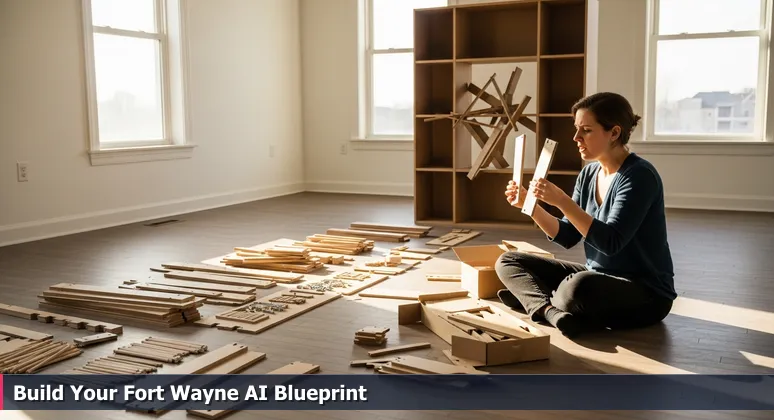
We've all been there: the instructions are clear, the parts are laid out, but the final product feels impossible. That exact gap is why most guides to becoming an AI engineer fail you in Fort Wayne. Following a generic manual is like trying to assemble complex furniture with the wrong tools - the result is wobbly and doesn't fit your space.
This 12-month blueprint is different. It's built on the insight that success isn't about memorizing global theory, but about becoming a local mechanic. You must adapt the universal engine of AI fundamentals to fit the specific chassis of Fort Wayne industries like Parkview Health, Steel Dynamics, and the growing tech ecosystem symbolized by "Skywalker," the city's first AI employee.
Here, an AI engineer isn't just a model-builder. You're a problem-solver who integrates intelligence into healthcare diagnostics, optimizes manufacturing lines, and improves supply chain logistics. The goal is applied AI that works on the factory floor and in the hospital ward.
With Fort Wayne's average AI professional salary at $92k and roles like AI Architect at Crowe offering $89,800 - $163,800, the opportunity is real. Combined with a significantly lower cost of living than coastal hubs, your financial runway for this intensive learning year is longer and more stable. This is your local blueprint for building a career firmly rooted in Northeast Indiana's innovative landscape.
Steps Overview
- Your Fort Wayne AI Journey Begins Here
- Prerequisites for AI Success in Fort Wayne
- Master AI Fundamentals: Programming and Math
- Core Machine Learning and Deep Learning Skills
- Specialize for High-Demand Fort Wayne Industries
- Deploy and Integrate AI in Production
- How to Know You're Ready for an AI Job in Fort Wayne
- Common Questions
If you're looking for the complete guide to starting an AI career in Fort Wayne, IN in 2026, this article has everything you need.
Prerequisites for AI Success in Fort Wayne
Before you open the first tutorial, ensure your workshop is ready. Your success hinges on having the right tools, a realistic schedule, and a mindset aligned with Fort Wayne's practical tech landscape.
First, the hardware: a modern computer with at least 8GB of RAM is essential. A dedicated NVIDIA GPU is a valuable bonus for training complex models faster, but isn't required for the initial months of foundational learning. Second, commit the time. This isn't a casual hobby; aim for a disciplined 15-20 hours per week of focused study and hands-on practice to progress through the 12-month blueprint.
Most importantly, cultivate the right mindset. You need curiosity and persistence, as debugging broken code is a core part of the job. Crucially, understand the local context. Fort Wayne employers need engineers who can build applied AI. As seen in a Research Data Engineer role at Parkview Health, this means integrating AI into existing healthcare systems and manufacturing lines, not just building theoretical models.
This is where Fort Wayne's unique advantage kicks in. With an average AI salary of $92k and a cost of living drastically lower than coastal cities, your financial runway is longer. Your affordable rent or mortgage translates into more stability, allowing you to dedicate resources and mental energy to this intensive learning period while targeting local giants like Steel Dynamics, GM, and Purdue University Fort Wayne.
Master AI Fundamentals: Programming and Math
Your first three months are about building an unshakable base for a Fort Wayne career. In this practical job market, strong fundamentals in programming, math, and data management are non-negotiable for integrating AI into real systems at Parkview or on a factory floor.
Begin by mastering Python, the lingua franca of AI. Don't just learn syntax; learn to write clean, efficient code for data manipulation. A practical exercise is writing a script that analyzes a CSV of local weather data to calculate average monthly temperatures. This foundational skill is directly applicable, as every data pipeline at Parkview Health or sensor stream at Steel Dynamics will be processed with Python. Resources like structured roadmaps for beginners can guide this 4-6 week immersion.
Concurrently, reactivate core mathematical thinking. Focus on Linear Algebra for structuring data, and Statistics & Probability for evaluating model performance and uncertainty. A resource like the "Mathematics for Machine Learning" specialization on Coursera provides this essential framework. This math is the language you'll use to explain your model's confidence to a plant manager or a hospital administrator.
Finally, learn to manage the fuel of AI: data. Basic SQL commands (SELECT, JOIN, WHERE) are crucial. As seen in requirements for a Research Data Engineer at Parkview Health, you'll constantly query complex systems like electronic health records. A common mistake is rushing through this phase to get to "the cool AI stuff," but a weak foundation will cause everything you build later to be unstable.
Verification Checkpoint: Can you comfortably manipulate a dataset using Python's Pandas library and explain the statistical significance of your findings? If yes, you're ready to transition from programmer to someone who can build intelligent systems.
Core Machine Learning and Deep Learning Skills
Now the real assembly begins. Months 4-6 are where you transition from a programmer to someone who can build, train, and evaluate intelligent systems - the core skills that transform data into decisions for Fort Wayne employers.
Start with a structured framework by completing a foundational machine learning course. The industry-respected choice is Andrew Ng’s Machine Learning Specialization on Coursera. While learning concepts like supervised and unsupervised learning, constantly ask the local question: “How could a classification model predict machine failure at the GM Assembly plant?” or “How could regression forecast patient admission rates at Parkview?” This applied mindset is what separates academic understanding from job-ready skill.
Choose Your AI Toolkit
Next, dive deep into one major deep learning framework. For Fort Wayne’s production-focused environments in manufacturing and healthcare, TensorFlow is often preferred due to its robust deployment tools, a skill reflected in TensorFlow salaries ranging from $107k to $486k. PyTorch is excellent for research flexibility. Choose one and achieve proficiency through building, not just watching. A practical exercise is creating a neural network to classify images of industrial parts - a direct skill for automated quality control.
Build Your First Portfolio Piece
This phase is defined by active creation. Use libraries like NumPy and Pandas daily. Most importantly, don’t just consume tutorials. For every concept, write your own code, break it, and fix it. As highlighted by accelerated programs like the top AI engineering bootcamps, your GitHub must show real work. Build and train a model on a real dataset from Kaggle, document the process in a Jupyter notebook, and achieve a measurable result.
Verification Checkpoint: Have you built, trained, and evaluated a model on a real dataset, documented it thoroughly, and achieved a reasonable accuracy score? This project is your first true portfolio piece, proving you can move from theory to a working prototype.
Specialize for High-Demand Fort Wayne Industries
This is where you stop being a generalist and start becoming the specialist Fort Wayne companies urgently need. Months 7-9 are about selecting the right AI tools from your kit and mastering them for a specific local industry challenge - whether that's analyzing medical notes or inspecting factory components.
Choose Your Local Path
Your specialization should align with the region's economic pillars. For Healthcare (Parkview Health), dive into Time Series Analysis for patient monitoring and Natural Language Processing for clinical notes, focusing on model interpretability so doctors understand the "why." For Manufacturing (Steel Dynamics, GM), specialize in Computer Vision for defect detection and time series for predictive maintenance. Logistics firms need Optimization Algorithms, while a firm like Sweetwater values Audio Signal Processing. Local education, like Indiana Tech's AI Certificate, can provide structured knowledge in these applied domains.
Build Your Flagship Project
The most critical output of this phase is a complex, end-to-end project for your portfolio. This demonstrates you can assemble a complete solution. For manufacturing, build a "Predictive Maintenance for Industrial Motors" model. For healthcare, create a "Patient Readmission Risk Classifier" using public datasets. Document everything on GitHub with a README that frames the business problem for a Fort Wayne audience.
Warning: Avoid the "tutorial trap" of only building guided projects. Your flagship must feature your own code, analysis, and conclusions to stand out to employers like Crowe, which offers roles like AI Architect with a salary up to $163,800. This project proves you can move from learning concepts to solving tangible business problems.
Verification Checkpoint: Do you have a complex, end-to-end project on GitHub that demonstrates your specialization? Can you explain its business impact to a non-technical plant manager or hospital administrator in Fort Wayne? If so, you're demonstrating the applied expertise that gets you hired.
Deploy and Integrate AI in Production
An AI model in a Jupyter notebook creates zero business value. An AI model integrated into a hospital's diagnostic workflow or a factory's quality control system does. Months 10-12 are about the "engineering" in AI Engineering - learning to move your specialized models from your laptop into a simulated production environment that delivers real impact.
Master Basic MLOps
This phase is about building the bridge between data science and software engineering. Start with containerization using Docker to package your model and its environment so it runs consistently anywhere - on a local server at Parkview or in the cloud. Next, learn to create APIs with FastAPI, building a simple web interface that allows other software applications to send data to your model and get predictions back. A practical exercise: take your flagship project, put the trained model in a Docker container, and create a FastAPI server that returns predictions.
Understand Cloud Deployment
You don't need to be a cloud architect, but understanding how to deploy a container to a service like Google Cloud Run or AWS is essential. This operational skill is what local employers value, as demonstrated by the rise of integrated, operational AI like "Skywalker," noted as Fort Wayne's first AI employee. Combine this with religious use of Git for version control; your GitHub becomes both your professional portfolio and a demonstration of collaborative practice.
This step feels daunting but is the ultimate differentiator. It transforms you from someone who builds prototypes into a professional who can deliver a finished, working product. As emphasized in expert roadmaps, the most valuable skill is building the "car" (the application) using the "engine" (the pre-trained model), which requires mastery of APIs, containers, and deployment pipelines.
Verification Checkpoint (Final): Can you access your flagship project's prediction API from a web browser or a separate program? Have you containerized it so it could be handed off to an IT team? If so, you've successfully moved from learning about AI to being capable of engineering a complete AI solution for Fort Wayne.
How to Know You're Ready for an AI Job in Fort Wayne
Success isn't a certificate; it's a demonstrable ability to solve problems for your community. You'll know you're ready for an AI engineering role in Fort Wayne when you've transformed from following generic instructions to building with a local blueprint.
Your readiness is measured by four concrete indicators. First, a robust GitHub portfolio featuring 3-4 substantial projects, with at least one focused on a Fort Wayne-relevant industry like healthcare or manufacturing and one that is deployed via a live API. Second, deep specialization where you can confidently discuss the intricacies of your chosen domain, such as computer vision for defect detection, and its local applications.
Third, proven integration competence. You can articulate how an AI model moves from training to deployment within existing business systems, a skill exemplified by operational AI like Fort Wayne's first AI employee, "Skywalker". Finally, local network awareness means you've begun engaging with the tech community through events at Purdue University Fort Wayne or online groups, understanding the specific challenges of area employers.
When you meet these criteria, you're not just another candidate with ML knowledge. You're a builder equipped for roles like AI Architect, ready to contribute to a market where professionals earn an average of $92k. You've leveraged Fort Wayne's affordable cost of living as a strategic advantage, turning lower expenses into dedicated learning time. The journey concludes not with a generic model, but with a career firmly rooted in the innovative, practical landscape of Northeast Indiana.
Common Questions
Can I realistically become an AI engineer in Fort Wayne without a formal degree?
Yes, many local employers like Parkview Health and Steel Dynamics prioritize hands-on skills and project portfolios over degrees, especially for applied AI roles. With Fort Wayne's lower cost of living, you can afford to invest in self-study programs like bootcamps or online courses to build the necessary expertise.
How much time per week do I need to commit to follow this blueprint successfully?
Aim for 15-20 hours weekly over 12 months, as outlined in the guide. Fort Wayne's affordable housing - about 30% cheaper than coastal metros - gives you more financial flexibility to dedicate time to learning while balancing other responsibilities.
What's the salary range for AI engineers in Fort Wayne, and how does it compare to living costs?
Salaries typically range from $85,000 to $110,000, with the lower cost of living in Fort Wayne making this comparable to higher earnings in pricier cities. For example, median home prices here are around $200,000, much lower than in tech hubs like San Francisco or New York.
Are there enough AI job opportunities in Fort Wayne to justify a career switch?
Yes, demand is growing with major employers like GM Fort Wayne Assembly and Parkview Health integrating AI, plus a rising tech startup scene in Northeast Indiana. Roles often focus on practical applications in healthcare, manufacturing, and logistics, aligning well with local industry needs.
What if I have no background in math or programming - can I still succeed in this field?
Absolutely, the guide starts with foundational steps like learning Python and core math concepts, tailored for beginners. Leverage local resources, such as Purdue University Fort Wayne's courses or online platforms, and take advantage of Fort Wayne's supportive community to build skills gradually.
Read about the innovative AI solutions emerging in Fort Wayne for 2026 and their industrial applications.
This article offers an introduction to tech careers in Fort Wayne, explaining opportunities and affordability.
If you're interested in advancing in tech, read about the top 10 AI tech bootcamps in Fort Wayne, IN in 2026.
For insights into high-paying tech jobs in Fort Wayne with cost of living analysis, read this.
A detailed guide to tech jobs in Fort Wayne that don't require a four-year degree by 2026 offers valuable local insights.

Irene Holden
Operations Manager
Former Microsoft Education and Learning Futures Group team member, Irene now oversees instructors at Nucamp while writing about everything tech - from careers to coding bootcamps.