









The Complete Guide to Using AI in the Government Industry in Fort Wayne in 2025
Last Updated: August 18th 2025
Too Long; Didn't Read:
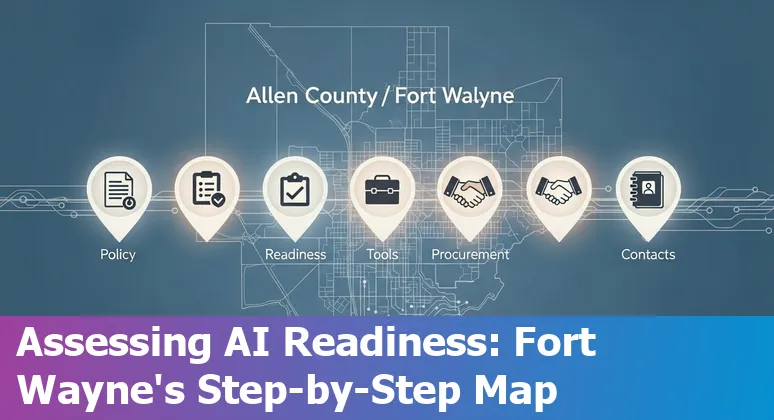
Fort Wayne agencies must follow Indiana's June 27, 2025 AI Readiness Assessment methodology, complete maturity assessments before projects, and align with NIST cybersecurity. Run a 15‑week AI Essentials pilot, prioritize public‑records redaction pilots, and note ChatGPT's 60.4% market share.
Fort Wayne agencies must navigate a new Indiana playbook for responsible AI: the Office of the Chief Data Officer now publishes an AI Readiness Assessment Methodology (published June 27, 2025) and sets a policy “floor” that requires maturity assessments before most projects, so local teams need clear documentation and repeatable controls - see the Indiana Office of the Chief Data Officer AI policies for required steps and timelines (Indiana Office of the Chief Data Officer AI policies).
At the same time federal guidance on AI cybersecurity is arriving from NIST, raising the bar for threat modeling and model protection that municipal systems must adopt (NIST AI cybersecurity guidance for federal agencies).
Practical upskilling matters: Fort Wayne can reduce deployment delays by training cross-functional staff in applied AI skills such as the 15-week AI Essentials for Work course to close the gap between policy and practice (Nucamp AI Essentials for Work syllabus - 15-week practical workplace AI course).
| Bootcamp | Key details |
|---|---|
| AI Essentials for Work | 15 weeks; practical workplace AI skills; syllabus: Nucamp AI Essentials for Work syllabus |
“A lot of [agencies] followed afterwards, and there was a lot of risk associated with that. A lot of work went into making sure that … could be mitigated, so we would avoid some of the fears [of AI].” - Zach Whitman
Table of Contents
- What is the new AI technology in 2025 and why it matters to Fort Wayne, Indiana
- What is the most popular AI tool in 2025 and how Fort Wayne, Indiana agencies might use it
- Indiana and US AI regulation in 2025: what Fort Wayne, Indiana agencies must know
- How to start with AI in 2025: step-by-step for Fort Wayne, Indiana agencies
- Readiness Assessment deep dive: documentation and timelines for Fort Wayne, Indiana
- Risks, protections and vendor negotiation for Fort Wayne, Indiana
- Operational best practices: organizing teams and workflows in Fort Wayne, Indiana
- Workforce, training and local examples in Fort Wayne, Indiana
- Conclusion: Practical checklist and resources for Fort Wayne, Indiana agencies starting with AI in 2025
- Frequently Asked Questions
Connect with aspiring AI professionals in the Fort Wayne area through Nucamp's community.
What is the new AI technology in 2025 and why it matters to Fort Wayne, Indiana
(Up)The dominant new AI technologies in 2025 combine AIOps-driven automation with emergent agentic and multimodal systems, and each has direct, practical value for Fort Wayne agencies: AIOps platforms now deliver real-time analytics, automated anomaly detection and incident remediation across hybrid cloud stacks - meaning a compromised node can be isolated and prebuilt remediation triggered automatically, turning hours of manual triage into minutes and cutting downtime for critical city services (AIOps real-time security and automation trends for 2025); agentic AI can autonomously plan and execute multi-step tasks such as logistics rerouting or casework prioritization, while multimodal and generative AI make it feasible to combine text, images and audio for richer, faster decisions in public health, permitting more accurate record review and citizen communications (Agentic, multimodal, and generative AI trends for 2025).
Locally, pilots like a public-records document triage tool show how GenAI and multimodal workflows speed redaction and reduce legal risk - so Fort Wayne can both protect privacy and reallocate staff to higher‑value services (Fort Wayne public-records AI document triage use case).
What is the most popular AI tool in 2025 and how Fort Wayne, Indiana agencies might use it
(Up)By mid‑2025 the generalist ChatGPT ecosystem remains the single most popular public-facing AI assistant - First Page Sage reports ChatGPT with roughly a 60.4% AI search market share (and other industry trackers put ChatGPT use well ahead of rivals) - and that market concentration matters for Fort Wayne agencies because it shapes integrations, vendor support, and user expectations; practical uses include rapid drafting of citizen communications, summarizing case files for managers, and feeding multimodal triage workflows that speed public‑records redaction while reducing legal risk (see a Fort Wayne public‑records document triage use case).
For agencies that must balance scale with security, pairing ChatGPT-powered public interfaces with Azure/Microsoft Copilot solutions (which Microsoft documents as already accelerating case processing and citizen services in government pilots) offers a path to combine broad user familiarity with enterprise controls and Copilot‑native workflows.
The concrete takeaway: prioritize pilots that test ChatGPT‑centered user journeys (API access, clear data‑handling rules, and a redaction triage pilot) so Fort Wayne can deliver faster, more consistent responses to residents while retaining the governance controls required by state and federal guidance (First Page Sage generative AI chatbot market share report, Microsoft Copilot government use cases blog, Fort Wayne public‑records AI triage example and coding bootcamp Fort Wayne).
| AI Tool | AI Search Market Share (Aug 2025) |
|---|---|
| ChatGPT | 60.40% |
| Microsoft Copilot | 14.10% |
| Google Gemini | 13.50% |
“I'm very busy, and it makes my life easier…”
Indiana and US AI regulation in 2025: what Fort Wayne, Indiana agencies must know
(Up)Fort Wayne agencies must follow Indiana's enterprise AI policy: submit an AI Readiness Assessment Questionnaire as soon as any AI system is identified, obtain a State AI Policy Exception from the Chief Privacy Officer, and provide annual or post‑change follow‑up reports - submissions are triaged and reviewed by the MPH AI Review Team and OCDO using the NIST AI Risk Management Framework, and the policy also requires a “just‑in‑time” (JIT) notice to users at the point of interaction; critically, the Indiana Office of Technology will not approve Software Authorization requests for systems with AI without either an AI Policy Exception or an Out of Scope Affirmation, so naming your Agency Privacy Officer (APO) and filing early prevents procurement delays and audit risk (contact ResponsibleData@mph.in.gov).
See the State of Indiana AI Policy and Guidance for required forms and processes via the State of Indiana AI Policy and Guidance documentation at https://www.in.gov/mph/AI/, and consult the OCDO policies page for the AI Readiness Assessment Methodology and supporting standards on the OCDO AI Readiness Assessment Methodology page at https://www.in.gov/mph/cdo/policies/.
Independent coverage summarizes the policy's goal to balance innovation with data and ethical safeguards in this CDO Magazine summary of Indiana's AI policy at https://www.cdomagazine.tech/aiml/indiana-introduces-new-policy-for-ai-projects.
| Risk Level | When it applies |
|---|---|
| High‑Risk | Broad‑context systems that may affect rights, safety, or critical services |
| Moderate‑Risk | Narrow‑context systems with limited, defined scope |
| Low‑Risk | Limited‑impact systems with easily mitigated risks |
“We worked with DWD and their vendor to train a model on workforce data and education data, and then separated the model from the underlying data and handed the model itself to the DWD for use in its app.”
How to start with AI in 2025: step-by-step for Fort Wayne, Indiana agencies
(Up)Start small and practical: pick a single, high‑volume pain point - public records redaction is a common one - and run a short, measurable pilot using a public records redaction triage tool to prove value quickly (public records redaction triage tool) ; assemble a cross‑functional team (IT, legal, records, and a service‑line manager), define success metrics (turnaround time, error rate, and legal exceptions), and limit initial scope to a single department.
While the pilot runs, formalize a workforce plan that leverages local partnerships - use AI job‑matching pilots with Ivy Tech to recruit or reskill staff and capture demonstrated wage gains in Fort Wayne (AI job‑matching pilot program with Ivy Tech for workforce reskilling in Fort Wayne).
Finally, convert freed capacity into higher‑value roles by training customer‑facing staff into case management, a proven growth path that preserves service quality and career mobility (case management career pathway for government service representatives); iterate, document decisions, and expand only after the pilot meets the predefined metrics.
speeds redaction and reduces legal risk
Readiness Assessment deep dive: documentation and timelines for Fort Wayne, Indiana
(Up)Fort Wayne agencies must treat the AI Readiness Assessment as a compact dossier: submit the AI Readiness Assessment Questionnaire as soon as any AI system is identified, document a clear risk classification (high/moderate/low), and include an inventory of data sources and lineage, model documentation (training data, validation results and known limitations), vendor contracts and SLAs, and explicit redaction and escalation workflows so reviewers can reproduce decisions - pilots that capture turnaround time, error rate and the exact triggers for manual review make approvals faster and reduce legal exposure (see the Fort Wayne public‑records document triage tool for documenting redaction controls: Fort Wayne public-records document triage tool and redaction controls).
Timelines matter: name an Agency Privacy Officer early, file for a State AI Policy Exception or Out‑of‑Scope affirmation before procurement to avoid authorization delays, and plan annual or post‑change follow‑ups; include a workforce plan that links pilot outcomes to reskilling pathways (use local partnerships such as the Ivy Tech job‑matching pilot program: Ivy Tech job-matching pilots for reskilling Fort Wayne government staff) and a concrete redeployment pathway for service staff into higher‑value roles like case management (see case management role transition example: case management redeployment and retraining guidance); a single, well‑documented pilot file often shortens review cycles and prevents procurement stalls, making the difference between a stalled project and an approved rollout.
Risks, protections and vendor negotiation for Fort Wayne, Indiana
(Up)Mitigating legal, privacy and procurement risk starts before code is signed: require vendors to show how a public‑records document triage tool will “speed redaction and reduce legal risk,” include clear data‑separation and export clauses so Fort Wayne can audit or run a model without exposing raw records, and insert SLAs for accuracy, turnaround time and incident response to prevent service‑disrupting surprises - these concrete contract terms shorten review cycles and limit liability.
Negotiate audit rights, breach notification timelines and a rights‑to‑remediation clause that mandates fixes and detailed change logs; when possible, insist on a model‑only delivery or escrow arrangement (separating the model from underlying data is a proven control in government pilots).
Protect the workforce by negotiating vendor support for reskilling and local hiring commitments that link freed capacity to retraining pipelines - build on existing initiatives like the AI job‑matching pilots with Ivy Tech and fund transitions into higher‑value roles such as case management to preserve jobs and capture measurable wage gains (public‑records document triage tool for Fort Wayne government, AI job‑matching pilots with Ivy Tech in Fort Wayne, case management career pathway in Fort Wayne government).
Operational best practices: organizing teams and workflows in Fort Wayne, Indiana
(Up)Organize AI operations in Fort Wayne around a tight, repeatable workflow that maps directly to Indiana's approval gates: form a cross‑functional core team (IT/security, legal/privacy, records management, and a service‑line manager), name an Agency Privacy Officer (APO) early, and treat the AI Readiness Assessment as the project's living spec so reviewers can triage risk and approve quickly; the State's process requires a Readiness Assessment submission to the MPH/OCDO before procurement, and IOT will block Software Authorization for systems with AI unless a Policy Exception or Out‑of‑Scope Affirmation is in place, so early APO engagement prevents procurement stalls (State of Indiana AI Policy and Guidance (MPH/OCDO)).
Build two parallel workflows: a rapid pilot lane (limited scope, measurable KPIs, manual‑review triggers) to prove value - examples include a public‑records document triage pilot that speeds redaction - and a compliance lane that collects model docs, data lineage, contracts and JIT notices for MPH review; low‑ and moderate‑risk submissions are often expedited while high‑risk systems receive full review, so design approval artifacts to demonstrate mitigations up front and negotiate vendor clauses that separate models from raw data to simplify audits and approvals (public records document triage tool for Fort Wayne government).
The so‑what: naming the APO and filing the Readiness Assessment before procurement is the single operational move most likely to turn a stalled project into an approved deployment.
| Team / Office | Primary operational role |
|---|---|
| OCDO | Issues enterprise AI policy; applies NIST AI RMF |
| MPH AI Review Team | Reviews Readiness Assessments; triages risk (Legal, Privacy, Data Science, Governance) |
| Agency Privacy Officer (APO) | Responsible for submissions and agency compliance |
| Office of Technology (IOT) | Software Authorization, web filtering and enforcement |
“It is wonderful and it is scary.” - Rep. Matt Lehman
Workforce, training and local examples in Fort Wayne, Indiana
(Up)Fort Wayne agencies should treat workforce development as a paired investment: run a short redaction pilot to free records staff for higher‑value roles, then use local reskilling pipelines and market data to staff them - examples include a public‑records document triage tool that “speeds redaction and reduces legal risk” and creates predictable capacity for retraining (Fort Wayne public-records document triage tool use case and AI prompts), and AI job‑matching pilots that partner with Ivy Tech to place and upskill displaced workers while lifting local wages (Ivy Tech AI job-matching and reskilling pilot details).
To budget and set competitive pay for new case‑management roles, use regional compensation benchmarks - Western Management Group's COMPBASE survey offers single‑metro reports (single geographic area reports start at $1,800) so agencies can plan realistic salary bands and reduce turnover risk (COMPBASE® USA Compensation Survey - Summer 2025).
The so‑what: pairing a fast, measurable pilot (redaction → capacity) with local training pipelines and market data turns automation savings into retained, higher‑skilled jobs instead of layoffs.
| Partner | Practical offering |
|---|---|
| Public‑records triage tool | Speeds redaction and reduces legal risk; creates redeployment capacity (Public-records triage tool use case details) |
| Ivy Tech job‑matching pilots | Local job‑matching and reskilling partnerships that raise wages and place trainees (Ivy Tech AI job-matching pilot summary) |
| COMPBASE (WMG) | Regional compensation benchmarking; single geographic area report starts at $1,800 |
Western Management Group invites you to participate in the Summer 2025 edition of CompBase® USA.
Conclusion: Practical checklist and resources for Fort Wayne, Indiana agencies starting with AI in 2025
(Up)Practical checklist: before buying or launching any AI, name your Agency Privacy Officer, submit the State AI Readiness Assessment Questionnaire to the MPH/OCDO, and request a Policy Exception or file an Out‑of‑Scope affirmation to avoid IOT procurement blocks - questions and submissions go to ResponsibleData@mph.in.gov and full guidance is on the State of Indiana AI Policy page (State of Indiana AI Policy and Guidance - Indiana MPH AI Resources); run a tight, measurable pilot (a public‑records document triage/redaction pilot is a common starter) to prove turnaround and legal controls (Public Records Triage Tool for Government AI Use Cases - Case Study), pair the pilot with a workforce plan and local reskilling partners (Ivy Tech pilots), and close the loop with targeted training such as the 15‑week AI Essentials for Work course to make redeployment to case management practical and auditable (Nucamp AI Essentials for Work Syllabus - 15‑Week Professional Course); the so‑what: early APO assignment plus a single, well‑documented pilot turns opaque reviews into approvable submissions and prevents procurement stalls.
| Action | Resource |
|---|---|
| Submit AI Readiness Assessment | MPH/OCDO AI Policy and Submission Forms - State of Indiana |
| Run redaction pilot | Public Records Triage Tool Case Study - Redaction Pilot |
| Train and redeploy staff | Nucamp AI Essentials for Work - 15‑Week Training Syllabus |
“The so‑what: naming the APO and filing the Readiness Assessment before procurement is the single operational move most likely to turn a stalled project into an approved deployment.”
Frequently Asked Questions
(Up)What state and federal AI policies must Fort Wayne agencies follow in 2025?
Fort Wayne agencies must follow Indiana's enterprise AI policy administered by the Office of the Chief Data Officer (OCDO) and MPH, which requires submitting an AI Readiness Assessment Questionnaire as soon as any AI system is identified, naming an Agency Privacy Officer (APO), and obtaining either a State AI Policy Exception or an Out‑of‑Scope affirmation before procurement. Submissions are triaged by the MPH AI Review Team and assessed using the NIST AI Risk Management Framework; annual or post‑change follow‑ups and just‑in‑time (JIT) user notices are required. Concurrently, federal guidance from NIST on AI cybersecurity and model protection must be incorporated into threat modeling and vendor controls. ResponsibleData@mph.in.gov and the State of Indiana AI Policy pages contain required forms and timelines.
How should Fort Wayne agencies start an AI project to avoid procurement delays and approval stalls?
Start small with a measurable pilot (common example: a public‑records document triage/redaction pilot). Early steps: name an APO, submit the AI Readiness Assessment Questionnaire before procurement, classify risk level (high/moderate/low), assemble a cross‑functional team (IT/security, legal/privacy, records management, service‑line manager), and define success metrics (turnaround time, error rate, legal exceptions). Collect model documentation, data lineage, vendor SLAs, redaction/escalation workflows, and JIT notice language. Filing early and keeping a single well‑documented pilot file shortens review cycles and prevents IOT from blocking Software Authorization.
Which AI technologies and tools matter most for Fort Wayne in 2025, and how can agencies use them?
Key 2025 technologies are AIOps (real‑time analytics, automated anomaly detection and remediation), agentic AI (multi‑step task automation), and multimodal/generative AI (combining text, images, audio). Practical municipal uses include automated incident remediation to reduce downtime, agentic routing for logistics/casework prioritization, and multimodal workflows for faster, more accurate public‑records redaction and citizen communications. The dominant public AI assistant ecosystem remains ChatGPT (≈60.4% market share mid‑2025); agencies can pilot ChatGPT‑centered user journeys for drafting communications and feeding triage workflows, while pairing public interfaces with enterprise solutions like Microsoft Copilot to gain stronger controls and Copilot‑native integrations.
What vendor, contract and security controls should Fort Wayne require to mitigate AI risks?
Require vendors to provide model documentation (training data summary, validation results, known limitations), data‑separation/export clauses, audit rights, breach notification timelines, SLAs for accuracy/turnaround/incident response, and rights‑to‑remediation with detailed change logs. Where possible negotiate model‑only delivery or escrow to separate the model from raw data. Include contractual support for reskilling/local hiring commitments and explicit redaction controls to reduce legal risk. Align contracts with NIST AI cybersecurity guidance and the State Readiness Assessment requirements so reviewers can reproduce mitigations.
How should Fort Wayne convert automation savings into workforce benefits and training?
Pair a short, measurable automation pilot (e.g., redaction triage) with local reskilling pipelines such as Ivy Tech job‑matching pilots to redeploy staff into higher‑value roles like case management. Document capacity freed by automation and link outcomes to training slots and wage benchmarks (use regional compensation data such as COMPBASE). Offer targeted courses like the 15‑week AI Essentials for Work to equip cross‑functional staff with applied AI skills, reducing deployment delays and making redeployment auditable and practical.
Find out how Email summarization for city officials can prioritize constituent communications while preserving public-records compliance.
Discover how local partnerships for AI adoption between government, colleges, and vendors accelerate results in Fort Wayne.
When automation replaces routine tasks, adaptation strategies for administrative staff will determine who stays ahead in local government.

Ludo Fourrage
Founder and CEO
Ludovic (Ludo) Fourrage is an education industry veteran, named in 2017 as a Learning Technology Leader by Training Magazine. Before founding Nucamp, Ludo spent 18 years at Microsoft where he led innovation in the learning space. As the Senior Director of Digital Learning at this same company, Ludo led the development of the first of its kind 'YouTube for the Enterprise'. More recently, he delivered one of the most successful Corporate MOOC programs in partnership with top business schools and consulting organizations, i.e. INSEAD, Wharton, London Business School, and Accenture, to name a few. With the belief that the right education for everyone is an achievable goal, Ludo leads the nucamp team in the quest to make quality education accessible