









How AI Is Helping Government Companies in Fargo Cut Costs and Improve Efficiency
Last Updated: August 18th 2025
Too Long; Didn't Read:
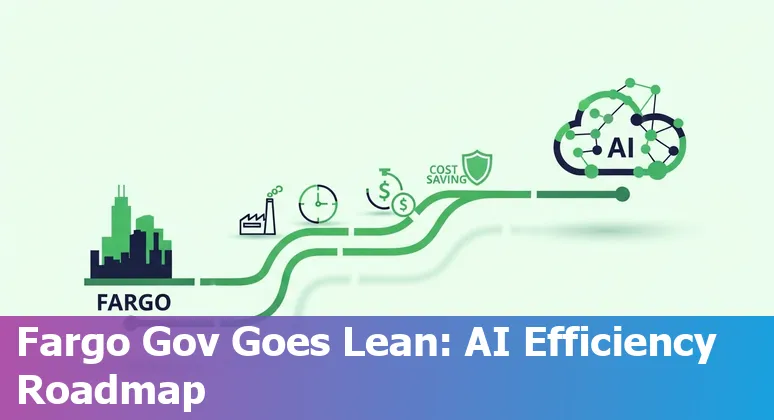
North Dakota agencies in Fargo use AI to cut costs and boost efficiency: NDIT's Cortex reduced open alerts 99.6% (16,000→~50) and auto‑resolves ~60% of incidents, while pilots and upskilling (67 participants, 938 hours) freed capacity equivalent to 8–10 SOC analysts.
North Dakota is turning early generative-AI investment into practical government wins: the state completed a gener8tor cohort with Microsoft to train cross‑agency teams (67 participants, 938 learning hours) to prototype citizen-facing tools and streamline workflows (North Dakota's generative AI cohort).
That focus matters because agencies here already face massive security pressure - roughly 4.5 billion cyberattacks per year - so AI for threat detection and Robotic Process Automation can cut manual processing and lower costs (state cybersecurity scale and workforce analysis).
For staff and small IT teams in Fargo, short, applied training like Nucamp's 15‑week AI Essentials for Work bootcamp teaches prompt writing and tool use to turn those AI pilots into measurable productivity gains.
“We've dramatically increased our Cybersecurity Operations Center... AI helps us speed through 4 billion automated attacks... to be great stewards of the citizens' data.”
Table of Contents
- How NDIT Uses AI to Strengthen Cybersecurity in North Dakota
- Generative AI Upskilling and Cross-Agency Projects in Fargo and North Dakota
- K–12 AI Guidance and Education Initiatives in North Dakota
- AI for Small Businesses and ND SBDC Support in Fargo
- Energy, Data Centers, and the Case for Fargo/North Dakota as an AI Hub
- Workforce Impacts: Jobs, Upskilling, and AI Roles in North Dakota
- Policy, Ethics, and Data Governance for AI in North Dakota
- Practical Steps for Government Teams in Fargo to Start with AI
- Case Study Snapshot: A Fargo Agency's AI Cost Savings Example
- Risks, Challenges, and How Fargo Governments Can Mitigate Them
- Conclusion: The Future of AI for Government in Fargo and North Dakota
- Frequently Asked Questions
Explore why an IPTs and IATs organizational model accelerates safe AI adoption across Fargo departments.
How NDIT Uses AI to Strengthen Cybersecurity in North Dakota
(Up)NDIT consolidated security across 600+ state entities by platformizing its Security Operations Center with Palo Alto Networks' Cortex stack, using AI/ML to automate routine triage and threat hunting so analysts can focus on high‑value forensics and red‑team work; the payoff is concrete - open alerts fell ~99.6% (from ~16,000 to ~50), Cortex XSOAR now automatically resolves roughly 60% of incidents, and Unit 42 managed hunting cut investigation time from weeks to minutes - allowing the team to comfortably monitor over 250,000 endpoints and contribute to statewide defenses that detected or prevented 572,945,827 threats in 2023–24.
Those efficiencies translate to measurable capacity (operational gains equal to 8–10 SOC analysts), lower burnout, and faster cross‑agency sharing through published XSOAR playbooks.
Learn more about the Cortex platform and NDIT's results in the Palo Alto Networks Cortex platform NDIT case study and the NDIT 2023–24 accomplishments report.
| Metric | Value |
|---|---|
| Open alerts reduction | 99.6% (16,000 → ~50) |
| Incidents auto‑resolved | 60% via Cortex XSOAR |
| Endpoints monitored | 250,000+ |
| Threats prevented/detected (FY 23–24) | 572,945,827 |
| Security incidents resolved (FY 23–24) | 53,159 |
| Data ingested daily | 5 TB |
| Analyst efficiency gain | Equivalent to 8–10 SOC analysts |
“The Cortex portfolio has really helped our SOC mature. With so many threats coming in, having that toolset has really been a big benefit for us.” - Michael Gregg, CISO, NDIT
Generative AI Upskilling and Cross-Agency Projects in Fargo and North Dakota
(Up)Statewide upskilling in generative AI in North Dakota combined focused training with cross‑agency collaboration: a 12‑week gener8tor cohort in Fargo and partnered Microsoft TechSpark sessions produced 67 participants who logged 938 learning hours, completed 335 LinkedIn Learning courses, formed 12 teams and delivered 10–11 capstone ideas - three of which were deemed “shovel ready,” including the Dakota chatbot pilot that aims to simplify citizen search across siloed state sites (gener8tor North Dakota 12‑week accelerator: https://www.gener8tor.com/investment-accelerators/north-dakota, FargoInc coverage of North Dakota's generative AI cohort: https://fargoinc.com/the-state-of-north-dakota-is-embracing-generative-ai/).
The practical payoff is immediate: staff gain prompt‑engineering and governance know‑how while prototypes like a legislative tracker and an online research assistant move from concept to pilot, cutting time citizens and clerks spend hunting for answers and creating clear ROI for future deployments.
Metrics: Cohort participants - 67; Learning hours - 938; LinkedIn courses completed - 335; Teams formed - 12; Ideas / shovel‑ready pilots - 10–11 ideas, 3 shovel‑ready.
“Participants were not merely voluntold; they willingly engaged.” - Danie Remmick
K–12 AI Guidance and Education Initiatives in North Dakota
(Up)K–12 AI guidance in North Dakota is being folded into existing NDDPI priorities - accessibility, assistive technology, Universal Design for Learning, and the statewide TIENET IEP database - so any classroom or district AI pilot must align with IDEA compliance and the department's monitoring tools; see the NDDPI Special Education and Accessibility Resources for background (NDDPI Special Education and Accessibility Resources).
The statewide Strategic Vision Framework sets concrete student outcomes - doubling NDSA reading proficiency and increasing ELA/math learning gains by 10 percentage points by 2025–26 - creating measurable success criteria that K–12 AI projects should target (North Dakota PK–12 Strategic Vision Framework).
The practical implication: districts that tie AI tools to IEP workflows, assistive‑tech guidance, and these statewide metrics can demonstrate faster, auditable impact on equity and proficiency rather than deploying models as one‑off experiments.
| Strategic Goal | Target / Year |
|---|---|
| Double NDSA reading proficiency (from 2020–21 levels) | By 2025–26 |
| Increase students meeting expected learning gains in ELA & math by 10 percentage points | By 2025–26 |
| All traditional diploma graduates Choice Ready (annual 5.4% increases) | By 2029–30 |
| Reduce Novice/Partially Proficient for students with disabilities by 12% per year | 5‑year goal |
| Reduce Novice/Partially Proficient for Native American & low‑income students by 25% per year | 5‑year goal |
AI for Small Businesses and ND SBDC Support in Fargo
(Up)Small businesses in Fargo are already seeing practical returns from ND SBDC's hands‑on use of generative tools: advisors use AI to produce session summaries, draft communications, and co‑create business‑plan outlines with clients so meetings shift from note‑taking to strategy and funding readiness - an approach detailed in the ND SBDC “Embracing AI” overview and promoted at events like the May 7 Fargo half‑day summit (ND SBDC: Embracing AI to Drive Small Business Success).
Advisors explicitly invite clients to “meet with one of our advisors” and use AI together to draft outlines and content during sessions, accelerating plan completion and grant/loan preparedness (Meet with an advisor and use AI tools).
The payoff is measurable: by July 2025 the network had served 1,112 unique clients and supported over $55 million in capital formation - so the real “so what?” is clear: AI is shortening the path from advice to capital for Fargo entrepreneurs.
| Metric | Value |
|---|---|
| Unique clients served (YTD July 2025) | 1,112 |
| New businesses launched (YTD) | 73 |
| Capital formation supported (YTD) | $55,000,000+ |
“Without the help of SBDC we wouldn't have known how to start our business the right way. We thank God, our family, and the ND SBDC for the support.”
Energy, Data Centers, and the Case for Fargo/North Dakota as an AI Hub
(Up)North Dakota's cold climate, abundant wind and gas, and spare transmission capacity make Fargo and nearby towns an attractive spot for “AI factories” that cut operating costs and scale quickly: studies and reporting note more than 220 days a year of free cooling and potential annual savings of $30–$50 million for major AI tenants, which is why purpose‑built developers like Applied Digital AI data center solutions are building large campuses in the state and why analysts call the northern Plains an “epicenter for AI infrastructure” in the InForum report on North Dakota AI factories.
Those savings are enabled by next‑gen designs - medium‑voltage powertrains and liquid‑cooling architectures - that shrink conversion losses and PUE while supporting extreme rack densities (see the ABB–Applied Digital MV‑UPS design template for Ellendale), so governments in Fargo can consider colocating sensitive AI workloads regionally to lower vendor OPEX, tap renewable or stranded power, and capture local economic benefits like new tax base and construction jobs.
| Metric | Value |
|---|---|
| Free cooling days | ~220+ days/year |
| Ellendale campus design capacity | 400 MW |
| CoreWeave lease at Ellendale | 250 MW (option for +150 MW) |
| Applied Digital pipeline | 480+ MW constructed; 1.4+ GW future pipeline |
“We presented a challenge to BASX to develop a highly efficient chiller to leverage North Dakota's climate and the demands presented by liquid‑cooled servers.” - Todd Gale, Chief Development Officer, Applied Digital
Workforce Impacts: Jobs, Upskilling, and AI Roles in North Dakota
(Up)North Dakota's tight labor market and legacy staffing gaps mean AI will reshape jobs more than erase them, shifting people out of repetitive processing into higher‑value oversight, governance, and AI‑native roles; practical pathways include skills‑based hiring and short, stacked upskilling so clerks become prompt engineers or auditors rather than unemployed.
Emerging occupations - prompt engineer, AI product manager, human‑machine interaction designer, AI auditor, machine manager and AI ethicist - often emphasize demonstrable skills over traditional degrees and can carry substantial upside (prompt engineers have advertised ranges of $250k–$335k, and machine managers $109k–$251k) per the market trends in the TestGorilla article on AI-driven roles (TestGorilla: 7 roles on the rise because of AI).
Timelines from higher‑education and workforce analyses show routine front‑line tasks will be automated within years, creating immediate demand for governance, tutoring‑oversight, and LLM‑ops skills (see the ETCJournal analysis of AI's impact on college jobs over the next 10–20 years: ETCJournal: AI impact on college jobs in the next 10–20 years), while state analyses argue AI augments capacity if paired with retraining (North Dakota workforce analysis: NDUS: AI will improve, not destroy, our jobs).
So what: by converting routine roles through targeted micro‑credentials and practical on‑the‑job AI coaching, Fargo agencies can plug immediate staffing shortfalls and create locally hireable, higher‑paid positions instead of hiring remotely at premium rates.
Emerging AI roles and reported salary ranges include: Prompt engineer - $250,000–$335,000; Machine manager - $109,000–$251,000; AI ethicist - up to $173,000.
Policy, Ethics, and Data Governance for AI in North Dakota
(Up)North Dakota's AI policy and ethics layer builds on existing education and privacy law, so any municipal or school AI pilot in Fargo must align with FERPA, GEPA and the NDDPI K–12 AI Guidance Framework to protect student data and civil rights (NDDPI K‑12 AI Guidance & privacy authorities).
Local boards that offer virtual instruction must adopt clear policies under HB 1105 and NDAC 67‑30 rules, and the state requires an annual report comparing virtual and in‑person outcomes - making governance a practical, auditable checkpoint rather than an afterthought (North Dakota Virtual Education Options guidance).
Operational details matter: English‑Learner procedures force prompt parent notification (within 30 days) and routine STARS reporting, so design choices about model training data, retention, and access controls directly affect compliance and the district's ability to demonstrate measurable student outcomes to the legislature (NDDPI innovation & implementation guidance).
The upshot: embed privacy and reporting controls from day one - otherwise pilots risk being paused or generating noncompliant records that undermine both trust and measurable ROI.
| Governance item | Relevant fact |
|---|---|
| Legal authorities | FERPA, GEPA, NDDPI K‑12 AI Guidance Framework |
| Virtual instruction policy | Boards must adopt policy per HB 1105 / NDAC 67‑30 |
| Reporting & parent notice | Annual virtual learning report to legislature; EL parent notification within 30 days; STARS deadlines (Sept 15, Dec 1, June 30) |
Practical Steps for Government Teams in Fargo to Start with AI
(Up)Practical steps for Fargo government teams begin with governance and a tiny pilot: follow the NDIT Artificial Intelligence Guidelines - submit an Initiative Intake Request via the NDIT Self‑Service Portal, never input medium‑ or high‑risk data into public AI services, and reserve state credentials for managed enterprise solutions to avoid account collisions (NDIT Artificial Intelligence Guidelines).
Pick a low‑risk, high‑value use case (content curation, meeting summaries, a citizen search chatbot like Dakota) and pair it with short, applied training - North Dakota's gener8tor/Microsoft work highlights a 4.5‑hour Career Essentials course and cohort models that turned 67 learners into cross‑agency project teams - so teams can show measurable time‑savings in weeks, not years (North Dakota generative AI cohort details).
Enforce periodic QA for bias and accuracy, log outcomes for auditability, and treat the first pilot as a governance test that proves ROI while protecting citizen data.
| Step | Action (from state guidance) |
|---|---|
| Governance intake | Submit an Initiative Intake Request via NDIT Self‑Service Portal |
| Starter use cases | Content curation, preliminary research, chatbots (low‑risk pilot) |
| Training | Short courses/cohort model (e.g., 4.5‑hour Microsoft/LinkedIn module) |
| Data handling | Do not enter sensitive data into public services; use managed enterprise accounts for production |
“We talked about the evolution of AI, the trends that they are seeing or anticipating in government, and responsible use of AI.”
Case Study Snapshot: A Fargo Agency's AI Cost Savings Example
(Up)The City of Fargo's recent deployment of Aurigo Masterworks Cloud modernized capital‑project workflows - bringing a $102M capital budget into a single system that integrates with Sungard HTE, ESRI, and Laserfiche and delivers automated permit/document tracking, daily construction‑phase reports, and estimated contract‑payment automation - cutting coordination time and manual paperwork across 20+ departments (Aurigo Masterworks Cloud case study - City of Fargo); paired with NDIT's Cortex platform modernization, which used AI/ML to reduce open security alerts from ~16,000 to ~50 and automatically resolve about 60% of incidents, Fargo agencies can convert thousands of analyst hours into frontline services and project delivery - an efficiency equivalent to 8–10 SOC analysts and a concrete “so what” that frees staff for higher‑value work rather than routine triage (NDIT AI-driven SecOps case study - Palo Alto Networks).
| Metric | Value |
|---|---|
| Fargo capital budget managed | $102M (Aurigo) |
| Capital program value | $300M+ annually |
| Open alerts reduction (NDIT) | 99.6% (16,000 → ~50) |
| Incidents auto‑resolved | ~60% via Cortex XSOAR |
“The Cortex portfolio has really helped our SOC mature. With so many threats coming in, having that toolset has really been a big benefit for us.” - Michael Gregg, CISO, NDIT
Risks, Challenges, and How Fargo Governments Can Mitigate Them
(Up)Fargo governments should treat AI not as a magic cost‑cutter but as a risk‑bearing technology: studies show decisioning models can perpetuate historic bias (one experiment found white applicants were 8.5% more likely to be approved than identical Black applicants), so unchecked automation can produce real harms in lending, benefits, hiring and justice systems (Study: racial bias in AI loan recommendations - North Dakota Monitor).
North Dakota's leaders are already pivoting toward agent‑based tools that make decisions, which raises urgent governance questions about when and how agents should act (North Dakota pivot to agent-based AI - KFYRTV coverage).
Practical mitigation follows national best practices: inventory and impact‑assess every use, require human‑in‑the‑loop review for consequential outcomes, run regular bias and privacy audits, and adopt the NIST AI Risk Management Framework's govern‑map‑measure‑manage approach before scaling pilots (NIST AI Risk Management Framework overview - FedScoop).
The so‑what: a disciplined intake, simple audit cadence, and a human‑review rule can prevent a single automated decision from creating years of litigation, lost benefits, or community distrust.
| Risk | Mitigation |
|---|---|
| Algorithmic bias | Pre/post bias tests; independent audits; stakeholder consultation |
| Data privacy & security | Inventories, restrict sensitive data, enterprise accounts, logging |
| Overreliance on agents | Human‑in‑the‑loop thresholds; phased pilots; monitoring |
| Misinformation & trust | Pre‑bunking, transparent notices, .gov channels |
“Really, the discussion is pivoting more to agent-based AI. AI that can make simple decisions and take action. So, how are we dealing with agents in the future? So what we have to do is get the state ready for that.”
Conclusion: The Future of AI for Government in Fargo and North Dakota
(Up)North Dakota's playbook for AI in government is clear: pair short, applied skilling with strict governance and local infrastructure so pilots become repeatable savings, not one-off experiments - the gener8tor/Microsoft cohort in Fargo turned 67 participants and 938 learning hours into cross‑agency teams and three “shovel‑ready” pilots (for example, the Dakota chatbot) that aim to cut citizen search time and clerical workload (gener8tor/Microsoft Fargo generative AI cohort coverage).
Follow the NDIT intake and data rules to keep sensitive records safe while proving ROI (NDIT Artificial Intelligence Guidelines for North Dakota), and use short, practical courses - like Nucamp AI Essentials for Work bootcamp syllabus - to convert clerks into prompt‑savvy auditors and bot supervisors in weeks.
With local data‑center advantages (≈220 free‑cooling days/year) and this combined approach, Fargo can lower vendor OPEX, keep control of citizen data, and redeploy hundreds of manual hours into higher‑value services.
| Bootcamp | Detail |
|---|---|
| AI Essentials for Work | 15 weeks - Early bird $3,582 - Syllabus: AI Essentials for Work syllabus - Register: Register for AI Essentials for Work |
“We've dramatically increased our Cybersecurity Operations Center... AI helps us speed through 4 billion automated attacks... to be great stewards of the citizens' data.”
Frequently Asked Questions
(Up)How has AI reduced security workload and costs for North Dakota's NDIT?
NDIT platformized its Security Operations Center using Palo Alto Networks' Cortex stack and AI/ML to automate routine triage and threat hunting. Results include a ~99.6% reduction in open alerts (from ~16,000 to ~50), roughly 60% of incidents auto-resolved by Cortex XSOAR, monitoring of over 250,000 endpoints, detection/prevention of 572,945,827 threats in FY 2023–24, and analyst efficiency gains equivalent to 8–10 SOC analysts - translating to lower manual processing, reduced burnout, and measurable operational cost savings.
What practical upskilling and pilot outcomes came from Fargo's generative AI cohort?
A gener8tor/Microsoft cohort in Fargo produced 67 participants who logged 938 learning hours, completed 335 LinkedIn Learning courses, formed 12 teams and delivered 10–11 capstone ideas, with three shovel-ready pilots (including the Dakota chatbot). Short, applied training taught prompt-engineering and governance, enabling prototypes (legislative tracker, online research assistant, citizen search chatbot) to move quickly to pilots and demonstrate measurable time savings for staff and citizens.
How are AI tools being used to help small businesses in Fargo and what are the results?
ND SBDC advisors use generative AI during sessions to produce meeting summaries, draft communications and co-create business-plan outlines with clients, shifting meetings toward strategy and funding readiness. By July 2025 the network served 1,112 unique clients, supported 73 new businesses (YTD) and helped with over $55 million in capital formation - showing AI shortens the path from advice to capital.
What governance and data-handling rules should Fargo government teams follow when piloting AI?
Teams should follow NDIT guidance: submit an Initiative Intake Request via the NDIT Self-Service Portal, avoid entering medium- or high-risk data into public AI services, use managed enterprise accounts for production, perform inventory and impact assessments, require human-in-the-loop review for consequential decisions, run bias and privacy audits, log outcomes for auditability, and apply NIST AI RMF principles (govern-map-measure-manage) before scaling pilots.
What infrastructure and workforce advantages make Fargo/North Dakota suitable for AI deployments?
Fargo/North Dakota offer ~220+ free-cooling days per year, abundant wind and gas, spare transmission capacity and large planned data-center campuses (examples: Ellendale design capacity 400 MW; CoreWeave lease 250 MW). These factors reduce operating costs (estimated $30–$50M annual savings for major tenants) and, combined with short upskilling programs (e.g., 15-week AI Essentials), enable local workforce transitions into AI-native roles (prompt engineers, machine managers, AI auditors) to capture economic benefits while keeping citizen data local.
We highlight how local NRCS forms and AI automation like AD-1026 are examples of routine tasks ripe for machine handling.
Discover how a unified citizen portal can make answers like “How do I start a business?” accessible in plain language.

Ludo Fourrage
Founder and CEO
Ludovic (Ludo) Fourrage is an education industry veteran, named in 2017 as a Learning Technology Leader by Training Magazine. Before founding Nucamp, Ludo spent 18 years at Microsoft where he led innovation in the learning space. As the Senior Director of Digital Learning at this same company, Ludo led the development of the first of its kind 'YouTube for the Enterprise'. More recently, he delivered one of the most successful Corporate MOOC programs in partnership with top business schools and consulting organizations, i.e. INSEAD, Wharton, London Business School, and Accenture, to name a few. With the belief that the right education for everyone is an achievable goal, Ludo leads the nucamp team in the quest to make quality education accessible