









The Complete Guide to Using AI in the Government Industry in Fairfield in 2025
Last Updated: August 18th 2025
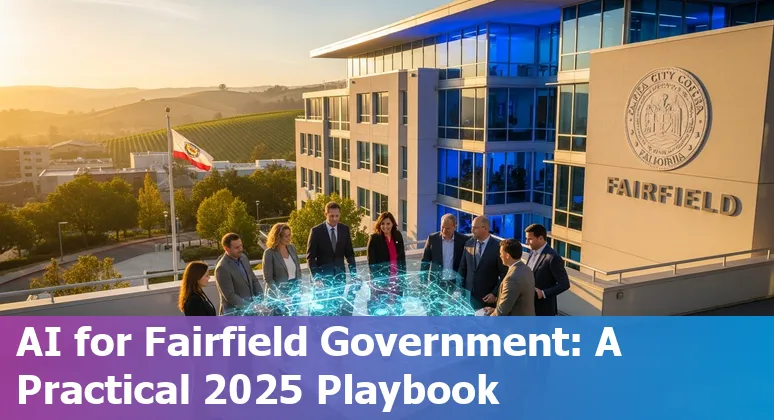
Too Long; Didn't Read:
Fairfield's 2025 AI plan: centralize governance under the city manager, require training‑data provenance, vendor audit rights and decommissioning clauses in contracts, complete NIST RMF pre‑use risk assessments, and pilot chatbots, permit triage, and predictive maintenance with staff upskilling. Cost example: 15‑week bootcamp $3,582.
Fairfield's municipal services - from Finance and Public Works to Police and Information Technology - are organized across ten city departments, meaning any AI rollout will touch billing, permits, public safety and GIS systems simultaneously (Fairfield city departments overview).
Local code requires that “all contracts shall be in writing,” placing an immediate premium on procurement language, data governance, and vendor auditability when buying AI tools (Fairfield contracting rules Chapter 2).
Because the city manager is charged with supervising department operations, a coordinated training and procurement plan will prevent fragmented pilots and legal gaps; practical upskilling options include the AI Essentials for Work bootcamp, which teaches prompt design, tool use, and workplace integration to prepare staff for responsible AI adoption (AI Essentials for Work bootcamp syllabus).
The practical takeaway: align contracts, centralize governance under the city manager, and train frontline staff before vendor deployment to reduce risk and unlock efficiency.
| Attribute | Information |
|---|---|
| Program | AI Essentials for Work |
| Length | 15 Weeks |
| Cost (early bird) | $3,582 |
| Courses included | AI at Work: Foundations; Writing AI Prompts; Job Based Practical AI Skills |
| Registration | Register for the AI Essentials for Work bootcamp (Nucamp registration) |
Table of Contents
- What is AI and What Is AI Used for in 2025? (Fairfield, California Context)
- What is the AI Regulation in the US 2025? Implications for Fairfield, California
- AI Governance and Strategy: Roadmap for Fairfield, California
- Procurement Best Practices for Fairfield, California Government
- Transparency, Disclosure, and Community Engagement in Fairfield, California
- Risk Management: Assessing and Mitigating AI Harms for Fairfield, California
- Sector Use Cases and Pilot Priorities for Fairfield, California
- Industry Outlook and AI for Good in 2025: Opportunities for Fairfield, California
- Conclusion and Action Checklist for Fairfield, California Government Leaders
- Frequently Asked Questions
Connect with aspiring AI professionals in the Fairfield area through Nucamp's community.
What is AI and What Is AI Used for in 2025? (Fairfield, California Context)
(Up)Artificial intelligence in 2025 refers to machine-based systems that learn from data and perform tasks that previously required human intelligence - spanning machine learning, deep learning, natural language processing, computer vision and the now-dominant generative AI foundation models that create text, images, audio and code (IBM AI primer on artificial intelligence).
In a city context like Fairfield, practical public-sector uses include AI chatbots and virtual assistants for customer service, ML models for fraud detection and predictive maintenance of infrastructure, NLP to triage and summarize thousands of citizen comments, and automated content-management that auto-categorizes paper records into workflows to speed permitting and inspections.
That technical power brings clear risks: biased training data, model drift, and cyberattacks can produce unfair or incorrect outcomes - issues California's 2025 state actions now target with automated-decision-system disclosures, provenance and auditing requirements (NCSL 2025 AI legislation tracker).
The practical takeaway: treat any AI tied to permits, housing, or benefits as “high-risk,” require training-data provenance and human review, and bake vendor auditability into contracts so one misconfigured model can't derail a permit decision or erode public trust.
What is the AI Regulation in the US 2025? Implications for Fairfield, California
(Up)Federal action in mid‑2025 tightened the procurement and disclosure expectations that will shape any AI purchase or federal grant used in Fairfield: the July 23 Executive Order on “Preventing WOKE AI in the Federal Government” requires agencies to buy only LLMs that meet two “Unbiased AI Principles” (truth‑seeking and ideological neutrality), directs the OMB to publish implementation guidance within 120 days, and tells agency heads to adopt compliance procedures within 90 days of that guidance - including contract terms that can charge vendors decommissioning costs for noncompliance and permit disclosure of system prompts and evaluations where practicable (Executive Order: Preventing WOKE AI in the Federal Government (July 23, 2025) - full text).
Meanwhile, the U.S. Department of Education's July 22 guidance clarifies how federal K‑12 and higher‑ed grant funds may support responsible AI and opens a public comment period that Fairfield schools and the city should watch when applying for funds (U.S. Department of Education guidance on AI use in schools (July 22, 2025)).
Practical takeaway for Fairfield: mirror federal contract language now - require training‑data provenance, vendor audit rights, a decommissioning‑cost clause, and disclosed system prompts/specs where allowed - so federal grants, school programs, and city procurements remain eligible and legally defensible as federal guidance and deadlines roll out.
| Federal action | Key detail / deadline |
|---|---|
| EO: Unbiased AI Principles | Truth‑seeking & ideological neutrality required for federally procured LLMs |
| OMB guidance | Issue within 120 days of EO (implementation factors, disclosures) |
| Agency procedures | Adopt within 90 days after OMB guidance; include contract enforcement terms |
| Contracts | Must allow vendor decommissioning costs if vendor noncompliance |
| Dept. of Education DCL | Guides responsible AI use with federal education funds; public comment period (comments due Aug 20, 2025) |
“Artificial intelligence has the potential to revolutionize education and support improved outcomes for learners,” said U.S. Secretary of Education Linda McMahon.
AI Governance and Strategy: Roadmap for Fairfield, California
(Up)A practical AI governance roadmap for Fairfield starts by translating DHS/CISA's four-part approach - built on the NIST AI Risk Management Framework - into city operations: create centralized oversight under the city manager with a designated AI program lead, require vendor contract safeguards (audit rights, training‑data provenance, and decommissioning clauses) as part of procurement, and classify every AI use (permits, public safety, billing, GIS) by risk so high‑impact systems receive human review and stricter controls; for contract language and vendor audit examples, see recommended Fairfield government AI data governance and vendor contract safeguards.
Operationalize measurement with repeatable metrics, logging, and scheduled third‑party audits, and embed rapid mitigation and incident response tied to existing emergency plans so a single misconfigured model can't derail a permit decision or erode public trust.
Use DHS's guidance as the compliance baseline - adoptable now - to ensure procurement, training, and monitoring align with federal best practices and make audits and transparency a routine deliverable (DHS safety and security guidelines for critical infrastructure AI).
| DHS Category | Fairfield Action |
|---|---|
| Govern | Centralize oversight; designate AI program lead; contract safeguards |
| Map | Inventory AI uses; classify high‑risk systems (permits, public safety, infrastructure) |
| Measure | Define metrics, logging, continuous monitoring, and third‑party audits |
| Manage | Prioritize mitigations, incident response, and vendor decommissioning plans |
“AI can present transformative solutions for U.S. critical infrastructure, and it also carries the risk of making those systems vulnerable in new ways to critical failures, physical attacks, and cyber attacks.”
Procurement Best Practices for Fairfield, California Government
(Up)Make every AI purchase contractualized: centralize procurement under the CIO/city manager, require vendors to deliver a GenAI Disclosure and Fact Sheet, and contractually bind them to publish the training‑data provenance that California now mandates - AB 2013 requires developers to post high‑level dataset summaries for systems made available to Californians and forces disclosure of sources, timeframes, and whether data includes personal or copyrighted material (compliance required by Jan 1, 2026 for systems used since Jan 1, 2022) (California AB 2013 generative AI disclosure rules).
Follow the California procurement playbook: run pre‑procurement risk and impact assessments, demand a CDT‑administered GenAI assessment for intentional purchases, require vendor audit rights and third‑party testing, and include notification and decommissioning clauses if a vendor materially changes a model or adds GenAI functionality without consent (California generative AI procurement guidelines and best practices).
Practical payoff: a clause requiring a vendor‑hosted dataset disclosure page plus contractual auditability turns an opaque black box into a manageable compliance deliverable - so the city can safely pilot chatbots or permit‑automation without triggering retroactive disclosure gaps or unexpected legal exposure (Fairfield, CA official AI governance and resources).
| Procurement action | Required deliverable / deadline |
|---|---|
| Vendor disclosures | GenAI Disclosure & Fact Sheet; website dataset summary (AB 2013) - compliance by Jan 1, 2026 |
| Pre‑procurement | CIO risk evaluation; CDT‑administered GenAI assessment for intentional purchases |
| Contract safeguards | Audit rights, third‑party testing, notification of model changes, decommissioning clause |
Transparency, Disclosure, and Community Engagement in Fairfield, California
(Up)Transparency must be operational, not rhetorical: Fairfield should publish clear GenAI disclosure pages for any city tool, run regular public demos and training sessions, and require vendors to deliver both manifest/latent disclosures and a free detection tool as California's AI Transparency Act mandates (effective Jan 1, 2026), turning abstract promises into auditable deliverables (Fairfield AI resources - official city AI information and guidance).
Pair those disclosures with independent third‑party verification and a simple adverse‑event reporting channel so community members can see what data informed a decision, who reviewed it, and how to appeal - actions echoed in the state's frontier‑AI guidance that elevates provenance, public disclosure, and whistleblower protections as core safeguards (California AI Transparency Act requirements and guidance).
The practical payoff: a single, public dataset provenance page plus quarterly community briefings makes AI procurement auditable, reduces litigation risk, and preserves trust when a contested permit or public‑safety alert depends on automated analysis.
| Transparency action | Source / note |
|---|---|
| Public GenAI disclosure and community education | Fairfield AI resources - city recommends openness and engagement |
| Detection tools + manifest/latent disclosures (watermarking) | California AI Transparency Act - effective Jan 1, 2026 |
“Safety of Californians” is the top priority.
Risk Management: Assessing and Mitigating AI Harms for Fairfield, California
(Up)Risk management in Fairfield must move from checklist to control plane: begin by inventorying every city AI system and applying the NIST AI RMF as Fairfield's Technology Risk Management Program plans to do, so each permit‑automation, housing decision, or hiring tool is classified by impact and assigned mitigation owners (Fairfield AI Technology Risk Management Program and NIST AI RMF guidance).
California's finalized privacy rules force a practical sequencing: conduct documented risk assessments before any “high‑risk” processing (sensitive data, ADMT used for significant decisions), maintain the assessment record, and be ready to certify and summarize those assessments to the CPPA under the new ADMT/risk‑assessment regime that takes effect in 2026 with phased audit/reporting obligations beginning in 2028 (California CPPA ADMT and privacy risk-assessment rules (2026–2028)).
Parallel civil‑rights rules - effective Oct. 1, 2025 - clarify that automated employment decisions can violate antidiscrimination law and require retention of automated‑decision records for four years, so any HR or hiring pilots must include bias testing, human‑in‑the‑loop review, and vendor audit rights from day one (California Civil Rights Council AI employment regulation details (effective Oct 1, 2025)).
The bottom line: a single missed pre‑use risk assessment or absent vendor audit clause can convert a useful pilot into a compliance liability - treat inventory, impact testing, vendor auditability, and documented mitigation plans as non‑negotiable controls now so Fairfield can safely scale AI across permits, public safety, and services without triggering state audits or discrimination claims.
| Trigger / Action | Required deliverable / date |
|---|---|
| City inventory & baseline (NIST AI RMF) | Inventory AI systems; perform current‑state analysis (Fairfield plan) |
| CPPA risk assessments | Pre‑use risk assessment for high‑risk processing; effective Jan 1, 2026; annual summaries/certifications begin Apr 1, 2028 |
| Civil Rights Council employment rules | Automated‑decision data retention: 4 years; regs effective Oct 1, 2025 |
"Using AI or other automated decision tools to make decisions about patients' medical treatment, or to override licensed care providers' determinations ... may violate California's ban on the practice of medicine by corporations and other 'artificial legal entities.'"
Sector Use Cases and Pilot Priorities for Fairfield, California
(Up)Prioritize pilots that pair clear public value with manageably scoped data and strong governance: expand the Archie chatbot (an AI assistant that interacts via the My FairfieldCA portal, supports 71 languages, and routes non‑emergency reports like potholes and streetlight outages) as the low‑risk, high‑visibility customer‑service pilot to prove consented automation and community outreach (Archie chatbot - GovLaunch project for Fairfield CA); run a permit‑automation pilot that ties AI document‑triage to existing DocuSign workflows and CompStat-style dashboards so clerks and inspectors retain human review while reducing manual routing friction (Fairfield IT projects summary and current initiatives); pilot predictive maintenance for fleet, telemetry, and SCADA assets (building on AssetWorks and recent telemetry upgrades) to shift repairs from reactive to scheduled work while keeping security hardening in place; and test AI-assisted case‑triage inside the Social Solutions houseless case management system to preserve the demonstrated cross‑department collaboration between CMO and Police.
Each pilot must be preceded by an inventory and NIST AI RMF baseline as Fairfield's AI plan recommends so the city can classify risk, require vendor auditability, and scale only those pilots that meet disclosure and governance gates (Fairfield AI plan and NIST AI RMF guidance).
The practical rule: start public-facing, low‑sensitivity pilots with measurable handoffs to humans and written vendor safeguards so one pilot's success becomes a repeatable pattern for other departments.
| Pilot | Lead Dept. | Priority / Why |
|---|---|---|
| Archie multilingual chatbot | IT / Customer Service | Low‑risk access & public engagement; routes non‑emergency reports |
| Permit document triage + DocuSign | Community Development / IT | Automates routing while preserving human review |
| Predictive maintenance (fleet/SCADA) | Public Works / Infrastructure | Leverages telemetry and AssetWorks data to schedule repairs securely |
| AI‑assisted houseless case triage | Homeless Services / CMO | Augments Social Solutions case management to improve cross‑agency coordination |
Industry Outlook and AI for Good in 2025: Opportunities for Fairfield, California
(Up)Fairfield can turn regulation and risk controls into a local economic advantage by leaning into two parallel movements already active in California: the GovAI Coalition's government‑by‑government playbook and the state's industry partnerships to upskill talent.
Joining or aligning with the GovAI Coalition gives Fairfield immediate access to ready‑made AI policy templates, vendor expectations, and cooperative purchasing models that hundreds of cities are already using to demand dataset provenance and audit rights from suppliers (GovAI Coalition templates and resources for local governments), while Governor Newsom's August 2025 agreements with Google, Adobe, IBM, and Microsoft open no‑cost training pathways for community colleges and K–12 that cover more than two million students statewide - an inexpensive pipeline to retrain clerks and inspectors into data‑steward and AI‑ops roles (California tech partnership and workforce programs for AI training).
The practical payoff: by adopting coalition templates and tapping state training, Fairfield can require vendor auditability as a procurement precondition and upskill staff within an academic term, turning compliance burdens into repeatable, low‑risk pilots that scale service improvements without sacrificing transparency.
| Opportunity | Concrete detail / source |
|---|---|
| GovAI Coalition adoption | Templates & resources used by hundreds of local governments; over 100 agencies adopting materials (GovAI Coalition / SPUR) |
| State tech partnerships | Google, Adobe, IBM, Microsoft programs covering 2+ million students at no cost to the state (Governor Newsom Aug 7, 2025) |
"AI is the future - and we must stay ahead of the game by ensuring our students and workforce are prepared to lead the way. We are preparing tomorrow's innovators, today."
Conclusion and Action Checklist for Fairfield, California Government Leaders
(Up)Action checklist for Fairfield leaders: 1) Centralize AI governance under the city manager with the CIO as procurement gatekeeper and update vendor contracts now to require training‑data provenance, audit rights, and decommissioning clauses (see recommended data governance and vendor contract safeguards for Fairfield government AI); 2) complete a citywide AI inventory and NIST‑aligned pre‑use risk assessment before any pilot expands beyond a single department; 3) prioritize low‑sensitivity, high‑visibility pilots (customer service/chatbot, permit triage, predictive maintenance) that include human review gates and public disclosure pages; and 4) fast‑track staff upskilling so clerks and inspectors can become accountable data stewards - consider cohort training such as the AI Essentials for Work bootcamp - registration & syllabus to teach prompt design, tool use, and workplace integration.
The practical rule: require written risk assessments + contractual auditability up front so one pilot's success becomes a repeatable, transparent program rather than a legal or public‑trust liability.
| Checklist item | Lead department | Why it matters |
|---|---|---|
| Centralize governance & procurement language | City Manager / CIO | Prevents fragmented pilots and ensures enforceable vendor obligations |
| Inventory & NIST RMF pre‑use risk assessments | IT / All departments | Classifies high‑risk systems and documents mitigation for audits |
| Start low‑risk public pilots with human review | IT / Customer Service / Community Development | Delivers measurable public value while protecting residents |
| Upskill staff as data stewards | HR / City Manager | Transforms at‑risk roles into accountable AI operators |
Frequently Asked Questions
(Up)What immediate steps should Fairfield take to govern and procure AI safely in 2025?
Centralize AI governance under the city manager with the CIO as the procurement gatekeeper; require written vendor contract safeguards (training‑data provenance, vendor audit rights, notification of model changes, and a decommissioning‑cost clause); run pre‑procurement risk and impact assessments (CDT GenAI assessment where required); and update all contracts to be in writing to meet local code and federal/state expectations.
Which regulations and deadlines should Fairfield plan for when deploying AI?
Key items include the mid‑2025 federal Executive Order requiring unbiased LLM principles and OMB/agency implementation timelines (OMB guidance within 120 days; agency procedures adopted within 90 days thereafter), California AB 2013 dataset disclosure requirements (website dataset summaries for systems used since Jan 1, 2022; compliance by Jan 1, 2026), the California AI Transparency Act (manifest/latent disclosures and detection tools effective Jan 1, 2026), CPPA ADMT/risk‑assessment regime (pre‑use risk assessments effective Jan 1, 2026; phased reporting/audits beginning 2028), and civil‑rights automated‑decision rules (effective Oct 1, 2025) including 4‑year retention for automated‑decision records.
How should Fairfield classify and manage AI risks across departments?
Inventory every AI system and apply the NIST AI Risk Management Framework (Map → Measure → Manage → Govern). Classify uses (permits, public safety, billing, GIS) by impact so high‑risk systems require documented pre‑use risk assessments, human‑in‑the‑loop review, logging/metrics, continuous monitoring, third‑party audits, and clear mitigation/incident‑response plans tied to existing emergency procedures.
Which pilot projects should Fairfield prioritize first and why?
Start with low‑sensitivity, high‑visibility pilots that have clear human handoffs: expand the Archie multilingual chatbot for customer service and non‑emergency reports; run permit document triage integrated with DocuSign while preserving human review; pilot predictive maintenance for fleet and SCADA assets using telemetry; and test AI‑assisted houseless case triage within Social Solutions. Each pilot must follow an inventory and NIST RMF baseline and include vendor auditability and public disclosures.
How can Fairfield upskill staff and leverage external resources to implement AI responsibly?
Fast‑track staff training to create data stewards and AI‑ops roles - examples include cohort bootcamps like 'AI Essentials for Work' (15 weeks, early‑bird cost $3,582) covering prompt design, tool use, and workplace integration. Also join or align with the GovAI Coalition for policy templates and cooperative purchasing, and tap state tech partnership training (agreements with major vendors offering no‑cost programs) to scale upskilling affordably.
City leaders can adopt NIST AI RMF governance actions to ensure transparent, safe AI deployments.
Discover how AI's role in local government is reshaping services and budgets in Fairfield, CA.
Discover the benefits of AI-driven GIS and environmental monitoring for flood mapping and land-use planning in Fairfield.

Ludo Fourrage
Founder and CEO
Ludovic (Ludo) Fourrage is an education industry veteran, named in 2017 as a Learning Technology Leader by Training Magazine. Before founding Nucamp, Ludo spent 18 years at Microsoft where he led innovation in the learning space. As the Senior Director of Digital Learning at this same company, Ludo led the development of the first of its kind 'YouTube for the Enterprise'. More recently, he delivered one of the most successful Corporate MOOC programs in partnership with top business schools and consulting organizations, i.e. INSEAD, Wharton, London Business School, and Accenture, to name a few. With the belief that the right education for everyone is an achievable goal, Ludo leads the nucamp team in the quest to make quality education accessible