









How to Become an AI Engineer in Cyprus in 2026
By Irene Holden
Last Updated: April 11th 2026
Quick Summary
You can become an AI engineer in Cyprus in 12 months by following a structured roadmap - learn Python and ML fundamentals, build MLOps skills, and complete three to five Cyprus-relevant portfolio projects - committing roughly 15 to 20 hours per week. With Cyprus’ AI adoption still low at 3.2 percent in 2023 (meaning strong hiring opportunity), EU market access and a 12.5 percent corporate tax rate, plus affordable local bootcamps from about €1,950 and programs reporting roughly a 78 percent graduate employment rate, the path is realistic if you combine focused study with industry-aligned projects.
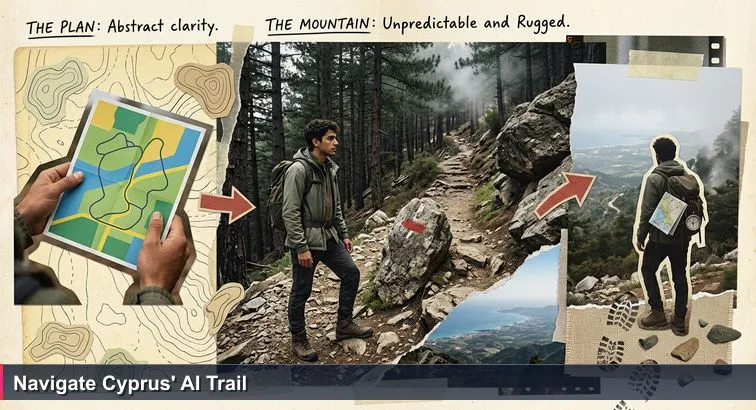
You unfold the glossy Troodos trail map: “Easy loop, 3 hours, well marked.” An hour later, the blazes fade, the path forks, and your calves are on fire. Getting into AI in Cyprus often feels the same: the internet hands you a perfect roadmap, but the ground under your feet - local employers, EU rules, tax incentives - looks nothing like Silicon Valley.
On this island, the “terrain” matters. AI adoption was only 3.2% in 2023, yet the GAIA report mapped over 100 AI-related organisations and a rapidly maturing ecosystem of visionary startups and corporate teams, as covered by the Cyprus Mail’s GAIA summary. Add an EU-regulated environment (AI Act compliance), a very attractive 12.5% corporate tax rate, and tech-heavy hubs in Limassol and Nicosia, and your roadmap has to be drawn for Cyprus, not California.
Set your minimum gear
Before you climb, make sure you have just enough “kit” to learn effectively without over-spending.
- Math & language: comfort with high-school algebra; functional English (most AI content and code).
- Machine: a mid-range laptop with 8-16GB RAM; GPU is optional early on.
- Nice-to-have: stable broadband and, if possible, an external monitor for long coding sessions.
Pro tip: if your laptop struggles with larger models, plan to rent cloud GPUs later instead of replacing hardware.
Choose your weekly time budget
- Standard 12-month route: 15-20 hours/week.
- Accelerated 6-month route: 25-30 hours/week.
- Extended 18-24-month route: 8-10 hours/week.
Warning: local employers already rank AI and cloud skills among the top tech needs, but burnout is real - Cyprus-focused guides like Nucamp’s overview of the most in-demand tech jobs in Cyprus assume a consistent, sustainable pace, not all-nighters.
Steps Overview
- Before you start: Cyprus essentials and setup
- Choose your route and set a realistic plan
- Months 1-3: Build math, Python and data foundations
- Months 4-6: Core machine learning and practical projects
- Months 7-9: Deep learning, NLP and domain specialisation
- Months 10-12: Data engineering, MLOps and capstone
- Designing strong Cyprus-relevant portfolio projects
- Plug into the Cyprus AI ecosystem and training options
- Verify your skills: end-of-journey checklist
- Troubleshooting and common mistakes to avoid
- Common Questions
Choose your route and set a realistic plan
Standing at that Troodos fork with three fading paths, you realise the map never told you which one matches your fitness, daylight, or weather. Choosing how to learn AI in Cyprus is the same: a generic “12-month roadmap” is useless unless it matches your background, schedule, and the kinds of roles firms in Limassol and Nicosia are actually hiring for.
Read the terrain before you pick a path
Start by being brutally honest about three things: your current technical level, how many focused hours you can protect each week, and whether you need a credential, a portfolio, or both. A recent wave of AI hiring in banking, iGaming and telecom means employers care less about where you learnt, and more about whether you can ship production systems that solve their problems.
Compare your main routes
| Route | Typical commitment | Strength in Cyprus | Best for |
|---|---|---|---|
| University track (UCY, CUT, EUC, NUP, CIU) | 3-5+ years part/full-time | Deep theory, EU-aligned research such as the MSc in Artificial Intelligence at UCY | Students or professionals wanting a formal degree |
| Nucamp bootcamps | 15-25 weeks, evenings/weekends | Affordable (€1,950-€3,660), live workshops in Nicosia/Limassol/Larnaca, ~78% employment and ~75% graduation rates | Career changers who need structure and portfolio projects |
| Self-directed online | Flexible, risk of drifting | Access to global courses (Coursera, fast.ai, OpenClassrooms), easy to tailor to fintech/iGaming/telecom | Highly disciplined learners, often with prior CS background |
Lock in a realistic 12-month plan
Once you’ve chosen a primary route, sketch a year as a series of “elevation gains”: months 1-3 on Python, math and SQL; 4-6 on core ML; 7-9 on deep learning and Cyprus-specific domains; 10-12 on deployment and a capstone. If you enrol in Nucamp’s Back End, SQL and DevOps with Python, AI Essentials for Work, or Solo AI Tech Entrepreneur bootcamps, align their 15-25-week syllabi with these phases so that every assignment feeds into a Cyprus-relevant portfolio, not just another tutorial notebook.
Months 1-3: Build math, Python and data foundations
Those first three months are like the long incline out of the Troodos car park: not dramatic, but if you rush or skip sections, everything higher up feels like thin air. In Cyprus terms, this is where you build the math, Python and data fluency that Limassol fintechs and Nicosia iGaming teams quietly assume you already have when you walk into an interview.
Month 1: Python fundamentals and basic statistics
Commit to writing Python every single day. Your targets for Month 1:
- Core syntax: variables, lists/dicts, conditionals, loops, functions and modules.
- Working in both Jupyter notebooks and plain .py files.
- Basic statistics: mean, median, variance, standard deviation and simple distributions.
Practice by scripting small utilities: grab daily FX rates from a public API, calculate summary stats, then save them to CSV; or build a CLI that ingests your electricity meter readings and outputs monthly averages. Pro tip: initialise a Git repository on day one and push everything to GitHub - local employers care that you can work with version control.
Month 2: Math intuition plus NumPy and Pandas
Next, give yourself a practical tour of linear algebra and calculus while you learn vectorised code:
- Vectors, matrices, dot products, matrix multiplication and a conceptual feel for eigenvalues.
- Derivatives and gradients, including numerical approximations.
- NumPy arrays and Pandas DataFrames for columnar data.
Re-implement a vector dot product and matrix multiplication in pure Python, then speed them up with NumPy. Load a CSV of monthly tourist arrivals to Cyprus and clean, aggregate and plot the data. Use a checklist like Coursera’s machine learning learning roadmap to ensure you’re covering the right math concepts.
Month 3: SQL, data cleaning and your first Cyprus mini-project
Month 3 is about talking to real data like a professional:
- Learn SQL: SELECT, WHERE, JOIN, GROUP BY, ORDER BY on PostgreSQL or MySQL.
- Clean messy CSVs: missing values, wrong types, outliers.
- Ship a mini-project, for example a tourism analytics report for a small Ayia Napa hotel.
Design a simple database of bookings, ingest data, then answer questions such as top nationalities per month or average stay length by season. Warning: do not treat SQL as optional; in banking, telecom and professional services across Cyprus, weak SQL is a fast way to stall your AI journey at the first fork in the trail.
Months 4-6: Core machine learning and practical projects
By Months 4-6 you’ve left the forest road and hit the switchbacks: this is where Python scripts and tourist CSVs turn into real models. In Cyprus, this is also the point where your skills start to look hireable to a Limassol fintech or Nicosia iGaming firm, because you’re no longer just analysing data - you’re predicting behaviour with clear metrics.
In Month 4, focus on supervised learning with scikit-learn. You should be able to explain and implement regression vs classification, and work with linear/logistic regression, decision trees, random forests and gradient boosting. Always split data into train/validation/test to avoid leakage. A practical exercise is a Cyprus real-estate model predicting price per square metre from area, district and distance to sea; compare models using RMSE and MAE for regression, or accuracy and F1 if you bucket prices into classes.
Month 5 is where you get serious about evaluation and feature engineering, then wrap it into a fintech-style mini-project. Learn to use ROC-AUC, precision, recall, F1 and confusion matrices, and to encode categorical variables, scale features and handle missing values. For a credit risk or fraud detection project that mimics a Limassol broker or local bank, target at least ROC-AUC ≥ 0.75 on validation and track precision at the top 10% highest-risk predictions. Guides like upGrad’s structured overview of how to learn artificial intelligence step by step can help you sanity-check that you’re covering the right evaluation skills.
Month 6 introduces unsupervised learning and your first neural network. Learn k-Means and DBSCAN for clustering, and PCA or t-SNE/UMAP for dimensionality reduction. A strong Cyprus-relevant project is customer segmentation for a Nicosia retailer: cluster customers by spend, categories and visit frequency, then assess quality with the silhouette score and, crucially, how interpretable each segment is for marketing. Only then move to a simple feedforward neural net on a reasonably sized dataset, so your deep learning foundations rest on solid ML instincts rather than just copying notebook code.
Months 7-9: Deep learning, NLP and domain specialisation
By Month 7 you’re above the tree line: the views are better, but every mistake costs more energy. This is where you turn from “person who can train models” into someone who can handle the heavier air of deep learning, sequence data and Cyprus-specific domains like telecom, iGaming and tourism.
“We’ll see a broader awakening around real, scalable AI… AI diligence is no longer just a technical concern, it’s a leadership discipline.” - Tom Clayton, CEO, IntelliAM, in Navigate VC’s expert AI predictions
Month 7: Deep learning and time series
Your goal is to understand why neural networks work, not just call .fit() on a tutorial. Focus on:
- Feedforward networks, activation functions and basic regularisation.
- CNNs for patterns in images and structured grids.
- RNNs/LSTMs (or modern alternatives) for sequences and time series.
Anchor this with a telecom-style project: forecast hourly network load for a CYTA/Epic-like operator using historical traffic plus features like hour, weekday and holidays. Compare simple baselines (moving average, ARIMA) with an LSTM or temporal CNN, and track MAPE/RMSE across regions to show where deep models really add value.
Month 8: NLP, Greek/English data and LLMs
Next, move into language. Learn tokenisation, embeddings and transformers, then fine-tune a multilingual model on a Greek/English sentiment task, such as restaurant or hotel reviews. In parallel, build a small Retrieval-Augmented Generation assistant that answers Cyprus residency or tax questions from official PDFs, paying attention to token limits, context windows and answer accuracy.
Month 9: Pick your Cyprus domain
Finally, specialise. Choose one or two sectors and go deep:
- iGaming: player churn prediction and simple game recommendations.
- Tourism: seasonal demand forecasting for airports or hotels.
- Health: appointment no-show prediction for a Nicosia clinic.
Each project should declare metrics upfront (e.g., recall on high-value churners, MAPE vs baseline, F1 for no-shows) and end with a short, honest write-up of results and limitations - the kind of diligence local employers rarely see from CVs alone.
Months 10-12: Data engineering, MLOps and capstone
When you hit Months 10-12, you’re not just “learning ML” anymore - you’re learning to keep models alive in the wild. This is exactly where Cypriot employers like XM, Exness, InData Labs or Playtech start paying attention: they need people who can move from notebook experiments to production-grade systems with monitoring, automation and rollback, a shift echoed in practical AI engineer paths such as the OpenClassrooms AI Engineer program.
In Month 10, focus on data engineering basics and ETL. Build a daily batch pipeline for synthetic banking or payments data that:
- Extracts CSV/JSON files from a “raw” bucket or folder.
- Validates schema and runs data-quality checks (nulls, ranges, duplicates).
- Transforms and loads clean tables into PostgreSQL or another warehouse.
Wrap this job in a Docker image so it can run the same on your laptop or a cloud VM. Use simple orchestration (cron, Airflow or Prefect) to schedule runs and log basic stats such as row counts and % of records passing validation.
Month 11 is about turning a trained model into a service. Take your best churn, risk, or forecasting model and:
- Expose it via a FastAPI or Flask endpoint that validates inputs and returns a versioned prediction.
- Add unit tests and smoke tests that run on every push.
- Set up GitHub Actions (or similar CI) to run tests and build/push a Docker image automatically.
Deploy to Azure or AWS - both common in Limassol and Nicosia - and log latency, error rates and simple business metrics (e.g., number of high-risk alerts per day).
Month 12 is your capstone. Choose one Cyprus-focused system - fintech risk platform, iGaming player-intelligence service, or tourism demand and pricing engine - and stitch everything together: automated data ingestion, training script, stored artifacts, API, container, deployment and monitoring. Finish with a clear README and architecture diagram. This becomes your summit photo: proof you can navigate from raw data to a running, maintained AI product in Cyprus’s real terrain.
Designing strong Cyprus-relevant portfolio projects
Think of your portfolio as the cairns on a Troodos ridge: small stone piles that quietly prove someone has walked this way before. In Cyprus, where firms like XM, Exness and InData Labs are hungry for people who can solve their problems, your projects need to look and feel local - not like copy-pasted Kaggle tutorials.
| Domain | Project idea | Core stack | Target metrics |
|---|---|---|---|
| Banking / fintech | Retail credit scoring under EU constraints | Python, SQL, scikit-learn/XGBoost, FastAPI, Docker | ROC-AUC ≥ 0.78, precision @ top 20% risk, stability over time (PSI) |
| iGaming (Limassol) | High-value player churn and bonus targeting | Pandas, scikit-learn, FastAPI | Recall for top-spend decile, uplift vs random targeting, retained revenue estimate |
| Telecom | Network anomaly detection for CYTA/Epic-style KPIs | Python, PyOD, time-series plots | Precision @ top N anomalies, time-to-detection, daily false-positive rate |
| Tourism & logistics | Airport/port traffic forecasting | Prophet or DL time-series, Pandas | MAPE vs naive baseline, seasonal accuracy, scenario forecasts |
| Greek/English NLP | Review sentiment & topic analysis for local businesses | HuggingFace transformers, spaCy | F1 by language, topic coherence, human-aligned sample outputs |
Use the table as a menu, not a checklist. Pick three to five projects that match where you want to work - for instance, an iGaming churn model and telecom anomaly detector if you’re aiming at Limassol and Nicosia engineering teams spotlighted in overviews of leading AI development companies.
For each project, tell a clear story: the Cyprus business problem, your assumptions, your design choices, and what the numbers actually mean. Local career guides, like the step-by-step roadmap for AI professionals in Cyprus on Cyber Shop Cyprus, consistently stress that a strong portfolio beats a long CV - especially when every repo looks like it could plug straight into a Cypriot product team tomorrow.
Plug into the Cyprus AI ecosystem and training options
Maps don’t show the weather, and AI roadmaps don’t show the ecosystem you’re walking into. The GAIA mapping of Cyprus’ AI economy found 116 organisations spread across “visionaries”, “leaders”, “niche players” and “challengers”, which means your learning path now intersects with real labs, startups and corporate teams. Add EU membership, a 12.5% corporate tax rate and dense tech clusters in Limassol and Nicosia, and plugging into this network becomes part of your training, not an optional extra.
Start with universities and research centres, even if you’re not enrolled. The University of Cyprus runs an AI Center and an MSc in Artificial Intelligence with strong ethics and explainability components. Cyprus University of Technology feeds talent into data and communications projects, while Neapolis University Pafos offers a BSc in Computer Science and Artificial Intelligence in partnership with JetBrains. European University Cyprus runs a fully online MSc in AI, and Cyprus International University’s Artificial Intelligence Engineering degree gives you hardware-software lab experience. Many of these are tied into EU-backed initiatives like MAI4CAREU, listed among the AI masters supported by the Connecting Europe Facility.
Layer in structured, practice-heavy training. Nucamp’s Back End, SQL and DevOps with Python (16 weeks, about €1,950), AI Essentials for Work (15 weeks, about €3,300) and Solo AI Tech Entrepreneur (25 weeks, about €3,660) give Cyprus-based learners affordable paths compared with many €10k+ bootcamps. With ~78% employment and ~75% graduation rates plus a 4.5/5 Trustpilot score (around 80% five-star reviews), they’re a pragmatic bridge from theory to portfolio.
Finally, tap into the broader ecosystem: grants from the Research and Innovation Foundation, diaspora links through Minds in Cyprus, and meetups or hackathons hosted by UCY, EUC, CIU, NUP or major firms like PwC, Deloitte, EY and KPMG. Aim to move from attendee to participant: ask questions, demo a project, or join a weekend hackathon in Nicosia or Limassol so your name begins to circulate alongside your GitHub.
Verify your skills: end-of-journey checklist
At the viewpoint above the Troodos pines, you finally see the whole loop you’ve walked. This checklist is that same moment for your AI journey: a way to confirm you’re not just following tutorials, but actually able to work as an AI engineer in Cyprus’ real economy.
Foundations and coding discipline
You’re past “copy and paste” if you can consistently:
- Write clean, modular Python with functions, tests and clear docstrings.
- Use Git confidently: branches, pull requests and meaningful commit messages.
- Query relational data with multi-table SQL joins and aggregations to answer business questions.
- Explain gradients, overfitting/underfitting and basic probability in plain language.
Machine learning and deep learning fluency
Your models are no longer black boxes if you can:
- Train and compare several supervised and unsupervised models, choosing metrics that fit the problem.
- Build and debug at least one convolutional and one sequence or transformer-based network.
- Work end-to-end on real, messy data rather than only benchmark datasets.
Production readiness and MLOps
Local employers expect “builders”, a theme echoed in practical guides such as Educative’s overview of how to become an AI engineer. You’re in that category if you can:
- Construct pipelines from ingestion to training, evaluation and artifact storage.
- Containerise services with Docker and wire up basic CI to run tests on every push.
- Deploy a model API to a major cloud provider and monitor latency, failures and simple business KPIs.
Cyprus context and professional readiness
You’re ready for the local trail if you also:
- Maintain three to five documented projects aligned with Cypriot sectors such as finance, telecoms, tourism or professional services.
- Understand, at a high level, how EU AI regulation affects high-risk use cases like credit, health or employment.
- Have participated in at least one local AI event, hackathon or seminar and can talk about your work with confidence and clarity.
Troubleshooting and common mistakes to avoid
Even with a good map, hikers still get turned around in Troodos. The same happens on the AI trail in Cyprus: people with talent stall not because they’re lazy, but because a few predictable mistakes quietly compound over months.
The most common traps:
- No fixed schedule: “I’ll study when I can” becomes zero hours by Month 3.
- Endless tutorials: binge-watching courses without building your own projects.
- Toy-only datasets: Titanic, Iris, MNIST - nothing that looks like Cypriot banking, iGaming or telecom data.
- Ignoring SQL and MLOps: great notebooks, no idea how to deploy or monitor a model.
- Over-aggressive timelines: trying to do a 6-month plan on top of a full-time job and family, then burning out.
To get back on track, treat troubleshooting as you would debugging code:
- Reduce scope: instead of “learn deep learning this month”, commit to “ship one telecom time-series model with clear MAPE targets”.
- Add constraints: 10-15 focused hours per week, scheduled in your calendar like meetings.
- Switch from passive to active: for every hour of video, spend at least one hour re-implementing ideas on Cyprus-relevant data.
- Introduce “production” early: containerise even a simple churn model and set up one CI job so you don’t bolt MLOps on at the end.
Companies that successfully roll out AI systems follow a similar pattern: they narrow scope, define metrics and build feedback loops, instead of chasing every shiny model, a discipline highlighted in practical implementation guides like the AI implementation roadmap from Fram. Apply that mindset to your own learning: shorter loops, clearer signals, and regular course-corrections based on what Cypriot employers actually use - not what went viral on YouTube.
Common Questions
Can I become an AI engineer in Cyprus in 12 months, and what will it realistically require?
Yes - the article’s 12-month roadmap assumes ~15-20 hours/week and covers Python, math, SQL, core ML, deep learning, MLOps and a Cyprus-relevant capstone. You’ll need comfort with high-school algebra, functional English, and a mid-range laptop (8-16GB RAM); you can push to a 6-month pace only if you can commit ~25-30 hours/week.
Which learning route should I pick in Cyprus: university, bootcamp, or self-study?
Choose by trade-offs: university (e.g., UCY MSc) if you want deep theory and multi-year commitment; bootcamps like Nucamp if you want practical, structured, part-time training (programs ~€1,950-€3,660 with ~78% reported employment outcomes); self-study is cheapest but needs strong discipline and a clear project plan.
Do I need an expensive GPU to get started, or can I rely on cloud resources?
You don’t need an expensive GPU to start - early months use a laptop with 8-16GB RAM and cloud GPUs for heavier training later. Cyprus employers and learners commonly use free/low-cost Azure and AWS tiers for experiments, and rent cloud GPUs for deep learning only when needed.
What portfolio projects will actually get noticed by Cypriot employers?
Focus on Cyprus domains: fintech credit/fraud models (aim ROC-AUC ≥0.75), iGaming player churn and recommendation systems (recall/lift for top spend decile), or tourism/airport demand forecasting (show MAPE improvement vs naive baselines). Employers in Limassol and Nicosia value clear business framing, documented metrics, and a deployed demo or API.
I work full-time - what if I can’t commit 15-20 hours/week to the standard roadmap?
Extend the plan: spread the 12-month roadmap over 18-24 months and study 8-10 hours/week, or use a part-time bootcamp that runs evenings/weekends; avoid attempting the 6-month accelerated path unless you can sustain ~25-30 hours/week. Also use local resources (meetups, UCY seminars, Nucamp workshops) to get feedback without huge weekly time spikes.
Comprehensive guide to scholarships, grants and government programs for coding bootcamps in Cyprus
For a comprehensive roundup of AI communities and meetups in Cyprus (2026), this article maps the island’s key events.
Browse a comparative analysis of the top AI companies hiring engineers in Cyprus to build your career plate.
best community and career resources for women in tech in Cyprus 2026
For career changers, the article on Top 10 tech apprenticeships and entry-level jobs in Cyprus 2026 explains which routes pay and which teach.

Irene Holden
Operations Manager
Former Microsoft Education and Learning Futures Group team member, Irene now oversees instructors at Nucamp while writing about everything tech - from careers to coding bootcamps.