









The Complete Guide to Using AI in the Financial Services Industry in Corpus Christi in 2025
Last Updated: August 17th 2025
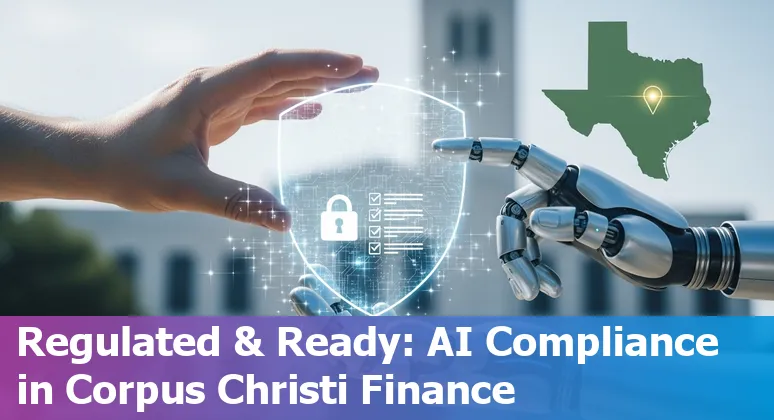
Too Long; Didn't Read:
Corpus Christi finance firms in 2025 must balance Texas's TRAIGA/HB149 compliance with fast local edge AI (Duos Edge: lower latency) to cut onboarding from days to minutes, reduce fraud, and upskill staff - 15‑week bootcamps, 30–90 day KYC pilots, and $200k penalty risks.
Corpus Christi financial services leaders face a decisive moment in 2025: Texas's new AI framework (TRAIGA/HB 149) raises disclosure, biometric‑consent and enforcement expectations while creating an innovation sandbox, even as local infrastructure arrives that makes real‑time AI practical; Analysis of Texas Responsible AI Law (TRAIGA/HB 149) and Duos Edge AI to deploy edge data centers in Corpus Christi illustrate the changing landscape.
Duos Edge AI's planned edge data centers in Corpus Christi will reduce latency and enable on‑site fraud detection, hyper‑personalized client experiences, and faster model inference for community banks and fintechs.
RGP's 2025 review underscores that AI delivers efficiency and systemic risk together, so the practical step for Corpus Christi firms is rapid, documented upskilling and governance - skills taught in Nucamp's AI Essentials for Work bootcamp registration so teams can pilot compliant, high‑ROI AI inside Texas's new regulatory guardrails.
| Attribute | Information |
|---|---|
| Description | Gain practical AI skills for any workplace; learn AI tools, prompt writing, and business applications - no technical background required. |
| Length | 15 Weeks |
| Courses included | AI at Work: Foundations; Writing AI Prompts; Job Based Practical AI Skills |
| Cost | $3,582 early bird; $3,942 regular; 18 monthly payments |
| Syllabus | AI Essentials for Work syllabus |
| Registration | Register for AI Essentials for Work |
“Our Corpus Christi project highlights the speed, precision, and value of our Edge AI model,” said Doug Recker, President and Founder of Duos Edge AI.
Table of Contents
- What is the Future of AI in Finance in 2025 - Implications for Corpus Christi
- How AI is Being Used in Financial Services: Core Use Cases for Corpus Christi
- Predictive Analytics & Forecasting: Speeding Decisions for Corpus Christi Investors
- Digital Twins, Climate Resilience & ESG for Corpus Christi's Coastal Risks
- Facility-Level AI and Predictive Maintenance for Corpus Christi Properties
- Vendors, Products, and Platforms to Consider in Corpus Christi
- Data Readiness, Governance, and AI Regulation in the US (2025) - Guidance for Corpus Christi
- Workforce, Training, and Partnerships: Tapping Texas Talent for Corpus Christi AI Projects
- Conclusion & Practical Next Steps for Corpus Christi Financial Services in 2025
- Frequently Asked Questions
Learn practical AI tools and skills from industry experts in Corpus Christi with Nucamp's tailored programs.
What is the Future of AI in Finance in 2025 - Implications for Corpus Christi
(Up)The near‑term future of AI in finance is pragmatic and fast: firms are moving from pilots to embedded, workflow‑level systems that speed onboarding, underwriting, and fraud response while demanding stronger governance; nCino's 2025 review highlights targeted automation (parsing tax returns, auto‑drafting loan memos, queue optimization) and warns that risk, efficiency, and personalization must be balanced to unlock value (nCino AI Trends in Banking 2025 report).
At the same time agentic AI - autonomous, multi‑step agents that can triage support tickets, synthesize documents, and execute routine portfolio tasks - is emerging as a practical layer for larger institutions, creating both upside in productivity and a new front for compliance and model‑risk oversight (Agentic AI in Finance Q3 2025 analysis).
For Corpus Christi banks and fintechs the takeaway is concrete: prioritize pilot projects that deliver measurable time‑savings on document‑heavy workflows, pair them with human‑in‑the‑loop controls, and leverage emerging local edge infrastructure to keep inference fast and data residency tight - that combination is the tangible “so what” that turns regulation and investment into competitive advantage.
| Metric | Value / Source |
|---|---|
| Organizations using AI in ≥1 function | 78% (McKinsey, cited in nCino) |
| Banking AI investment (2023) | ~$21 billion (nCino) |
| Banks >$100B expected to fully integrate AI by 2025 | 75% (nCino) |
How AI is Being Used in Financial Services: Core Use Cases for Corpus Christi
(Up)Corpus Christi financial firms should treat AI as a toolkit for practical, revenue‑and‑risk outcomes: generative models and ML power conversational finance (client chatbots and auto‑drafted loan memos), fast document analysis for KYC/onboarding and audit‑ready reporting, real‑time fraud and AML detection, automated underwriting and credit scoring, predictive forecasting for portfolios and treasury, and back‑office RPA that removes repetitive work - these are the core, proven use cases in finance today.
Local banks and fintechs can deploy lightweight LLMs to summarize earnings calls and compress manual research, use synthetic data to train fraud models, and run scenario‑based stress tests that improve capital planning; industry surveys and case studies catalog these into repeatable pilots (see the Top 25 Generative AI Finance Use Cases & Case Studies and RTS Labs' Top 7 AI Use Cases in Finance for concrete examples).
Measurable payoff is immediate: firms report faster approvals and onboarding (approvals that once took days can move to minutes), fewer false positives in monitoring (HSBC saw large reductions), and striking fraud gains in generative‑AI pilots (Mastercard's work doubled compromised‑card detection while cutting false positives dramatically) - so the practical “so what” for Corpus Christi is clear: deploy focused pilots that cut manual cycle time, secure data residency at the edge, and pair AI outputs with human review to unlock near‑term ROI. For a quick operational play, start with back‑office document automation to shorten KYC and audit cycles.
| Core Use Case | Why it Matters for Corpus Christi |
|---|---|
| Generative AI and Conversational Finance: Use Cases and Benefits | Faster client support and auto‑generated loan memos reduce staff load and speed decisions. |
| Real‑Time Fraud Detection & AML with AI: RTS Labs Use Cases | Real‑time scoring and synthetic fraud data lower losses and false positives. |
| Document Automation for KYC and Onboarding in Financial Services | Cuts manual cycle time and creates audit‑ready records for compliance. |
| Predictive Analytics & Forecasting for Treasury and Portfolios | Improves liquidity, portfolio rebalancing, and scenario planning for local economic swings. |
| Automated Underwriting & AI‑Driven Credit Scoring | Expands access and speeds approvals while incorporating alternative data. |
Predictive Analytics & Forecasting: Speeding Decisions for Corpus Christi Investors
(Up)Predictive analytics turns static spreadsheets into continuously updated decision engines for Corpus Christi investors by fusing historical patterns with live feeds - bank transactions, payroll, and market indicators - so forecasts adjust the moment a large customer payment posts or an economic signal shifts; practical pilots that connect accounting systems to ML models can convert quarterly scenario planning into an ongoing process and help portfolio and treasury teams act faster.
Real‑world results are concrete: platforms that integrate real‑time data have cut inventory costs by 20%, improved cash‑flow accuracy by 90% and reduced forecasting errors by 40%, making it easier for local funds and SMB investors to reallocate capital and tighten liquidity windows (real-time forecast adjustments for financial forecasting).
Start with a focused cash‑flow or revenue pilot, track MAPE/RMSE on automated dashboards, and bake in drift detection and human review so models remain reliable; FP&A copilot tools also speed model building and can slash forecast production time by roughly three‑quarters, converting analysis that once took weeks into minutes (AI financial modeling and forecasting techniques, Dataiku return on AI case studies).
The practical "so what": measurable error reduction and real‑time scenario testing let Corpus Christi investors respond to coastal market shocks and funding events with clearer, faster capital decisions instead of guessing from stale numbers.
| Metric | Result / Source |
|---|---|
| Forecasting error reduction | 40% (Lucid) |
| Cash‑flow accuracy improvement | 90% (Lucid) |
| Inventory cost reduction | 20% (Lucid) |
| Forecast production time | ~76% reduction (Dataiku) |
“Machine learning will transform finance, making finance operations more effective and driving transformation that will allow employees to focus on value-adding activities such as enhancing their capabilities in customer experience and delivering better results to their internal and external customers.” - Shawn Seasongood, Managing Director, Protiviti
Digital Twins, Climate Resilience & ESG for Corpus Christi's Coastal Risks
(Up)Digital twins are becoming a practical tool for measuring and managing Corpus Christi's coastal risk exposure: Texas A&M's NSF‑funded Galveston project builds an updatable virtual model that fuses GIS, urban planning, marine science and real‑time feeds to test resilience scenarios and policy choices (Texas A&M Galveston digital twin study on coastal resiliency), while the Port of Corpus Christi's OPTICS initiative demonstrates how a 50‑square‑mile, Unity/ArcGIS‑based digital twin can centralize vessel tracking, weather, structural health and emergency workflows to speed response and planning (Port of Corpus Christi OPTICS digital twin initiative overview).
These platforms generate the same scenario outputs that hydrodynamic models (e.g., ADCIRC+SWAN datasets used to evaluate ship‑channel deepening and storm surge) produce for engineers and planners, creating machine‑ready layers that ESG teams, underwriters, and risk officers can use for stress testing, capital allocation and climate disclosure work (GRIIDC ADCIRC+SWAN modeled impacts for channel dredging and storm surge).
The practical payoff for local finance: clearer, data‑driven stress scenarios and faster incident‑level insights that make coastal loan portfolios and insurance exposure auditable and actionable in real time.
| Project | Key detail |
|---|---|
| Texas A&M Galveston digital twin | NSF grant: $300K, 2‑year study to model resilience scenarios |
| Port of Corpus Christi - OPTICS | 50 sq. miles; Unity + Esri; real‑time vessel, weather, and asset data |
| GRIIDC ADCIRC+SWAN modeling | Channel scenarios (ES/OPS/FPS) for Category 4 storms; model outputs for surge and velocity |
“A digital twin of Galveston is something that planners and citizens can use to better understand how planning and infrastructure alterations and additions can positively or negatively affect a community's natural hazard resilience.” - Xinyue Ye
Facility-Level AI and Predictive Maintenance for Corpus Christi Properties
(Up)Facility‑level AI transforms Corpus Christi properties by turning noisy equipment signals into scheduled work orders, cutting both surprise outages and energy waste: AI models fed by IoT sensors (temperature, vibration, humidity, amperage) and edge/cloud analytics spot anomalies and trigger technician dispatches before failures escalate, a pattern shown to cut unplanned downtime by up to 50% and maintenance expenses by 10–40% in industry case studies (Predictive maintenance case studies for industrial equipment).
For coastal commercial buildings and energy‑intensive sites, start with low‑cost, high‑impact steps - professional duct sealing, VFD tuning, and basic sensor retrofits - to stabilize systems quickly; one oil‑and‑gas plant example returned an 11‑month ROI with −22% energy use and −18% HVAC downtime after adding sensors and controls, while duct leakage dropped from 18% to under 5% (Predictive HVAC maintenance case study in West Texas detailing IIoT and duct sealing savings).
Local service and monitoring options matter: factory‑authorized providers like Carrier Commercial Service - Corpus Christi SMART monitoring and preventive maintenance offer SMART monitoring, preventive plans, and field‑service integration so lenders, insurers, and property managers can quantify risk, shorten repair cycles, and document savings for audits and capital planning.
| Metric | Result / Source |
|---|---|
| Unplanned downtime reduction | Up to 50% (ProValet) |
| Maintenance cost reduction | 10–40% (ProValet) |
| Typical energy savings (HVAC upgrades + IIoT) | Up to 30% (Doctor Frío) |
| Case study outcomes | −22% energy, −18% HVAC downtime, ROI 11 months; duct leakage 18% → <5% (Doctor Frío) |
Vendors, Products, and Platforms to Consider in Corpus Christi
(Up)For Corpus Christi firms building coastal risk, operational‑risk, or client‑facing analytics, prioritize vendors that proved themselves at scale in the port's OPTICS project: the Unity + Esri stack (ArcGIS Maps SDK for Unity) for photorealistic, multi‑layer digital twins, The Acceleration Agency as a Unity integrator, and enterprise GIS backends like GeoPORT that keep spatial data authoritative; see the Port of Corpus Christi case study on Unity's site for architecture and outcomes (Port of Corpus Christi Unity + Esri digital‑twin platform case study) and the OPTICS implementation overview for operational lessons (Port OPTICS implementation overview and operational lessons).
Complement geospatial platforms with telemetry and fleet integrations (Samsara) and local facilities partners for SMART monitoring - Carrier's Corpus Christi commercial service offers field integration and preventive plans that lenders and insurers can audit (Carrier Commercial Service - Corpus Christi commercial HVAC field integration and preventive maintenance).
The practical takeaway: OPTICS covers roughly 50 square miles and replaced a workflow that once forced staff to juggle “three, four or five monitors,” demonstrating that an integrated vendor stack can turn siloed feeds into a single pane of glass that speeds decisions and makes coastal portfolios auditable in real time.
| Vendor / Platform | Role / Note |
|---|---|
| Unity + Esri (ArcGIS Maps SDK for Unity) | 3D active digital‑twin rendering and geospatial canvas; used in OPTICS (50 sq. miles) |
| The Acceleration Agency | Integrator / Project Gemini architecture for OPTICS |
| GeoPORT & Samsara | Planned integrations for enterprise GIS and vehicle/telemetry feeds |
| Carrier Commercial Service - Corpus Christi | SMART monitoring, preventive maintenance and field‑service integration for facility risk |
“How can we leverage our data better? We know we're sitting on a lot of data, but it's all siloed in different systems, or we're just not making use of it.” - Darrell Keach, Port of Corpus Christi Business Systems Manager
Sources: Port of Corpus Christi Unity + Esri digital‑twin platform case study (Unity Port of Corpus Christi case study) and the OPTICS implementation overview (Port OPTICS implementation overview).
Data Readiness, Governance, and AI Regulation in the US (2025) - Guidance for Corpus Christi
(Up)Corpus Christi financial institutions must treat 2025 as a compliance inflection point: U.S. policy is a layered mix of federal executive actions, new statutes (e.g., the TAKE IT DOWN Act), emerging federal bills (CREATE AI Act/NAIRR) and an active patchwork of state laws tracked by the NCSL - meaning a single “one‑size” playbook won't suffice (Xenoss: AI regulations in the US, 2025; NCSL state legislation summary).
Practical steps for Corpus Christi teams: build an AI use‑case inventory and model registry, instrument explainability and bias audits for credit and underwriting (FCRA/ECOA scrutiny can trigger private suits and statutory damages), maintain immutable audit trails for model outputs and training data, and adopt voluntary frameworks that are rapidly becoming de‑facto requirements - NIST's AI RMF and ISO 42001 bring lifecycle controls that make federal procurement and audits smoother (Schellman: EO, BBB, ISO 42001 guidance).
The “so what”: firms that document model lineage, automated monitoring, and human‑in‑the‑loop controls will avoid fines (regulators already levy six‑figure penalties) and shorten diligence cycles for partners and insurers - while laggards face regulatory friction, higher capital charges, and loss of market access.
| Jurisdiction | Key 2025 Items |
|---|---|
| Federal | Executive orders (EO 14179/14141), TAKE IT DOWN Act, CREATE AI Act proposals; NIST AI RMF guidance |
| State | Fast‑moving, varied rules (disclosures, chatbot notices, bias audits); NCSL tracks many state bills |
| Finance sector | CFPB/SEC/OCC/FDIC focus on explainability, fair lending, AML/KYC, and model governance |
Workforce, Training, and Partnerships: Tapping Texas Talent for Corpus Christi AI Projects
(Up)Corpus Christi's workforce strategy for AI pairs short, job‑focused training with a visible hiring pipeline so financial firms can hire or trial talent quickly: Texas A&M‑Corpus Christi's AI Machine Learning Bootcamp is a six‑month, 300+ hour program that builds practical Python and ML skills and prepares learners for the Microsoft Azure AI‑102 certification (TAMU‑CC AI Machine Learning Bootcamp program page); a nearby NSF AI Institute partnership that includes TAMU‑CC and Del Mar College funds a pilot AI certificate for community‑college learners, supports internships/mentoring for underrepresented students, and backs a 2+2+2 pipeline into bachelor's and graduate research roles - backed locally with $3.2M in support (NSF AI Institute partnership announcement on Coastal Dynamics Lab); employers can further shorten hiring cycles by sponsoring single‑semester or summer interns through TAMU‑CC Career Services (postings via HireAnIslander/Handshake) which explicitly steers internships as a way to reduce recruiting costs and evaluate candidates on real projects (TAMU‑CC Career Services internship programs and employer opportunities).
The practical payoff: banks and fintechs in Corpus Christi can convert classroom time into vetted, certified contributors within a semester or two, lowering recruiting expense and accelerating compliant AI adoption.
| Program | Key detail |
|---|---|
| TAMU‑CC AI Machine Learning Bootcamp | Six months, 300+ hours; hands‑on Python/ML and Microsoft AI‑102 prep |
| NSF AI Institute (TAMU‑CC & DMC) | Pilot AI certificate for community colleges; local partnership backed by $3.2M to build pipeline and internships |
| TAMU‑CC Internships | Single‑semester/summer internships via HireAnIslander/Handshake; reduces recruiting costs and supplies project‑ready candidates |
“The Island University is the intellectual capital of the region. Our interdisciplinary research, like Coastal AI, is strategically unique and is a result of our innovation ecosystem.” - Dr. Ahmed Mahdy
Conclusion & Practical Next Steps for Corpus Christi Financial Services in 2025
(Up)Practical next steps for Corpus Christi financial services: treat TRAIGA's January 1, 2026 effective date as a deadline, not a suggestion - use the roughly 18‑month runway to inventory and stratify AI use cases, document cessation of any prohibited practices, and align governance to NIST/ISO frameworks so safe‑harbor protections apply; see the Texas Responsible AI Governance Act summary and compliance guide for specifics on the sandbox, 60‑day cure period, and civil penalties up to $200,000 per uncurable violation (Texas Responsible AI Governance Act summary and compliance guide).
Launch a 30–90 day pilot that targets back‑office document automation for KYC/onboarding (fast ROI, audit trails), instrument explainability and drift detection from day one, and enroll two functional owners in a practical upskilling program - Nucamp's AI Essentials for Work bootcamp (15‑week, job‑focused training) is a job-focused option that prepares staff to write prompts, run pilots, and maintain human‑in‑the‑loop controls (Nucamp AI Essentials for Work bootcamp - 15‑week practical AI training).
If planning novel models, prepare a sandbox application early (quarterly reporting will be required) so innovative services can be tested with regulatory safe harbors; the concrete “so what” is simple - documented pilots plus trained staff turn TRAIGA's compliance burden into a competitive edge by shortening diligence cycles, avoiding six‑figure penalties, and keeping inference local and low‑latency for Corpus Christi customers.
| Action | Timeline / Source |
|---|---|
| AI use‑case inventory & model registry | 30 days - Data readiness guidance / TRAIGA |
| Pilot: document automation for KYC/onboarding | 30–90 days - proven ROI & audit trail benefits |
| Staff upskilling (AI Essentials for Work) | Next cohort (15 weeks) - Nucamp AI Essentials for Work bootcamp - 15‑week course |
| Sandbox application for novel AI | Within 12 months - Texas DIR 36‑month pilot / quarterly reporting |
| Adopt NIST AI RMF / ISO 42001 | Ongoing - improves safe‑harbor posture |
“Our Corpus Christi project highlights the speed, precision, and value of our Edge AI model,” said Doug Recker, President and Founder of Duos Edge AI.
Frequently Asked Questions
(Up)What are the biggest regulatory changes Corpus Christi financial firms must prepare for in 2025?
In 2025 the key regulatory inflection points include Texas's TRAIGA/HB 149 (responsible AI governance with disclosure, biometric‑consent and enforcement provisions and a regulatory sandbox), layered federal activity (executive orders, proposed CREATE AI legislation and guidance like NIST AI RMF), and a patchwork of state rules tracked by NCSL. Practical steps: build an AI use‑case inventory and model registry, document model lineage and audit trails, run explainability and bias audits for credit/underwriting, and adopt NIST/ISO lifecycle controls to improve safe‑harbor posture and shorten diligence cycles.
Which AI use cases deliver the fastest ROI for Corpus Christi banks and fintechs?
Priority pilots with fast, measurable ROI are back‑office document automation for KYC/onboarding (reduces cycle time and creates audit‑ready records), real‑time fraud/AML detection at the edge (lower false positives and faster response), automated underwriting and credit scoring (faster approvals), and predictive analytics for treasury/portfolio forecasting (reduced forecasting error and better liquidity management). Start with 30–90 day pilots, instrument explainability and drift detection, and pair outputs with human‑in‑the‑loop controls.
How does new local infrastructure in Corpus Christi change AI deployment strategies?
Planned edge data centers (e.g., Duos Edge AI) reduce latency and enable on‑site inference, making real‑time fraud detection, hyper‑personalized client experiences, and faster model inference practical for community banks and fintechs. The recommended approach is to keep sensitive inference local for data residency and low latency, use synthetic data for fraud model training when appropriate, and combine edge deployments with documented governance and monitoring to meet regulatory expectations.
What data readiness and governance practices should Corpus Christi firms implement now?
Implement a model registry and AI use‑case inventory, maintain immutable audit trails for training data and model outputs, run bias and explainability audits (especially for credit and underwriting), instrument drift detection and monitoring, and document human‑in‑the‑loop controls. Adopt NIST AI RMF and consider ISO 42001 to operationalize lifecycle controls that ease audits and federal procurement.
How can Corpus Christi firms build the talent pipeline and operational skills needed for compliant AI?
Pair short, job‑focused training with internship/hiring pipelines. Local programs include TAMU‑CC's six‑month AI Machine Learning Bootcamp (300+ hours) and NSF‑backed community‑college certificate pilots that create a 2+2+2 pipeline. Employers should sponsor single‑semester or summer internships via TAMU‑CC career services to vet candidates on projects. For immediate upskilling, consider a 15‑week job‑focused bootcamp (e.g., Nucamp's AI Essentials for Work) so functional owners can run compliant pilots and maintain human‑in‑the‑loop controls.
Understand how predictive treasury management for energy-constrained regions helps Corpus Christi banks optimize liquidity amid Texas water and energy challenges.
Learn how mastering advanced analytics and storytelling can help junior analysts offer strategic recommendations that AI alone cannot provide.
Plan ahead using revenue and risk forecasting that factors in weather and tourism cycles affecting Corpus Christi.

Ludo Fourrage
Founder and CEO
Ludovic (Ludo) Fourrage is an education industry veteran, named in 2017 as a Learning Technology Leader by Training Magazine. Before founding Nucamp, Ludo spent 18 years at Microsoft where he led innovation in the learning space. As the Senior Director of Digital Learning at this same company, Ludo led the development of the first of its kind 'YouTube for the Enterprise'. More recently, he delivered one of the most successful Corporate MOOC programs in partnership with top business schools and consulting organizations, i.e. INSEAD, Wharton, London Business School, and Accenture, to name a few. With the belief that the right education for everyone is an achievable goal, Ludo leads the nucamp team in the quest to make quality education accessible