









Top 5 Jobs in Retail That Are Most at Risk from AI in Brunei Darussalam - And How to Adapt
Last Updated: September 6th 2025
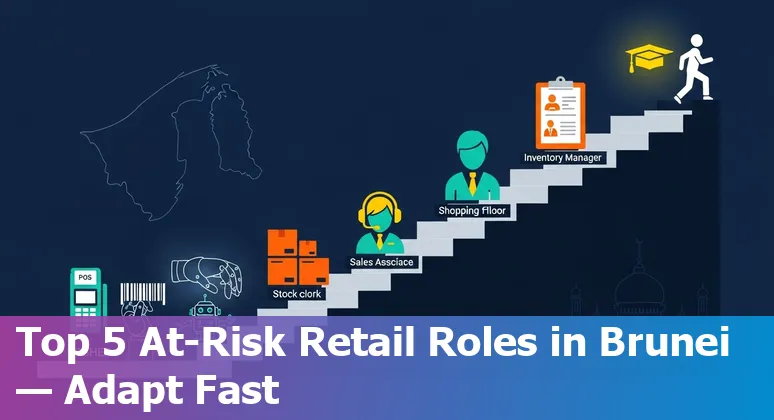
Too Long; Didn't Read:
AI threatens top retail roles in Brunei - cashiers, in‑store reps, warehouse staff, fast‑food frontline and clerical bookkeepers - but adaptation via upskilling is possible. Local pilots show chatbots cut response times ~35%, forecasting hits ~90% accuracy, targeted marketing +40% engagement, OCR trims data entry ~75%.
Brunei's retail sector is at an AI tipping point: adoption is still nascent but a tech‑savvy population and government support mean chatbots, personalized recommendations and smarter inventory systems can quickly shift how stores operate and how workers spend their time, not just whether jobs exist.
Local pilots show real wins - AI chatbots cutting response times and boosting online conversions, machine‑learning forecasting hitting roughly 90% accuracy for electronics stock, and targeted marketing lifting engagement by about 40% - yet barriers remain (cost, integration and workforce upskilling) and many projects stall when they try to scale.
For retail employees in Bandar Seri Begawan and beyond, learning practical AI skills - like using workplace prompts and tooling - turns threat into advantage; explore how Brunei's retail landscape is changing at BytePlus and consider Nucamp's 15‑week AI Essentials for Work bootcamp to build job‑ready AI skills for the shop floor and back office.
| Attribute | Details for the AI Essentials for Work bootcamp |
|---|---|
| Description | Gain practical AI skills for any workplace; learn AI tools, prompts, and apply AI across business functions. |
| Length | 15 Weeks |
| Courses included | AI at Work: Foundations; Writing AI Prompts; Job Based Practical AI Skills |
| Cost | $3,582 early bird; $3,942 regular. Paid in 18 monthly payments, first due at registration. |
| Syllabus | AI Essentials for Work syllabus (Nucamp) - Register for AI Essentials for Work (Nucamp) |
Table of Contents
- Methodology: How We Chose the Top 5 At-Risk Retail Jobs in Brunei
- Retail Cashiers
- In-store Customer Service Representatives
- Warehouse and Stockroom Workers
- Fast Food & Restaurant Frontline Workers
- Back-office Clerical Bookkeepers
- Conclusion: Next Steps for Retail Workers in Brunei Darussalam
- Frequently Asked Questions
Get inspired by measurable results in our local case studies from Gadong and Berakas that show real ROI.
Methodology: How We Chose the Top 5 At-Risk Retail Jobs in Brunei
(Up)Selection began by triangulating hard local signals with global trend research: local pilots and metrics in BytePlus's Brunei retail analysis (chatbots cutting response times ~35%, machine‑learning forecasting at ~90% accuracy and targeted marketing lifting engagement ~40%) were used to spot tasks already automating, while industry guidance on scaling and workforce impact helped shape the scoring rules.
Roles were scored against clear, research‑driven criteria - routineness of tasks (how repeatable a duty is), customer‑facing automation potential (chatbots, GenAI assistants), operational automation fit (inventory, forecasting, robotics) and barriers to adoption such as cost, system integration and upskilling needs noted in both BytePlus and PwC - and cross‑checked with 2025 retail trend forecasts (hyperautomation, AI assistants, metaverse/robot retail) from WNS and Ciklum to ensure forward relevance.
The result: a practical, evidence‑led shortlist that prioritises high‑frequency, low‑complexity tasks most vulnerable to AI while flagging where targeted training can convert displacement risk into new job value (see BytePlus case studies and PwC's AI guidance for the consumer markets).
“Consumer companies that proactively manage their portfolios and capitalize on opportunities for both short-term growth and long-term reinvention are more likely to thrive, with market rewards for successful divestitures and strategic acquisitions.” - Mike Ross, US Consumer Markets Deals Leader
Retail Cashiers
(Up)Retail cashiers in Brunei are on the front line of a fast‑moving checkout revolution: cloud‑based POS systems are becoming the operational hub that handles payments, inventory and CRM, while AI enhancements, contactless mobile wallets and self‑service kiosks steadily shave routine scanning and payment tasks from the till‑operator's day.
Global signals are loud - the POS market leapt from about $29.02B in 2023 to $33.41B in 2024 and is forecast to climb much higher, and automated checkout solutions (a $4.62B market in 2023) are projected to expand rapidly by 2032 - so stores in Bandar Seri Begawan that adopt smarter terminals, dynamic pricing and instant payments risk reducing cashier hours even as customer service shifts to digital channels.
Local pilots show how tech can still help: a Malay‑and‑English chatbot cut response times and raised CSAT in Brunei, pointing to hybrid roles that combine in‑store assistance with AI tools rather than pure headcount replacement.
For cashiers, the pathway is clear: mastering cloud POS workflows, basic AI prompts and mobile payment handling turns a single‑task role into a multitool skillset that retail employers will prize.
Read more on POS trends at Host Merchant Services POS market report, payments innovation at Capgemini payments innovation analysis, and Brunei chatbot pilots from Nucamp's case studies.
| Metric | Figure (source) |
|---|---|
| Global POS market (2023) | $29.02B - Host Merchant Services |
| Global POS market (2024) | $33.41B - Host Merchant Services |
| Self‑service/automated checkout market (2023) | $4.62B; projected growth to $15.49B by 2032 - Host Merchant Services |
In-store Customer Service Representatives
(Up)In Brunei's stores, in‑store customer service representatives are increasingly paired with AI chatbots that handle routine queries, freeing staff to focus on empathy, product demos and complex problem‑solving that build loyalty; evidence from a large field experiment shows AI suggestions cut response times by roughly 22% and lifted customer sentiment, with the biggest gains for less‑experienced agents (response time improvements up to 70% in some cases), so new hires can hit their stride far faster than before - though managers must watch handoffs closely, since replies that arrive “too fast” can leave customers wondering whether they're still talking to a person.
Practical playbooks matter: simple nudges and “priority queue” promises ease adoption while protecting human access when needed, and local pilots (including a Malay‑and‑English multilingual AI customer service chatbot) have already reduced wait times and raised CSAT in Brunei.
For implementation guidance and agent‑assist strategies, see the Harvard Business School research on AI chatbots and human agents, the Zendesk guide to AI in customer service, and the Nucamp AI Essentials for Work syllabus (local chatbot case study).
| Metric | Figure (source) |
|---|---|
| Average response time drop with AI assistance | ~22% - Harvard Business School |
| Response time improvement for less‑experienced agents | Up to 70% - Harvard Business School |
| Potential staffing cost reduction with chatbot nudges/queues | Up to 22% - Johns Hopkins Carey research |
“You should not use AI as a one-size-fits-all solution in your business, even when you are thinking about a very specific context such as customer service.” - Shunyuan Zhang, Harvard Business School
Warehouse and Stockroom Workers
(Up)Warehouse and stockroom workers face some of the clearest near‑term changes from AI and robotics: systems from AMRs and AS/RS to cobots can take over the most repetitive, heavy and error‑prone tasks - picking, sorting and replenishment - while freeing people for quality control, maintenance and data monitoring; operators and managers in Brunei Darussalam should note that global pilots show real gains (robots often deliver 25–30% efficiency uplifts in year one and much higher throughput in specialized systems), so a phased rollout that targets high‑impact processes first is a practical route to modernization.
These machines also cut mistakes that drive returns, improve safety by removing the heaviest lifts, and generate operational data for smarter inventory decisions, but implementation costs and integration with existing WMS remain important considerations that planners must budget for.
For practical context see industry guidance on phased deployment and ROI in the Raymond Corporation warehouse robotics overview, how robotics reshape labour and safety at Exotec robotics labour and safety, and Amazon's experience of dramatically cutting picker walking and raising picker productivity in the Vox report on Amazon picker productivity - remember: the most useful outcome for workers is not “no robots” but “fewer bruised backs and more skilled roles” as robots handle the grunt work and humans manage the exceptions.
| Metric | Figure (source) |
|---|---|
| Large‑warehouse robotics adoption (2025 forecast) | Nearly 50% - RaymondHC |
| Typical first‑year efficiency gain | ~25–30% - RaymondHC |
| Throughput boost (Exotec Skypod example) | Up to 5× - Exotec |
| Picker walking pre‑robotics | 10–20 miles/day; large reductions reported - Vox |
“The robots have raised the average picker's productivity from around 100 items per hour to what… is a target of around 300 or 400.” - Vox
Fast Food & Restaurant Frontline Workers
(Up)Fast‑food and restaurant frontline workers in Brunei are already feeling the ripple effects of self‑service kiosks: these touchscreens often lift average checks and shift routine order-taking into a machine, but the payoff comes with tradeoffs - kiosks can upsell fries and milkshakes (pushing tickets higher) while dumping more complex, larger batches onto kitchen teams and creating new “guest experience” or kiosk‑support roles.
Global studies show customers order noticeably more at kiosks, and operators see upsell gains and improved throughput when kiosks are well‑integrated, yet crews can face heavier back‑of‑house pressure unless workflows and training change; local Brunei pilots that paired Malay‑and‑English AI helpers with staff reduced response times and protected service quality, showing one practical path to balance efficiency and human touch.
Thoughtful rollout - training staff as kiosk guides, reallocating labour to food prep and customer care, and monitoring menu nudges - turns a potential threat into an opportunity for higher‑value frontline work rather than pure job loss (see the CNN report on touchscreen self-service kiosks and Samsung kiosk efficiency research for implementation lessons).
| Metric | Finding (source) |
|---|---|
| Average order increase at kiosks | +14% and +16% (two studies) - Universität Hamburg kiosk order uplift study |
| Transaction value uplift | ~20–30% on average - Samsung kiosk efficiency research |
| Estimated labour cost reduction | Up to 10% in some implementations - Wisk.ai labour cost reduction analysis |
“Kiosks ‘guarantee that the upsell opportunities' like a milkshake or fries are suggested to customers when they order.” - Robert Lynch, Shake Shack CEO (reported by CNN)
Back-office Clerical Bookkeepers
(Up)Back‑office clerical bookkeepers in Brunei Darussalam are squarely in the sights of OCR‑driven automation: tools that extract invoice line items, receipts and bank statements can turn a shoebox of paperwork into searchable, auditable records in minutes, shifting work from keystrokes to review and analysis.
The payoff is concrete - specialised OCR solutions can cut manual data‑capture time by as much as ~75% and, in vendor case studies, drive productivity uplifts approaching 90% - so shops in Bandar Seri Begawan that adopt cloud OCR and smart accounting integrations can redeploy staff into higher‑value tasks like variance analysis, fraud checks and customer reporting rather than monotonous entry.
Practical reading: an overview of accounting OCR workflows at DocuClipper accounting OCR workflows overview, AutoEntry value of OCR for bookkeepers, and Mindee analysis of OCR's impact on the accounting software market to understand integration and audit benefits for local firms.
| Metric | Figure (source) |
|---|---|
| Manual data entry reduction | Up to ~75% - AutoEntry / ZenBusiness |
| Reported productivity gain (case study) | ~90% - AutoEntry (customer testimony) |
| Accounting software market (2023) | $18.7B - Mindee |
“Before AutoEntry, we had over a 100 people spending hours each week to manually upload data for our bookkeeping clients, which was an impractical use of resources in the long term. Since implementing the solution, we've driven productivity by almost 90% when processing bookkeeping data entry - an incredible time saving which we can reinvest into the business.” - Toby Woodhead
Conclusion: Next Steps for Retail Workers in Brunei Darussalam
(Up)The path forward for retail workers in Brunei Darussalam is practical and immediate: combine small, high‑impact pilots (start with conversational commerce and agent‑assist tools) with serious upskilling so routine tasks become opportunities for higher‑value work - turning a “shoebox” of paperwork or repeated checkout steps into time for customer care and problem‑solving.
Local and global research shows institutions are already expanding AI programs and businesses are investing in training (see BytePlus's overview of AI in Brunei), while PwC's 2025 AI Jobs Barometer finds workers with AI skills earn a substantial premium and that skill change is accelerating, so prompt writing, OCR workflows and POS/agent‑assist fluency are sensible near‑term bets.
Gallup's data also warns many employees aren't being encouraged enough to learn, so employers and workers should pair small pilots with clear learning plans and recognition.
For practical training that targets shop‑floor and back‑office needs, see Nucamp AI Essentials for Work syllabus which focuses on workplace prompts, tool use and job‑based AI skills to make human+AI roles the default in Bandar Seri Begawan and beyond.
| Attribute | AI Essentials for Work (Nucamp) |
|---|---|
| Description | Practical AI skills for any workplace: AI tools, prompt writing, job‑based AI applications. |
| Length | 15 Weeks |
| Courses included | AI at Work: Foundations; Writing AI Prompts; Job Based Practical AI Skills |
| Cost | $3,582 early bird; $3,942 regular. Paid in 18 monthly payments. |
| Syllabus / Register | Nucamp AI Essentials for Work syllabus (Nucamp) |
“Retailers should start experimenting now because this technology has the potential for a serious uptick in customer engagement and revenue.” - Sudip Mazumder, Publicis Sapient
Frequently Asked Questions
(Up)Which retail jobs in Brunei are most at risk from AI and automation?
Five frontline and back‑office roles show the highest near‑term exposure in Brunei: retail cashiers (self‑service kiosks, smarter POS), in‑store customer service representatives (chatbots and agent‑assist), warehouse and stockroom workers (AMRs, AS/RS and cobots), fast‑food/restaurant frontline staff (ordering kiosks and upsell automation), and clerical bookkeepers (OCR and smart accounting integrations). These roles were selected because they involve high volumes of routine, repeatable tasks that AI and robotics can already perform or augment.
What local and global evidence shows AI is already changing retail in Brunei?
Local pilots and global studies indicate measurable impacts: conversational AI pilots in Brunei cut response times by roughly 35% (and multilingual chatbots improved CSAT), machine‑learning forecasting reached about 90% accuracy for electronics stock, and targeted marketing lifted engagement by ~40%. Other metrics cited include global POS market growth from $29.02B (2023) to $33.41B (2024), an automated checkout market of $4.62B (2023) with forecasts to $15.49B by 2032, warehouse robotics first‑year efficiency gains of ~25–30%, kiosk order uplifts of roughly +14–16% (transaction value +20–30%), and OCR solutions cutting manual data entry by up to ~75% with case studies showing productivity uplifts approaching 90%.
How were the “top 5 at‑risk” roles in Brunei chosen?
Selection used a mixed methodology: triangulation of local pilot data (BytePlus Brunei findings) with global trend research (WNS, Ciklum, PwC), then scoring roles on routineness of tasks, customer‑facing automation potential, operational automation fit, and barriers to adoption (cost, systems integration, upskilling). The shortlist prioritised high‑frequency, low‑complexity tasks most vulnerable to automation while flagging where targeted training can convert displacement risk into higher‑value human+AI roles.
What practical steps can retail workers and employers in Brunei take to adapt?
Combine small, high‑impact pilots (conversational commerce, agent‑assist, phased robotics, OCR for accounts) with focused upskilling. For workers: learn cloud POS workflows, basic AI prompt writing, agent‑assist tooling, kiosk guidance and support, OCR review and variance analysis, and robotics maintenance basics. For employers: start with pilot projects that target clear ROI, protect human access for complex queries, reallocate staff to higher‑value tasks (customer experience, quality control, data review), and pair pilots with learning plans and recognition to encourage adoption.
What training options and costs are available to build job‑ready AI skills for retail staff in Brunei?
Nucamp's AI Essentials for Work bootcamp is one practical option: a 15‑week program that includes 'AI at Work: Foundations', 'Writing AI Prompts', and 'Job Based Practical AI Skills'. Cost is $3,582 (early bird) or $3,942 (regular), payable in 18 monthly payments with the first payment due at registration. The curriculum focuses on workplace prompts, tooling and applied AI use cases for shop‑floor and back‑office roles to help make human+AI workflows the default.
Discover how small retailers can increase basket size using Personalized product recommendations tuned for Brunei shoppers and local buying patterns.
Discover the impact of demand forecasting accuracy in Bandar Seri Begawan, where some retailers reached ~90% accuracy.

Ludo Fourrage
Founder and CEO
Ludovic (Ludo) Fourrage is an education industry veteran, named in 2017 as a Learning Technology Leader by Training Magazine. Before founding Nucamp, Ludo spent 18 years at Microsoft where he led innovation in the learning space. As the Senior Director of Digital Learning at this same company, Ludo led the development of the first of its kind 'YouTube for the Enterprise'. More recently, he delivered one of the most successful Corporate MOOC programs in partnership with top business schools and consulting organizations, i.e. INSEAD, Wharton, London Business School, and Accenture, to name a few. With the belief that the right education for everyone is an achievable goal, Ludo leads the nucamp team in the quest to make quality education accessible