









The Complete Guide to Using AI as a HR Professional in Baltimore in 2025
Last Updated: August 11th 2025
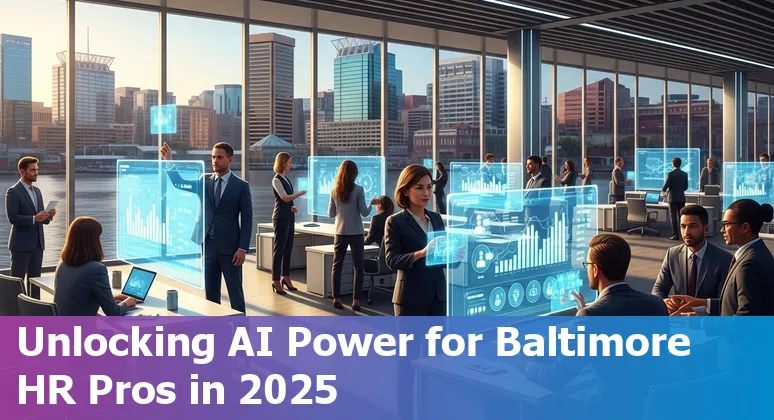
Too Long; Didn't Read:
In 2025, Baltimore HR professionals leverage AI to reduce time-to-hire by 50% and cut recruitment costs by 30%, using tools like machine learning and predictive analytics. Adhering to Maryland's AI regulations, they focus on ethical AI use, bias mitigation, and upskilling to enhance recruitment, engagement, and workforce planning.
In 2025, Baltimore's HR landscape is rapidly evolving with the integration of artificial intelligence (AI), reflecting national trends where approximately 70% of organizations and employees interact daily with AI-powered tools.
AI is reshaping HR functions such as recruitment, employee engagement, performance management, and workforce planning, significantly improving efficiency and personalization while reducing time-to-hire by up to 50% and cutting recruitment costs by 30%.
However, Maryland employers face unique challenges including compliance with state-specific regulations on AI use, particularly concerning privacy and anti-discrimination measures.
Ethical considerations, bias mitigation, and transparent workplace AI policies are critical as AI tools become more prevalent. HR professionals in Baltimore must balance leveraging AI benefits with safeguarding data security and employee rights, aligning with federal initiatives like the AI Bill of Rights and increased vigilance by the EEOC on algorithmic fairness.
For HR leaders aiming to build AI fluency and strategic application, local opportunities such as Nucamp's AI Essentials for Work bootcamp offer practical training to master AI tools without technical backgrounds.
Baltimore stands at the forefront of an AI-driven HR transformation that enhances human capital management while reinforcing the indispensable role of human judgment in the workforce.
Explore more about AI's impact on HR functions, policy development, and upskilling at SHRM's 2025 AI insights for HR leaders, Tulane Law's analysis of artificial intelligence in HR processes, and Hirebee's comprehensive 2025 AI HR statistics and trends.
Table of Contents
- AI Strategy in Maryland for HR Professionals
- Current HR Activities in Baltimore Using AI in 2025
- Key AI Technologies Empowering HR Professionals in Baltimore
- Popular AI-Powered HR Tools in Baltimore Workplaces
- Benefits of AI Adoption for HR in Baltimore, Maryland
- Challenges and Ethical Considerations of AI in Baltimore HR
- Practical Steps to Getting Started with AI in HR in Baltimore in 2025
- Future Outlook: How AI Will Shape HR Roles in Baltimore
- Conclusion: Embracing AI in Human Resources in Baltimore, Maryland
- Frequently Asked Questions
Explore hands-on AI and productivity training with Nucamp's Baltimore community.
AI Strategy in Maryland for HR Professionals
(Up)In 2025, Maryland has established a comprehensive AI Enablement Strategy and Study Roadmap designed to accelerate the safe and ethical adoption of artificial intelligence across the state, directly benefiting HR professionals in Baltimore and the broader Maryland area.
Spearheaded by the Maryland Department of Information Technology (DoIT) and guided by the AI Subcabinet, this strategy focuses on five key areas: maturing AI governance with sector-specific frameworks aligned to six state AI principles; strengthening data foundations to ensure accurate, trusted AI outputs; fostering momentum in AI experimentation and scaling successful initiatives across agencies; increasing the state workforce's "AI IQ" through targeted training and partnerships with academia and industry; and conducting focused studies on AI impacts in 12 critical domains, including workforce productivity and economic development.
This coordinated approach aims to equip HR professionals with reliable AI tools while addressing ethical concerns, enabling them to enhance decision-making and operational efficiency responsibly.
Montgomery County's proactive AI Action Plan complements these statewide efforts, featuring initiatives such as the launch of Monty 2.0, an advanced generative AI chatbot supporting multilingual resident services, and strict data classification to protect sensitive information, reflecting a balanced emphasis on innovation and privacy.
As Katie Savage, DoIT Secretary, states, Maryland is “poised to adopt this technology in practical ways to make our state safer, more competitive, and more productive.” Maryland's AI roadmap facilitates increased AI literacy, ethical governance, and practical AI deployment within state agencies - a forward-looking foundation that HR professionals in Baltimore can leverage to optimize talent management and operational workflows.
For further details, the full AI Enablement Strategy & Study Roadmap is available on the Maryland DoIT website with AI Strategy and Study Roadmap, while the local governmental perspective and implementation insights can be explored through Montgomery County's AI Action Plan and initiatives.
Additionally, the broader 2025 AI policy landscape and legislative framework impacting AI adoption is documented extensively by the National Conference of State Legislatures' 2025 AI Legislation and Policy Overview, highlighting Maryland's role in shaping responsible AI governance nationwide.
Current HR Activities in Baltimore Using AI in 2025
(Up)In 2025, HR professionals in Baltimore are increasingly leveraging AI to streamline and enhance various recruiting and talent acquisition activities. AI technologies such as machine learning, natural language processing (NLP), and predictive analytics are widely integrated into Applicant Tracking Systems (ATS) to automate resume screening, candidate sourcing, and interview scheduling, significantly reducing time-to-hire and improving quality of talent matches.
Baltimore employers benefit from AI's ability to proactively source candidates beyond traditional channels, analyze behavioral and performance data to predict candidate success and retention, and personalize candidate interactions through AI-driven chatbots and virtual assistants.
For example, platforms like Workday and Eightfold Talent Intelligence enable more efficient hiring workflows by automating screening and providing insights that increase recruiter capacity by over 50%.
These AI tools also support diversity and inclusion by minimizing unconscious bias through data-driven assessments, while automating routine administrative tasks allows HR teams to focus on strategic decision-making and cultural fit assessments.
However, ethical considerations and transparency remain priorities, with firms in Baltimore adopting a “human-in-the-loop” approach to oversee AI decisions and ensure fairness.
To meet the demand for skills-based hiring, Baltimore organizations also utilize AI to evaluate practical competencies and soft skills over traditional credentials, aligning with broader industry trends toward inclusive and resilient workforce development.
Tools like the Radancy Talent Acquisition Cloud exemplify this approach by integrating sourcing, engagement, and analytics into a unified system that enhances candidate experience and recruiter productivity.
For HR professionals in Baltimore aiming to adopt AI effectively, blending AI capabilities with human judgment and maintaining compliance with ethical standards is essential for transforming recruitment into a faster, fairer, and more data-driven process.
Learn more about these advancements and how AI can empower your HR team in Baltimore through detailed insights at Simpplr's comprehensive 2025 AI recruiting guide, the in-depth analysis from Morgan McKinley on AI-driven recruitment technologies, and the transformative AI hiring frameworks discussed in the Forbes AI recruitment takeover article.
Key AI Technologies Empowering HR Professionals in Baltimore
(Up)In 2025, HR professionals in Baltimore are empowered by a suite of advanced AI technologies that streamline recruitment, performance management, and employee relations while enhancing strategic decision-making.
Key platforms like Leena and Eightfold Talent Intelligence AI platforms automate resume screening, job description drafting, and onboarding processes through autonomous AI agents and natural language interfaces.
Tools such as HR Acuity's AI-powered employee relations software specialize in improving compliance, documentation, and investigation workflows with transparent, bias-reducing algorithms that support human oversight.
Additionally, platforms like PerformYard and BambooHR AI tools for performance reviews facilitate AI-assisted performance reviews and real-time employee feedback, enabling personalized career development and boosting retention rates.
These tools embody generative AI's role in automating routine HR tasks, reducing bias, and providing actionable workforce insights - allowing Baltimore's HR teams to focus on cultivating inclusive workplace cultures and strategic talent management.
With the growing adoption of AI-driven analytics and virtual assistants, Baltimore's HR professionals can anticipate talent shortages, streamline compliance, and enhance employee engagement, positioning AI as an indispensable partner in modern human resource management.
Popular AI-Powered HR Tools in Baltimore Workplaces
(Up)In Baltimore workplaces in 2025, HR professionals are turning to advanced AI-powered tools to streamline employee relations, recruitment, performance management, and engagement.
Among these, HR Acuity stands out as the premier AI-driven employee relations platform, offering transparent, bias-reducing investigations with features like olivER™ AI companion and multilingual support tailored for complex HR challenges.
For broader HR automation, Zoho People is favored by small to medium-sized enterprises in Baltimore for its AI capabilities that predict burnout, automate scheduling, and analyze employee sentiment, balancing affordability and scalability.
Meanwhile, performance and retention analytics tools such as Lattice help Baltimore HR teams align goals and anticipate turnover risks through AI-driven insights, boosting engagement and long-term workforce planning.
These AI solutions have become essential for compliance, reducing manual burdens, and enhancing decision-making, making them indispensable resources for HR professionals committed to modernizing their practices while addressing the specific needs of Maryland's dynamic labor market.
Benefits of AI Adoption for HR in Baltimore, Maryland
(Up)AI adoption in Baltimore's HR sector offers a multitude of benefits that are transforming traditional practices into more efficient, data-driven operations. By automating repetitive tasks such as resume screening, benefits administration, and scheduling, AI frees up HR professionals to focus on strategic initiatives like workforce planning and employee engagement, as highlighted by IMD Business School's comprehensive analysis of AI in HR.
The University of Maryland, Baltimore's AI Governance Policy underscores the importance of ethical and compliant AI use, ensuring that AI applications enhance fairness, inclusivity, and transparency while safeguarding privacy in accordance with Maryland state laws.
Furthermore, AI-powered tools contribute to improved decision-making through predictive analytics, enabling HR teams in Baltimore to identify employee retention risks early, tailor personalized onboarding and development programs, and promote diversity and equity by reducing hiring biases.
Real-world data show that 93% of HR managers leverage AI to reduce costs and improve efficiency, reflecting a growing confidence in AI's capacity to enhance HR functions without replacing the human touch, a balance emphasized by experts in the field.
Popular AI solutions, such as chatbots for 24/7 employee support and advanced analytics platforms, further boost Baltimore's competitive edge by elevating employee experience and streamlining compliance.
As local HR departments embrace these innovations, they not only improve accuracy and speed in recruitment and management tasks but also foster a more responsive and inclusive workplace culture, setting Maryland apart as a leader in responsible and strategic AI integration in human resources.
For a deeper dive into effective AI tools and ethical frameworks shaping Baltimore's HR landscape, explore resources on the AI Governance Policy at UMB, discover how AI transforms HR globally, and see the top benefits and challenges of AI in human resources.
Challenges and Ethical Considerations of AI in Baltimore HR
(Up)As AI adoption in HR accelerates in Baltimore and across Maryland, professionals must navigate significant challenges and ethical considerations, particularly concerning data privacy, bias, and evolving regulations.
Maryland's introduction of the Maryland Online Data Privacy Act (MODPA), effective October 2025, exemplifies the increasing legal demands, focusing on data minimization and protecting sensitive information, though enforcement concerns remain.
Experts at local events such as UpSurge Baltimore emphasize that AI systems, while efficient in tasks like resume screening and job matching, can perpetuate biases if not properly audited and governed, underlining the importance of transparency and human oversight.
Legal counsel is advised to ensure compliance with federal guidelines and state laws, which vary but are growing in scope to address AI's role in employment decisions, including requirements for bias audits and candidate notifications about AI use.
The transition from third-party to first-party data and concepts like the Data Bill of Material (DBoM) help businesses manage personal data responsibly, fostering consumer trust amid a fragmented regulatory environment.
As Maureen Dry-Wasson, global privacy officer at Allegis Group, cautions,
“We cannot compare AI to perfection. People are innately biased... we have to be careful, but we are not comparing it to perfection.”
Local institutions like Ardent Privacy provide AI-driven solutions for data discovery, minimization, and breach notification tailored to Maryland's regulatory landscape.
HR professionals in Baltimore are encouraged to implement privacy-by-design principles, conduct regular audits, and engage diverse stakeholders to mitigate AI risks and uphold ethical standards in their workforce practices.
For deeper insights into Maryland's data privacy laws and AI governance strategies, explore the detailed analysis by Anurag Varshney from Ardent Privacy on Data Privacy Day, the comprehensive review of AI biases and MODPA impact by Ardent Privacy, and expert legal perspectives in the Baltimore Business Journal's exploration of AI hiring risks and compliance.
Practical Steps to Getting Started with AI in HR in Baltimore in 2025
(Up)For HR professionals in Baltimore looking to integrate AI effectively in 2025, practical first steps include enrolling in specialized educational programs that build foundational and applied AI knowledge tailored to human resources.
Towson University offers a comprehensive AI for Professionals course providing 16 hours of live, instructor-led training on core AI concepts, use cases, ethical implications, and hands-on skills like prompt engineering, essential for strategic AI integration within HR workflows.
Similarly, the University of Maryland's Robert H. Smith School of Business provides a free, online certificate in Artificial Intelligence and Career Empowerment targeting early to mid-career individuals – including HR practitioners – emphasizing AI literacy, career transition strategies, and real-world business applications.
Additionally, Baltimore-based HR professionals can pursue AI+ Human Resources™ certification that validates expertise in AI-enabled talent acquisition, employee engagement, and HR analytics, further solidifying their competitive edge in the local job market.
Complementing formal education, HR practitioners should also explore curated AI tools and prompts designed to identify recruitment bias and enhance employee retention analytics unique to Baltimore workplaces.
By combining targeted coursework, certification, and practical tool integration, Baltimore's HR professionals can confidently adopt AI technologies, responsibly manage ethical considerations, and strategically lead their organizations through digital transformation in 2025 and beyond.
Future Outlook: How AI Will Shape HR Roles in Baltimore
(Up)As AI continues to evolve, HR roles in Baltimore are poised for transformative change by 2025 and beyond, blending advanced technology with human insight to optimize workforce management.
AI-driven tools will streamline processes such as resume screening, candidate sourcing, and employee retention analytics, enabling HR professionals to focus more on strategic decision-making and cultivating workplace culture.
Predictive analytics are expected to play a crucial role in forecasting talent needs, reducing burnout, and enhancing employee engagement, making HR a strategic business partner rather than merely an administrative function.
However, ethical challenges - like algorithmic bias, privacy concerns, and the necessity of maintaining human empathy - remain central to AI's future integration.
Successful Baltimore HR teams will balance AI's efficiency with rigorous governance and transparent practices to ensure fairness and accountability. Moreover, AI will automate up to 75% of transactional HR tasks, shifting professionals toward AI management, coaching, and workflow redesign roles.
This evolving landscape calls for proactive upskilling and collaboration with IT to redesign work processes and leverage AI tools effectively. As Josh Bersin notes, HR's identity is in flux, moving toward a consultant role that harnesses real-time data insights to support workforce productivity and growth.
Local organizations can prepare by investing in AI education, piloting intelligent systems, and fostering a human-centered approach that complements AI automation.
For Baltimore HR professionals eager to embrace these changes, resources like Compunnel Talent Solutions' guide on AI-driven recruitment, Josh Bersin's insights on AI reshaping HR, and Tulane Law's overview of AI legal and ethical considerations provide critical frameworks and practical strategies for navigating this future landscape.
Conclusion: Embracing AI in Human Resources in Baltimore, Maryland
(Up)As AI rapidly reshapes human resources in Baltimore and across Maryland in 2025, embracing this technology is essential for HR professionals aiming to enhance efficiency, strategic decision-making, and employee experience.
While 82% of HR professionals now utilize AI tools - ranging from automated resume screening to predictive workforce analytics - significant training gaps remain, with only 30% having comprehensive, job-specific AI education, underscoring the need for ongoing skill development and leadership commitment to AI integration.
AI's transformative potential, likened to historical innovations like the steam engine, offers local HR teams the opportunity to elevate their roles from administrative to strategic, leveraging AI to automate routine tasks, reduce bias, and forecast talent needs with unparalleled precision.
However, success depends on building trust, maintaining ethical oversight, and fostering a culture where human judgment complements AI capabilities, as highlighted in research showing 71% of employees trust their employers to deploy AI responsibly.
For Baltimore HR professionals ready to lead in this new era, practical education paths such as Nucamp's AI Essentials for Work bootcamp offer actionable training to master AI tools and applications without technical prerequisites, accelerating readiness to harness AI's full workplace potential.
As organizational leaders in Maryland increasingly recognize the value of AI - projecting substantial revenue growth and productivity gains - embracing AI not only future-proofs HR careers but also empowers professionals to create more inclusive, efficient, and data-driven workplaces.
Learn more about advancing your AI skills and joining this transformative journey at Nucamp's comprehensive AI training programs, and explore how Baltimore businesses are adopting AI solutions like Lattice retention analytics to predict turnover and elevate employee engagement.
Embracing AI responsibly and strategically is the defining opportunity for HR professionals in Baltimore to lead their organizations confidently into the future.
Frequently Asked Questions
(Up)How is AI transforming HR functions for professionals in Baltimore in 2025?
In 2025, AI is reshaping HR functions in Baltimore by streamlining recruitment, employee engagement, performance management, and workforce planning. AI tools reduce time-to-hire by up to 50%, cut recruitment costs by 30%, and enhance personalization and efficiency. HR professionals use AI-driven platforms to automate resume screening, candidate sourcing, interview scheduling, and employee feedback, enabling more strategic decision-making while maintaining human oversight for fairness.
What are the key ethical and regulatory challenges Maryland HR professionals face with AI adoption?
Maryland HR professionals must comply with state-specific regulations like the Maryland Online Data Privacy Act (effective October 2025), focusing on data minimization and privacy protection. They also need to mitigate biases in AI algorithms through transparent human-in-the-loop oversight and comply with federal initiatives such as the AI Bill of Rights. Ensuring fairness, protecting employee rights, conducting regular audits, and adopting privacy-by-design principles are critical to navigating these ethical and legal challenges.
Which AI tools and technologies are popular among Baltimore HR teams in 2025?
Popular AI tools in Baltimore HR include platforms like Workday and Eightfold Talent Intelligence for recruiting automation, Radancy Talent Acquisition Cloud for unified talent sourcing and engagement, olivER™ AI companion for unbiased employee relations investigations, and analytics tools for predicting turnover and enhancing retention. These tools leverage machine learning, natural language processing, and predictive analytics to improve efficiency while supporting compliance and diversity.
What practical steps can Baltimore HR professionals take to get started with AI in 2025?
HR professionals can start by enrolling in targeted AI training programs such as Nucamp's AI Essentials for Work bootcamp, Towson University's live instructor-led AI in HR course, or the University of Maryland's online AI literacy program. They should also pursue certifications validating AI talent acquisition and engagement expertise, explore curated AI tools for bias detection and retention analytics, and combine education with practical integration to responsibly adopt AI within their HR workflows.
What is the future outlook for AI's impact on HR roles in Baltimore?
By 2025 and beyond, AI will automate up to 75% of routine HR tasks, shifting professionals toward AI management, coaching, and strategic roles. Predictive analytics will enable better workforce planning and employee engagement while maintaining the essential human judgment to oversee ethical AI use. Baltimore HR teams will need to upskill, collaborate with IT, and foster a human-centered approach, balancing AI efficiency with fairness and transparency to transform HR into a strategic business partner.
Discover key local HR resources and events in Baltimore that provide support and education on AI integration in human resources.
Discover how Lattice retention analytics can help predict employee turnover and boost engagement.
Explore ways to automate onboarding processes with AI, making new hire experiences seamless and engaging even for remote employees.

Ludo Fourrage
Founder and CEO
Ludovic (Ludo) Fourrage is an education industry veteran, named in 2017 as a Learning Technology Leader by Training Magazine. Before founding Nucamp, Ludo spent 18 years at Microsoft where he led innovation in the learning space. As the Senior Director of Digital Learning at this same company, Ludo led the development of the first of its kind 'YouTube for the Enterprise'. More recently, he delivered one of the most successful Corporate MOOC programs in partnership with top business schools and consulting organizations, i.e. INSEAD, Wharton, London Business School, and Accenture, to name a few. With the belief that the right education for everyone is an achievable goal, Ludo leads the nucamp team in the quest to make quality education accessible