









Will AI Replace Finance Jobs in Bahrain? Here’s What to Do in 2025
Last Updated: September 4th 2025
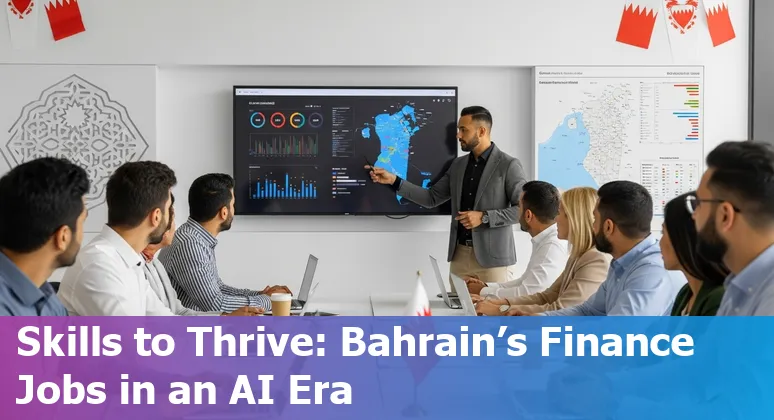
Too Long; Didn't Read:
Bahrain's 2025 finance sector markets AI-driven onboarding, fraud detection and chatbots; routine roles face ~30% automation risk by 2035. Upskill: Tamkeen targets (50,000 trained by 2030), short courses (AI Essentials: 15 weeks, early-bird $3,582) and sandbox pilots to stay relevant.
Bahrain in 2025 feels less like a passive observer and more like a lab where policy, private banks and startups are testing AI in finance - from chatbots (Batelco's Basma, ila Bank's Fatima) to fraud detection and predictive cash‑flow tools - guided by a national roadmap and ethics rules in the Bahrain National AI Strategy; public‑private partnerships and training targets (Tamkeen's large upskilling push) mean the risks to routine roles are real, but so are the openings for people who can combine domain know‑how with prompt and tool skills.
Local advisors highlight generative AI's reach into finance - automation, better risk signals and 24/7 customer experiences - and the practical response is reskilling: short, work‑focused programs like Nucamp's AI Essentials for Work can help finance professionals move from fearing displacement to adding measurable value while systems run the boring hours.
| Attribute | Details |
|---|---|
| Program | AI Essentials for Work |
| Length | 15 Weeks |
| Courses included | AI at Work: Foundations; Writing AI Prompts; Job Based Practical AI Skills |
| Cost (early bird) | $3,582 (then $3,942) |
| Registration / Syllabus | AI Essentials for Work Registration · AI Essentials for Work Syllabus |
"The future of AI in Bahrain is incredibly promising and transformative," - Jatin Karia, Grant Thornton Bahrain.
Table of Contents
- How AI is already changing finance in Bahrain
- Jobs most at risk in Bahrain's finance sector
- Jobs likely to grow or be safe in Bahrain
- Skills Bahrain finance professionals need in 2025
- Practical steps to future-proof your finance career in Bahrain
- Working with AI tools in Bahraini finance teams (day-to-day)
- Regulation, ethics and responsibility in Bahrain
- Local success stories and case studies in Bahrain
- Resources and next steps for Bahraini finance professionals
- Frequently Asked Questions
Implement responsible AI practices for Bahraini finance to reduce bias and protect public trust.
How AI is already changing finance in Bahrain
(Up)In Bahrain the practical side of "AI and automation" in finance is already visible in fast, integrated identity and onboarding systems: BENEFIT's national eKYC hub - built with cloud architecture and APIs that connected banks, the Information & eGovernment Authority (iGA) and the Central Bank of Bahrain - cut months of manual onboarding into an automated service that went live in weeks and has since enabled digital wallets and faster product launches; Fenergo's API‑first, blockchain‑backed rules engine and biometric identity checks have removed duplicate KYC requests for banks and fintechs, improving customer experience and operational efficiency; and the national eKey single sign‑on plus biometric layers supply the reliable identity backbone that lets institutions verify customers across channels.
Together these cloud, API, biometric and blockchain building blocks are doing the heavy lifting - speeding onboarding, reducing fraud risk and letting finance teams focus on judgement and exceptions rather than form‑filling.
Read more on BENEFIT's cloud build, the Fenergo partnership, and Bahrain's eKey framework for details.
| Attribute | Details |
|---|---|
| Operator | BENEFIT (with iGA, supervised by CBB) |
| Key technologies | Hyperledger Fabric, cloud (AWS), APIs, biometric ID |
| Partner highlights | Fenergo, AWS, CrimsonLogic |
| Speed to market | Infrastructure in 2 weeks; eKYC implementation phase ~8 weeks; first phase by Fenergo in 4 weeks |
“Regulatory mandated KYC utilities represent a massive opportunity to enable significant efficiency, improve customer experience and help drive regulatory certainty.” - Marc Murphy, CEO, Fenergo
Jobs most at risk in Bahrain's finance sector
(Up)In Bahrain's finance sector the jobs most exposed to automation are the routine, high‑volume tasks that AI and RPA can replicate fastest: entry‑level accounting roles that spend hours on invoice matching, bank reconciliations and payroll; frontline teller and call‑centre positions being replaced by chatbots and 24/7 virtual assistants; and transactional compliance or loan‑processing functions where rules engines and eKYC pipelines cut manual steps.
Local research flags this pattern - a Springer review of Bahrain's labour market notes AI's potential to upend “vulnerable to automation” roles even as it creates new tech jobs, while industry guides for accounting show how OCR, RPA and time‑series tools can siphon off repetitive work into machines.
The practical takeaway is stark: positions defined by predictable data entry or fixed decision trees are the ones to watch, like the junior accountant reconciling thousands of lines each month - a task that increasingly finishes in minutes with the right models.
See the detailed analysis in the Bahrain AI labour market review (Springer) - AI Essentials for Work syllabus and practical accounting automation impacts for finance teams - AI at Work syllabus.
| Role | Why it's at risk |
|---|---|
| Entry‑level accounting | Invoice processing, bank reconciliation and payroll automation (Accounting automation examples - AI Essentials for Work) |
| Tellers & customer service | Chatbots, virtual assistants and automated payments (Customer service AI use cases - AI Essentials for Work) |
| Transactional compliance / loan processing | Rules engines, eKYC and automated risk scoring (Regulatory automation and eKYC - AI Essentials for Work) |
“Approximately 30% of accounts and finance jobs could be automated by 2035. AI systems like Robotic Process Automation (RPA) will streamline the majority of the routine tasks in Accounting. Finance and Accounting professionals must master tools like Python for data analysis, Tableau for data visualization, and blockchain technology to stay relevant.”
Jobs likely to grow or be safe in Bahrain
(Up)Jobs that look set to grow - and stay relatively safe - in Bahrain's finance ecosystem are the higher‑order, judgment and policy roles that sit above automation: AI ethics and governance leads, senior ethicists and specialists (job boards already list multiple full‑time roles, including a Lead AI Ethicist posting at BHD150,000), as well as data scientists, ML engineers and fintech product owners who translate models into compliant, customer‑facing services backed by the national playbook; the WhatJobs AI governance job listings in Bahrain make the demand obvious, while the Bahrain National AI Strategy official page and training push (Tamkeen's targets, Bahrain Polytechnic's AI Academy) supply the talent pipeline; similarly, consultancy, cloud/API and regulatory‑compliance roles tied to fintech sandboxes and risk frameworks will expand as firms scale AI responsibly - see industry analysis on sector transformation and workforce plans in the 10xDS industry review on integrating AI into Bahrain industries.
Picture a senior ethicist earning rates that match mid‑management bank salaries while advising product, legal and ops teams - that real pay‑and‑power signal helps explain why these roles are growing faster than routine jobs that AI can already do.
| Role | Evidence / Indicative pay |
|---|---|
| Lead AI Ethicist / Senior AI Ethicist | WhatJobs postings (e.g., Lead AI Ethicist, Bilad Al Qadeem - BHD150,000) |
| AI Ethics & Governance Lead / Specialist | Multiple full‑time listings across Seef, Diplomatic Area (BHD85,000–BHD130,000 range) |
| Data scientists / ML engineers / Fintech product owners | Supported by national strategy, Tamkeen training targets and Bahrain Polytechnic AI Academy for workforce supply |
Skills Bahrain finance professionals need in 2025
(Up)To stay relevant in Bahrain's fast‑changing finance sector, combine practical AI literacy with role‑based technical skills and people‑centric capabilities: learn how generative models and vendor tools fit into workflows (prompting, safe tool selection and procurement), build basic data skills for forecasting and time‑series work (see DataRobot's ERP‑friendly forecasting use cases), and sharpen compliance, Bahrainization and bilingual communication acumen so tech solutions actually pass local audits and hiring rules (top ATS vendors in Bahrain are explicitly built for Arabic support and compliance).
Equally important are payment‑sector specialist courses and applied product know‑how from local partnerships that turn new tools into customer features, plus modern L&D fluency - personalised learning paths, storytelling and gamified “gameinar” formats that help busy bankers practise rather than just watch slides.
Together these mix hard technical skills (AI, RPA, blockchain awareness, forecasting), domain depth (payments, compliance) and learner‑centred habits that let teams convert automation into better, not just faster, customer outcomes; practical programs and industry collaborations in Bahrain already target this blend of skills.
“We are excited to see our shared efforts in honing intellectual and technical capabilities in Bahrain improve customer satisfaction and effectiveness of financial services.” - Raghav Prasad, General Manager for Gulf Countries, Mastercard
Practical steps to future-proof your finance career in Bahrain
(Up)Future‑proofing a finance career in Bahrain means a mix of practical courses, on‑the‑job pilots and local networks: start by mapping which parts of your role are routine and score vendors with an AI‑procurement checklist before buying tools; join hands‑on training - Bahrain Polytechnic's AI track and Master's pathways cover Python, forecasting, ML and ethics for exactly this purpose (Bahrain Polytechnic Artificial Intelligence Track and Master's Pathways) - and attend sector events and workshops to turn learning into contacts and pilots (the BIBF “AI for All” conference and workshops are a good place to practice prompts and vendor demos, and often free) (BIBF AI for All conference and workshops).
Use national supports and ecosystems: Tamkeen and the Polytechnic AI Academy feed the talent pipeline while fintech sandboxes and published roadmaps invite small, safe experiments that demonstrate value to managers (see the industry review on Bahrain's AI strategy for workforce and sandbox detail).
Regularly upskill in role‑specific tools (ERP time‑series forecasting, compliance automation and prompt engineering), join hackfests or capstone projects to build a visible project portfolio, and treat one pilot - say, an automated reconciliation trial - as a proof point that replaces “busy work” with higher‑value exception handling and customer insight (10xDS review on integrating AI into Bahrain industries).
| Step | Quick action | Source |
|---|---|---|
| Hands‑on training | Enroll in AI track or Master's modules (Python, ML, ethics) | Bahrain Polytechnic Artificial Intelligence Track and Master's Pathways |
| Network & workshops | Attend conferences, webinars and training workshops | BIBF AI for All conference and workshops |
| Policy & sandbox pilots | Run small compliant pilots; use national sandboxes and Tamkeen supports | 10xDS review on integrating AI into Bahrain industries |
Working with AI tools in Bahraini finance teams (day-to-day)
(Up)Working with AI tools in Bahraini finance teams now means leaning on an API‑first identity and rules layer so everyday work shifts from data entry to exception handling: onboarding that once required piles of forms is often resolved via the BENEFIT eKYC hub and Fenergo's rules engine (biometric ID&V tied to national ID), so a single API call plus a fingerprint check can clear routine KYC and let teams focus on risk judgements and customer nuance; the Central Bank's push for eKYC and open‑banking APIs encourages integration with core systems and mobile apps, while the national eKey/NAF single sign‑on and linked digital wallets (BenefitPay, stcPay) provide the authentication backbone that keeps workflows secure and auditable.
Day‑to‑day practice is pragmatic: run vendor APIs through procurement checklists, automate standard attestations to a blockchain ledger for reuse, and route only flagged exceptions to senior staff - a change that turns hours of repetitive checks into minutes and preserves human time for higher‑value decisions.
Read the technical and regulatory details on Fenergo's partnership with BENEFIT and Bahrain's digital ID plans for how teams should adapt.
“Regulatory mandated KYC utilities represent a massive opportunity to enable significant efficiency, improve customer experience and help drive regulatory certainty.” - Marc Murphy, CEO, Fenergo
Regulation, ethics and responsibility in Bahrain
(Up)Regulation in Bahrain now sits at the centre of practical AI adoption - not as a brake but as a clear lane marker that helps finance teams innovate with confidence; a 2024 standalone AI law enshrines privacy, transparency and mandatory human oversight, bans harmful uses and even sets penalties (including up to three years in jail or fines up to BD2,000) to keep deployments accountable (Bahrain 2024 AI law and governance framework); at the same time national initiatives - from procurement guidelines and an AI Academy at Bahrain Polytechnic (with Microsoft) to Tamkeen's training targets and Central Bank fintech sandbox guidance - create pathways for compliant pilots and skills development, so a small, well‑governed proof‑of‑value pilot can become a trusted production service rather than a regulatory headache (Bahrain national AI strategy, workforce targets and fintech sandbox guidance).
The practical upshot for finance teams is straightforward: follow procurement and audit checklists, build human‑in‑the‑loop controls, and treat explainability and data protection as product features - that's what turns compliance from a box‑ticking chore into a competitive advantage.
| Regulatory element | Details |
|---|---|
| 2024 AI law | Privacy, transparency, human oversight; bans harmful uses; penalties up to 3 years jail or BD2,000 fines |
| Workforce / training | Tamkeen targets (train 50,000 Bahrainis by 2030); AI Academy at Bahrain Polytechnic |
| Procurement & pilots | AI procurement guidelines and public sandboxes to run compliant trials |
Local success stories and case studies in Bahrain
(Up)Local wins show how Bahrain's AI and open‑banking push is already turning into products that matter: Tarabut's regulated open banking engine - built with partners like DashDevs and now linked to BENEFIT's national authenticator - went from zero to a white‑label product used by 200K+ app users (about 4% of the country) and cleared the Central Bank sandbox, proving speedy, secure app‑to‑app flows that let FLOOSS deliver near‑instant loan approvals via BenefitPay; regional analysis even credits Tarabut with capturing the vast majority of connected accounts and creating an API layer that reduces onboarding friction while unlocking data enrichment and payments use cases across banks and fintechs.
These case studies show practical lessons for Bahraini finance teams: start small, integrate with the national ID/auth stack, and measure value in seconds saved and customers onboarded rather than lines of code - a turnkey open‑banking proof of value that regulators and product teams can point to when arguing for scaled pilots.
Read the technical case study and partnership announcement to follow the implementation and results.
| Metric | Detail / Source |
|---|---|
| App users | 200K+ downloads (~4% country coverage) - DashDevs Tarabut case study |
| Banks integrated | Integrated 8+ banks in 6 months; connected 24 commercial banks for open banking integrations - DashDevs |
| Regulatory progress | Passed CBB sandbox testing; licensed AISP/PISP - Tarabut / PwC |
| Valuation | £25M product evaluation after launch - DashDevs results |
| Authentication partnership | BENEFIT + Tarabut + FLOOSS for centralized open banking authentication (BenefitPay) - Tarabut blog / IBSIntelligence |
“This partnership marks a pivotal moment for Open Banking in Bahrain and beyond; combining Benefit's infrastructure, FLOOSS's lending model, and Tarabut's technology to set new standards for accessibility and security.” - Abdulla Almoayed, Founder & CEO, Tarabut
Resources and next steps for Bahraini finance professionals
(Up)Practical next steps for Bahraini finance professionals start with the supports already on offer: tap Tamkeen's employer and training programs to fund upskilling and leadership pathways (Tamkeen employer and training programs) and consider enterprise routes like the Overseas Expansion Program - an 8‑month soft‑landing and advisory track for Bahraini firms (applications open until July 25, 2025) if scaling to KSA is part of your plan (Tamkeen Overseas Expansion Program for KSA market entry).
For hands‑on AI capability, a short, job‑focused course can move staff from reactive to proactive: Nucamp's AI Essentials for Work is a 15‑week practical pathway (early‑bird $3,582) that covers foundations, prompt writing and role‑specific AI skills - ideal for finance teams wanting measurable pilots rather than theory (Nucamp AI Essentials for Work bootcamp registration).
Combine these: run a small Tamkeen‑supported pilot, document outcomes against compliance rules from the updated training framework, then scale training across teams so tech replaces busywork while people move to exception handling and product thinking.
| Resource | Quick detail |
|---|---|
| Tamkeen programs | Employer & training supports; Leadership Skills program with Harvard (200 participants) - Tamkeen employer and training programs |
| Overseas Expansion Program | 8 months, KSA soft‑landing support; application deadline 25 July 2025 - Tamkeen Overseas Expansion Program for KSA market entry |
| Updated training framework | Tamkeen regulatory update (Aug 25, 2025) to improve training impact and outcomes |
| Nucamp - AI Essentials for Work | 15 weeks; early bird $3,582; practical AI at work, prompts & job‑based skills - Nucamp AI Essentials for Work bootcamp registration |
Frequently Asked Questions
(Up)Will AI replace finance jobs in Bahrain in 2025?
AI is automating routine, high-volume tasks (e.g., invoice matching, reconciliations, teller and basic call-centre work) and poses real risk to entry-level, predictable roles. However, Bahrain's regulatory framework, public–private upskilling programs (Tamkeen, Bahrain Polytechnic AI Academy) and growing demand for higher-order roles (AI ethics, data scientists, ML engineers, product owners) mean AI is more likely to reshape jobs than fully replace skilled professionals. People who reskill in AI tools, prompting, forecasting and domain-specific fintech skills can shift to exception-handling, product, governance and higher-value roles.
Which finance roles in Bahrain are most at risk and which are likely to grow?
Most at risk: routine, rules-based positions such as entry-level accounting (invoice processing, bank reconciliations, payroll), tellers and basic customer-service agents, and transactional compliance/loan-processing roles driven by rules engines and eKYC. Likely to grow or remain in demand: AI ethics and governance leads, senior ethicists, data scientists, ML engineers, fintech product owners, cloud/API and regulatory-compliance specialists - supported by national strategies, sandboxes and training targets.
What practical skills should finance professionals in Bahrain learn in 2025?
Combine practical AI literacy (prompting, vendor/tool selection, human-in-the-loop controls) with role-based technical skills (basic Python, forecasting/time-series, RPA, OCR awareness, data visualization) and domain depth (payments, KYC/eKYC, compliance, Arabic bilingual capabilities). Also develop learner-centered habits: hands-on pilots, capstones or hackfests, and familiarity with procurement and explainability checklists so automated systems meet local audits and regulations.
How can Bahraini finance professionals and teams future-proof their careers and organisations?
Practical steps: map routine parts of your role and score vendors against AI procurement checklists; run small, compliant pilots using national sandboxes and use Tamkeen supports; enroll in short, job-focused programs (e.g., Nucamp's 15-week AI Essentials for Work) or local AI tracks at Bahrain Polytechnic to learn prompting, practical AI tools and ethics; document pilots as proof points to shift staff from busywork to exception handling and product thinking; attend sector events and build a portfolio of measurable pilots.
What is the regulatory and infrastructure context in Bahrain that affects AI adoption in finance?
Bahrain has a 2024 AI law requiring privacy, transparency and mandatory human oversight with penalties for misuse, plus national building blocks like BENEFIT's eKYC hub, eKey single sign-on and API/open-banking sandboxes supervised by the Central Bank. These frameworks and infrastructures make it easier to run compliant pilots, integrate biometric and API-first identity flows, reduce onboarding friction, and scale AI responsibly - provided teams follow procurement, audit and explainability guidelines.
Convert dense rules into a regulatory summarization to-do list that teams can act on immediately.
Discover regional insights fast with AlphaSense market research for investment teams and deal diligence.

Ludo Fourrage
Founder and CEO
Ludovic (Ludo) Fourrage is an education industry veteran, named in 2017 as a Learning Technology Leader by Training Magazine. Before founding Nucamp, Ludo spent 18 years at Microsoft where he led innovation in the learning space. As the Senior Director of Digital Learning at this same company, Ludo led the development of the first of its kind 'YouTube for the Enterprise'. More recently, he delivered one of the most successful Corporate MOOC programs in partnership with top business schools and consulting organizations, i.e. INSEAD, Wharton, London Business School, and Accenture, to name a few. With the belief that the right education for everyone is an achievable goal, Ludo leads the nucamp team in the quest to make quality education accessible