









The Complete Guide to Using AI as a Finance Professional in Bahamas in 2025
Last Updated: September 4th 2025
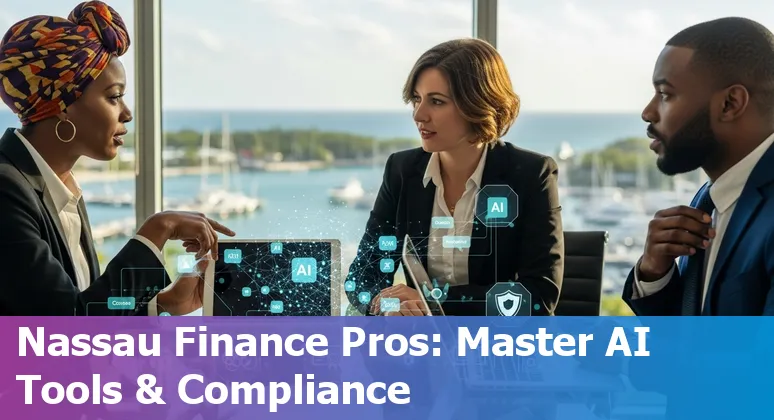
Too Long; Didn't Read:
For Bahamian finance professionals in 2025, GenAI boosts efficiency (56% firms) and profitability (34%) amid 70% regional CEO growth optimism. Prioritise pilots for fraud detection, cash‑flow forecasting and KYC, pair with governance, DPIAs, upskilling, and measurable KPIs (cycle time, false‑positive rate).
For finance professionals in Nassau in 2025, AI is no longer a distant trend but a practical lever for efficiency, risk reduction, and strategic reinvention: PwC's 2025 Caribbean CEO Survey shows almost 70% of regional CEOs optimistic about growth, with GenAI already delivering efficiency gains for 56% of firms and profitability boosts for 34%, even as only about 28% report high trust in embedding AI - a reminder that adoption must pair capability with governance.
National leaders are echoing the call: Prime Minister Davis's business outlook pushes digital transformation and workforce upskilling to sustain recovery and competitiveness.
That makes targeted workplace training essential; explore the AI Essentials for Work syllabus to learn prompt-writing and real-world AI workflows. For a tourism-weighted economy like The Bahamas, practical AI use - faster financial reporting, fraud detection, and cash-flow forecasting - can raise productivity while addressing budget and cyber-resilience priorities.
| Bootcamp | Details |
|---|---|
| AI Essentials for Work | 15 Weeks; Learn AI tools, write effective prompts, apply AI across business functions; Early bird $3,582, then $3,942; Paid in 18 monthly payments; AI Essentials for Work syllabus - Nucamp • Register for AI Essentials for Work - Nucamp |
Matt Wood, Global and US CTIO, PwC: "GenAI is maturing in enterprises; CEOs see opportunities but also challenges. Emphasis on trust in AI design and prioritising integration into core processes."
Table of Contents
- What is AI and the future of AI in financial services in Bahamas in 2025?
- Key AI use cases for finance professionals in Bahamas
- How can finance professionals use AI day-to-day in Bahamas?
- Data, privacy, and regulatory considerations in Bahamas
- How to start with AI in 2025: a step-by-step roadmap for Bahamas finance professionals
- Which AI courses and training are best for finance professionals in Nassau, Bahamas?
- Tools, platforms, and vendors to consider in Bahamas
- Governance, testing, and measuring AI ROI for finance teams in Bahamas
- Conclusion and next steps for finance professionals in Bahamas in 2025
- Frequently Asked Questions
Transform your career and master workplace AI tools with Nucamp in Bahamas.
What is AI and the future of AI in financial services in Bahamas in 2025?
(Up)AI in finance is simply the set of tools that turn data into faster decisions - automating payments and onboarding, spotting fraud in real time, and tailoring advice to individual customers - and in the Bahamas that shift is already practical and policy-driven: the country is named among early adopters of central bank digital currencies, a signal that AI‑enabled payments and CBDC plumbing are moving from pilot to production (Financial services: industry trends shaping 2025).
Across global financial firms the headline trends for 2025 - digital currencies, the rise of neobanks, automated money services, and generative/NLP systems for customer support - are reshaping day‑to‑day work and product design, with wins so concrete some banks cut verification from days to minutes and others use GenAI to compress routine document reviews into seconds (Five key AI trends that shaped financial services in 2025).
so what?
For Bahamian finance professionals this means two connected priorities: operational uplift (real‑time fraud detection, smarter cash‑flow and payments automation, embedded finance for tourism and cross‑border clients) and governance (regulatory reform, upskilling, and secure deployments) as outlined in the Bahamas Report 2025 - so the
AI is not an abstract future here, it's the practical engine powering faster, safer, and more personalised financial services in Nassau and beyond.
Key AI use cases for finance professionals in Bahamas
(Up)Key AI use cases for finance professionals in the Bahamas start with hardened fraud prevention and identity verification: with the Central Bank warning about fake internet ads, videos and social posts impersonating officials, including deepfakes that ask for payments, protecting customers and public trust is urgent (Central Bank of The Bahamas deepfake investment scam alert).
Practical deployments that matter locally include real‑time transaction monitoring and anomaly detection to stop suspicious payments before settlement, behavioral biometrics and voice/facial checks to block synthetic identities, and AI‑assisted KYC/AML linking across accounts and cross‑border flows to flag money‑laundering patterns - tools proven to reduce investigation time and lift detection rates in industry tests (see specialist implementations and accuracy claims in Deltec's overview) (Deltec Bank AI fraud prevention overview).
For front‑line teams, chatbots and automated alerts speed customer verification while predictive models forecast fraud spikes; vendors and case studies on real‑time models outline how banks can cut losses and false positives as they scale (Appwrk real‑time AI fraud detection banking use cases).
The takeaway: combine adaptive ML, explainability, and customer education so Bahamian finance teams can block a convincing fake video or scam in minutes - not days - while keeping service friction low.
How can finance professionals use AI day-to-day in Bahamas?
(Up)Day-to-day AI for Bahamian finance teams looks less like sci‑fi and more like reliable, measurable lift: start by auto-ingesting invoices, bank statements and KYC documents so AP/AR clerks spend minutes on exceptions instead of hours on data entry, using purpose-built IDP platforms such as ABBYY intelligent document processing for financial services to speed verification and keep auditable trails (ABBYY intelligent document processing for financial services).
Pair that extraction with low-code orchestration - Tungsten TotalAgility workflow automation for finance - so approvals, exception routing and report generation flow across legacy ERPs without manual handoffs, and generative copilots turn natural-language requests into extraction models and workflows (TotalAgility claims up to 80% faster extraction model creation) (Tungsten TotalAgility workflow automation for finance).
On the accounting bench, AI agents handle routine close tasks - journal entries, data transformation and reconciliations - so teams move from preparers to reviewers; FloQast AI Agents for accounting automation demonstrate how a Journal Entry Agent and Data Transformation Agent can free time for analysis while preserving auditability (FloQast AI Agents for accounting automation).
The practical payoff in Nassau: faster onboarding for tourism and cross‑border clients, near-real-time anomaly alerts to spot fraud, and a monthly close that feels like a checkpoint, not an emergency - imagine a 200-page document set reduced to report-ready entries in the time it takes to make coffee.
Data, privacy, and regulatory considerations in Bahamas
(Up)Data privacy in The Bahamas rests on the long-standing Data Protection (Privacy of Personal Information) Act - a functional foundation that nonetheless leaves practical gaps for 2025-era AI: the Act binds local controllers and those using Bahamian equipment and requires lawful collection, accuracy, limited retention and “industry‑standard” security, while oversight sits with the Data Protection Commissioner (DPC).
Crucial limits for finance teams: there is no statutory duty to appoint a DPO, no mandatory breach‑notification rule, and transfers outside The Bahamas can be restricted unless contract or safeguards satisfy the DPC, so cross‑border AI stacks and cloud vendors need explicit contractual safeguards and careful data mapping.
Regional analysis urges reform to add rights like erasure, portability and breach notification and to strengthen enforcement and algorithmic oversight - a reminder that legacy law can lag behind modern AI risks.
Practically, finance leaders in Nassau should adopt data‑minimisation, clear retention policies, vendor due diligence, DPIAs for high‑risk AI use, and playbooks that treat every incident as reportable - that combination protects customers, preserves trust, and keeps payments and reporting automation on the right side of both law and public confidence.
| Key DPA Feature | What it means for finance teams |
|---|---|
| Scope & extraterritoriality | Applies to controllers established in The Bahamas and those using Bahamian equipment → map where data is processed |
| Core controller duties | Lawful collection, accuracy, limited retention, adequate security → adopt minimisation and retention rules |
| No mandatory DPO / No breach notification | Statutory gaps exist → implement internal DPO roles and voluntary breach playbooks |
| Transfers | DPC may prohibit transfers lacking safeguards → use contracts and assess international vendors |
| Enforcement & penalties | DPC can investigate; fines up to BSD 100,000 and other remedies → prioritise compliance and audit trails |
How to start with AI in 2025: a step-by-step roadmap for Bahamas finance professionals
(Up)Begin with a clear, business-led assessment: set a short portfolio of work - “ground‑game” pilots that fix one friction (invoice intake, KYC checks), a couple of “roofshots” for cross‑functional uplift, and one strategic “moonshot” to explore new services - then decide build vs.
buy using evidence from pilots and vendor due diligence (see the practical build-vs-buy debate in the 2025 State of AI for Business and Finance report by AlphaSense: 2025 State of AI for Business and Finance report).
Prioritise a high‑quality subset of data to demonstrate value quickly, instrument simple KPIs (new revenue, cycle time, false‑positive rate, productivity) and run a time‑boxed pilot with audit trails and SOC‑2/vendor checks; this approach converts abstract AI hype into measurable wins.
Pair pilots with a light governance layer and Responsible AI checks so risk doesn't scale faster than value; use upskilling and recorded playbooks from expert series like the CCH Tagetik AI adoption webinars for finance to train reviewers and managers: CCH Tagetik AI adoption webinars for finance.
Finally, plan for scaling: codify what worked, lock in data/contract safeguards, and expand incrementally - imagine turning a slow verification queue into report‑ready entries over a single quarter, freeing teams to focus on interpretation, not extraction - then use strategy reviews and ROI metrics from PwC to guide the next wave of investment (see PwC 2025 AI predictions for business and finance: PwC 2025 AI predictions for business and finance).
“Top performing companies will move from chasing AI use cases to using AI to fulfill business strategy.” - Dan Priest, PwC US Chief AI Officer
Which AI courses and training are best for finance professionals in Nassau, Bahamas?
(Up)For finance professionals in Nassau who need practical, career-ready AI skills, start local and scale up: short, hands‑on options from The Knowledge Academy in Nassau - like the one‑day "Artificial Intelligence and Machine Learning in Banking and Finance" and the "Certified Artificial Intelligence (AI) for Accountants" courses - deliver focused modules on forecasting, fraud detection, KYC automation and governance with onsite or online delivery and fees starting from $1,795 (ideal for upskilling without a long leave of absence) (Artificial Intelligence and Machine Learning in Banking and Finance - The Knowledge Academy Nassau, Certified Artificial Intelligence (AI) for Accountants - The Knowledge Academy Nassau).
Complement that practical training with locally grounded credentials and pathways at the Bahamas Institute of Financial Services (BIFS), which lists AI for Financial Services alongside degree and compliance programs to bridge industry practice and regulation (Bahamas Institute of Financial Services (BIFS) - AI for Financial Services and Programs).
For leaders planning strategy and vendor selection, consider longer online executive options to master AI strategy, data governance and ROI measurement before scaling pilots into production (programs from Cornell/eCornell and MIT/UT Austin are commonly highlighted in comparative guides for strategic leaders).
| Provider | Course / Program | Notes |
|---|---|---|
| The Knowledge Academy | AI & ML in Banking; Certified AI for Accountants | Nassau delivery; 1‑day options; online/instructor‑led/self‑paced; fees start from $1,795 |
| Bahamas Institute of Financial Services (BIFS) | Associates Degree, AI for Financial Services, specialist MBAs | Local institute with industry‑focused programmes and postgrad certificates for finance professionals |
| Cornell / eCornell | AI Strategy Certificate | Online executive programme (≈3 months); price example listed at $2,730 in comparative guides for strategic leaders |
Tools, platforms, and vendors to consider in Bahamas
(Up)For finance teams in Nassau thinking practically about vendors, start with platforms that solve the three common frictions - complex consolidation and reporting, cross‑border payments, and day‑to‑day workflow orchestration - so the technology elevates people rather than replacing them.
CCH® Tagetik's AI‑powered Corporate Performance Management platform proves useful where consolidation is painful: its whitepaper shows faster consolidation, AI‑driven analytics, automated disclosures and enhanced encryption for large groups (one APAC case involved a conglomerate with 1,000+ subsidiaries) - a helpful model when local banks or finance houses need reliable group reporting (CCH Tagetik AI-powered CPM whitepaper on faster consolidation and AI analytics).
For payments and remittances, consider Tipalti to simplify global supplier payments and reduce AP headaches common in tourism and cross‑border vendor flows (Tipalti global supplier payments solution for finance teams).
Tie these systems together with a work‑management layer like Adobe Workfront to automate approvals, keep auditable workflows, and shorten review cycles so reconciliations and close tasks move from firefighting to routine - imagine invoices cleared and matched while the kettle boils in the break room (Adobe Workfront work management and automation platform).
Governance, testing, and measuring AI ROI for finance teams in Bahamas
(Up)For finance teams in Nassau, governance isn't a checkbox - it's the nervous system that keeps AI-driven reporting, fraud detection and payments automation trustworthy and measurable: start by creating an AI inventory and cross‑functional committee (IT, compliance, legal, ops and business owners), adopt clear policies and vendor standards, and bake continuous monitoring and bias checks into model lifecycles so decisions are auditable and explainable; practical frameworks such as the NIST AI Risk Management Framework or ISO AI guidance help structure risk assessments and conformity reviews while governance tooling and playbooks make oversight repeatable.
Measure ROI with concrete KPIs tied to finance outcomes (cycle time saved, false‑positive rate, cost per investigation, new revenue from faster onboarding) and run time‑boxed pilots that include audit trails and vendor due diligence so risk doesn't scale faster than value.
Use best practices - diverse governing teams, standardized intake and regular model testing - to translate regional commitments into results: anti‑corruption and integrity bodies in the Caribbean are already backing AI to fight illicit flows, so local finance leaders should pair those ambitions with operational controls and continuous measurement to protect customers and unlock real, trackable gains (Commonwealth report: Caribbean anti‑corruption chiefs endorse AI solutions to tackle illicit financial flows, LeanIX guide to AI governance best practices, OneTrust resource: building a future‑ready AI governance program).
“The Commonwealth's award‑winning anti‑corruption work is needed more than ever to help countries curb corruption and redirect funds toward sustainable development goals... this meeting has been an excellent opportunity... provide more tailored assistance to the region, including using the power of AI.”
Conclusion and next steps for finance professionals in Bahamas in 2025
(Up)Actionable next steps for finance professionals in The Bahamas: start small, learn fast, and govern early - sign up for a one‑day practical upskill like The Knowledge Academy's AI in Banking and Finance course in Nassau to master fraud detection, forecasting and KYC automation, link that to a recognised local pathway such as the Bahamas Institute of Financial Services accredited programs and industry connections, and if a deeper workplace program is the goal, consider a focused cohort like Nucamp's AI Essentials for Work 15-week bootcamp to learn prompt writing, practical AI workflows and job‑based skills; combine training with a short, time‑boxed pilot (12‑month action plan resources are available) that measures cycle‑time saved, false‑positive reductions and onboarding speed, then lock in vendor contracts, run a DPIA for high‑risk models, and use local conferences and UB/CELEARN short courses to keep teams current - a steady, measured programme turns AI from a compliance headache into a productivity engine that helps Nassau firms onboard tourism partners faster and keep client trust intact.
| Next Step | Why it helps | Where to start |
|---|---|---|
| Short practical course | Fast grounding in fraud, forecasting, KYC | The Knowledge Academy - AI in Banking and Finance (Nassau, from $1,795) |
| Local credential & networks | Industry alignment, accredited pathways | Bahamas Institute of Financial Services - AI for Financial Services and programs |
| Workplace bootcamp | Hands-on prompts, workflows, job-based skills | Nucamp AI Essentials for Work (15 weeks) registration |
“Really good course and well organised. Trainer was great with a sense of humour - his experience allowed a free flowing course, structured to help you gain as much information & relevant experience whilst helping prepare you for the exam” - Joshua Davies, course testimonial
Frequently Asked Questions
(Up)What practical AI use cases should finance professionals in The Bahamas prioritize in 2025?
Priorities are operational uplift and governance. High-value use cases include real-time transaction monitoring and anomaly detection for fraud prevention, behavioral biometrics and voice/facial checks for identity verification, AI-assisted KYC/AML linking across accounts and cross-border flows, automated invoice and bank-statement ingestion (IDP), low-code workflow orchestration for approvals and exception routing, generative copilots for report generation, and AI agents for routine close tasks (journal entries, reconciliations). These reduce investigation time, speed onboarding for tourism and cross-border clients, and make monthly closes faster and more audit-ready.
How should Bahamian finance teams balance adoption with data privacy and regulatory requirements?
Adopt a compliance-first approach: map where data is processed (recognizing extraterritorial scope of the Data Protection Act), apply data minimization and retention rules, run Data Protection Impact Assessments for high-risk AI, implement vendor due diligence and contractual safeguards for cross-border transfers, and create internal breach playbooks and a voluntary DPO role since mandatory DPO and breach-notification requirements are limited. Combine these with audit trails, encryption, and documented DPIAs to protect customers and meet DPC expectations.
What step-by-step roadmap should a finance team in Nassau follow to start with AI in 2025?
Start with a business-led assessment and a small portfolio: one ground-game pilot (e.g., invoice intake or KYC checks), one or two cross-functional roofshots, and one strategic moonshot. Decide build vs buy based on pilot evidence, prioritize a high-quality data subset, instrument simple KPIs (cycle time, false-positive rate, new revenue), run time-boxed pilots with audit trails and SOC2/vendor checks, add a light governance layer with Responsible AI checks, upskill staff via short practical courses, then codify and scale successful pilots with contractual and data safeguards.
Which courses, bootcamps and training paths are recommended for finance professionals in Nassau?
For hands-on practical skills: local short courses such as The Knowledge Academy's one-day 'AI & ML in Banking' or 'Certified AI for Accountants' (fees from about $1,795) provide focused modules on forecasting, fraud detection, KYC automation and governance. For accredited local pathways, consider programs from the Bahamas Institute of Financial Services (BIFS). For leaders, online executive certificates (e.g., Cornell/eCornell, MIT/UT Austin) teach AI strategy, governance and ROI measurement. For workplace reskilling, consider multi-week bootcamps (example: AI Essentials for Work, 15 weeks) that teach prompt-writing, workflows and job-based skills.
How should finance teams measure AI ROI and govern models once deployed?
Measure ROI using finance-specific KPIs: cycle time saved, false-positive rate, cost per investigation, onboarding time, and new revenue. Maintain an AI inventory, form a cross-functional governance committee (IT, compliance, legal, ops, business owners), adopt policies and vendor standards, and use continuous monitoring, bias and explainability checks, and standardized intake and testing. Leverage frameworks like NIST AI RMF or ISO AI guidance, time-box pilots with audit trails and vendor due diligence, and iterate based on measurable outcomes to prevent risk from scaling faster than value.
Predict tourist demand swings with confidence using DataRobot automated demand forecasting that simplifies ML for finance teams.
Follow a simple pilot checklist for Bahamian firms to start small and scale AI safely.
Discover the growth areas for finance talent in the Bahamas, including AI-savvy analysts and data engineers, and why those focused on growth areas for finance talent will be in demand.

Ludo Fourrage
Founder and CEO
Ludovic (Ludo) Fourrage is an education industry veteran, named in 2017 as a Learning Technology Leader by Training Magazine. Before founding Nucamp, Ludo spent 18 years at Microsoft where he led innovation in the learning space. As the Senior Director of Digital Learning at this same company, Ludo led the development of the first of its kind 'YouTube for the Enterprise'. More recently, he delivered one of the most successful Corporate MOOC programs in partnership with top business schools and consulting organizations, i.e. INSEAD, Wharton, London Business School, and Accenture, to name a few. With the belief that the right education for everyone is an achievable goal, Ludo leads the nucamp team in the quest to make quality education accessible