









Top 5 Jobs in Financial Services That Are Most at Risk from AI in Toledo - And How to Adapt
Last Updated: August 30th 2025
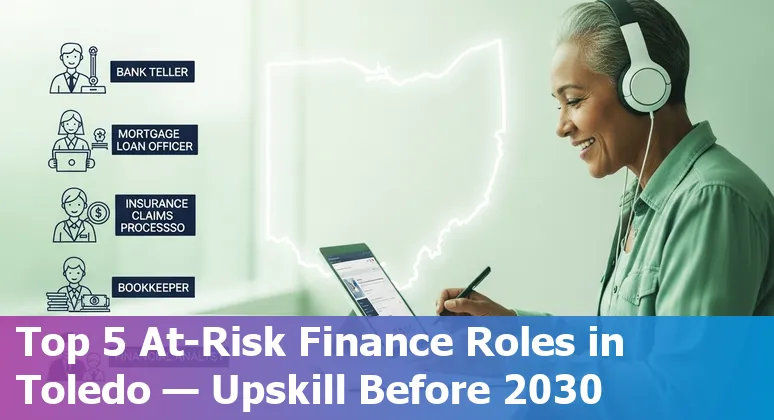
Too Long; Didn't Read:
In Toledo finance, AI could fully automate ~30% of U.S. jobs by 2030 and affect 60%+ of tasks; bank tellers, data entry, basic customer service, junior bookkeeping, and entry-level analysts are most at risk. Upskill in AI tools, prompting, and exception-handling to stay relevant.
Toledo's financial-services workforce sits squarely in the crosshairs of a national shift: AI could fully automate roughly 30% of U.S. jobs by 2030 and change tasks in another 60%, with routine, data-heavy roles - think teller counters, basic customer support and entry-level data work - most exposed (see National University's roundup of AI job statistics).
Finance is especially “data-rich,” so adoption can be fast and deep: the World Economic Forum notes industries awash in data may see 60–70% AI uptake, which makes frontline finance tasks vulnerable in cities like Toledo where banks and credit operations process high volumes of transactions.
That's not doom - it's a call to action: learning practical AI skills (prompting, tool use, process redesign) can shift workers from replaceable task-doers to AI-augmented problem solvers; Nucamp's AI Essentials for Work bootcamp offers a 15-week, workplace-focused pathway to those skills.
Imagine a local branch where chatbots handle routine balance inquiries while employees solve the one-in-a-hundred complex case - that's the future of resilient finance work.
| Program | Length | Cost (early bird / regular) | Key features | Links |
|---|---|---|---|---|
| AI Essentials for Work | 15 Weeks | $3,582 / $3,942 | AI at Work: Foundations; Writing AI Prompts; Job-Based Practical AI Skills | AI Essentials for Work syllabus | Register for AI Essentials for Work |
“AI models learn from data. An AI model with limited data is like a toddler; with extensive data, like an experienced grandfather.” - World Economic Forum
Table of Contents
- Methodology: How we picked the top 5 at-risk finance jobs for Toledo
- Bank Tellers & Retail Branch Staff
- Data Entry Clerks & Clerical Administrative Staff
- Customer Service Representatives (Basic Support)
- Bookkeepers, Junior Accounting Roles, and New-Accounts Clerks
- Market Research Analysts (Entry-Level) & Junior Data Analysts
- Conclusion: Practical next steps for Toledo finance workers and employers
- Frequently Asked Questions
Find a checklist for choosing AI vendors and partners that fit Toledo institutions' needs and budgets.
Methodology: How we picked the top 5 at-risk finance jobs for Toledo
(Up)Selection began with the strongest real-world signal available: a large Stanford analysis of ADP payrolls showing steep declines for entry-level workers in AI-exposed roles - coverage summarized in outlets like Stanford study on generative AI reshaping US job market - CNBC coverage - and then applied three local filters for Toledo: task routineness (how codified and repetitive the work is), data intensity (high-volume transaction and record-keeping tasks common in local branches), and the automation-versus-augmentation balance highlighted by the researchers.
Jobs that are both routine and richly data-driven - and where firms can deploy generative systems without heavy human oversight - ranked highest. Each candidate role was cross-checked against evidence in the Stanford coverage (ages 22–25 saw double-digit declines since late 2022) and local use cases for AI in Toledo's financial sector, such as personalized transaction nudges and automated customer workflows documented in the Nucamp guide to local AI use cases, to prioritize roles most likely to see displacement rather than augmentation.
“It's always hard to know [what's happening] if you're only looking at a particular company or hearing anecdotes.” - Erik Brynjolfsson
Bank Tellers & Retail Branch Staff
(Up)Bank tellers and retail branch staff in Toledo face one of the clearest fronts of AI-driven change: routine cash-handling and scripted inquiries are being hoovered up by smarter self-service channels, while branches shrink and the remaining roles morph into “universal” or advisory positions that require product knowledge and digital fluency.
Industry research shows this isn't hypothetical - the Burning Glass Institute documents a quiet vanishing of teller jobs (employment has fallen nearly 30% since 2010 and job postings plunged), and Accenture finds generative AI could affect 73% of bank employee time with roughly 60% of teller tasks amenable to AI support - a recipe for fewer pure-transaction roles and more hybrid jobs that blend sales, troubleshooting, and tech use.
For Toledo workers that means practical upskilling matters: local use cases such as personalized transaction nudges and branch automation show how employees can move from handing over forms to guiding customers through digital products (see the Nucamp guide to personalized transaction-based nudges in Toledo: Nucamp AI Essentials for Work syllabus and guide).
The human touch won't vanish - it will be concentrated where it matters most - but the image of a four-foot “Pepper” robot doing selfies in a flagship lobby is a vivid reminder that simple interactions are now ripe for automation.
“Banking is necessary, Banks are Not.” - Bill Gates
Data Entry Clerks & Clerical Administrative Staff
(Up)Data entry clerks and clerical administrative staff in Toledo are squarely in the middle of a practical reshuffle: routine keystrokes and form-filling are increasingly handed to faster, cheaper automation while human specialists pivot to quality control, exception handling, and cross-system reconciliation.
Nationally, more than 60% of data-entry roles are now remote and employers report steady demand - job postings rose about 7% last year - yet automation already handles basic input for roughly 30% of companies, so the day-to-day is changing from “type and file” to “validate and escalate” (see the updated Data Entry Statistics).
For Toledo's banks and back offices that process high volumes of transactions, that means staff who earn the solid sector premium (average pay around $38K, up to $45K in finance) and who hold certifications - which boost hire prospects and pay - will be best placed to move into higher-value workflows.
Local teams can lean on emerging trends like AI-driven data pipelines and low-code integrations to cut error rates and free time for customer-facing or analytic tasks (explained in WhereScape's 2025 automation trends), and Nucamp's practical AI use-case guides show how to turn routine work into opportunity by focusing on validation, governance, and model-aided review.
The memorable takeaway: rather than a conveyor belt of manual forms, envision a scanner + AI doing the heavy lift while trained clerks catch the 1% of exceptions that actually matter.
| Key Stat | Figure | Source |
|---|---|---|
| Remote work share | >60% | 2025 Data Entry Statistics report - remote work share |
| Job postings (year-over-year) | +7% | 2025 Data Entry Statistics report - job postings growth |
| Average salary (general / finance) | $38,000 / up to $45,000 | 2025 Data Entry Statistics report - average salary |
| Firms using automation for basic entry | ~30% | 2025 Data Entry Statistics report - automation adoption |
| Certification hiring advantage | +20% chance to hire; ~10% higher pay | 2025 Data Entry Statistics report - certification impact |
Customer Service Representatives (Basic Support)
(Up)Customer service reps handling basic support in Toledo are squarely in the automation zone: routine, repeatable asks - balance checks, password resets, basic account status - are the very interactions chatbots handle fastest and cheapest, with industry roundups projecting up to 95% of interactions AI-powered and roughly 80% of routine inquiries manageable by bots (see Fullview's 2025 AI customer service roundup), which translates into big cost and time savings (chatbot interaction ≈ $0.50 vs.
$6.00 for a human, and average ROI around $3.50 per $1 invested). That doesn't mean every job evaporates in Lucas County; Harvard Business School's large chat-analysis shows AI assistance cuts response times and raises sentiment - especially for less-experienced agents - so the local shift looks more like a role remix than a disappearance: front-line staff become editors, exception handlers, and relationship builders who handle the tricky 1-in-100 cases humans still must resolve.
The catch for Toledo employers is training and governance - Zendesk's 2025 findings flag a persistent training gap - so the smartest local play is to pair practical AI tools with focused upskilling so reps can supervise AI, fix edge cases, and own outcomes; picture a Toledo contact center where AI clears the morning flood and a human steps in for the one fraught fraud call that needs judgment and heart.
“You should not use AI as a one-size-fits-all solution in your business, even when you are thinking about a very specific context such as customer service.” - Shunyuan Zhang
Bookkeepers, Junior Accounting Roles, and New-Accounts Clerks
(Up)Bookkeepers, junior accountants, and new-accounts clerks in Toledo are entering a phase where routine transaction work is being siphoned to cloud feeds and bots, but the jobs aren't simply disappearing - they're being redesigned.
Modern platforms like QuickBooks and Xero push automated bank feeds, invoice automation, and reconciliation that shorten manual cycles (see the QuickBooks vs Xero comparison), while RPA proofs-of-concept show bots can match roughly 80% of transactions and flag the rest for human review, turning a daily grind into exception-handling and judgment work (QuickBooks vs Xero comparison, Valenta RPA proof of concept for account reconciliation).
For Toledo firms that means bookkeepers who learn tool integrations, controls, and fraud-detection oversight will be more valuable than those who only type entries; also be alert to security risks - phishing and account compromises target popular accounting tools - so governance and multi-factor access matter.
Picture a local office where a scanner + AI clears the routine stack and a skilled clerk steps in to resolve the 1-in-5 exceptions that actually move the business forward.
| Tool / Approach | Why it matters for Toledo bookkeepers | Source |
|---|---|---|
| QuickBooks | Wide adoption, strong bank feeds and invoice automation for US SMBs | QuickBooks vs Xero comparison |
| Xero | Cloud updates, unlimited users, good bank reconciliation workflows | Xero vs QuickBooks guide |
| RPA / Bots | Automates reconciliation and matches ~80% of transactions; flags exceptions for humans | Valenta RPA proof of concept for account reconciliation |
Market Research Analysts (Entry-Level) & Junior Data Analysts
(Up)Entry-level market research analysts and junior data analysts in Toledo face a fast-evolving mix of risk and opportunity: routine tasks - data cleaning, basic reporting and keyword or survey counts - are increasingly automated, but the human edge remains in interpretation, storytelling, and designing the right questions; entry-level roles (0–2 years) typically center on supporting senior analysts and assembling reports, per the Market Research Analyst Career Path Guide (Market Research Analyst Career Path Guide - AIApply).
National guidance underscores stable demand - BLS-backed projections show about 8% growth through 2033 with roughly 88,500 openings annually - so Toledo firms can still hire if local candidates bring analytical tool fluency (R, SQL, Tableau), strong communication, and domain judgment, as summarized in Coursera's 2025 guide (What Is a Market Research Analyst? 2025 Guide - Coursera).
The practical takeaway for Ohio job-seekers: double down on measurable skills that complement AI - data visualization, statistical methods, and survey design - so that when models surface an odd churn signal at 2 a.m., a trained junior analyst is the person the team calls to explain why it matters and what to test next.
| Metric | Figure | Source |
|---|---|---|
| Projected growth (2023–2033) | 8% | Market Research Analyst Job Growth & Outlook - Coursera 2025 Guide |
| Annual openings (avg.) | ~88,500 | Annual Market Research Analyst Openings - Coursera 2025 Guide |
| Median US salary | $74,680 | Median Salary for Market Research Analysts - Coursera 2025 Guide |
| Typical entry experience | 0–2 years | Market Research Analyst Career Path - AIApply |
Conclusion: Practical next steps for Toledo finance workers and employers
(Up)Practical next steps for Toledo's finance workers and employers start with targeted reskilling and clear governance: prioritize short, focused training that teaches staff how to use AI tools, write effective prompts, and move from transaction processing to exception handling and data storytelling, as recommended in Paylocity's guide to AI upskilling and the Controllers Council roadmap for finance teams; these resources stress automation literacy, visualization skills (Power BI/Tableau), and low-code experiments so controllers and front-line staff become strategic advisors instead of form-fillers.
Employers in Ohio should formalize learning pathways, pair tool rollouts with hands-on sessions led by IT, and track outcomes so training becomes part of the job - Toledo Finance's hiring pages show local firms still value on-the-job training and customer skills, making upskilling a natural fit.
For individuals ready to act, a practical route is a workplace-focused program that teaches prompting and job-based AI skills (see the AI Essentials for Work syllabus), combined with short Coursera/LinkedIn modules or internal workshops; the payoff is concrete: fewer brittle jobs and more roles that catch the 1% of exceptions where judgment and empathy still win.
| Program | Length | Cost (early / regular) | Links |
|---|---|---|---|
| AI Essentials for Work | 15 Weeks | $3,582 / $3,942 | AI Essentials for Work syllabus - Nucamp | AI Essentials for Work registration - Nucamp |
Frequently Asked Questions
(Up)Which financial-services jobs in Toledo are most at risk from AI?
The article highlights five roles most exposed in Toledo: bank tellers & retail branch staff, data entry clerks & clerical administrative staff, customer service representatives handling basic support, bookkeepers/junior accounting & new-accounts clerks, and entry-level market research analysts/junior data analysts. These roles are routine and data-heavy, making them vulnerable to AI automation and generative tools.
What evidence and local filters were used to select the top at-risk roles?
Selection began with national signals such as a large Stanford analysis of ADP payrolls and industry research (e.g., Burning Glass, Accenture). Roles were then filtered for Toledo using three local criteria: task routineness (how codified and repetitive the work is), data intensity (high-volume transaction and record-keeping common in local branches), and the automation-versus-augmentation balance. Candidates were cross-checked against local AI use cases and employment trends.
How will these jobs change rather than disappear, and what new skills will be needed?
Most affected roles are being redesigned: routine tasks will be automated while humans focus on exception handling, quality control, interpretation, and relationship work. Key skills to adapt include AI tool use and prompting, digital fluency, validation and governance, data visualization (Power BI/Tableau), basic analytics (SQL/R), low-code integrations, and customer-relationship/advisory abilities. Certification and workplace-focused training improve hiring and pay prospects.
What local impacts and statistics should Toledo workers consider?
Relevant signals include national and industry figures applied to local contexts: roughly 30% of U.S. jobs could be fully automated by 2030 with another 60% seeing task changes; bank teller tasks may be ~60% amenable to AI support; basic customer interactions could see up to 80–95% AI powering routine inquiries; about 30% of firms already use basic automation for data entry. In Toledo this translates to fewer pure-transaction roles and more hybrid or advisory positions, with average pay for data-entry/clerical roles around $38K (up to $45K in finance) and continued demand for certified, upskilled workers.
What practical steps can Toledo workers and employers take to adapt?
Practical next steps include short, targeted reskilling focused on workplace AI skills (prompting, tool use, process redesign), formalizing learning pathways, pairing tool rollouts with hands-on IT-led sessions, and tracking outcomes. Programs like Nucamp's AI Essentials for Work (15-week, workplace-focused) plus Coursera/LinkedIn modules or internal workshops are recommended. Emphasize automation literacy, exception handling, governance, and data storytelling to move from brittle task work to higher-value roles.
Understand why secure enterprise generative models matter for keeping customer data in-house and meeting regulatory requirements.
See why low-code platforms for community banks make AI adoption practical for small Toledo institutions.

Ludo Fourrage
Founder and CEO
Ludovic (Ludo) Fourrage is an education industry veteran, named in 2017 as a Learning Technology Leader by Training Magazine. Before founding Nucamp, Ludo spent 18 years at Microsoft where he led innovation in the learning space. As the Senior Director of Digital Learning at this same company, Ludo led the development of the first of its kind 'YouTube for the Enterprise'. More recently, he delivered one of the most successful Corporate MOOC programs in partnership with top business schools and consulting organizations, i.e. INSEAD, Wharton, London Business School, and Accenture, to name a few. With the belief that the right education for everyone is an achievable goal, Ludo leads the nucamp team in the quest to make quality education accessible